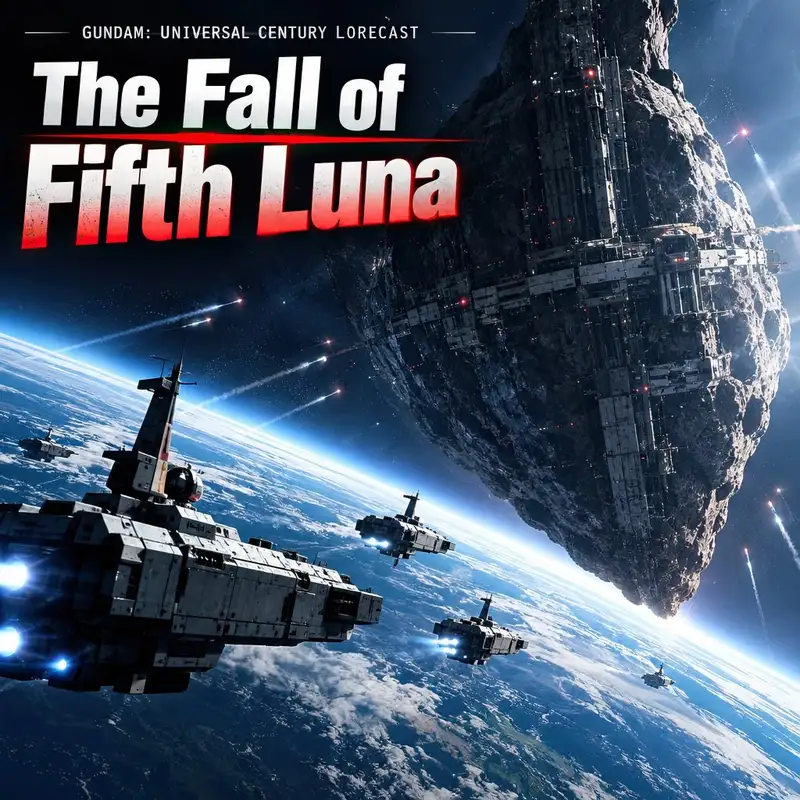
The Fall of Fifth Luna
An asteroid under control is not merely a piece of rock, a fortress, or a navigational hazard. Once its engines have placed it on a course toward an inhabited city, it becomes a strategic weapon with its own momentum, timetable, and political purpose. Every minute spent fighting the mobile suits defending it is another minute in which the impactor continues toward its target. That was the problem facing Londo Bell in Universal Century ninety-three, when Neo Zeon turned Fifth Luna into an instrument of mass destruction and sent it toward Lhasa.
The target mattered before the first mobile suit launched. Lhasa was the Earth Federation’s headquarters on Earth, a center of political authority, administration, communications, and military coordination. It was also a city. Federation officials, clerks, soldiers, workers, families, medical staff, and ordinary residents all lived within the larger human environment Char Aznable chose to place beneath an asteroid. Fifth Luna was not aimed at an empty installation where damage could be measured in damaged buildings and disrupted command circuits. It was aimed at a populated political center, where military destruction and civilian catastrophe would arrive together.
Londo Bell had experienced leadership. Bright Noa commanded the Ra Cailum. Amuro Ray was available as its most capable mobile-suit pilot. The task force possessed trained crews, modern machines, and a command staff accustomed to operating under pressure. Yet Fifth Luna still fell. The contradiction is central to the event. How could a force with Bright’s operational experience and Amuro’s ability fail to stop an attack so visible, so consequential, and so openly directed at the Federation’s terrestrial center of power?
The answer begins with a distinction that military history repeatedly forces upon commanders. Winning a fight is not always the same as completing a mission. A force can shoot down enemy aircraft and still fail to stop a bombing raid. It can win a tank engagement and still lose a crossing. It can seize ground and still fail to prevent an enemy withdrawal. In this case, Londo Bell had to do far more than defeat Neo Zeon mobile suits. It had to identify Fifth Luna’s trajectory, reach the asteroid, break through its defenses, protect its own ships, find the means by which Neo Zeon controlled the object, and disable or redirect that system before the remaining approach time disappeared.
The film does not provide a reliable engineering ledger for Fifth Luna. Its exact mass, thrust, acceleration, warning time, and impact energy are not securely established on screen, and there is no need to invent them. The military reality is plain enough without a calculator. An object large enough to serve as an asteroid base, once maneuvered toward Earth, presents a problem of orbital control. The defenders do not need to defeat every enemy pilot. They need only preserve the trajectory long enough. The interceptors, by contrast, need access, information, coordination, and time. They must solve every part of the problem before the window closes.
That imbalance explains why the action around Fifth Luna cannot be understood as an ordinary mobile-suit battle. The visible combat mattered. Amuro’s engagement with Gyunei Guss mattered. Char’s arrival in the Sazabi mattered. But those encounters occurred within an operation whose decisive conditions had already been created. Neo Zeon had seized Fifth Luna. Neo Zeon had prepared it for use. Neo Zeon had selected the target. Neo Zeon had arranged a defense. By the time Londo Bell entered the engagement, it was not preventing an enemy plan from becoming operational. It was trying to reverse a plan that had already entered its final phase.
Lhasa made sense as a target because Char’s operation was political as much as military. Destroying the Federation’s terrestrial headquarters struck at the most visible expression of Earth-centered authority. It threatened command continuity, embarrassed the government, and demonstrated that Earth itself was vulnerable. For a movement claiming to challenge the political order of the Earth Sphere, that symbolism carried enormous value. Fifth Luna announced that Neo Zeon could reach beyond colony disputes, fleet maneuvers, and local garrisons. It could turn orbital infrastructure into a weapon against the political center of the Federation.
But symbolism does not make an attack legitimate. Char presented Earth’s entrenched population as a historical and environmental problem. In his argument, humanity’s continued attachment to Earth prevented the larger migration into space and preserved an unequal political order in which those living on Earth retained disproportionate privilege. The Universal Century gives that grievance real foundations. The Federation had failed to create equal political representation, equal security, or equal dignity for the people living in the colonies. Earth retained prestige, influence, and material advantages that made its relationship with the colonies deeply unstable.
Char’s diagnosis, however, did not justify his prescription. He did not propose a negotiated redistribution of authority, a political settlement, or a gradual transformation of Earth Sphere society. He chose coercion on the largest scale available to him. Fifth Luna was meant to kill, terrorize, and force social change through catastrophe. The operation treated city residents, civil servants, military personnel, and the wider population of Earth as material in a political experiment. It was not liberation through consent. It was authoritarian social engineering delivered from orbit.
The distinction matters because Char’s cause cannot be reduced to one motive. He was neither simply an environmental reformer nor merely a man acting from private resentment. His political language drew upon genuine colonial inequality and the failures of the Federation. His actions also carried the imprint of personal fixation, accumulated trauma, and a conviction that he possessed the right to decide humanity’s future. The danger of Fifth Luna lay partly in that fusion. A leader who sees a real injustice may still choose methods that reproduce domination on a far greater scale.
For the people in Lhasa, the distinction between political theater and military objective would have been meaningless at the moment of impact. A headquarters contains records, command posts, communications systems, and officials. A city contains hospitals, power systems, transport networks, homes, schools, food distribution, and people who have no ability to vote on whether an asteroid should be sent toward them. The destruction of Lhasa was therefore not simply a strike against a government. It was an urban disaster whose victims included those connected to the Federation’s authority and those merely living beneath it.
Neo Zeon’s advantage began before the battle because it possessed initiative. Char had rebuilt a Neo Zeon movement capable of undertaking a complex offensive operation. Nanai Miguel coordinated the operational side of the effort, while Gyunei Guss served as a valuable mobile-suit defender and personal military asset. Their task was not to win a glorious duel. Their task was to protect the larger operation long enough for Fifth Luna to complete its descent. That is a narrower objective than conquering Londo Bell, but it is also more realistic. A force defending a timetable does not need to destroy every pursuer. It needs to delay them.
Initiative in warfare means more than moving first. It means choosing the question the enemy must answer. Char chose Fifth Luna. He chose its military use. He chose the target. He selected the time at which the Federation would have to react. He also structured the battle so that Londo Bell had to divide attention among multiple urgent tasks. The Ra Cailum had to maintain command, protect itself, launch and recover mobile suits, preserve its pilots, identify threats, and somehow generate an answer to an asteroid already committed toward Earth. Neo Zeon, meanwhile, had prepared defenses around a single object and could withdraw once delay had achieved its purpose.
The Federation was not necessarily ignorant of Char’s reappearance. His return as leader of Neo Zeon was no secret by the time of the operation. The failure was more serious and more specific than simple ignorance. The Federation had not prevented Char from converting Fifth Luna into an operational weapon before Londo Bell was forced to confront it. Strategic warning that an adversary is dangerous is not the same thing as actionable intelligence that allows a force to stop a particular operation at its preparatory stage.
Londo Bell was not the whole Earth Federation military. It was a specialized force, organized to respond to dangerous armed threats that the broader Federation could not or would not address quickly enough. That made it valuable. It also made it vulnerable to being asked to solve problems larger than its available strength. Bright Noa had a capable command, but no commander can produce additional ships, trained pilots, reserve mobile suits, repair facilities, or a second interception axis merely by issuing better orders.
The Ra Cailum was central to this reality. It was not simply the ship from which famous characters launched. It was Londo Bell’s command center, carrier, maintenance space, recovery platform, communications node, medical refuge, and logistical foundation. Every sortie depended on its ability to brief pilots, prepare machines, launch them, monitor the battle, recover damaged personnel and equipment, and continue moving under threat. A mobile-suit team may appear independent once it leaves the catapult, but its combat endurance remains tied to the ship that supports it.
The film characterizes Londo Bell as fighting in isolation. That does not prove that the Federation possessed no other military resources anywhere in the Earth Sphere. It means that whatever larger resources existed were not effectively present to stop this specific operation. The distinction is important. A state can be powerful in the abstract and still be unready at the decisive place and time. It can possess ships, factories, garrisons, and political authority, yet fail because those assets are dispersed, delayed, poorly coordinated, or unavailable when the enemy creates an emergency.
This was not a failure of courage. Bright’s command faced the kind of situation that exposes the limits of courage when it is asked to substitute for readiness. Good leaders reduce confusion. They preserve morale. They make sound decisions with limited information. They cannot reverse elapsed time. They cannot make a task force larger than it is. They cannot erase the advantage gained by an enemy that has spent days, weeks, or longer preparing an operation while the defender is still assembling a response.
Minovsky particles intensified the problem without explaining it away. In the Universal Century, Minovsky conditions interfere with long-range electronic detection and communications, complicating the clean, centralized picture of battle that modern staffs often want to possess. Forces can still locate one another. They can still communicate by methods suited to the environment. They can still coordinate. The film plainly shows ships and mobile suits finding, engaging, and directing against their opponents. But the process is harder, slower, and more dependent on local judgment.
Under those conditions, close-range mobile-suit combat becomes more significant. Pilots must identify threats, maneuver visually, make rapid decisions, and operate with less certainty about the wider battle. That gives experienced personnel real value. It also creates danger. A skilled pilot may see and defeat the enemy directly in front of him while remaining unable to affect a threat located elsewhere in the operation. Commanders must rely more heavily on prearranged plans, mission intent, and subordinate initiative because they cannot assume that every order will arrive instantly and every report will provide a complete picture.
Neo Zeon entered that environment with the advantage of preparation. Its defenders knew what they were protecting and why. Their mission was focused. Londo Bell had to conduct reconnaissance, establish access, screen its ship, deploy mobile suits, respond to enemy movement, and find a way to interfere with the asteroid itself. In a Minovsky environment, this burden of reaction becomes heavier. The particles did not make Londo Bell helpless. They made an already difficult coordination problem more difficult at exactly the moment when the force had the least time to spare.
Amuro Ray entered the battle in the Re-GZ, the machine available to him at the moment of crisis. It is tempting to describe the Re-GZ only in terms of what it was not. It was not the Nu Gundam that Amuro would later receive. It was not an invincible answer to Char’s Sazabi. It was not the final expression of Federation mobile-suit development. But that framing misses the military point. The Re-GZ was a capable operational asset, fielded when Londo Bell needed a capable operational asset.
A military force does not always fight with the machine its pilots would prefer in an ideal future. It fights with the systems that have been designed, delivered, maintained, armed, and made ready in the present. The Re-GZ gave Amuro mobility, firepower, and the ability to engage Neo Zeon’s defenders during a critical intercept. In the hands of an exceptional pilot, it could create opportunities for Londo Bell. That was valuable. It was not enough to make one pilot responsible for every level of the operation.
Amuro’s task was to help create access to Fifth Luna. To do that, he had to engage the mobile suits shielding the asteroid and prevent Neo Zeon from freely controlling the space around it. This was an essential tactical mission. Yet access is not the same as mission completion. Even if Amuro drove defenders away, someone still had to exploit the opening. The task force still had to know what mechanism controlled Fifth Luna, reach it in time, disable it without creating a different catastrophe, and do so while preserving enough combat power to survive the enemy’s response.
The distinction is not a criticism of Amuro. It is a recognition of scale. A great pilot can alter the outcome of an engagement. He can preserve a ship, defeat a superior machine, exploit a moment of confusion, or force an enemy commander to react. He cannot become a fleet, an engineering detachment, a reconnaissance network, and an orbital-interception plan at the same time. In this case, the Federation had placed extraordinary expectations on a small force and on one exceptional pilot because the operation had already become an emergency.
The clash with Gyunei Guss demonstrates the point. Gyunei was not simply another anonymous Neo Zeon pilot. He was a Cyber Newtype, a product of an institution that attempted to turn human perception and responsiveness into military advantage. That did not make him a predictable machine or give him a universal set of powers. Cyber Newtype programs in the Universal Century were built around exploitation, coercion, unstable conditioning, and the demand that individuals perform under technological and psychological pressure. Gyunei’s role in the battle was shaped by that system, but he remained a person making decisions under extreme stress.
In the Jagd Doga, Gyunei served as part of Neo Zeon’s protective screen around Fifth Luna. His purpose was not simply to test himself against Amuro. He was there because the operation required skilled defenders able to delay Londo Bell’s best pilot. Amuro gained an advantage in their engagement. The film shows his effectiveness clearly enough. He could pressure Gyunei, force reactions, and challenge Neo Zeon’s attempt to control the battle on its own terms.
But local advantage did not automatically become mission success. Char entered the fight in the Sazabi, and his intervention changed the immediate tactical situation. He protected the defensive screen long enough for Gyunei to withdraw. That was operationally useful even if it did not amount to a final battlefield victory over Amuro. Char did not need Gyunei to destroy Amuro. He needed Neo Zeon’s defenders to remain effective long enough for Fifth Luna to continue along its path.
This is the central logic of delay operations. The defending force measures success not only in enemy machines destroyed, but in time denied to the enemy. A pilot who survives, withdraws, and continues to occupy the attacker’s attention may have fulfilled the mission more effectively than a pilot who wins an isolated duel but abandons the objective. Neo Zeon’s defensive screen did not have to dominate every exchange. It had to keep Londo Bell from reaching meaningful control of Fifth Luna before the operation became irreversible.
Amuro’s performance therefore should not be described as a personal defeat. He fought effectively with the machine and support available to him. He created pressure where pressure was needed. Yet the mission entrusted to Londo Bell was larger than what tactical skill alone could accomplish. The more successful Amuro became in the immediate fight, the more clearly the larger limitation appeared. He could force Neo Zeon to respond, but he could not restore the time already consumed by Char’s preparations.
The confrontation between Char and Amuro matters for the same reason. It is not important merely because two famous rivals meet in battle. Their brief exchange exposes the political purpose behind Fifth Luna. Char argues, in effect, that Earth’s population has become so entrenched that it must be driven away from the planet. Amuro rejects the premise that any one man has the authority to judge humanity and impose that judgment through mass death. Their disagreement is not abstract philosophy conducted at a safe distance. It unfolds while an asteroid approaches an inhabited city.
Char’s position contains a real observation. Earth had become a center of privilege and inertia. The Federation’s political order had repeatedly failed to resolve the relationship between Earth and the people living in space. It had produced corruption, complacency, and repression. Yet Char turns that observation into a claim of sovereign authority over everyone beneath him. He decides that the residents of Earth must be punished, displaced, or eliminated in order to force history into a different course.
The point of no return in this battle is therefore operational, not mystical. The film establishes that Fifth Luna reaches a stage at which it cannot be stopped in time. That does not mean that every technical detail is known. It means that the remaining time, access, and available force no longer permit Londo Bell to alter the outcome. The battle changes character at that moment. The mission is no longer to prevent impact. It becomes an effort to survive the failure, preserve the force, and pursue the enemy responsible for it.
Fifth Luna falls. Lhasa is destroyed. The immediate visual result is catastrophic, but the historical significance requires several levels of analysis. In tactical terms, Neo Zeon’s defenders succeeded in delaying Londo Bell long enough. They did not need to annihilate the Ra Cailum or eliminate Amuro. They needed to protect the operation’s final minutes, and they did.
At the mission level, Neo Zeon succeeded because Fifth Luna reached its target. Londo Bell failed because it could not prevent that outcome. This is the clearest level of failure, but it is not the only one. At the operational scale, Char demonstrated that he could seize, prepare, defend, and employ a major orbital object before the Federation could mount an effective counter-interception. That revealed a serious weakness in the Federation’s ability to protect Earth against an adversary willing to weaponize infrastructure on a strategic scale.
In political terms, Fifth Luna exposed the hollowness of any belief that institutional size alone guarantees safety. The Federation could claim legal authority across much of the Earth Sphere. It could field armed forces and command immense resources. Yet Char had forced it into a reactive posture. He had chosen a target that made the consequences impossible to conceal. The destruction of Lhasa was not simply damage to a bureaucracy. It was a blow against the Federation’s public image as the power capable of maintaining order around Earth.
For civilians, the impact was a mass-casualty catastrophe. The film does not provide a reliable total, and there is no reason to manufacture one. The absence of a number does not reduce the scale of the crime. A city destroyed by an asteroid contains people who cannot evacuate on command, people without access to military intelligence, people dependent on urban systems that collapse under attack, and people who will never appear in the reports of generals or the memories of famous pilots. Fifth Luna’s victims must remain part of the history, not an incidental cost in the rivalry between Char and Amuro.
What does this reveal about the Federation? Not that every Federation officer was incompetent, and not that Londo Bell lacked commitment. The event reveals an institutional mismatch. A specialized rapid-response force was asked to carry responsibility for a strategic emergency without the mass, preparation, and support that such an emergency required. Londo Bell had skilled personnel and a capable command ship. It did not have the luxury of a mature defensive plan built around the possibility that a hostile force had already weaponized an asteroid.
Strategic readiness is more than owning advanced weapons. It requires warning networks able to identify preparations before they become attacks. It requires dispersed forces that can assemble in useful time. It requires political authorities willing and able to authorize action before the crisis reaches its final phase. It requires contingency planning, heavy interception capability, technical specialists, secure communications, trained crews, and enough reserve capacity that one task force is not expected to solve every emergency alone.
There is a dry, grim lesson in the timing of the Federation response. A command structure cannot solve an orbital emergency by discovering, at the moment of impact, that its best available answer is still being completed. This does not make the later Nu Gundam irrelevant. It explains why its arrival carries a different meaning. The machine represents adaptation after failure, not proof that the original crisis had been adequately prepared for.
After the fall of Fifth Luna, Amuro proceeds to Anaheim Electronics’ lunar facility to receive the Nu Gundam. The machine is associated with Amuro’s own involvement in its development and incorporates psycho-frame technology. It is more than a replacement suit handed to a famous pilot. It represents a technical and industrial effort to provide Londo Bell with a more capable instrument for the confrontation that remains ahead.
But a machine’s existence is not the same thing as its operational availability. The Nu Gundam’s story at this point involves design, construction, delivery, preparation, and integration into an active campaign. It arrives after Lhasa has been destroyed. That timing matters. Military procurement can respond rapidly by ordinary standards and still be too slow for a strategic surprise. A system can be advanced, well designed, and highly valuable while remaining absent from the battle in which it might have mattered most.
Chan Agi stands at the intersection of those realities. Her role connects Londo Bell’s immediate operational needs with Anaheim’s industrial and technical capacity. The transition from Fifth Luna to the Nu Gundam is not a simple upgrade sequence. It is a reminder that combat power depends on a chain extending from engineers and production facilities to transport, assembly, crews, pilots, and command decisions. The Federation’s response now becomes more capable, but it is responding to a blow already suffered.
The Nu Gundam should not be treated as a retroactive answer that would certainly have saved Lhasa. The film does not establish that. A more advanced machine cannot automatically solve an orbital-interception problem created by late warning, insufficient force density, uncertain access, and a trajectory already approaching its terminal phase. Technology matters, especially when it gives a pilot like Amuro better tools. But technology enters history through timing, organization, and mission context. Fifth Luna had already demonstrated the cost of arriving after the decisive conditions were set.
The failure also helps explain the urgency of Londo Bell’s continued pursuit of Neo Zeon. Fifth Luna was not an isolated act of destruction with no further purpose. It formed part of Char’s wider effort to reshape the Earth Sphere through coercive environmental catastrophe. The attack showed that he possessed both the will and the means to threaten Earth with orbital mass attack. That made the surviving Neo Zeon force, its leaders, and its remaining strategic assets an immediate danger rather than a problem that could be postponed.
Londo Bell failed to stop Fifth Luna because it was sent into a battle that had already become an operational emergency. Bright did not lack resolve. Amuro did not lack skill. The Re-GZ was not simply worthless because a newer machine would later appear. Each of those elements mattered, and each performed a real function. But none could undo the fact that Char had already seized the asteroid, prepared its maneuver, selected the target, organized its defense, and forced the Federation into a late interception.
Neo Zeon’s defenders then did what an effective covering force must do. They delayed. Gyunei contested Amuro. Char intervened when the screen required reinforcement. The defenders preserved the operation long enough for Fifth Luna to pass beyond Londo Bell’s ability to stop it. Their success was not measured by a clean tactical victory in every exchange. It was measured by the continued movement of the asteroid. On that measure, they succeeded.
Londo Bell’s local fighting could not recover the time that had passed before contact. It could not create a second approach route after the geometry of the intercept had narrowed. It could not turn one carrier task force into a fleet or one exceptional pilot into an entire strategic defense system. The battle was fought in mobile suits, but the outcome was determined by preparation, initiative, access, and the ruthless logic of a weapon already in motion.
That is the larger lesson of Fifth Luna. In the Universal Century, governments repeatedly confront systemic political failure with emergency measures. They rely on exceptional pilots, advanced prototypes, improvised task forces, and crisis decisions made after the danger has become visible. Those measures can be brave. They can be necessary. They can even succeed in the next battle. But they cannot repair readiness, legitimacy, or time once an adversary has already turned infrastructure into a weapon.
Fifth Luna fell because Char understood that an asteroid could be more than terrain. It could be converted into a political argument with millions of lives beneath it. Londo Bell understood the danger, fought effectively, and still arrived at the point where tactical excellence could no longer change the mission’s result. The destruction of Lhasa was not proof that Char’s vision was right. It was proof that a society unable to resolve its political failures can leave its most vulnerable people trapped between institutional complacency and revolutionary violence.