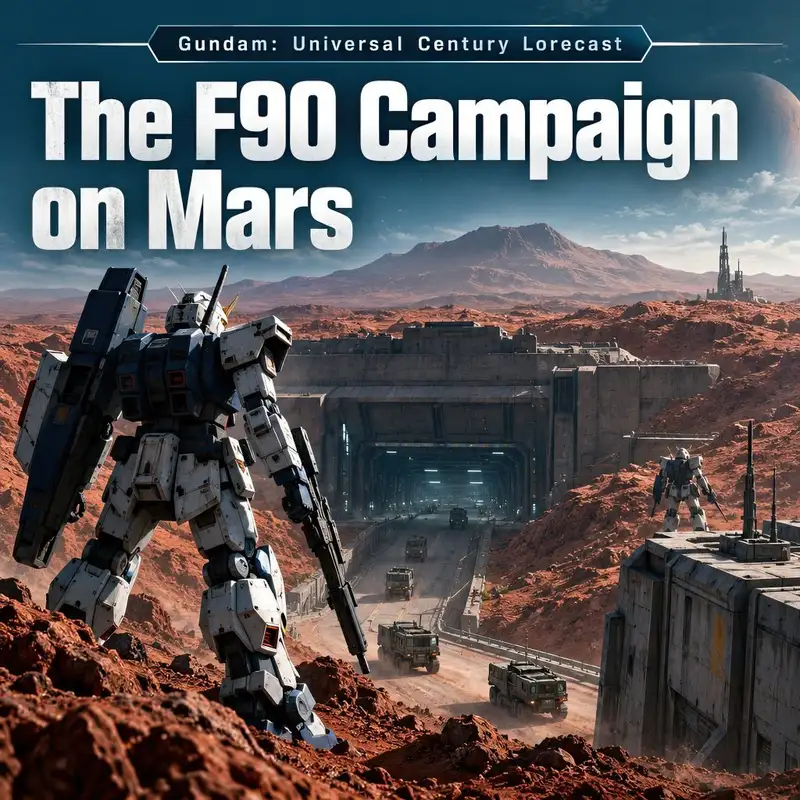
The F90 Campaign on Mars [Manga and Game]
On October twenty-fifth, Universal Century one hundred twenty, a vessel called the Kobayashi was attacked and sunk by a force the Earth Federation had every reason to consider obsolete. Three days later, the situation became more serious. During testing near Side Four, hostile forces seized Gundam F90 Unit Two. A warship lost to a raider is a security failure. A next-generation experimental mobile suit captured during a controlled test is something worse. It means the enemy knows where the test is happening, can reach it, can identify the target, and believes it can escape with the prize. The immediate question was not why a remote Zeon remnant still fielded machines with old Zeon silhouettes. It was how that remnant had penetrated a Federation weapons program at all.
The Federation called the enemy Oldsmobile. The name was dismissive, perhaps deliberately so. Its forces appeared to preserve the visual vocabulary of the old Principality of Zeon: familiar shapes, familiar colors, and designs that seemed to belong to a war fought more than four decades earlier. But the organization called itself the Mars Independent Zeon Forces. Its equipment looked old because old Zeon imagery still had military and political value. It provided identity, morale, and a claim to continuity. It also encouraged an analytical mistake. A machine that resembles an old Zaku is not necessarily an untouched museum piece, and an army using old symbols is not necessarily incapable of adapting them.
The theft of F90 Unit Two changed the meaning of the conflict. The Federation had not merely lost expensive equipment. It had exposed a development program. A captured prototype can reveal design priorities, maintenance access points, pilot interfaces, weapons integration, structural compromises, and the assumptions made by the engineers who built it. Even incomplete access can help an enemy understand what a future generation of Federation mobile suits is intended to do. It can also allow that enemy to study the institutional habits behind the machine. Which parts are difficult to replace? Which systems require specialized support? Which components can be substituted? Those are not questions answered by a duel. They are questions answered in workshops, depots, hangars, and technical offices.
The Federation response was to transform a local security crisis into a Mars expedition. The Thirteenth Experimental Battle Group, originally associated with the F90 program, was reorganized as the Thirteenth Autonomous Mobile Fleet and sent toward Mars. That redesignation tells its own story. An experimental formation had been assigned an operational mission far beyond ordinary weapons testing. It now had to investigate hostile activity, recover or neutralize the stolen Unit Two, strike Mars Zeon’s base, and suppress a renewed Zeon military capability at the far edge of the Federation’s practical reach.
By the time the fleet arrived in Universal Century one hundred twenty-one, the operation had become more than a pursuit of stolen property. Mars Zeon had time to prepare. It possessed a base, defensive forces, technicians, and enough internal organization to sustain an armed challenge. The Federation was no longer chasing raiders through a familiar space lane. It was approaching a prepared enclave whose leadership understood its own terrain, its own infrastructure, and its own political purpose. The F90 might have been more advanced than the machines facing it, but technological superiority does not erase the advantage held by a defender who has prepared the ground.
Mars Zeon’s visible attachment to old Zeon designs has sometimes encouraged the idea that it was simply preserving the debris of the One Year War. The surviving record does not support such a simple reading. The organization clearly preserved Zeon symbols and older design language, but its machines were not necessarily untouched survivors from Universal Century seventy-nine. The available material points instead toward local rebuilding, replication, modernization, modification, and substitution. The exact industrial history of every machine is not securely established. That uncertainty is important. A remote remnant does not need a complete copy of the old Zeon war economy to be dangerous. It needs enough skilled labor, enough tools, enough materials, enough technical knowledge, and enough support networks to keep a limited force alive.
That does not make Mars Zeon a liberation movement by default. The name Zeon carried genuine associations with colonial grievance, autonomy, and resentment toward Federation rule. It also carried the inheritance of dictatorship, aggressive war, occupation, and mass killing. A remnant could use the language of independence while preserving the habits of military authoritarianism. The record of Mars Zeon is not detailed enough to construct a complete civil history of Martian settlement, and it would be irresponsible to invent one. But a functioning military base on Mars cannot be sustained by pilots alone. It implies workshops, stores, transport, technical personnel, administrators, dependents, and some relationship with a broader civilian environment. Mars was not empty terrain merely because the story concentrates on combatants.
The captured F90 Unit Two became the clearest material expression of that problem. Mars Zeon did not simply display the machine as a trophy. It modified it for its own use. Later reference material commonly identifies the altered machine as the Mars Independent Zeon Forces Type, sometimes with the designation O M S ninety R. That later terminology is useful as a label, but it should not be mistaken for a complete technical record of the original manga campaign. What matters is the broader fact established by the conflict: Mars Zeon took a Federation prototype and adapted it to the requirements of an isolated remnant force.
The modifications associated with Unit Two are best understood as a maintenance decision as much as a combat decision. An isolated force cannot depend on receiving factory-perfect replacement parts from the Federation. It must find ways to armor, repair, fuel, and service what it possesses using its own workshops and supply arrangements. External changes, altered propulsion-related equipment, and local substitutions all reflect the same reality. Mars Zeon was trying to make a captured Federation machine sustainable under Martian conditions. That does not prove it could manufacture an entire F90 production line. It proves something more plausible and more troubling: that it had enough technical competence to turn one captured machine into a usable weapon.
Later mechanical material adds further claims about the modified Unit Two, including assertions tied to a pseudo-personality system associated with Char Aznable. Those claims belong to later technical elaboration and should not be allowed to dominate the campaign’s meaning. There is no need to invoke a preserved consciousness or a mystical inheritance to explain why the machine mattered. The captured F90 was dangerous because it joined advanced Federation engineering to a hostile organization that understood the political value of symbols and the practical value of adaptation. One altered prototype could become both a combat asset and a declaration that the Federation’s technological lead was neither secure nor untouchable.
Bosch Weller stood near the center of this crisis. He was a Federation officer connected to the F90 project and a veteran of the Second Neo Zeon War. His prior experience gave him institutional weight. He belonged to the generation that had already watched the Federation confront Neo Zeon’s revival, Char’s rebellion, and the dangers of treating old political movements as settled history. Yet Bosch’s role in the Mars campaign became bound up with divided allegiance and internal failure. The manga’s compressed account does not justify a fully detailed reconstruction of every prior contact, every conspirator, or every step in his planning. The essential point is clearer than the missing detail. Sensitive Federation programs were vulnerable not only to external attack but to compromised loyalty inside their own command environment.
That vulnerability mattered because Mars Zeon possessed something more consequential than a stolen mobile suit. It had the Olympus Cannon. The available record does not provide a secure engineering manual for the weapon, and it is not necessary to invent one. Its importance was strategic. A major fixed weapon gave Mars Zeon a means to threaten forces far stronger than its own mobile-suit units. A remnant did not need to defeat the Federation fleet in a conventional campaign if it could hold the fleet at risk, force caution into Federation planning, and preserve the ability to threaten the Earth Sphere.
The Olympus Cannon converted the operation from a raid and recovery mission into a coercion campaign. A fixed strategic weapon is never merely a gun. It is an organization. It requires construction, power, maintenance, security, command authority, fire control, target information, procedures for launching, and personnel willing to carry out the order. It must be defended against infiltration, bombardment, sabotage, and internal failure. It also requires a political purpose. A weapon of that scale has value not only because of what it can destroy, but because of what it can make an opponent fear before it fires.
For the Thirteenth Autonomous Fleet, this created a difficult problem. The Federation needed to protect its ships, manage the stolen F90, locate and penetrate a defended Martian installation, and neutralize the Olympus Cannon before it could create a strategic crisis. These tasks competed with one another. A fleet concentrating on the cannon might expose itself to mobile-suit attack. A force pursuing Unit Two might neglect the larger installation. A commander trying to preserve ships for the journey home might hesitate at the moment when a decisive assault was required. There was no clean separation between tactical, operational, and political choices.
Tactically, the cannon threatened the Federation force. Operationally, it restricted maneuver and imposed urgency. Strategically, it allowed a remote remnant to claim leverage over a much larger state. Politically, it revived the question of whether Zeon resistance had truly been extinguished or merely displaced. A military organization can survive defeat if it retains a sanctuary, a story, and a means of making the enemy pay attention. Mars Zeon had all three. Its sanctuary was distant. Its story was Zeon continuity. Its means of attention was the Olympus Cannon.
The most severe failure of the campaign, however, did not come from the Martian surface. It came from within the fleet. The rebellion aboard the Federation flagship demonstrated that command cohesion had failed at the moment it mattered most. It is tempting to describe such an event as a personal betrayal and leave it there. Bosch Weller’s divided allegiance was undeniably central. But a betrayal becomes operationally decisive only when the institution around it cannot contain the damage. The fleet’s problems were failures of counterintelligence, compartmentalization, authentication, command relationships, and internal security.
A naval force can carry advanced weapons and still lose its mission if it cannot trust its own orders. In a Minovsky-era military environment, communications are already vulnerable to disruption and uncertainty. That makes authentication and disciplined command procedures especially important. Who has authority to redirect a vessel? Who controls weapons release? Which messages are verified, and by whom? How much does a subordinate commander know about classified plans? How quickly can a crew distinguish a legitimate emergency order from a hostile seizure of authority? Those questions are often invisible when a campaign is remembered through its mobile-suit battles. They become painfully visible when a flagship turns into a contested space.
Bosch’s past in the Second Neo Zeon War adds a grim layer to the story. He had lived through an earlier period when the Federation confronted the return of Zeon symbols, Zeon rhetoric, and Zeon military power. That experience may help explain the emotional and ideological terrain in which he acted. It does not make his later choices inevitable. Veterans are not prisoners of their past, and trauma is not an excuse for betrayal. But the case does demonstrate how unresolved wars can survive inside institutions. A government may declare a conflict finished. The people who fought it may carry its loyalties, resentments, and myths into the next generation of command.
The campaign’s tactical climax came in the confrontation between Def Stallion in F90 Unit One and Bosch Weller in the captured and modified Unit Two. It is easy to let this duel consume the history because the imagery is so direct. Two versions of the same experimental machine face one another, one representing the Federation’s official development program and the other representing Mars Zeon’s ability to steal, modify, and repurpose that program. But the duel should be understood as a concentrated expression of a wider conflict, not as a substitute for it.
Unit One belonged to a research system backed by Federation industry, technical institutions, and a long-term modernization program. Unit Two, in Mars Zeon service, represented salvage, adaptation, political symbolism, and local maintainability. Neither machine can be understood simply by asking which one was stronger. Their performance depended on pilots, damage, configuration, support, tactical position, and the collapsing command environment around them. The more important contrast lies in what each machine represented. The Federation had the capacity to design a flexible future weapon. Mars Zeon had the capacity to make captured technology serve a surviving past.
A tactical victory in that duel could help defend the mission. It could remove a dangerous opponent, deny the enemy a captured prototype, and protect the forces still able to act. But it could not restore a destroyed command structure. It could not rebuild ships already lost. It could not erase the existence of the Olympus Cannon or resolve the political question of Mars Zeon’s survival. This is the difference between tactical success and campaign success. A pilot can win the engagement in front of the cockpit and still return to find that the operation around that engagement has failed.
The manga’s chronology places the effective destruction of the Thirteenth Autonomous Fleet on March twenty-sixth, Universal Century one hundred twenty-one. The Olympus installation also suffered catastrophic failure and self-destruction. The exact losses, technical sequence, and final distribution of responsibility are not secure enough to reduce the event to a neat casualty table. What is clear is that the Federation neutralized a major threat at terrible cost. The fleet had reached Mars to impose control. It instead suffered a collapse severe enough to turn survival and withdrawal into the immediate concern.
The surviving personnel eventually regrouped with an unmanned supply ship. That detail may lack the spectacle of the F90 duel or the Olympus Cannon, but it contains the campaign’s clearest logistical lesson. An expeditionary force survives through sustainment. Once its principal ships, command arrangements, and support network have been shattered, even a small surviving supply asset can become decisive. The remaining personnel could not simply will themselves back across interplanetary space. They needed transportation, stores, maintenance capacity, life support, and a functioning route home. The survivors returned to the Earth Sphere in July, but the return should not be mistaken for a clean victory parade.
Olympus had been neutralized. The stolen F90 had been contested within the campaign’s final struggle. Mars Zeon had suffered a major reverse. Yet the Federation had lost a significant expeditionary force, exposed its internal vulnerabilities, and failed to demonstrate that the deeper network supporting the remnant had been dismantled. A base can be destroyed. A weapon can be destroyed. A fleet can withdraw. None of those outcomes automatically erase the people, skills, hidden stores, political loyalties, and external contacts that allowed a movement to exist in the first place.
The Super Famicom game Formula Report zero one two two begins from that unresolved condition. It is a separate game narrative, not a simple documentary continuation of every detail in the manga. Its fixed story framework places the next phase in Universal Century one hundred twenty-two. By its account, Oldsmobile had supposedly been destroyed at its Martian base two years earlier. Yet it had rebuilt enough strength to threaten the Earth Sphere again. That premise is an intelligence embarrassment before it is an action premise. The Federation had declared a problem solved, or at least treated it as solved, and then discovered that destruction of a base was not the same thing as elimination of an organization.
The Federation’s mission in the game therefore expands beyond retaliation. It must destroy Oldsmobile forces, investigate colonies associated with renewed activity, and determine who supplied the money and technology that made rearmament possible. That is a more mature question than simply asking where the enemy is. The Federation now has to ask how the enemy lives. Who provides financing? Who moves components? Who preserves technical knowledge? Which colonies, depots, contractors, or political sympathizers serve as nodes in the network? The available story does not justify naming a single all-powerful sponsor behind every development. It does establish that Oldsmobile’s regeneration exceeded Federation assumptions.
The game’s Federation force operates around the ship Abram, commanded by Captain Weibull Gardner. Bergh Squelette becomes the F90’s operational pilot after an Oldsmobile attack during transport. Bergh belongs to the game’s record and must not be merged with Def Stallion, whose role belongs to the earlier manga campaign. The difference matters because the two stories are not a seamless biography of one hero and one machine. They are related accounts of a continuing problem: a Federation prototype and a Federation military system repeatedly confronting an enemy that survives by dispersal, adaptation, and political memory.
The game campaign extends Oldsmobile’s threat through operations in both space and on Earth. Its strategic premise is broader than the original Mars expedition. The danger is no longer confined to a distant enclave with a single fixed weapon. The organization’s apparent ability to move, rebuild, and establish connections elsewhere suggests that the Federation is dealing with a distributed remnant problem. Such organizations are difficult to defeat because their center of gravity may not be one fortress, one leader, or one visible fleet. It may instead be the network that connects personnel, ideology, equipment, funding, and safe locations.
Formula Report zero one two two is also useful because its game systems emphasize operational constraints that military history sometimes overlooks. The player must account for fuel, machine durability, radar-assisted detection, weapon range, the survival of allied forces, and the safety of the mother ship. These should not be treated as precise historical measurements. A game’s fuel gauge is not a verified F90 propellant figure. Its durability system is not an official armor model. A tactical map is not a literal record of unit placement, and a player’s successful mission run is not a fixed historical event. Games must create rules so players can make decisions. Those rules are not automatically archival evidence.
But the game’s mechanics do reveal its intended military argument. A mobile suit is not an independent strategic weapon. It depends on a ship. It must travel, receive support, select weapons appropriate to distance, and avoid exhausting the resources needed to continue the operation. Allied units matter because campaigns are not won by a single player-controlled machine. The mother ship matters because it is the mobile suit’s base, command post, repair facility, supply source, and route home. Fuel matters because even a fusion-powered machine must still maneuver, accelerate, decelerate, and return. The game translates these ideas into player decisions rather than technical lectures.
That emphasis is especially appropriate for the F90. Its modular design invites attention because mission equipment can make it look like a machine that adapts to any problem. But no mission pack eliminates the need for logistics. A configuration useful in one engagement may require support unavailable in another. A weapon suited to long range may be less useful in close terrain. A high-performance system may become a burden if it cannot be repaired after damage. The F90 represents modernization, but modernization does not mean self-sufficiency. It means that a military has chosen to place more capability inside a system that must be trained, supplied, and governed properly.
The game also returns the narrative to the problem of intelligence. Radar, detection, weapon range, and operational movement are not merely gameplay features. They point toward the uncertainty that governs combat. A commander does not begin every mission with a perfect picture of enemy strength, location, intent, and supply. Oldsmobile’s continued existence depends in part on exploiting that uncertainty. It can appear where the Federation does not expect it, use associated colonies or routes, and force a larger power to react. The Federation may possess far greater formal resources, but a larger state can still be slow to recognize which threat deserves concentrated attention.
The second conflict therefore should not be read as proof that the Federation had learned nothing. Its mission now includes investigation, not simply destruction. It recognizes that money and technology have to come from somewhere. It recognizes that remnant warfare is sustained by more than the hardware visible in battle. But recognition is not the same thing as resolution. Investigating a network requires dependable intelligence, political will, careful distinctions between civilian communities and military supporters, and the ability to act without turning every associated colony into an enemy population. Counterinsurgency and remnant suppression are not solved by finding a dramatic target and firing until the target disappears.
The two F90 stories remain separate records, and their details should not be flattened into one perfect chronology. The original manga presents the First Oldsmobile War through the Mars expedition, the stolen Unit Two, Bosch Weller’s betrayal, the Olympus Cannon, and the destruction of the Thirteenth Autonomous Fleet. Formula Report zero one two two presents a later game narrative in which Oldsmobile has reconstituted itself and the Federation must pursue both military destruction and investigative leads. The relationship between the stories is thematic as much as chronological. Both ask what happens when a modern state treats the defeat of an armed remnant as proof that the conditions sustaining it have vanished.
At the tactical level, the First Oldsmobile War demonstrated that the captured F90 and the Olympus Cannon could be contested and neutralized. At the operational level, the destruction of the Thirteenth Fleet revealed the fragility of a long-distance expedition whose command cohesion had failed. At the strategic level, Mars Zeon proved that a remote remnant could use prepared infrastructure and a major coercive weapon to threaten a far more powerful opponent. At the intelligence level, both stories expose the danger of assuming that a defeated base equals a defeated network.
At the industrial level, the F90 demonstrated the value of a flexible Federation test platform. Mars Zeon demonstrated something different but equally important. Captured technology can be repurposed without reproducing the original industrial base. A remnant does not need to manufacture every component of an advanced system from raw materials. It can salvage, substitute, cannibalize, modify, and concentrate scarce resources on a small number of high-value assets. That is inefficient by the standards of a great power. It can still be effective enough to create a crisis.
At the institutional level, the campaign exposed blurred responsibilities. The S N R I was a research organization, yet its test program became part of a punitive military expedition. A fleet intended to project Federation power became vulnerable to internal rebellion. Commanders carried responsibilities that ranged from prototype evaluation to counterinsurgency to strategic-weapons suppression. The F90 itself was not the failure. Nor was the concept of modular development. The problem was the assumption that a sophisticated weapon could compensate for weak security, incomplete intelligence, and a command structure placed under impossible strain.
At the political level, Oldsmobile showed that Zeon memory remained usable long after the Principality’s original defeat. That memory did not need to preserve every old institution exactly. It only needed to provide a language through which new followers could understand their grievances, loyalties, and military identity. The Earth Federation’s continuing reach and technological capacity did not automatically answer those political conditions. A state can defeat armed formations repeatedly while leaving enough alienation, neglect, or unresolved symbolism for another formation to recruit from the ruins.
The civilian dimension remains less developed in these stories than the military one, and that limitation should be acknowledged. The sources do not provide a detailed account of Martian workers, families, settlements, or political life. Still, the existence of a sustained base and a strategic cannon means that civilians cannot be treated as absent. Workers build and repair. Technicians maintain systems. Families and dependents live with the consequences of militarization. Any weapon intended to threaten the Earth Sphere risks drawing an entire settlement into retaliation, siege, or destruction. A remnant’s military survival is never only a matter of the people in its cockpits.
The F90 campaign was not a simple demonstration that Federation technology could overcome obsolete Zeon equipment. It was a warning that modernization without institutional vigilance produces fragile power. Mars Zeon remained dangerous not because it preserved old machines, but because it preserved the people, skills, symbols, supply networks, and political memory needed to make old machines dangerous again.