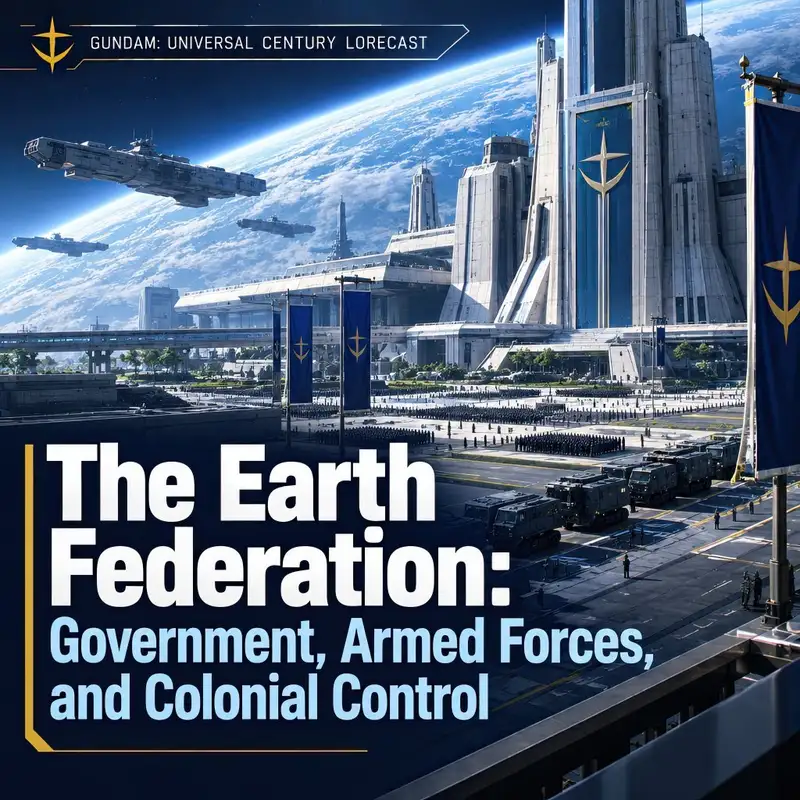
The Earth Federation: Government, Armed Forces, and Colonial Control
In Universal Century one hundred five, the Earth Federation can still move people by force. On Earth, the Man Hunter system pursues civilians marked for relocation, enforcing an environmental and social order that reserves the planet’s remaining comfort for those already permitted to live there. The machinery of control is visible in uniforms, transport, checkpoints, and frightened families. Yet the system’s strength is also its confession. A government confident in its legitimacy does not need to make ordinary residence on Earth look like a privilege defended by armed men. This is the same Federation that defeated the Principality of Zeon, survived the Titans, outlasted successive Neo Zeon movements, and retained formal authority across much of the Earth Sphere. It possesses military institutions, industrial resources, legal claims, and the ability to declare policy. What it repeatedly lacks is consent from many of the people it claims to govern.
That failure helps explain the political environment of Hathaway Noa’s era, but it does not excuse Mafty’s campaign of assassination and terror. The Federation’s inequality is real. So are the coercive practices used to preserve it. But political grievance does not automatically make violent resistance democratic, wise, or humane. The point is larger than Mafty. By Universal Century one hundred five, the Federation has developed a familiar habit. It treats problems created by unequal power, colonial resentment, environmental decline, and political exclusion as security problems. Security institutions then become the tool for managing consequences that civilian institutions have failed to address. The result is a state that remains formidable in a crisis, but brittle in peace.
To understand how that happened, it helps to return to the beginning of the Universal Century. The Federation emerged as humanity began a vast migration into space. Colonies were built at strategic points around Earth, along transport routes and in orbital regions where industry, agriculture, habitation, and military access could develop. This was not simply a frontier expansion. It was a transformation of human geography. Population, labor, industrial capacity, and political identity began moving away from Earth, while Earth retained enormous institutional importance as the old center of civilization.
The Universal Century was inaugurated under a Federation-centered political order. Later events surrounding the Laplace space station show that the founding moment carried disputes and secrets which remained politically significant for generations. But the surviving animated record does not provide a complete constitutional diagram of the early Federation. It does not establish every ministry, election rule, tax arrangement, or formula for colonial representation. What it does establish is more important for this history. The Federation claimed authority over a civilization whose people and productive capacity were increasingly dispersed beyond Earth, while political prestige and much of the governing center remained tied to the planet.
That arrangement created a structural problem. Colonies were not remote military outposts inhabited by anonymous dependents. They were homes, workplaces, industrial communities, transport hubs, and political societies. Their residents had local interests shaped by distance from Earth, by the risks of living inside vulnerable artificial habitats, by the demands of colonial labor, and by the sense that decisions affecting their lives were often made elsewhere. The Federation did not need to be uniformly cruel or uniformly incompetent for that system to generate resentment. A political order can be legally established, materially powerful, and still fail to persuade large parts of its population that it serves them fairly.
The Earth Federation government and the Earth Federation Forces must be kept separate. The government is the formal political authority. It sets policy, claims jurisdiction, negotiates, administers, and defines the legal order. The armed forces are its military instrument, responsible for defending that order against external threats and, at times, enforcing it internally. In practice, the boundary between political direction and military action is not always clean. Civilian leaders may rely on commanders to solve political problems. Military officers may gain influence when ordinary administration fails. Security emergencies may expand institutions designed for temporary purposes. But the distinction still matters. A government is more than its armed forces, and an army can preserve a state without making that state legitimate.
Federation power rested on several durable foundations. Earth offered population, resources, established infrastructure, launch sites, and strategic depth. The Federation also possessed access to lunar and orbital industry, transport networks, shipyards, trained workers, research institutions, and an existing military establishment. These advantages gave it the ability to absorb losses and mobilize over time. But the Earth Sphere is not governed by drawing lines on a map. It is governed through transport, communications, access to ports and docks, control of launch routes, industrial cooperation, local administration, and the willingness of people to recognize authority. Holding Earth did not automatically mean governing every colony. A garrison could secure a dockyard. A fleet could protect a route. Neither one could, by itself, create political trust.
The One Year War revealed both the Federation’s immense potential and its dangerous limitations. On January third, Universal Century seventy-nine, the Principality of Zeon declared independence from the Earth Federation and began a war that rapidly became catastrophic. Zeon’s leaders invoked colonial grievance and independence, but their state was not a simple democratic revolt against distant rule. It was an authoritarian regime that launched aggressive war, conducted mass violence, and treated civilian populations as instruments of strategy. Federation failures helped create a political environment in which anti-Federation anger could grow. They did not justify dictatorship, conquest, colony gassing, or the destruction inflicted during the war’s opening phase.
The Federation entered that conflict with greater long-term resources, but long-term resources are not the same thing as immediate readiness. Zeon had prepared for a particular kind of war. It had developed mobile-suit doctrine, trained pilots and crews, and built forces able to exploit the tactical conditions created by Minovsky particle interference. Under those conditions, long-range detection and communications became less reliable. Large formations could lose clarity about the enemy’s position. Commanders could not always rely on distant headquarters to direct every engagement. Local initiative, visual identification, close-range combat, and prearranged plans became more important.
That environment did not make the Federation helpless, but it punished complacency. A government may possess factories, population, and territorial depth, yet still struggle to turn those assets into combat power at the moment of attack. Ships must be available. Pilots must be trained. weapons must be produced and delivered. Damaged machines must be repaired. Command relationships must be understood before communications begin to fail. Forces must know where to go, how to recognize friendly units, and what to do when orders cannot arrive. The Federation’s opening crisis was not proof that it lacked power. It was proof that power sitting in factories, depots, and political institutions takes time to become operational strength.
Zeon gained the initiative because it combined preparation, surprise, and a willingness to accept methods that shattered the existing rules of war. The Federation’s routes, formations, and confidence were badly disrupted. Its leaders faced a strategic emergency across a sphere too large to manage through centralized direction alone. Yet the Federation did not collapse. It retained the industrial and demographic depth that Zeon, despite its early victories, could not match. It also retained key bases, infrastructure, and the ability to adapt. The war demonstrated a recurring truth of the Universal Century. Tactical brilliance can create a crisis. Strategic endurance depends on whether a state can replace losses, learn, coordinate, and sustain operations over time.
Federation recovery depended on more than one celebrated machine or one famous crew. The development of Federation mobile suits mattered because it gave the armed forces a means to contest Zeon’s tactical advantage. The Gundam demonstrated capabilities that influenced Federation development, and exceptional crews proved that Zeon’s early superiority was not permanent. But a prototype is not a war-winning institution by itself. The Federation’s eventual return to the offensive required mass production, pilot training, technicians, ammunition, propellant, transports, repair capacity, carriers, ground forces, naval forces, and an industrial system able to keep replacing what battle consumed.
The Federation’s victory over the Principality was therefore a victory of mobilization as much as combat. It adapted to a changed battlefield and brought its larger resource base into the war. But defeating Zeon’s state did not answer the political question that had existed before Zeon’s dictatorship seized control of colonial discontent. It did not automatically repair damaged colonies, restore trust, provide meaningful political inclusion, or reconcile veterans and civilians who had experienced the war from very different positions. Military reconquest restored formal Federation authority. It did not necessarily make that authority feel legitimate to every community subjected to it.
This distinction is central to colonial control. A government can defeat an enemy fleet, retake a fortress, occupy a port, and install officials. It may still govern through fear, distance, and resentment. Colonies were especially difficult places to manage through coercion alone. Their life-support systems, industrial facilities, transport links, and dense civilian populations made them vital and vulnerable at the same time. A military commander might secure an installation, but a population that believed itself neglected, exploited, or politically disposable could not be permanently stabilized by patrols and checkpoints. The Federation won the One Year War, but it emerged with the same center-periphery problem, now intensified by death, destruction, displacement, and memory.
Postwar reconstruction created another test. In Universal Century eighty-three, the Federation was rebuilding from the One Year War while trying to absorb its lessons. The Gundam Development Project, the pursuit of advanced weapons, and the reorganization of military capability all reflected an institution determined not to be caught so unprepared again. But reconstruction also exposed the Federation’s dependence on compartmentalized programs, special missions, corporate relationships, and unevenly shared information. A state recovering from catastrophe often develops a taste for secrecy. Classified projects can protect a genuine military advantage. They can also ensure that no one sees the entire problem until the crisis is already underway.
Operation Stardust exposed that weakness. The Delaz Fleet was not the whole of Zeon, nor was every former Zeon soldier part of its program. It was a particular remnant organization with its own objectives, allies, and methods. The Federation faced a real security threat, and the attack demonstrated that victory in the One Year War had not removed every hostile force from the Earth Sphere. But the Federation’s response was shaped by failures of intelligence, coordination, political responsibility, and command judgment. The crisis became evidence not only that remnants remained dangerous, but also that the Federation’s security structure could be manipulated, bypassed, or paralyzed.
Corporate influence formed part of this environment, but it should not be reduced to a simple story of secret corporate rule. Firms such as Anaheim Electronics could design, build, repair, finance, and broker advanced military systems. That gave them influence. Governments needed industrial expertise, production capacity, and technical labor. Companies needed contracts, access, protection, and political permission. This was a relationship of mutual dependence and opportunity. It could encourage competition, secrecy, and moral evasions. It did not mean that one corporation issued every order or controlled every war from behind a curtain. Governments, commanders, and political leaders remained responsible for the choices they made.
The deeper consequence of the postwar security climate was political. Fear of Zeon remnants became a source of institutional power. That fear was not invented from nothing. The One Year War had been real, and the Delaz conflict showed that its violence had not disappeared. But states often use genuine danger to justify authorities that outgrow their original mission. A security organization created to defend public order can become a political faction. It can treat dissent as treason, blur the line between investigation and persecution, and define broad populations as potential enemies. That was the environment in which the Titans rose.
In the television history of Mobile Suit Zeta Gundam, the Titans were an elite Federation military organization, not the entire Earth Federation Forces. Many Federation personnel were not Titans. Many civilians opposed them. Some officers and soldiers would later resist or defect from their methods. But the Titans held enough authority, equipment, and political access to act as a powerful internal force. They drew legitimacy from anti-Zeon rhetoric and postwar anxiety, while directing much of their coercion toward colonial populations and political opponents. Their existence showed how a government can use military institutions to compensate for its failure to command trust.
The Titans did not merely provide security. They became an internal power center. Their anti-Spacenoid repression turned the language of public safety into a justification for surveillance, intimidation, collective suspicion, and violence. This was strategically self-defeating. Coercion can suppress opposition in a particular place and at a particular moment. It can arrest organizers, seize facilities, and frighten communities into temporary compliance. But it also enlarges the number of people who see the government as an enemy. It creates martyrs, drives moderates toward resistance, and makes local grievances part of a wider political crisis.
The Titans’ methods also damaged the Federation from within. When a military formation operates with weak civilian accountability, it begins to confuse the state’s survival with its own authority. Rival commanders become traitors. Political criticism becomes sabotage. Colonial identity becomes suspicion. Security policy becomes a method of factional advancement. This is the point where armed force ceases to be a tool of public order and becomes a threat to the political order it claims to defend. The Federation still possessed armies, ships, and industrial capacity. But the use of those assets against its own population made its formal sovereignty look increasingly like occupation.
The Anti-Earth Union Group, or A.E.U.G., and Karaba emerged from this crisis. They were not a single cleanly organized democratic replacement government. They included defectors, civilians, former Federation personnel, political opponents, and people with different motives for opposing the Titans. Their military capabilities depended on difficult alliances, contested resources, and the willingness of individuals to act outside normal channels. Yet their existence mattered because it demonstrated that the Federation’s crisis was not simply an external Zeon problem. The state had generated armed opposition from within its own political and military world.
That is a serious sign of institutional breakdown. When citizens, officers, and local communities believe that ordinary political mechanisms cannot restrain an abusive security force, armed defection begins to replace lawful opposition. The immediate result may be resistance to tyranny. The long-term result is often more militarized politics. The A.E.U.G. and Karaba could oppose the Titans, but they could not by themselves rebuild civilian legitimacy across the Earth Sphere. Removing an abusive institution is necessary when that institution has become dangerous. It is not the same as creating a durable political settlement afterward.
The Gryps Conflict weakened the Federation at precisely the moment it needed competent and trusted institutions. The Titans were defeated, but the damage they caused did not disappear with them. In the period that followed, the Federation faced Neo Zeon pressure while suffering from exhaustion, division, and reduced confidence. Mobile Suit Gundam ZZ presents a government vulnerable to political leverage and struggling to respond with the coherence expected from a system that still claimed broad authority. The weakness was not simply military. It was administrative and political. A state that has spent years fighting itself finds that its enemies do not wait politely for reconstruction.
The later crisis of Char’s Rebellion showed a related problem. Char’s Neo Zeon was not the Principality of Zeon reborn in a simple institutional sense. It was a different movement, using Zeon’s legacy, colonial anger, and Char’s symbolic power for its own program. The Federation had the legal authority to oppose it and the military resources to do so. Yet political hesitation and limited operational support placed enormous pressure on Londo Bell. Londo Bell was a Federation formation, not an independent state. Its ability to act depended on orders, resources, intelligence, ships, crews, and the willingness of political leadership to recognize danger before that danger became impossible to ignore.
Londo Bell’s record illustrates the difference between possessing armed forces and using them effectively. A specialized formation can be capable, disciplined, and committed. It can respond where larger institutions hesitate. But repeated reliance on exceptional units is not a sign of healthy governance. It often means that routine command structures have become too slow, too cautious, too compromised, or too politically constrained to act on available warning. The Federation could still produce skilled officers and effective crews. It could still field modern weapons. What it struggled to create was a system in which responsible action did not depend on extraordinary individuals carrying more than their share of the burden.
By Universal Century ninety-six and ninety-seven, the Federation had become even more dependent on secrecy, intelligence bodies, special forces, and exceptional technologies to manage political crisis. The Laplace Incident revealed how historical memory, classified information, corporate interests, and inherited political legitimacy could converge around a single event. The importance of Laplace’s Box was not that one document could mechanically cure a century of inequality. No archive can do that. Its importance was that it exposed how foundational political questions could be concealed, deferred, and treated as dangerous rather than resolved through open public authority.
The Federation’s response to these crises also showed the costs of compartmentalization. Intelligence organizations and special units can be necessary. Sensitive technology can require security. A government has legitimate reasons to prevent dangerous weapons or classified operations from becoming public knowledge in the middle of an emergency. But secrecy narrows the circle of people who understand what is happening. It can prevent panic, but it can also prevent accountability. Different offices act on partial information. Military formations pursue narrow missions. Political leaders protect institutional reputation. Corporations protect commercial interests. By the time the whole picture becomes visible, decisions may already have been made by people who had no mandate to make them.
The Vist Foundation, Anaheim Electronics, Luio and Company, and other powerful actors in this period should be understood as influential participants in a strained political system. They possessed money, technology, access, and the ability to shape events. But their influence worked because the Federation relied on private industry, classified research, and informal networks to perform tasks that its public institutions could not always manage transparently. The problem was not a hidden cabal replacing the state. The problem was a state whose formal authority increasingly depended on arrangements that made responsibility harder to locate.
Colonial control, then, was never just a question of fleets and mobile suits. The Federation needed to maintain routes between Earth, the Moon, colonies, and other strategic locations. It needed ports, docks, launch facilities, industrial cooperation, communications, and local officials willing to carry out policy. It needed civilians to believe that law offered something more than the threat of force. The Earth Sphere’s geography made this difficult. Distance imposed delays. Orbital infrastructure created chokepoints. Colonies possessed their own economies and identities. A local crisis could become strategically important because a colony was not just a habitat. It was a workplace, a supply node, a political community, and a pressure vessel full of civilians.
Minovsky conditions made centralized control harder during war, but the larger administrative problem existed even in peace. Communications interference could disrupt combat command. Distance and bureaucracy could disrupt government command. In both cases, local initiative became important. Commanders, officials, corporate managers, and community leaders often had to make decisions before instructions arrived from a distant center. That could make the Federation more resilient when competent people acted responsibly. It could also make governance uneven. One colony might encounter negotiation and practical administration. Another might encounter neglect, corruption, or armed repression.
It is important not to treat colonial populations as a single revolutionary bloc. The Earth Sphere contained Federation loyalists, Zeon supporters, neutral communities, refugees, workers, local officials, dissidents, collaborators, veterans, and people trying to keep their families alive. Many residents did not have the luxury of ideological purity. They lived where warships docked, where military factories operated, where food and air depended on infrastructure that could be cut off by political conflict. A Federation policy that treated all Spacenoids as potential rebels was not only unjust. It was strategically foolish. It ignored the diversity of colonial society and helped create the solidarity it feared.
Likewise, Earth residents were not one privileged class acting with a single will. Many were distant from the political elite and may have understood little about how colonial populations experienced Federation rule. But the institutional center remained tied to Earth. The planet’s resources, prestige, and protected status mattered. Over time, the contrast between Earth as a guarded political privilege and the colonies as populations to be administered became increasingly difficult to ignore. A system built around that contrast could maintain itself for decades, especially with military power behind it. It could not easily claim to represent a shared political future.
That brings us back to Universal Century one hundred five. Hathaway presents a Federation that has survived, but survival is not the same as health. The Man Hunters are not simply another security detail. They are evidence of a political order attempting to manage environmental pressure and social privilege through forced movement. The policy treats human beings as a population to be relocated rather than citizens to be included in a collective decision about the Earth Sphere’s future. It is the mature form of a pattern seen across the earlier century. When reform is difficult, authority reaches for control. When control breeds resistance, the state expands security. When security fails to produce trust, it demands still more coercion.
Mafty’s campaign emerges from that environment, but it does not solve it. The organization’s violence exposes the anger produced by Federation inequality and exclusion. It also demonstrates how anger can be captured by an armed movement that substitutes assassination for political representation. Mafty is not the inevitable voice of every colonial resident, nor is terrorism an unavoidable result of bad governance. The Federation created conditions of resentment through its choices. Mafty’s leaders still chose their own methods. The tragedy is that both sides operate within a political space where ordinary people are too often treated as leverage, collateral, or an obstacle to someone else’s program.
Later Universal Century history suggests further fragmentation of Federation authority, but that decline should not be treated as an automatic consequence of one decision or one war. Institutions change. Regional powers rise. New military organizations emerge. Economic and demographic conditions shift. Still, the pattern established by Universal Century one hundred five is clear enough. The Federation remains able to field force, preserve formal claims, and intervene in crisis. What it cannot reliably do is persuade distant populations that its power exists for their benefit rather than for the preservation of an Earth-centered order.
By Universal Century one hundred five, the Federation still possesses law, armed force, administration, and the ability to compel movement. What it has not built is the political trust those instruments cannot manufacture. Repeatedly, the government treats inequality and alienation as security problems, then relies on coercion when containment fails. That keeps institutions alive without settling the question beneath them. The Federation can defend a route, defeat an armed faction, or preserve a government. It cannot make distant populations feel represented simply by surviving. Its endurance is real, but so is the instability created by preserving authority without reforming the relationship between Earth and the people governed from it.