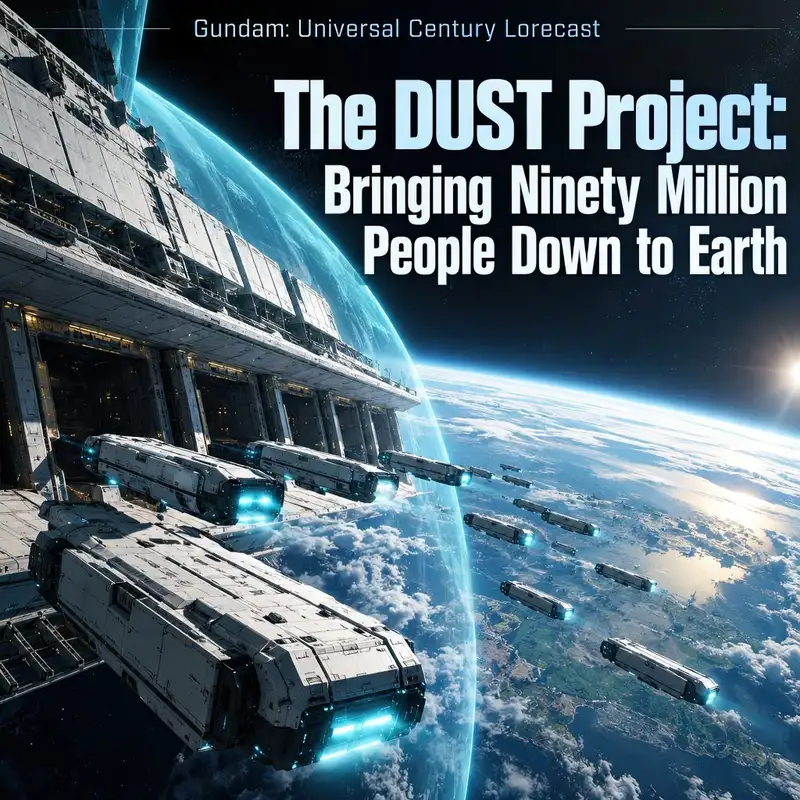
The DUST Project: Bringing Ninety Million People Down to Earth [Manga]
The final approach was not a battle over a fortress, a fleet, or a supply route. It was a battle over whether a habitat carrying roughly ninety million people could reach Earth without becoming the largest weapon in the war. Neo-1 Bunch, converted into the vessel called the Ark, was descending toward the planet while armed forces still contested its movement. Every attack risked more than the destruction of a military objective. A damaged control system, a breached living section, a failed maneuver, or a panic inside the colony could turn a rescue into an uncontrolled impact.
That was the terror at the center of the DUST Project. The Ark was an inhabited colony, with homes, life-support systems, public institutions, refugees, workers, children, medical facilities, and all the accumulated vulnerabilities of a society built in space. But it was also an immense object in motion. The same mass that made a colony a place where millions could live made it catastrophic if it fell without control. The project’s planners had to prove that it was a lifeboat, not a projectile. Their enemies had every reason to doubt them, and some had reasons to ensure that doubt became reality.
The most obvious response to a threatened colony was conventional defense. Fortify the approaches. Deploy mobile suits. Organize patrols. Prepare firing positions. Rally ships and allies. In a smaller settlement, those measures might at least buy time. But defending Neo-1 Bunch meant accepting that a colony packed with refugees would become the center of sustained combat. A mobile suit battle near a colony is never merely a mobile suit battle. Missed shots, debris, damaged docks, interrupted power, breached pressure sections, and destroyed transport links can create civilian consequences far beyond the machines immediately involved.
The defenders also faced the limits of the late-century military environment. A fragmented political order did not produce dependable reinforcement schedules. Old machines could be formidable in the hands of skilled pilots, but they also reflected a world in which maintenance, spare parts, ammunition, and standardized training were increasingly difficult to sustain. A restored mobile suit could win a local engagement. It could not, by itself, guarantee the safety of ninety million people or solve the strategic problem of a threatened colony.
Ordinary evacuation was no more realistic. Moving ninety million people requires far more than ships with empty seats. It requires docking capacity, traffic control, fuel and propellant, food, water, medical care, records, shelter at the destination, and some government willing to accept the arrivals. It requires protection against panic, criminal exploitation, and military attack. It requires the ability to move patients, children, elderly people, workers, technical crews, and the equipment needed to keep a community alive. An evacuation without a destination is not a solution. It is the beginning of another refugee crisis.
The Earth Federation’s failure was not simply that it lacked transport. The deeper failure was political. Earth remained a place of enormous symbolic and practical value, but access to it was restricted by authority, population policy, security fears, and the old division between those who governed from Earth and those who lived in space. The refugees of Neo-1 Bunch were not merely people in danger. They were people whose movement could alter political power. That made them inconvenient to institutions that preferred them contained.
Ash King’s proposal began where normal military planning ran out of answers. If Neo-1 Bunch could not be held indefinitely and its population could not be evacuated by conventional means, then the colony itself had to move. Not as a weapon aimed at Earth, but as the vehicle that would carry its people there. The plan was extraordinary because the scale of the problem was extraordinary. It did not ask how to transport ninety million residents away from their home. It asked whether their home could become the transport.
Leo Orpham gave the proposal its name: the DUST Project. The name did not make the operation less dangerous, but it gave it political and public identity. Ash became its principal operational architect. Neo-1 Bunch’s authorities, including Tarls Vance, had to decide whether the colony would gamble on the plan. The decision was not a technical choice delegated to engineers. It was a choice by a community facing the prospect of attack, abandonment, or a descent toward Earth that could fail catastrophically.
The colony was converted into the Ark, with resource satellites attached as part of the larger effort to make movement and descent possible. That description can sound deceptively simple. In practice, turning a colony into a controlled vehicle required far more than attaching engines to a structure. It required propulsion support, structural work, attitude control, navigation, power management, repairs, communications, and defensive coordination. It required people who could understand the colony’s internal systems well enough to change their purpose under wartime conditions.
The Ark also needed a chain of command that connected the people steering and defending the colony with the people living inside it. A military operation can sometimes function through compartmentalization. Civilian survival cannot. Residents needed to know enough to prepare. Medical personnel needed to organize for casualties. Technical workers needed access to essential infrastructure. Families needed information about shelter, movement, food, and pressure safety. Public leadership needed to maintain trust without pretending the danger did not exist. A population of ninety million cannot be handled as cargo. It has to remain a society while the operation is underway.
That was the moral distinction between DUST and a colony drop. Operation British and later attacks involving falling colonies or celestial bodies used mass as a weapon. Their planners treated habitat structures as instruments of destruction. DUST attempted to preserve the people inside the colony, preserve enough of the colony’s social and physical infrastructure for those people to survive, and place the structure on Earth under control rather than use it to devastate a target. The object was similar. The political and moral purpose was not.
But purpose alone does not overcome physics. A controlled descent that loses control can become indistinguishable, in its effects, from a colony drop. This was not a matter of rhetoric. The Ark had to enter an atmosphere, manage immense stresses, retain structural integrity, maintain life support, and avoid becoming a falling mass that nobody could steer. A plan to save civilians could still kill them if its engineering, command, or defense failed. The people supporting DUST were asking ninety million residents to accept risk not because it was safe, but because the available alternatives were worse.
The manga presents a particular operational answer to that problem. The Ark’s descent was intended to use a horizontal approach, increasing atmospheric drag rather than sending the colony downward in the manner of a conventional impact body. The living sections were separated from the outer structure in an effort to reduce the rotational forces imposed on the inhabitants. The colony’s existing cushioning systems and the preparation of its population were part of the survival plan. These were the story’s proposed solutions, not a set of technical figures that can be treated as independently validated aerospace calculations.
What matters historically is the logic behind them. The planners understood that the colony was not a warhead with passengers added as an afterthought. It was a habitat whose population had to survive the maneuver. That required attention to the loads imposed on living areas, the integrity of pressure systems, the protection of critical utilities, and the practical behavior of millions of people under extreme danger. A descent of this scale could not be managed through a single heroic command from a cockpit. It required preparation throughout the colony.
Civil defense therefore became as important as mobile suit defense. Residents had to shelter. Medical teams had to prepare for mass emergency conditions. Engineers had to preserve power, atmosphere, water, and communications. Internal authorities had to manage movement and prevent panic. Food distribution still mattered. So did sanitation, emergency repair, and the ability to keep essential workers at their stations. A colony can survive a military threat only if it remains habitable while that threat unfolds. In DUST, the difference between a rescue and a disaster depended as much on public order and maintenance labor as on weapons.
There was no single moment when the Ark could simply be declared ready and launched. The conversion required sustained work under pressure. Components failed. Systems required repair. Defensive forces had to keep hostile units from interfering with critical structures. Navigation and attitude control had to continue while the colony moved. A ship can lose an engine, alter a route, and perhaps limp to a port. A colony containing ninety million people has far less room for improvisation once it has committed itself to atmospheric descent.
The operation’s failure mode shaped every decision. If control was lost, the Ark could become a mass-casualty event on a planetary scale. The project’s supporters understood that risk. The story presents internal preparations for the possibility that the operation might have to be stopped if it became too dangerous, though exact thresholds and technical probabilities are not securely established. That uncertainty is appropriate. No responsible command could reduce such an operation to a neat percentage. The relevant fact is that the planners knew success was not guaranteed and that failure could endanger both the people aboard and those below.
The DUST Project therefore required more than engineering. It required legitimacy. Ash, Leo, and their allies publicly broadcast the project’s purpose, its safety rationale, and its claim to humanitarian necessity. This was not public relations added after the real work was complete. It was a defensive system of another kind. The Ark could not hide. A colony on the move was too large, too politically consequential, and too vulnerable to be treated as a secret operation.
By broadcasting, the project’s leaders made a claim before the wider Earth Sphere. They argued that the Ark was not an attack on Earth, not a covert weapon, and not an unauthorized act of destruction. It was an attempt to bring a threatened population down alive. That disclosure imposed political costs on anyone who chose to attack it. An enemy could still say that the colony was too dangerous to permit. But that enemy would now have to explain why stopping the project required risking the destruction of millions of civilians.
Transparency also carried costs. A public broadcast revealed intent. It exposed the project’s movement, its political stakes, and much of its vulnerability. Secrecy might have protected some operational details, but it would have left Neo-1 Bunch isolated and easier to misrepresent. A hidden colony descending toward Earth could be described as a weapon before its people had any chance to speak for themselves. The broadcast accepted military exposure in exchange for political visibility.
That decision reveals an important feature of late Universal Century warfare. Information was not merely about locating hostile forces. It was about defining what an operation meant. If Cyclops could define the Ark as an uncontrolled colony drop waiting to happen, interception could be framed as planetary defense. If Neo-1 Bunch could define the Ark as a refugee evacuation with a controlled descent plan, then an attack on it became an attack on civilians seeking survival. Neither narrative eliminated the physical danger. Both shaped the political space in which force could be used.
Cyclops was central to that conflict. It was a powerful Federation faction that claimed descent from the Titans, carrying forward a security-minded institutional culture into a much later and more fragmented era. Cyclops possessed unusual residual industrial capacity, standardized communications systems, and military resources that stood out in a setting where much of the Earth Sphere relied on restoration and improvisation. It could project force. It could coordinate units. It could present itself as a guardian of order.
Cyclops was not the entire Earth Federation. The Federation had weakened, fractured, and lost much of its effective reach. But Cyclops mattered precisely because it retained enough capacity to act where broader institutions could not. That made its political character decisive. An organization with advanced communications and military infrastructure can protect civilians, organize relief, and stabilize a crisis. It can also classify populations as threats, burdens, or obstacles to be managed.
Arnold Gilvester, Cyclops’s commander, saw the battle around Neo-1 Bunch as an opportunity to eliminate or reduce the refugee population concentrated there. This was not simply a disagreement over engineering safety. Nor was it a normal concern about the risks of an inhabited colony entering Earth’s atmosphere. Those concerns were real. The DUST Project was dangerous. But Arnold’s calculation went further. The presence of so many refugees had become, in his view, a population problem that military crisis could solve.
That is the moral center of Cyclops’s role in the operation. Security language can conceal decisions about who is allowed to live where, who is permitted to move, and which lives count as administratively manageable losses. A state or faction need not openly announce hostility toward civilians to endanger them. It can claim that civilians are too difficult to protect, too politically destabilizing to admit, or too dangerous to let move freely. It can turn the failure of policy into an argument for treating human beings as excess population.
The DUST Project challenged that logic directly. If the Ark reached Earth with its residents alive, it would demonstrate that the refugees were not a problem to be reduced in space. They were people with a claim to live on the planet from which Earth-centered institutions had long exercised power. The project threatened the Federation’s ability to control immigration through simple refusal. It also threatened the moral authority of officials who could speak of public safety while treating mass civilian death as a useful outcome.
For Cyclops, that made pursuit politically necessary even when it was militarily dangerous. The organization could not simply allow a huge colony to descend toward Earth without asserting authority over the event. But it also could not safely attack the Ark as though it were an ordinary ship or fortress. A direct strike might compromise life support, fragment structures, damage control systems, or cause the uncontrolled descent Cyclops claimed it was trying to prevent. Tactical success could create strategic catastrophe.
This was an unusual rules-of-engagement problem. The target was a moving colony, increasingly committed to a trajectory toward Earth. It could not be seized casually. It could not be disabled casually. It could not be destroyed without consequences that would extend far beyond the immediate battle. A pursuing force had to consider not only whether it could hit the Ark, but where, when, and with what result. Every weapon became politically and physically constrained by the fact that the target contained a civilian society.
The pursuit force itself was unstable. Cyclops incorporated surviving Hymn Nation forces, bringing together elements that did not share a single history, command culture, or political objective. Such coalitions can add strength, but they also add friction. Units may not trust one another. Officers may disagree over the mission. Intelligence may be incomplete or selectively shared. The incorporation of former enemies can create practical military capability while exposing deeper uncertainty about who, exactly, is directing the operation and toward what end.
Cyclops’s communications advantage mattered in this environment. Standardized systems, disciplined coordination, and residual industrial capacity are real military strengths. They can improve situational awareness and enable more coherent pursuit. But no communications architecture can solve a mission whose political objective is self-contradictory. Cyclops could improve its ability to reach the Ark. It could not make it morally or operationally simple to stop a colony full of civilians without risking their deaths.
Font Bo understood that contradiction. A Cyclops strategist and a former ally of Ash, Font initially opposed the DUST Project. His opposition was not irrational. The plan was unprecedented, dangerous, and capable of producing disaster if the Ark failed. A responsible analyst had to recognize that a colony descending toward Earth was not something to celebrate merely because its leaders used humanitarian language. The project placed ninety million people in extraordinary peril.
But Font’s analysis changed as the operation developed. Once the Ark was committed to descent, the question was no longer whether the original decision had been perfect. It was whether an attempted interception would make failure more likely. The available choices had narrowed. Preventing the project safely might no longer be possible. Continuing to oppose it through force could convert a controlled descent into the very catastrophe everyone claimed to fear.
Font’s reversal was not a simple conversion to Ash’s political cause. It was a judgment made under conditions in which no clean option remained. He recognized that there is a point in a crisis when institutions must stop pretending they can return to a safer earlier decision. The task becomes damage limitation. A commander who cannot accept that transition may continue pursuing an abstract objective long after it has become destructive in practice.
By helping make the landing survivable, Font exposed the difference between loyalty to an organization and loyalty to its stated purpose. Cyclops presented itself as a security institution. If security meant preserving human life and preventing catastrophe, then assistance to the Ark became more defensible than an attack likely to destroy it. If security meant preserving administrative control and removing an unwanted population, then destruction remained useful. Font’s choice made that divide visible inside Cyclops itself.
His intervention also reinforces the wider lesson of DUST. The Ark did not survive because one side possessed the superior mobile suit. It survived because people across different institutions recognized that the situation had changed. Engineers, colony authorities, defenders, residents, and even some former opponents had to shift from stopping the project to making it less deadly. This was not a clean military victory. It was an emergency coalition formed around the minimum requirement that ninety million people not be allowed to die for the convenience of a political order.
Ash still had a direct military problem to resolve. During the final phase, he left the main operation to confront Evans Gilvester. Ash fought in the Anchor Version Four, an improvised late-century configuration shaped by the era’s culture of adaptation and scarcity. Evans operated the Baroque Custom Custom. Their clash mattered because Evans remained a threat to the Ark and to the operation’s fragile path toward survival.
But the duel should not be mistaken for the explanation of DUST’s success. The late Universal Century often produces machines that look like the work of desperate mechanics, veteran pilots, and accumulated battlefield improvisation. They are important because institutions have weakened and standardized support has decayed. Yet no individual combat machine, however capable, could land Neo-1 Bunch by itself. The duel could remove or reduce an immediate threat. It could not replace engineering, navigation, resident preparation, civil defense, strategic communications, or Font’s decision to assist rather than sabotage.
Ash’s role was therefore larger than his cockpit performance, but smaller than the myth of a lone savior. He was an operational architect willing to take an immense risk because conventional options had failed. He could inspire action and confront a dangerous enemy. He could not make the risk disappear. The real achievement of the project was collective. It depended on the people inside the Ark accepting that their survival required discipline, labor, and trust in a plan no one could prove safe in advance.
The landing took place in or near California Bay. The available account describes preparation of the colony’s lower section so that water and soil could enter and help anchor the structure. The details should be treated cautiously. The manga establishes the landing as the culmination of the DUST Project, but it does not provide a complete engineering record from which exact mechanics, damage levels, or casualty figures can be derived. What is clear is that the goal was not merely to survive impact. It was to create a condition in which the colony and its people could remain on Earth.
At the tactical level, the Ark was not prevented from reaching the planet. That mattered because the pursuing forces had every opportunity to turn the final approach into disaster. At the operational level, the project carried out a colony-scale evacuation and controlled descent under combat conditions. It moved a threatened population out of a battle zone without breaking the colony’s social structure into millions of isolated evacuees.
At the strategic level, DUST challenged the assumption that Earth could remain closed to mass spacenoid settlement through administrative refusal backed by military force. The Ark’s descent did not solve the wider political conflict over Earth, migration, or authority. It did, however, make that conflict impossible to ignore. A population that had been treated as a distant refugee burden had arrived physically on the planet. Their presence transformed a question of policy into a question of coexistence.
At the political level, Leo emerged as an important public voice for the people of Neo-1 Bunch. The project’s broadcast had already framed the refugees as people seeking survival rather than conquest. After landing, that claim had to become the basis for some form of public legitimacy. The manga points toward that political transition, but it does not provide a fully developed account of constitutional arrangements, resettlement policy, or the long-term administration of the settlement. It would be a mistake to invent a stable new state simply because the Ark reached Earth.
At the institutional level, Cyclops was exposed as divided. Its material strength and communications capacity had not produced moral clarity. Arnold’s population-management calculation revealed how easily a security organization could redefine civilians as an obstacle. Font’s eventual assistance revealed that not everyone within the organization accepted that purpose. The division did not erase Cyclops’s power, but it showed that institutional discipline cannot permanently conceal a conflict between declared mission and actual policy.
At the civilian level, the landing represented survival, but not an uncomplicated triumph. The DUST manga ends at the threshold of a new existence rather than documenting every consequence that followed. It does not provide a full accounting of reconstruction, casualties, medical conditions, environmental effects, resettlement, or governance after the colony reaches Earth. The absence of that record matters. Landing was not the end of the refugees’ struggle. It was the moment when survival in space gave way to the difficult politics of living on a planet that had not prepared to receive them.
That limitation is part of the project’s meaning. The DUST Project was never a magic solution to the Earth Sphere’s political failures. It did not end fragmentation. It did not restore the Federation. It did not eliminate the military forces that had threatened Neo-1 Bunch. It did not prove that colonies could routinely be landed safely. It did not make the technical risks disappear. What it did was force a choice that the late Universal Century had spent generations avoiding.
A colony can be a weapon when leaders treat its people as expendable mass. It can be a refuge when leaders preserve the people, institutions, and future inside it. DUST did not become the opposite of a colony drop because it used different machinery. It became the opposite because its planners attempted to keep the colony’s inhabitants alive and carry their society with them rather than convert them into a projectile. Yet the need for such a plan remains the indictment. Ninety million people had to gamble on turning their home into an emergency spacecraft because the institutions claiming to govern humanity could neither protect them in space nor admit them to Earth.