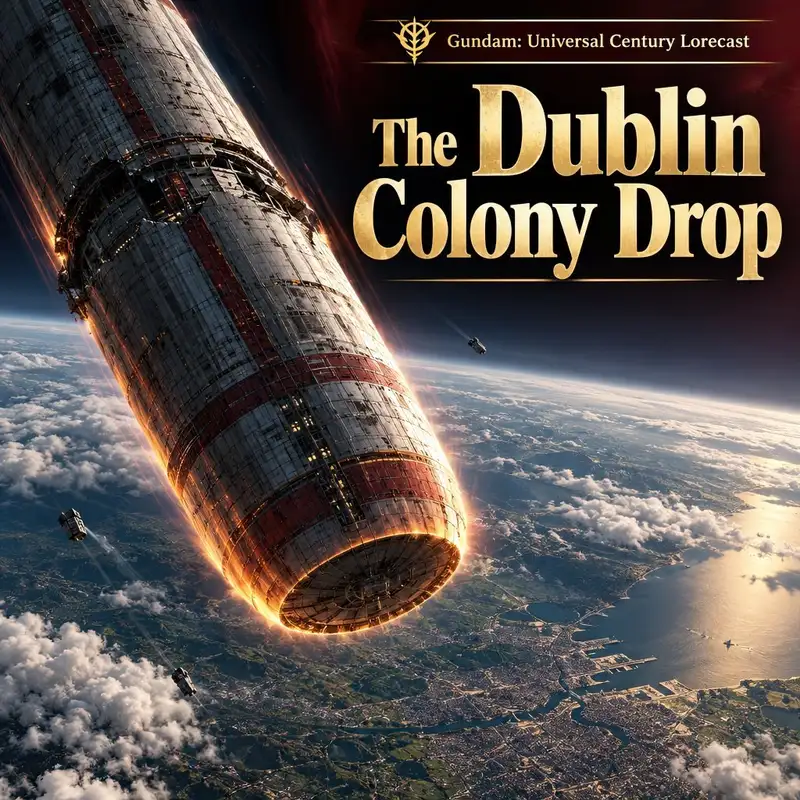
The Dublin Colony Drop
In Dublin, the decisive front was not a trench line, a fleet screen, or a mobile-suit formation. It was a city trying to move its people before the sky came down. Medical workers had patients to carry. Families had to choose what they could take and what they had to leave behind. Transport had to find routes through a city already strained by panic and political confusion. Above them, Neo Zeon had turned a colony into an instrument of coercion. The colony was the visible weapon, but the deeper weapon was the message attached to it. The Earth Federation could not guarantee protection. Its officials could bargain, delay, and save themselves. They could not make Dublin safe.
That was the point of the Dublin colony drop in late October, Universal Century eighty-eight. It was not simply an attempt to destroy a city, though it did destroy one. It was a political operation conducted through mass civilian vulnerability. Haman Karn’s Neo Zeon did not need to annihilate every opposing mobile suit, sink the Argama, or prevent every civilian from escaping. It needed to demonstrate that the Federation’s formal authority had become hollow at the moment citizens needed it most. Once that demonstration succeeded, political concessions became easier to extract than a conventional military victory would have been.
Dublin was therefore not an empty target marker. It was a living city, with hospitals, streets, homes, transport networks, public institutions, and people who had no role in the war’s grand strategy. Its destruction mattered because it was visible and because it exposed a basic failure of government. A state does not maintain legitimacy merely by possessing laws, offices, and military uniforms. It maintains legitimacy by persuading people that its authority means something in a crisis. Warning systems, evacuation plans, defense forces, rescue capacity, and public trust are not administrative details. They are the practical substance of political power.
The colony drop made that failure impossible to hide. Neo Zeon transformed a civilian population into leverage, then forced the Federation to confront a choice between resistance and further catastrophe. The people of Dublin did not consent to become part of a negotiation over Side Three. They were made part of it anyway. That is why the operation must be understood as both strategically purposeful and morally indefensible. Its political logic explains the attack. It does not excuse it.
The setting had been prepared by the end of the Gryps Conflict. The Titans had been defeated, but their defeat did not leave behind a confident, unified Earth Federation capable of restoring order. The Anti-Earth Union Group, or AEUG, had played a central role in breaking Titan power, but it was not a substitute for a stable state or a fully integrated military command. It had suffered heavily. Its personnel, ships, and political influence were all limited. Its survival as an armed force did not mean that it possessed the logistics, reserves, communications network, or legal authority of a conventional theater command.
The Argama remained active under Bright Noa, but it was an overworked warship carrying a small, exceptional group of pilots rather than the center of a broad Federation defense system. The Gundam Team could fight. Bright could command. The crew could improvise under pressure. None of that gave them the ability to defend every city on Earth against a strategic threat. Their strength was local initiative. Their weakness was that they were being asked, again and again, to compensate for institutions that had failed at a much larger scale.
Neo Zeon understood the opportunity. Haman Karn had inherited a political environment shaped by Federation complacency, Titan brutality, and the exhaustion of those who had fought the Titans. The Federation had survived the Gryps Conflict, but survival is not the same as recovery. Its authority was compromised by its own recent history. Its military institutions were fractured. Its leaders faced a renewed Zeon movement that possessed both military power and a sharper understanding of political theater.
Haman’s objective was not battlefield annihilation for its own sake. She sought submission, recognition, and political leverage. In the immediate context of the First Neo Zeon War, the critical prize was the Federation’s concession of Side Three to Neo Zeon. That concession carried importance beyond territory. Side Three was the historic center of Zeon politics and identity. For the Federation to recognize Neo Zeon’s control there would signal weakness, reward coercion, and give Haman a major political gain without requiring her to conquer Earth through a prolonged conventional campaign.
Haman’s political calculation was cold rather than irrational. Neo Zeon did not need to prove that it could occupy every Federation city. It needed to prove that the Federation could not reliably protect one. It did not need to force every citizen into submission by direct military control. It needed to make the government responsible for those citizens doubt its ability to resist. The planned destruction of Dublin made that calculation credible by placing an immediate, human cost on any refusal to yield.
The political purpose of the operation must not make its character seem abstract. A colony drop is not a clean strategic signal. A colony is an engineered habitat, a home, and a political community. Turning one into a weapon means destroying that community and directing its remains against another civilian community on Earth. Dublin’s population was not collateral to a military objective. Its exposure was central to the operation’s value. The disaster was meant to be seen, feared, and remembered.
Haman directed the political and military strategy, but she did not personally conduct every local action. That work fell to commanders such as Rakan Dakaran. Separating those levels of command is important. Haman’s purpose was to compel a concession. Rakan’s mission was to make evacuation difficult, increase civilian exposure, and prevent local resistance from reducing the operation’s political effect. Strategic coercion requires operational enforcement. A threat becomes less useful if people can simply escape it under organized protection.
The Dublin crisis also exposed the difference between formal authority and practical responsibility inside the Federation. Bright arrived expecting contact with Federation officials, but what he encountered was a political class more prepared to discuss accommodation than defense. The officials possessed titles, access, and legal standing. Yet those formal advantages did not produce warning, interception, organized evacuation, or public confidence. Their authority was real on paper and increasingly empty in practice.
Bright’s objection was not merely emotional resistance to compromise. He understood the strategic danger in rewarding coercion. A government that concedes under a threat may gain immediate relief, but it also teaches its opponent that threats work. In the short term, a concession can appear humane if it promises to prevent further suffering. In the longer term, it can invite additional demands by demonstrating that civilian danger is an effective bargaining tool. The question is not whether negotiation is always wrong. The question is what kind of political order negotiation creates when one side has made mass killing part of the discussion.
The behavior of the Dublin officials should be treated carefully. The series presents them as cynical, detached, and concerned above all with their own survival. One official view of the crisis treats human loss in language so cold that it suggests population management rather than public duty. That is an in-universe expression of compromised leadership during this emergency, not proof that every Federation office, soldier, or civilian institution embraced a single formal policy. But it does reveal a dangerous political mentality. When leaders begin treating citizens as numbers to be absorbed, reduced, or exchanged, evacuation stops being a duty and becomes an inconvenience.
Judau Ashta’s anger at that indifference is significant because it is not the reaction of a staff officer protecting institutional prestige. Judau sees the gap between what the Federation claims to be and what its representatives are willing to do when ordinary people are in danger. His response is impulsive, but the underlying judgment is difficult to dismiss. Political legitimacy depends on more than flags and treaties. It depends on whether people believe the system regards their lives as worth protecting.
The crisis quickly becomes more than an argument in a meeting room. Neo Zeon forces attack the area, and Bright and Judau are detained amid the confusion. The details matter because they show how rapidly political authority can disintegrate when it has not prepared for the emergency it is supposed to manage. The officials are not directing a coordinated defense. Bright is not being given a proper military mission with adequate support. Instead, local actors must seize initiative as the threat becomes immediate.
That is the point at which Hayato Kobayashi and Karaba become essential. Hayato, operating with Karaba aboard the Audhumla, brings the warning that Haman intends to drop a colony on Dublin and calls for assistance in evacuating civilians. This is a major change in the character of the operation. The Argama is no longer primarily concerned with political contact, pursuit, or mobile-suit combat. It must become part of an emergency rescue effort. Bright’s command problem is no longer how to win a clean tactical engagement. It is how to save as many people as possible with the forces actually available.
An evacuation is a military operation only in part. It is also a transportation problem, a medical problem, a communications problem, and a problem of public order. People must know that danger is coming. They must have somewhere to go. Vehicles must have fuel. Roads and air corridors must remain open. Medical teams need supplies and space for casualties. Families must be directed toward collection points. The injured, the elderly, and children need assistance that cannot be provided by a mobile suit waving people toward the horizon.
The Audhumla and the Argama therefore form an improvised coalition. Karaba contributes local rescue leadership and airborne support. The Argama contributes Bright’s command experience, its crew, and the Gundam Team’s combat power. Civilians and medical workers contribute the labor that makes evacuation real. None of these elements is sufficient by itself. Together, they can reduce the scale of catastrophe. But they cannot overcome every constraint imposed by time, panic, enemy interference, and the absence of a larger Federation response.
The Dodai Kai illustrates the logistical reality beneath the action. It is easy to remember a subflight platform only as a way of giving a mobile suit mobility in the atmosphere. In Dublin, it also matters as transport infrastructure. It can carry supplies, support movement, and help position combat assets where they can protect the evacuation. That is not a glamorous role, but it is often the decisive one. A weapon system that cannot be fueled, repaired, supplied, and moved to the right place at the right time is only an expensive object.
Hayato’s use of the Dodai Kai underscores this point. The system is part of an emergency network, not simply a stage for a duel. It supports the movement of resources and allows mobile suits to operate across a city whose normal transportation order is collapsing. In a functioning military system, such support would be planned, escorted, and integrated with larger air defense and civil authorities. In Dublin, it is improvised under attack. That makes every transport flight, every supply movement, and every protected route more fragile.
Mobile suits are still important. Their mobility and firepower allow them to intervene quickly against enemy units in dense and disrupted terrain. They can cover evacuation routes, defend transports, and contest key points where Neo Zeon seeks to create panic. Yet the very density of an urban evacuation limits the freedom to use that firepower. Civilians are present. Infrastructure is already damaged. Routes are congested. A mobile suit can easily become too large, too destructive, or too slow to distinguish a military target from the human consequences around it.
The hard truth is that evacuation was never going to be complete. The available assets could save people, perhaps many people, but not everyone. The city had too little time and too little organized support. That does not make the rescue effort futile. Saving a transport load, keeping a medical team alive, opening one route, or protecting one group of families is a real success. Military history often makes the mistake of recognizing only outcomes that change maps or force surrenders. For those who escaped Dublin, local success was not symbolic. It was survival.
But a partial rescue could not by itself defeat Haman’s political purpose. Neo Zeon did not need a perfect blockade of the city. It needed enough disorder, enough civilian exposure, and enough visible Federation incapacity to make the threat work. That is why Rakan Dakaran’s local interdiction mission was so important. He was not simply sent to test himself against Judau and the Gundam Team. His forces were part of the coercive mechanism.
Rakan’s role was to obstruct evacuation. His forces attacked civilians attempting to flee and contested the movements that Karaba and the Argama were trying to organize. Such actions were not incidental excesses around a conventional battle. They increased the political and psychological effect of the colony drop. Every blocked route, every transport destroyed, and every crowd driven back into danger reinforced the message that no rescue was secure.
There is a difference between fighting enemy mobile suits and hunting the conditions that allow civilians to survive. Rakan’s force did both, but the second task was more relevant to the wider operation. The Gundam Team could be drawn into combat, delayed, or scattered. The evacuation system could be broken into smaller, more vulnerable pieces. Panic could spread faster than any formal warning. In that environment, Neo Zeon did not need to hold every street. It needed to make movement dangerous enough that rescue capacity collapsed.
Urban warfare is well suited to that kind of disruption. Streets, buildings, damaged infrastructure, and crowds divide the battlefield into short lines of sight and competing priorities. A mobile suit may have impressive weapons, but it cannot be everywhere at once. It must choose between pursuing an enemy, covering a transport, protecting a hospital, or responding to a new threat. The defenders are always reacting. The attackers can exploit fear, confusion, and the need to protect civilians.
Rakan’s attacks on evacuees must be described plainly. They were attacks on people attempting to escape a known mass-casualty event. They served the operational purpose of trapping civilians in the danger zone and undermining the credibility of rescue. There is no need to embellish that with spectacle. The horror lies in the military logic itself. A force assigned to make catastrophe politically useful must ensure that civilians remain exposed to catastrophe.
This does not mean every Neo Zeon soldier shared Rakan’s conduct or every Neo Zeon formation had the same assignment. Institutions are not single personalities. But in Dublin, Rakan’s actions show how Haman’s strategic coercion was translated into local violence. The colony’s descent created the threat. Interdiction made the threat harder to escape. Together, they made the Federation’s inability to protect the city visible.
Bright’s position in all this is a study in command responsibility without adequate authority. He has experience, judgment, and a clear sense of the stakes. He understands that the civilians must be moved and that the Neo Zeon operation cannot be treated as an ordinary tactical engagement. Yet he cannot summon reinforcements from a functioning Federation chain of command. He cannot order a citywide emergency apparatus into existence. He cannot manufacture transports, escorts, or air defense assets that were not committed in time.
A commander in Bright’s position has to make decisions with incomplete information and insufficient resources. That does not absolve him of responsibility. It defines the burden of it. He must allocate the Argama’s limited strength between combat, protection, recovery, and movement. He must rely on subordinates to act independently. He must accept that even good decisions will leave people behind. That is the kind of command problem that heroic fiction often avoids because it offers no clean victory.
Judau represents another dimension of the crisis. He is young, capable, and increasingly aware that the adults and institutions around him have failed to meet the moral test they claim to understand. His anger toward Federation indifference is not a complete political program, but it is a legitimate response to abandonment. He is asked to fight for civilians in a city whose official leaders have already treated civilian survival as subordinate to negotiation.
That anger gives Judau energy, but it also creates danger. Rage can sharpen a pilot’s determination while narrowing judgment. A mobile-suit cockpit is not a place where moral outrage automatically becomes strategic wisdom. Bright’s command role includes guiding people like Judau toward the practical tasks that matter. Protect the route. Recover the wounded. Stop the attackers who are blocking escape. Stay alive long enough to keep helping. In a crisis, discipline is not the opposite of compassion. It is often the means by which compassion becomes effective.
Fa Yuiry’s role keeps the humanitarian reality in view. She is working in medical care while caring for Kamille Bidan, whose condition after the Gryps Conflict leaves him unable to function as he once did. Her presence reminds us that war’s casualties do not disappear when a battle ends or a regime falls. The Gryps Conflict is over, but its injuries remain in hospitals, families, and damaged minds. Dublin is not beginning from a clean slate. It is landing on a society already carrying trauma forward from the previous war.
Kamille himself cannot return to combat as though nothing has happened. He is not a reserve weapon waiting to be switched back on when the situation becomes desperate. The series presents his continued incapacity as one of the costs of the conflict that preceded Dublin. His humanity has been wounded by events that institutions will later describe in political and military terms. Fa’s care for him is not a side story. It is part of the same historical record as the colony drop, because both concern what warfare leaves behind in people who survive it.
Kamille still demonstrates extraordinary Newtype perception. He senses suffering and, in moments of crisis, offers a connection to Judau that reaches beyond normal communication. The series presents this as a real experience for those involved. It should be taken seriously on those terms. But it does not create an evacuation plan, stop the colony, or supply the Argama with more aircraft. Newtype perception can reveal emotional and human reality with unusual force. It cannot replace command, logistics, or political responsibility.
Hayato Kobayashi’s final actions bring the local battle into focus. Hayato is not trying to win the entire war. He is trying to protect the people immediately dependent on the rescue effort. Using the Dodai Kai and remotely operated support from a GM Three, he engages Rakan’s Zaku Three in an attempt to protect Judau and preserve the evacuation operation. His purpose is direct and limited. Delay the enemy. Keep the route open. Give others time to escape.
Hayato’s death is therefore meaningful, but it should not be romanticized. He does not die because sacrifice is inherently noble or because war somehow requires a final gesture from every veteran. He dies because the system around him has failed so badly that individuals are forced to spend their lives buying time that institutions should have provided through warning, defense, and organized evacuation. His courage is real. So is the failure that made such courage necessary.
His action does not stop the colony drop. It does not restore the Federation’s credibility. It does not reverse the political bargain Haman is seeking to impose. It does, however, preserve lives and protect the people near him. That distinction matters. A tactical sacrifice can be decisive for those it saves without being strategically decisive for the war. Military history should be able to honor the first truth without pretending it accomplished the second.
There is also a harder lesson in Hayato’s death. The burden of rescue is frequently carried by those who have the least power to determine whether the catastrophe happens at all. Political leaders negotiate. Strategic commanders choose targets. Senior officials fail to act. Then pilots, transport crews, doctors, mechanics, and civilians are asked to absorb the consequences. Hayato becomes part of the rescue effort because he refuses to abandon people. But refusal to abandon people is not a substitute for a government that never should have abandoned them in the first place.
The colony reaches Dublin. The series presents the aftermath through ruins, survivors, disrupted evacuation, and suffering rather than through a precise technical accounting of impact energy. No reliable casualty figure is required to understand the scale of the crime. The city is shattered. Civic infrastructure is broken. Medical needs multiply. People are missing, injured, displaced, and traumatized. The destruction continues after the initial impact because a devastated city cannot resume ordinary life simply because the falling object has stopped moving.
It is important not to turn that destruction into an engineering exercise. The television record does not provide a basis for calculating crater dimensions, impact velocity, atmospheric effects, or a precise death toll. Nor does the visual scale of the animation permit reliable measurement. The historical meaning of Dublin does not depend on false precision. It depends on the fact that a habitable colony was weaponized against an inhabited city, and that the result devastated human communities on both ends of that act.
The colony had once been a place where people lived. Dublin had been a place where people lived. The operation destroyed both realities in different ways. One community was reduced to a weapon. Another was reduced to a target. That is the human meaning of a colony drop. It is not merely an oversized bombardment. It is the conversion of civilian infrastructure, habitat, labor, and memory into an instrument of mass killing.
The aftermath also reveals why emergency rescue cannot be measured only by whether the city survives. The Argama, Karaba, and the surviving evacuees demonstrate that resistance still existed. The rescuers did not simply vanish under Neo Zeon pressure. They continued operating amid the ruins. Survivors were recovered. The people saved by the evacuation effort were not abstract symbols of defiance. They were evidence that abandonment had not been total.
Yet partial rescue could not erase the larger political message. The Federation had failed to stop the threat. It had failed to assemble a coordinated defense. It had failed to reassure its own population that it could prevent a recurrence. The Argama and Karaba had acted with courage, but their courage also exposed the absence of state capacity. They were doing what a government should have organized at scale, with more warning, more transport, more protection, and clearer authority.
This is why Neo Zeon did not need to defeat the Argama outright. Destroying Bright’s ship would have been useful, but it was not necessary to compel the intended concession. Rakan did not need to eliminate every Karaba survivor. He needed to disrupt the rescue effort enough that the colony drop remained a credible demonstration of Federation helplessness. Haman did not need to conquer all of Earth. She needed the Federation leadership to conclude that continuing resistance was politically more dangerous than yielding Side Three.
The target, in other words, was not only Dublin’s physical infrastructure. It was the Federation’s will and credibility. Coercive operations often work by making a government imagine future disasters. The city that is destroyed matters, but so does the city that might be next. If the state cannot protect Dublin, why should any other population trust its promises? If Neo Zeon can impose a concession through one catastrophe, what prevents it from demanding more through another?
The Federation’s eventual concession of Side Three to Neo Zeon marks the strategic success of the operation. That result did not mean Neo Zeon had solved every military problem it faced. The Argama survived. Karaba continued to resist. The Gundam Team remained active. Local rescue efforts had saved civilians. But Haman had achieved the political outcome for which the operation was designed. The Federation recognized Neo Zeon’s control of Side Three after Dublin’s destruction.
The institutional outcome was equally revealing. The AEUG and Karaba showed that decentralized, improvised forces could still act with initiative and moral purpose. They could identify danger, move people, and fight under desperate conditions. But they could not replace the state. A resistance movement or independent military formation can expose governmental failure. It cannot indefinitely compensate for the absence of a coherent government without becoming exhausted itself.
For civilians, the distinction between levels of success is painful. Some survived because evacuation efforts worked. That matters absolutely. But survival did not restore homes, families, hospitals, streets, or trust. Dublin’s social fabric was shattered. The disaster taught those who lived through it that political bargaining in the Earth Sphere could reach into ordinary life with terrifying force. A city could become a negotiating position. A colony could become a threat. And the institutions charged with protecting people could decide that protection was too inconvenient, too expensive, or too politically risky.
The Dublin colony drop was therefore not simply a Neo Zeon military victory, and it was not simply a Federation military defeat. It was a coercive success built on the conversion of political weakness into civilian catastrophe. Haman Karn made resistance appear less survivable than concession. Rakan Dakaran’s forces made escape more difficult. Federation officials failed to translate authority into defense. Bright, Hayato, Fa, Judau, Kamille, Karaba, and the Argama crew acted inside the gap left by that failure.
Their actions saved lives. They did not save Dublin. They did not prevent the concession of Side Three. And that is precisely why the event remains so important. The colony drop’s real success lay not in the destruction of a city or in the defeat of one warship. It lay in proving that a government which abandons people in a crisis can be coerced long before it is militarily conquered.