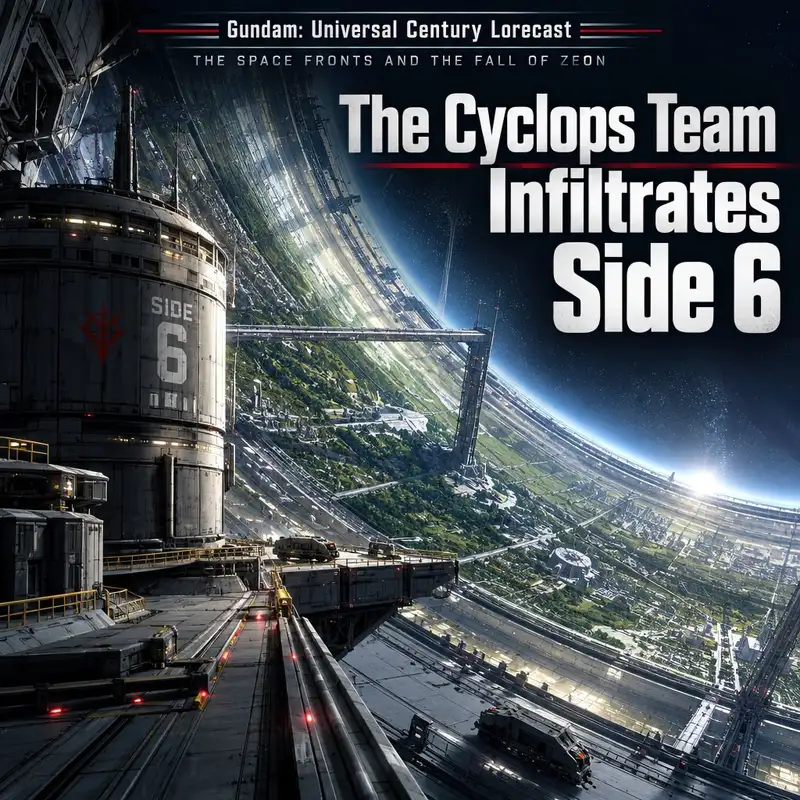
The Cyclops Team Infiltrates Side 6
A dismantled mobile suit moved through Libot’s commercial system as cargo. Its armor, weapons, and frame components were broken down, packaged, and passed through a neutral colony’s routines of docks, manifests, warehouses, and work crews. Nothing about that process looked like a conventional invasion. That was the point. Side 6 was supposed to stand apart from the One Year War. Its colony cylinders were civilian homes, industrial centers, schools, parks, and transport hubs. Zeon could not openly send a strike force into Libot without risking a diplomatic crisis and perhaps provoking the very Federation response it hoped to avoid. So the Cyclops Team entered through the narrow space between what the colony could inspect and what it could prove.
Their first weapon was not the Kämpfer. It was administrative normality. A neutral port has to keep traffic moving. It cannot halt every shipment because a crate looks heavy, a work crew seems unfamiliar, or a set of documents carries just enough ambiguity to invite suspicion. Commercial infrastructure depends on trust, routine, and the assumption that most cargo is what it claims to be. A small special-operations team could exploit that assumption more easily than a fleet. But the same civilian systems that made covert access possible also imposed limits. The Cyclops Team could enter Libot. It could hide equipment. It could observe. It could not control the colony, secure the surrounding space, or fight an extended battle without turning the neutral habitat into a war zone.
The operation was called Rubicon, an appropriate name for a mission that crossed a political boundary as much as a physical one. Zeon’s objective was the Federation’s RX-78NT-1 Gundam, known as the Alex. The machine was not a standard production mobile suit, and its loss would not have decided the One Year War by itself. The Federation was too large, and the war too far advanced, for a single prototype to settle the larger contest. But the Alex represented something Zeon had reason to fear. It was an advanced Gundam intended for Newtype use, a testbed for capabilities that could affect future mobile-suit development and the military competition around specially capable pilots.
The Cyclops Team had already learned how little strategic importance matters when tactical access is missing. Before arriving at Side 6, the team had attempted to seize the Alex at a Federation facility in the Arctic. The operation failed. The Gundam escaped the attack and was launched toward space before Zeon could secure it. The team lost personnel, including Andy Strauss, and the survivors were left with the usual special-operations problem after a failed raid. They knew the target mattered. They knew it had moved. They did not know enough about where it would appear next, how it would be protected, or whether another opportunity would exist.
Intelligence about the existence of a weapon is not the same as intelligence that permits its capture. A headquarters may know that an enemy is developing a prototype. It may even know the prototype’s broad purpose and approximate route. But an assault force needs more practical answers. Where is the machine now? Is it assembled? Is it fueled? Who has access to it? What security protects the site? Is there a pilot nearby? Can the machine be removed, destroyed, or disabled before defenders react? The Arctic failure showed that Zeon’s information about the Alex had not yet become a usable operational picture. Operation Rubicon was an attempt to close that gap under the most politically restrictive conditions imaginable.
The first useful clue did not come from an elegant intelligence network or a carefully recruited agent. It came from an eleven-year-old boy with a camera and an appetite for war stories. Alfred Izuruha was a Libot resident. He was not a Zeon operative, not a trained observer, and not someone capable of judging the importance of what he had seen. He was a civilian child who watched military activity with the excitement of someone far enough from the front to mistake danger for adventure. That distance was already an illusion. The war had entered his colony through secret cargo, hidden facilities, and adults who understood far more than they were willing to tell him.
Bernard Wiseman, known as Bernie, was in no position to be an ideal intelligence officer. He was a rookie pilot attached to a team that had already suffered losses. His damaged Zaku and his awkward arrival in Libot placed him in contact with Alfred almost by accident. Alfred had recorded images connected to the Federation shipment. Bernie recognized that the recording might contain information the team needed, and he exchanged his rank insignia for it. The transaction was improvised, almost casual, and militarily significant. It gave Zeon evidence that the Federation’s new Gundam had reached Side 6.
In a war shaped by Minovsky particle interference, local observation could become unusually valuable. That did not mean electronic sensors had ceased to exist, or that every battlefield had become blind. It meant that long-range detection, identification, and communications could be less reliable than commanders wanted. A camera recording, a glimpse of an unusual shipment, a vehicle seen entering the wrong industrial district, or a worker’s memory of unfamiliar personnel could matter. The Cyclops Team did not discover the Alex through a vast system of omniscient espionage. It exploited an accidental piece of human intelligence that happened to fit a larger pattern.
That success came with a cost. Alfred had now encountered a Zeon pilot, possessed material of military interest, and become curious about people who had every reason to keep their presence secret. Intelligence collection and operational security are often in tension. A source can provide information while also becoming a liability. In this case, Alfred was not even a source in the professional sense. He was a child who had wandered close to a classified operation because the adults around him had failed to keep the war outside civilian life.
Captain Hardie Steiner understood the danger. He commanded the Cyclops Team, and command in a covert operation means managing more than the enemy. It means managing cover identities, timing, discipline, fear, uncertain intelligence, and the mistakes of one’s own personnel. Steiner had to decide what to do with Alfred after the boy discovered the team. The crudest solution would have been to eliminate a witness. Steiner did not do that. Instead, he chose to exploit Alfred’s fascination with the team and placed Bernie in the position of keeping him close, watching him, and preventing him from creating further trouble.
It was a practical decision, and it was also a compromised one. Steiner avoided an unnecessary killing, which mattered. But he did not restore Alfred’s safety. He turned a civilian child into an unmanaged part of the team’s security problem. Bernie’s relationship with Alfred became useful because it gave the team some influence over what the boy saw and said. Yet it also tied the operation to a person with no training, no reliable discipline, and no real understanding of the danger. The team could not fully trust him, could not abandon him without risk, and could not erase his knowledge from the situation.
This is one of the less glamorous realities of covert warfare. Secrecy is rarely perfect. It is an accumulation of temporary advantages. A false name holds until someone checks it. A disguise works until a guard asks a question that was not rehearsed. A witness remains quiet until fear, curiosity, loyalty, or accident changes the calculation. The Cyclops Team had entered Libot without open combat, but it had not entered cleanly. From the moment Alfred became involved, the mission carried a civilian security breach that could not be completely controlled.
Steiner’s problem was compounded by the nature of the target. The Federation had concealed the Alex inside what appeared to be ordinary industrial space. The G-4 test organization had established a secret facility within Libot, where Christina Mackenzie served as the Gundam’s test pilot and worked through its final adjustments. The site drew protection from concealment as much as from guards. In a colony built around manufacturing, maintenance, cargo movement, and technical labor, an industrial building did not automatically announce itself as a military installation. That was precisely why it was useful.
The Federation’s decision created its own political contradiction. Side 6 neutrality gave Libot a measure of insulation from the wider war. A covert Federation research and testing facility weakened that insulation. It placed an advanced military project inside a civilian habitat whose political status depended on appearing separate from the belligerents. But the existence of the facility did not mean every Side 6 official knew about it, or that Libot’s population had consented to hosting it. Neutrality can be compromised from above without becoming meaningless to the people who depend on it below.
For Zeon, finding the facility required target development rather than simple discovery. The team knew the Alex was somewhere in the colony. That was not enough. A colony is not an open battlefield where a mobile suit can be located by sending a patrol down a road. Libot contained civilian movement, industrial sites, internal transport routes, and ordinary activity that could conceal unusual activity. The team needed to connect fragments. Alfred’s observations and Bernie’s contacts helped point toward the site. The result was not a complete blueprint of the facility. It was a workable identification of where the military secret had been hidden.
The team still lacked important information. It did not possess a secure map of the installation. It did not know every guard position, every internal alarm procedure, or every route by which the Federation could reinforce the facility. It had no reliable guarantee about the Alex’s condition. A prototype might be incomplete, unarmed, disassembled, or ready to move at a moment’s notice. The difference between those possibilities could determine whether a small raid was feasible or suicidal. Zeon’s strategic intelligence had improved. Its tactical intelligence remained incomplete.
That gap between knowing a target exists and knowing how to take it became the central weakness of Operation Rubicon. The team could identify the facility. It could prepare a raid. But capture required more than penetration. To seize the Alex intact, the Cyclops Team would have needed to secure the machine, control its immediate surroundings, prevent the pilot or crew from activating it, obtain whatever technical material mattered, and move the prize out of a neutral colony under pressure. Even destroying the prototype required positive confirmation that the damage could not be repaired. A small team could create a moment of confusion. It could not easily create sustained control.
The Kämpfer was meant to solve part of that problem, not all of it. Its covert insertion into Libot was an achievement of logistics and deception. A mobile suit does not simply appear because a commander needs a diversion. It must be transported, hidden, assembled, armed, maintained, and brought to a launch point without attracting the attention that its presence would inevitably cause once revealed. The Cyclops Team had moved a specialized raiding machine into a civilian colony by disguising its parts as industrial cargo. That required labor, planning, cover documentation, and confidence that ordinary commercial procedures would not look too closely.
The Kämpfer was not the infiltration. It was the instrument that would end the infiltration phase. Once Mikhail Kaminsky launched it into combat, no paperwork or disguise could preserve the fiction that Libot remained untouched by the war. The machine’s role was to create a diversion, suppress immediate defenders, and force the Federation to respond outside the facility while the internal team moved toward the Alex. It was a classic split operation. One element would make noise. The other would use that noise to reach the objective.
This was also why the Kämpfer’s presence represented an escalation threshold. Covert action depends on limiting attribution and delaying reaction. A mobile-suit raid inside a colony does the opposite. It announces that a hostile force has introduced military violence into civilian space. The team could hope that the diversion would be brief enough to create an opening. It could not hope that it would remain deniable. The more effectively the Kämpfer fought, the more clearly it revealed the scale of the intrusion.
The final plan placed Steiner, Bernie, and Gabriel Garcia inside the Federation facility under the cover of Federation uniforms and assumed identities. Kaminsky, known as Misha, would operate the Kämpfer outside. The internal element needed its disguise to survive initial scrutiny. The external element needed to draw security forces away at the right moment. Both depended on timing. The defenders had to be confused long enough for the infiltrators to reach the Gundam. The infiltrators had to move quickly enough that the diversion did not become the whole battle.
The plan rested on several assumptions that were reasonable in isolation and dangerous in combination. Forged identities had to withstand casual inspection. The facility’s personnel had to be too distracted to conduct careful authentication. The Alex had to remain inaccessible or unready. The colony’s security systems had to react slowly enough for the team to exploit the first moments of confusion. And an escape route had to remain available after the team had either captured or damaged the target. Every special operation accepts some uncertainty. This one accumulated uncertainty at every stage.
The mission’s stated purpose also contained an unresolved tension. Capture and destruction are not interchangeable tasks. Destroying a prototype can be accomplished through violence and denial. Capturing it requires custody, technical control, transport, and time. A team sized for sabotage may be able to plant explosives or damage a machine. It may not be able to tow, load, guard, and remove that same machine while operating inside a neutral colony. Operation Rubicon attempted to preserve both options, but the available force and the political constraints favored neither one completely.
Infiltration failed when the team’s assumed identity could no longer survive scrutiny. Bernie made an avoidable mistake, and in a less fragile operation it might have been recoverable. But uniforms and credentials are not identities. They are only the visible parts of identity. A convincing infiltrator also needs the right timing, the right manner, enough local knowledge to answer unexpected questions, and the confidence that comes from belonging in a place. The Cyclops Team had none of the advantages of a long-established undercover network. Its members were operating in an unfamiliar facility, inside an unfamiliar colony, under immediate pressure.
It would be too simple to say that one rookie’s error destroyed the mission. Bernie’s mistake mattered. Tradecraft failures matter because covert operations often have no reserve margin. But the team had already been sent into a target it did not fully understand, with an objective more demanding than its resources could comfortably support. It had a civilian witness to manage, incomplete information about the Alex, and no robust plan for controlling the situation once combat began. The disguise failure exposed weaknesses that had been present from the beginning.
The moment the internal element was compromised, Misha’s diversion became the main effort whether the plan intended that or not. The Kämpfer’s attack drew Federation attention outward and temporarily disrupted the defense. It gave the infiltrators a chance to move, but it also transformed the mission from covert penetration into open combat. The Federation now knew that Zeon had inserted a hostile force into Libot. The colony itself became part of the tactical problem. Security personnel, industrial buildings, roads, internal transit, power systems, and civilian spaces all became potential obstacles, cover, or collateral danger.
The Kämpfer’s raid demonstrated the value of a specialized mobile-suit asset in a short, violent action. It could move quickly, engage defenders, and force a response that ordinary security forces could not ignore. But that did not make it a strategic solution. The machine had been brought into Libot for a narrow purpose. It was not supported by a conventional Zeon force, protected by a fleet screen, or backed by a reliable recovery system. It was a raider operating far from any secure base. Its effectiveness depended on surprise, speed, and the expectation that the mission would be over before the enemy could organize.
The Federation response revealed another intelligence failure. The Alex was not simply a piece of cargo waiting to be removed or destroyed. Christina Mackenzie was able to activate the machine in an emergency. The Gundam’s condition, its defensive capacity, and the presence of a qualified pilot changed the balance of the raid. Zeon had identified the target but had not fully understood its readiness. This is a common problem in operations against advanced weapons. Intelligence officers may know a program exists. They may know its location. They may still not know whether the system is operational at the exact moment it is attacked.
The resulting fight did damage the Alex. It also proved that the prototype could defend itself. That was enough to frustrate Zeon’s hopes of a clean seizure and to turn the surrounding area into a habitat-defense emergency. In a colony, combat cannot be separated neatly from civilian infrastructure. A mobile suit moving through industrial districts threatens power, transport, workplaces, and buildings designed for ordinary life rather than armored warfare. Even when combatants aim at military objectives, the environment itself magnifies danger. A damaged wall, ruptured system, blocked route, or panicked civilian movement can spread the effects of a battle far beyond the intended target.
The Cyclops Team reached the facility and engaged the Alex. Tactically, that was real achievement. They had penetrated a neutral colony, found a concealed military site, brought in a combat asset, and forced the Federation to reveal and activate its secret prototype. But tactical access is not mission success. The team did not capture the Alex. It did not confirm its destruction. It could not preserve its own operational capacity. The closer it came to the target, the less control it had over what followed.
Steiner was mortally wounded during the collapse of the raid. Garcia remained behind to delay the defenders and enable Bernie’s escape. Misha was killed in the Kämpfer. These were acts of courage under pressure, and they should be understood as such. But courage does not retroactively make a plan sound. Special operations are often remembered through sacrifice because sacrifice is visible. The less visible question is why skilled personnel were placed in a position where survival, extraction, and mission completion had become mutually incompatible.
The team’s losses were not simply individual tragedies. They represented the destruction of a specialized capability that Zeon could not casually replace. A unit like Cyclops depends on experience, trust, rehearsed procedures, and the ability of members to understand one another under pressure. Losing trained personnel is not the same as losing a number on an organizational chart. Replacements can fill a nominal vacancy. They do not immediately recreate the relationships and judgment that make a small unit effective. The Arctic operation had already reduced the team. Libot nearly erased it.
From the perspective of Zeon headquarters, however, the team could be treated as expendable. Colonel Killing’s conduct exposed the distance between field-level risk and higher command priorities. For Steiner and his people, the mission involved immediate decisions about civilians, cover, survival, and whether they could still reach the Alex. For headquarters, the central concern was denial. The Federation must not retain the prototype. When the covert operation failed, the response under consideration was not necessarily to reassess whether the target justified further risk. It was to escalate.
That escalation took the form of a contemplated nuclear strike against Libot. The threat marked a profound change in the character of the operation. Operation Rubicon had begun as an attempt to penetrate a neutral colony discreetly and remove or destroy one military asset. A nuclear attack would not be a more forceful version of the same mission. It would be collective punishment directed at a civilian habitat in the name of denying the Federation its prototype. The military objective might remain the Alex. The political and moral act would be entirely different.
The logic of denial can become dangerously abstract at headquarters. A prototype becomes a symbol of future enemy capability. A colony becomes a point on a map that contains the prototype. Operators become assets that can be spent. Civilians become an obstacle to be calculated around, rather than people whose lives impose limits on military action. The Cyclops Team’s failure did not compel a nuclear response. It revealed that elements of Zeon command were willing to consider one because they valued the destruction of the target above the political consequences of destroying the society around it.
Side 6 neutrality did not prevent this crisis because neutrality is not a force field. It is a political condition that depends on recognition, restraint, and institutions capable of defending their status. Libot’s commercial traffic and civilian routines created opportunities for covert entry. The Federation’s secret test facility exploited the same environment for concealment. Zeon exploited it to move personnel and a dismantled Kämpfer into the colony. Both sides treated neutral infrastructure as militarily useful because its civilian character made it less likely to be watched as an obvious battlefield.
That does not make the residents of Libot responsible for the war brought into their homes. The Federation’s covert facility compromised the colony’s insulation from the conflict. It did not transform every worker, student, customs official, or family into a legitimate military target. Zeon’s infiltration exploited the gap between public neutrality and private military activity. It did not give Zeon the right to erase that distinction altogether. The essential moral problem is not that one side hid a military project and the other side found it. It is that both sides were prepared to make a civilian habitat bear the cost of secrets held by institutions far above the people living there.
The colony’s vulnerability also explains why the Cyclops Team’s initial success was so limited. The team could enter by exploiting commerce. It could identify the target through chance, observation, and local access. It could temporarily disrupt the Federation’s defense through a mobile-suit raid. But it could not govern the consequences of exposure. It could not decide how Libot’s authorities would react, how the Federation would reinforce the facility, how civilians would respond to combat, or how Zeon headquarters would interpret failure. Covert access gave the team a door. It did not give it political control over the room beyond that door.
The immediate consequences extended beyond the failed raid. Bernie’s later attempt to prevent the threatened destruction of the Alex, and Alfred’s exposure to the human cost of the war he had once treated as exciting, followed directly from the collapse of Operation Rubicon. But those events are not separate from the infiltration. They are what happens when a covert mission fails to secure its objective, its personnel, or its political limits. The operation left survivors and civilians to deal with problems that the original plan had never truly solved.
The Cyclops Team penetrated Side 6 because it combined opportunism, commercial cover, forged legitimacy, local observation, and a carefully prepared diversion. It failed because none of those tools could compensate for incomplete target intelligence, fragile deception, inadequate extraction planning, and a command structure willing to spend skilled operators for an objective it could not reliably seize. The Alex survived. The team was shattered. And Libot learned that neutrality offered shelter only until competing powers decided that a secret machine mattered more than the civilian society built around it.