The Crossbone Vanguard Reborn as Space Pirates
The transport ship Smashion was not a warship, a fortress, or a symbol of government authority. It was a vessel moving through the long and politically thin space between the Earth Sphere and Jupiter, carrying passengers and cargo toward a destination most people understood as distant, difficult, and economically necessary. When armed mobile suits and the warship Mother Vanguard moved against it, the passengers had every reason to reach the obvious conclusion. Pirates had found them. In an era where formal patrols were unreliable and Jupiter lay far beyond the immediate reach of Earth Federation authority, an armed interception could look like robbery long before anyone explained its purpose.
For Tobia Arronax, the young passenger drawn into that encounter, the raid was not an abstract question of grand strategy. It was a sudden intrusion of military force into civilian travel. Armed strangers had the power to stop a ship, inspect its people, control its movement, and decide what information left with it. That is what piracy means to those on the receiving end. The Crossbone Vanguard could claim a higher purpose, and eventually it would. But its methods still depended on coercion, surprise, and the fear created by superior force.
The contradiction was difficult to miss. These so-called pirates carried the name Crossbone Vanguard, a name associated ten years earlier with the attack on Frontier Side and the attempt to create Cosmo Babylonia. Their leader was Berah Ronah, once known as Cecily Fairchild, heir to the Ronah family’s political project. Their senior pilot, Kincade Nau, was the concealed identity of Seabook Anno, the young man who had fought against that project aboard the Space Ark. Veterans of the old Vanguard served beside them. Yet this force was no longer trying to build an aristocratic state. It was trying to uncover and stop a hidden Jupiterian war.
That transformation is the real history behind the pirate flag. The reborn Crossbone Vanguard was not simply a former enemy becoming heroic, nor was it a conventional navy wearing skull-and-crossbones insignia for style. It was a small armed organization operating outside recognized law because the state it had once served had failed, and the larger state that claimed responsibility for the Earth Sphere was not confronting a new danger. Its piracy was a disguise, an operational method, and an admission that formal authority had left a strategic vacuum behind it.
What it could not do was remain politically unchanged. A military organization can survive the regime that formed it, but the question becomes what it survives for. Some veterans may reinterpret their service. Others may continue to believe in the old hierarchy, even after the state that embodied it has failed. Still others may treat the organization itself as the object of loyalty, separate from any political program. That tension would matter deeply in the reborn Vanguard. It was never a clean break from the past. It was a contested attempt to redirect a compromised military inheritance.
By Universal Century one hundred thirty-three, Cecily Fairchild had resumed the identity of Berah Ronah. In the manga record of this period, that identity was not merely a private family matter. Berah’s name carried dynastic weight, political danger, and symbolic value. She could not erase what the Ronah family had attempted, nor could she fully escape the fact that some people would see her as the surviving heir of Cosmo Babylonia. But she could reject the old project and use the authority attached to her name for a different purpose.
That was a precarious form of legitimacy. Berah did not command a recognized state. She did not possess a territory secured by law, a parliament, a regular navy, or a universally accepted mandate. Her authority rested on personal credibility, on the loyalty of those who chose to follow her, and on the practical value of protecting people threatened by Jupiterian expansion. It also rested, uneasily, on the symbols of the old Vanguard. She was trying to turn a legacy of aristocratic conquest into an instrument of resistance. That made her position powerful, but never uncomplicated.
Seabook’s transformation into Kincade Nau carried a similar logic. The alias was not a costume change for its own sake. It separated the public identity of the young man associated with the Frontier conflict from the covert operational role required near Jupiter. A clandestine force cannot survive if every major participant is easily identified, tracked, pressured, or used for propaganda. Kincade’s concealed identity gave the organization some protection from enemies, governments, and the simplifying stories that others might impose on it.
It also reflected a deeper political reality. Seabook Anno had been a civilian drawn into the collapse of Cosmo Babylonia. Kincade Nau was a senior figure in an armed organization that had deliberately chosen to remain in the shadows. The difference was not just a new name. It was the difference between surviving a war and accepting responsibility for preventing another one. That responsibility required skills that did not fit comfortably into ordinary civilian life, but neither did it come with the legal authority of a formal military command.
The Earth Federation remained the nominal authority over much of the Earth Sphere, but nominal authority is not the same as effective control. By this point in the Universal Century, the Federation still possessed institutions, military forces, political relationships, and an established place in interplanetary commerce. Yet the distance to Jupiter created a problem that no official seal could solve. Jupiter was far from the Federation’s central political attention, far from rapid reinforcement, and far from the daily experience of most citizens who depended on its trade.
That distance was not only measured in travel time. It was measured in oversight, intelligence, and political urgency. Economic exchange with Jupiter could appear routine because it had become routine. Cargo moved. Energy and resources mattered. Commercial relationships created habits of assumption. A transport route that exists for trade can also conceal military preparation, especially when the people watching it are accustomed to seeing ships, materials, and technical personnel moving under legitimate commercial cover.
The Federation’s failure in this period should not be reduced to a claim that every official supported the Jupiter Empire’s ambitions. The evidence does not require a universal conspiracy. Political inertia, fragmented responsibility, limited inspection, bureaucratic caution, and the difficulty of interpreting distant activity can produce strategic blindness without a single master plan behind it. Governments often fail not because nobody sees a warning, but because no institution is prepared to treat the warning as its responsibility.
That was the strategic vacuum in which the reborn Crossbone Vanguard operated. It saw, or came to suspect, that the public face of Jupiterian exchange concealed a military danger. The problem was not simply whether the Vanguard had enough mobile suits to fight a battle. The prior problem was whether anyone with recognized authority would identify hostile intent before an invasion force arrived near the Earth Sphere. A threat discovered only after it has assembled openly is no longer an intelligence problem. It is an emergency.
The adversary was the Jupiter Empire under Crux Dogatie. It should not be treated as Zeon under another name, nor as an interchangeable late Universal Century villain. Jupiter had its own strategic environment, political structure, and material pressures. It existed in a region where distance magnified every logistical challenge. Ships, supplies, spare parts, food, medicine, trained labor, and military equipment all had to be sustained across a vast interplanetary route or produced within a limited local system. Such conditions encouraged secrecy, self-reliance, and strict control.
Resource scarcity and difficult logistics can explain pressure. They do not excuse conquest. The Jupiter Empire’s response to its circumstances was not merely defensive planning. It developed an expansionist military project directed toward the Earth Sphere. That choice turned economic dependence and distance into elements of a hidden war. Jupiter’s leaders could present commerce and exchange as normal relations while preparing the instruments of coercion behind that public image.
For the Crossbone Vanguard, this created a problem of prevention. A small force could not wait for the Jupiter Empire to reveal every capability, mobilize openly, and depart in strength. By then, the Empire would be operating on a strategic timetable of its own. The Vanguard had to gather information, test suspicions, intercept movements, and disrupt preparations before the threat reached its intended target. That is why its early operations could resemble criminal raids. It was fighting for evidence as much as for territory.
The Smashion interception illustrates the method. A transport ship could be a civilian vessel, a commercial carrier, an intelligence source, a logistical node, or several of those things at once. Stopping it could reveal passengers, cargo, routes, communications, and connections that no distant government office would see. It could also send a message to Jupiterian authorities that their activity was being watched. But such an operation carried real costs. The people aboard did not necessarily know why they had been stopped. They could not be expected to trust armed strangers simply because those strangers claimed to be resisting a hidden danger.
For that reason, the pirate identity cannot be treated as harmless theater. It gave the Crossbone Vanguard concealment. A pirate vessel could move outside the formal expectations placed on a recognized navy. It could appear where a Federation patrol would create diplomatic complications. It could strike quickly, collect intelligence, board a target, and withdraw before a larger force could react. The image of piracy also created uncertainty. Enemies could not always tell whether an attack was politically directed, commercially motivated, or simply opportunistic.
Deniability mattered as well. A recognized government must explain its actions through treaties, jurisdiction, diplomatic channels, and public accountability, however imperfectly. A clandestine force has fewer protections, but it can act before those processes catch up. The Vanguard could not openly declare war on Jupiter without exposing itself, inviting retaliation, and perhaps giving skeptical Federation authorities a reason to dismiss it as a remnant militia. The pirate label allowed it to operate in the gray zone between commerce, intelligence work, and armed resistance.
Mobility was another advantage. Near Jupiter, a small force could not hold territory in the conventional sense. It could not build a broad defensive line or depend on a chain of secure bases. Its strength lay in movement, surprise, local knowledge, and the ability to choose where to appear. Irregular routes, compartmentalized information, and delegated initiative allowed the Vanguard to do what a conventional fleet might struggle to do under political scrutiny. The organization could concentrate briefly against a vulnerable target, then disperse before a stronger adversary could bring its full weight to bear.
But piracy solved an operational problem, not a moral one. It did not automatically make the Vanguard legitimate. It did not give passengers a reason to welcome a boarding party. It did not eliminate the risk of collateral damage, mistaken identity, panic, or hostage-taking accusations. It did not guarantee that every member understood or accepted Berah’s political purpose. A force living outside the law can resist a greater danger while still creating new dangers for people caught in its path.
The political cost was especially severe because of the Vanguard’s name. A group calling itself the Crossbone Vanguard could not expect civilians to forget Frontier Side merely because its leaders had changed course. Nor could it rely on the idea that an enemy of the Jupiter Empire must be a friend of the Earth Sphere. Its actions had to establish a claim to legitimacy over time, through restraint, protection, and the accuracy of its warnings. That claim remained conditional. It depended on whether the organization’s conduct matched its stated mission.
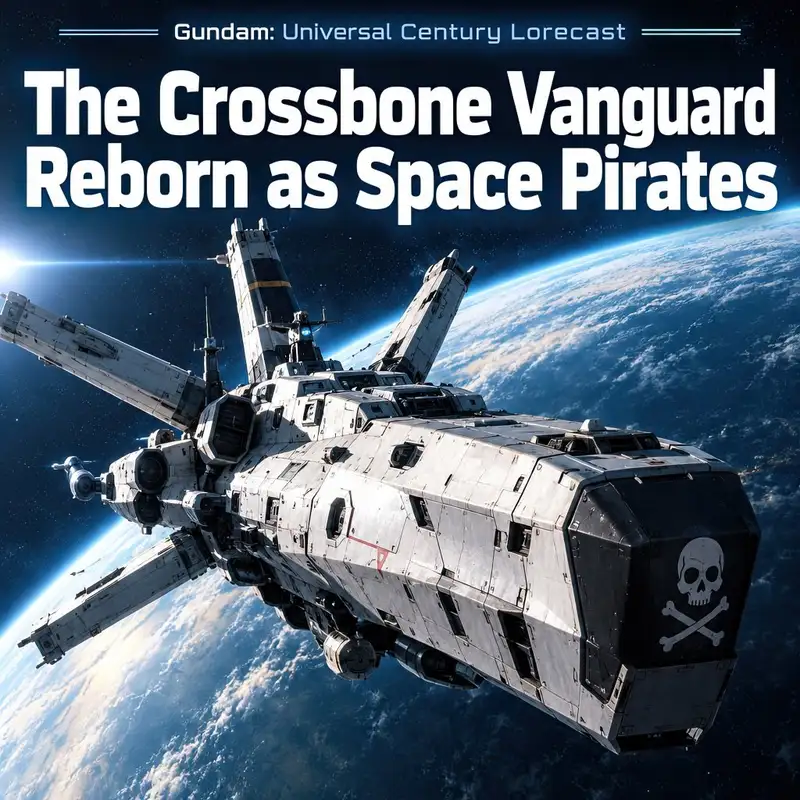
The force’s ability to operate also depended on infrastructure. The Mother Vanguard was not merely a dramatic pirate ship or a convenient setting for mobile-suit launches. It was the core of a mobile political and military system. A clandestine organization without secure territory must carry much of its institutional capacity with it. The ship served as command center, carrier, communications hub, repair base, supply node, and place of refuge. It was where strategic information could be assembled, where orders could be issued, and where a dispersed group could become an organization.
Its practical functions were even more important than its symbolism. Mobile suits require maintenance. Pilots require rest, briefing, medical treatment, and recovery after combat. Weapons consume ammunition and parts. Maneuvering through deep space consumes propellant and imposes wear on machines. Damaged units must be retrieved, repaired, cannibalized, or abandoned. Crews need food, water, air, medical supplies, and some degree of discipline if they are to remain effective through long operations.
A pirate force cannot simply live off what it captures, especially when its equipment is specialized and its missions take place far from ordinary industrial support. The Mother Vanguard therefore functioned as a mobile base of survival. It enabled the Crossbone Vanguard to preserve the trained technicians, pilots, intelligence personnel, and command relationships that made its operations possible. Without that ship and the system around it, the organization would have been reduced to isolated raiders with impressive machines and very limited endurance.
The ship also acted as a political headquarters. Berah’s authority needed a place from which it could be exercised. Kincade’s operational leadership needed a place where intelligence could become planning. New recruits needed a place where they could learn the organization’s rules, loyalties, and worldview. In that sense, the Mother Vanguard was a counterstate in motion. It could not replace a government, but it carried many of the functions that a state normally provides to an armed force.
That arrangement brought vulnerabilities of its own. A conventional government can lose one ship and still rely on depots, factories, hospitals, training institutions, and territorial depth. The Vanguard could not. Damage to its mobile base threatened command, logistics, morale, medical care, and political continuity all at once. A small organization gains flexibility by concentrating its essential functions. It also risks catastrophic failure if that concentration is struck.
The Crossbone Gundams must be understood within that support system. These were specialized Vanguard machines associated with the Jupiter conflict, not proof that a handful of superior mobile suits could solve every strategic problem. Their compact, high-performance design suited the demands of operations where space, endurance, maneuver, and rapid reaction mattered. Their distinctive equipment, including the anti-beam coating mantle, reflected an environment in which survivability could depend on brief windows of protection during close and dangerous engagements.
The machines’ close-combat orientation also made sense for their likely missions. Interception, reconnaissance, raids, boarding-adjacent operations, and short-duration strikes often force mobile suits into ranges where maneuver, reaction, and local initiative matter more than broad fleet formations. A force trying to inspect a transport, seize information, or disable a specific target cannot always rely on stand-off firepower. It may need to get close enough to identify what it is fighting and control the immediate situation.
That did not make the Crossbone Gundams universally superior. Specialized equipment has specialized burdens. High-performance machines require skilled pilots, trained mechanics, spare parts, weapons support, and a command system able to employ them intelligently. Their advantages could be wasted by poor intelligence, exhaustion, inadequate maintenance, or a mission that placed them against prepared defenses. The distinctive silhouette of an elite machine may inspire confidence, but confidence is not a supply chain.
The Vanguard’s machines could create operational disruption. They could help a small force strike above its numerical weight, gather intelligence, escape a trap, or threaten an enemy’s assumptions. What they could not do was match the Jupiter Empire’s strategic-industrial base by themselves. An empire preparing for invasion had access to institutions, production, manpower, and planning beyond the reach of a single mobile carrier and a small corps of veterans. The Crossbone Gundams were instruments of leverage, not substitutes for a state.
Tobia Arronax’s entry into the Vanguard reveals another problem that elite machines cannot solve: replacement. A clandestine organization may preserve experienced veterans, but it cannot preserve them forever. Pilots are injured, killed, exhausted, or politically divided. Technicians carry knowledge that may not exist in any manual. Intelligence networks depend on trust built over years. Commanders cannot simply requisition trained replacements from a national academy when the organization has no recognized government behind it.
Tobia begins as a civilian observer, which is precisely why his perspective matters. He sees the difference between the public image of the Vanguard as pirates and the organization’s stated purpose. He also sees the human reality behind both images. The people aboard the Mother Vanguard are not magical outlaws living beyond ordinary needs. They are personnel trying to sustain a military mission in a hostile and uncertain environment. Their apparent freedom is shaped by secrecy, danger, and the lack of any secure place to return to.
Yet Tobia’s recruitment should not be romanticized. The Vanguard may need new people, and Tobia may choose to take part in its struggle, but necessity does not erase the moral cost of bringing another young civilian into war. The late Universal Century repeatedly turns young people into pilots, symbols, inheritors of old conflicts, and replacements for losses that institutions failed to prevent. The Crossbone Vanguard is resisting one form of political violence, but it is not free from the pressures that make militarization seem like the only available path.
His presence therefore exposes both renewal and fragility. Tobia represents the possibility that the reborn Vanguard can become more than a gathering of survivors from Cosmo Babylonia. He also demonstrates how much the force depends on improvisation. A state with stable institutions can train personnel through schools, service systems, and long-term planning. A clandestine counterstate recruits where it can, teaches under pressure, and hopes that conviction can compensate for limited depth. It is an effective model for urgent resistance. It is a dangerous model for a society that must endure.
Zabine Chareux embodies the other side of organizational continuity. He is a veteran of the original Crossbone Vanguard, and his presence gives the reborn force access to experience that cannot be improvised. He understands the military culture of the organization, the expectations of elite mobile-suit operations, and the habits formed under the Ronah project. For Berah and Kincade, retaining such veterans is practical. They need people who can operate in the difficult space between secrecy and open combat.
But experience carries political baggage. A former military organization does not become a new institution merely because its leaders announce a new mission. Personnel bring their old beliefs, resentments, ambitions, and understandings of authority with them. Some may accept Berah’s rejection of Cosmo Babylonia. Others may accept the new mission only conditionally. Still others may value the Vanguard’s martial identity more than the political restraint Berah is trying to impose.
The tensions surrounding Zabine show why the reborn Vanguard should not be imagined as morally purified. It has changed its purpose, but it has not escaped its history. Its veterans remain a source of competence and a source of instability. The old Vanguard had been built for hierarchy, elite status, and decisive force. Berah’s new organization needed discipline, but it also needed a different relationship to power. It could not fight Jupiterian authoritarianism by simply recreating the political instincts of Cosmo Babylonia under a new flag.
That was the central institutional challenge. The Vanguard needed the old organization’s memory without reproducing its old mission. It needed secrecy without becoming unaccountable to its own stated principles. It needed commanders who could act independently without allowing personal ambition to replace political purpose. It needed to protect civilians while using methods that could frighten civilians. None of those problems could be solved by changing uniforms or repainting machines.
As the conflict developed, the Vanguard’s raids, interceptions, and intelligence work escalated into direct resistance against the Jupiter Empire’s plans for Earth. This escalation matters because it distinguishes tactical action from strategic effect. A successful raid can stop a shipment, expose a contact, recover information, or force an enemy commander to adjust. It can be a genuine military success. But no single raid resolves the larger question of whether the Earth Sphere will recognize the threat and mobilize against it.
At the operational level, the Vanguard’s actions mattered because they forced a hidden conflict toward visibility. They disrupted the assumption that Jupiterian preparation could proceed without challenge. They gave the organization information that could be acted upon, and they made the Jupiter Empire spend effort on security, counterintelligence, and defense. Small forces often create disproportionate effects not by destroying everything before them, but by making an enemy’s plans more costly, slower, and less certain.
At the strategic level, however, the Vanguard faced hard limits. It could contest an invasion plan, but it could not replace the Earth Federation’s responsibility for collective defense. A clandestine force may provide warning and buy time. It cannot permanently substitute for the political institutions that should protect populations across the Earth Sphere. The fact that the Vanguard had to take on this role was evidence of Federation weakness, not proof that piracy was a sustainable foundation for order.
Its political legitimacy grew from the protection it offered and the danger it exposed. People could see that the Vanguard was not merely looting for private gain. It was confronting a threat that larger institutions had neglected. But legitimacy remained conditional because the organization still operated through armed coercion. Neutral shipping, civilian passengers, and people caught between Jupiterian secrecy and Vanguard interdiction bore the risk of a conflict they had not chosen. Protection and disruption could exist in the same operation.
This is one reason the pirate identity remained useful and troubling. It allowed a small force to act where governments hesitated. It also made that force difficult to regulate, difficult to trust, and difficult to distinguish from the disorder it claimed to resist. The late Universal Century did not lack military capability. It lacked political arrangements capable of directing that capability toward a credible and legitimate common defense.
The Smashion raid therefore looks different once the larger context is visible. At first, it appears to be a familiar act of armed predation. A transport is stopped by a warship. Passengers are frightened. A young civilian is pulled into events beyond his control. But the raid is also the first sign of a hidden war being forced into view. The people carrying out the interception are not acting for plunder alone. They are searching for the connections, information, and leverage needed to confront the Jupiter Empire before its plans reach the Earth Sphere.
That does not absolve the Crossbone Vanguard of its past. Berah Ronah’s rejection of Cosmo Babylonia does not erase the original Vanguard’s aggression against Frontier Side. Kincade Nau’s operational discipline does not erase the fact that his organization acts outside normal law. Zabine’s experience does not become harmless because it is useful. Tobia’s willingness to join does not erase the cost of recruiting youth into armed conflict. The force’s transformation is meaningful precisely because its inheritance remains so difficult.
The Crossbone Vanguard became space pirates because formal authority had failed twice. Cosmo Babylonia failed because its aristocratic project was politically bankrupt and willing to use mass violence when its legitimacy collapsed. The Earth Federation later failed in a different way. It retained legal authority, commercial relationships, and military institutions, yet proved too distant, complacent, or fragmented to confront Jupiterian preparations before they became an immediate danger.
The reborn Vanguard filled that gap as a clandestine counterstate. It preserved trained personnel, specialized machines, intelligence networks, and the Mother Vanguard’s mobile infrastructure. It redirected those assets away from dynastic conquest and toward resistance against an expansionist empire. But it could never become a simple symbol of freedom. Its pirate flag was both a weapon and an indictment. It gave the organization concealment, mobility, and room to act, while reminding everyone that the people attempting to protect civilians had no recognized place within the political order that was supposed to protect them.