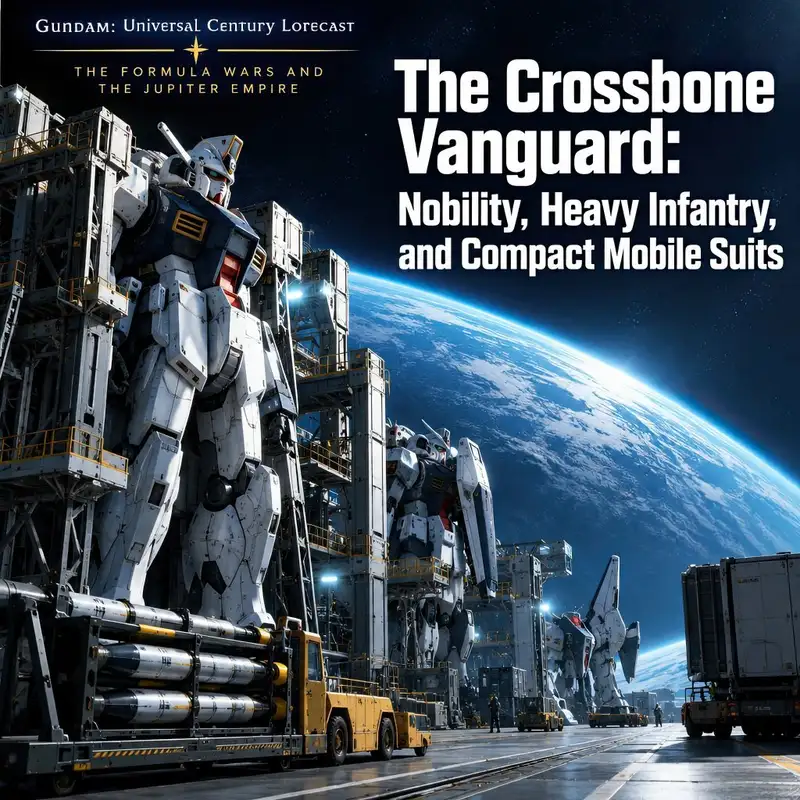
The Crossbone Vanguard: Nobility, Heavy Infantry, and Compact Mobile Suits
On March sixteenth, Universal Century one hundred twenty-three, the first warning at Frontier IV was not a grand fleet engagement visible across the Earth Sphere. It was violence arriving inside an inhabited colony. Earth Federation defenders found themselves facing Crossbone Vanguard mobile suits that were smaller than the older Jegans many of them knew, but smaller did not mean slight. These machines carried beam weapons, shields, sensors, and the mobility to exploit streets, docks, hangars, and internal approaches that constrained larger designs. The immediate military question was whether the local garrison could stop the assault. The larger political question was more unsettling. Why did a movement claiming that society required responsible, noble leadership begin its project by seizing a civilian habitat through surprise attack?
The answer was not simply that the Crossbone Vanguard possessed better machines. Frontier Side exposed a deeper imbalance. The Vanguard arrived prepared for an offensive operation, with trained personnel, a coherent political purpose, industrial backing, and a doctrine suited to close action in colony terrain. The Federation presence was unready, fragmented, and caught inside a political system that had grown accustomed to delay. The Vanguard’s compact mobile suits gave it an advantage in the first fighting, but the advantage mattered because commanders had a plan for using it. Technology provided the instrument. Organization provided the force. Ideology supplied the purpose.
That ideology was called Cosmo Aristocracy. Its leading advocate was Meitzer Ronah, the patriarch of the Ronah family and the political founder of Cosmo Babylonia. Ronah’s argument began with problems that were real enough. The Earth Federation had become complacent, bureaucratic, and increasingly detached from the people living in space. Political power remained concentrated around Earth even as colonies, lunar communities, and other off-world societies carried more of the Earth Sphere’s population, industry, and strategic burden. Environmental decline on Earth, corruption among elites, and the inability of the Federation to reform itself gave Ronah’s critique considerable force.
His prescription was hereditary rule by people trained to see themselves as public servants. In theory, the aristocrat possessed not merely privilege but obligation. The phrase noblesse oblige described the expected duty of a superior class to govern responsibly, set an example, and accept burdens ordinary citizens could not carry. Ronah presented this as an answer to the failures of democratic institutions and bureaucratic government. If elected officials and career administrators had become self-interested, then perhaps society required rulers whose education, status, and inherited responsibility made them capable of thinking beyond the next political crisis.
It was a seductive argument for a stagnant age. It promised competence without the mess of public disagreement. It promised responsibility without dependence on institutions that had plainly lost public trust. But Cosmo Aristocracy contained a flaw that no polished theory of noble duty could resolve. Birth could not establish consent. A ruling family could claim superior responsibility, but it could not make itself accountable merely by saying that it was. And once political authority depended on hereditary status, criticism became more than disagreement. It became a challenge to the ruling family’s right to rule at all.
That was where the Crossbone Vanguard entered the picture. The Ronah project did not intend to persuade the Federation into accepting a new order. It required a military instrument capable of creating political facts before the Federation could organize a response. The Vanguard was the armed edge of the Cosmo Babylonia project, a force built to seize space, intimidate resistance, and demonstrate that the old system could no longer defend its citizens. Its uniforms, elite formations, and aristocratic language gave it an image of discipline and order. Its actual mission was much harder and more dangerous. It had to transform a political theory into control over colonies full of people who had not voted for Ronah rule.
The family’s influence rested on more than rhetoric. The Buch Concern and its associated industrial institutions provided financial and manufacturing support for the wider Ronah system. That relationship mattered because no elite mobile-suit force appears from conviction alone. It requires factories, laboratories, shipyards, test facilities, technicians, spare parts, transport, trained crews, and access to capital. Buch’s connection to the Ronah family gave the Vanguard an industrial base from which to develop and sustain advanced equipment. That does not mean every employee, engineer, or executive shared the political ambitions of Cosmo Babylonia. Corporations are not single-minded actors. But the Ronah project had what many rebel movements lack: a substantial material foundation.
The family also understood that political power required symbols. Cecily Fairchild’s forced reintroduction as Berah Ronah was not merely a private family revelation. It was dynastic statecraft. Meitzer Ronah needed an heir who could embody continuity, legitimacy, and a future for Cosmo Babylonia. Cecily’s identity was therefore treated as political property. Her education, relationships, and personal wishes mattered less to the project than her usefulness as a living emblem of the Ronah line. A system that claimed rulers bore special obligations to society began by denying one of its own central figures the freedom to decide her own public role.
Carozzo Ronah, known in battle as Iron Mask, provided the project with its most aggressive military expression. He was not identical to Meitzer, and it would be too simple to treat every act of Carozzo as a direct statement of Cosmo Aristocracy. Meitzer articulated a paternalistic theory of noble government. Carozzo pushed that theory toward coercion, population control, and eventually mass murder. Dorel Ronah, field commanders, elite pilots, industrial backers, and political figures all occupied different places within the wider system. The Vanguard was not one man in a mask. It was an organization in which family power, military professionalism, personal ambition, and institutional obedience could reinforce one another until restraint failed.
The Vanguard’s military culture matched its political image. It emphasized elite quality, disciplined presentation, and decisive local force. Its mobile suits were part of a wider late Universal Century shift toward smaller frames with more densely packed systems. By the time of Frontier Side, the increasing size and cost of mobile suits had become a procurement concern across the Earth Sphere. The Federation’s Formula Project, which produced the F91, reflected the same broad pressure. Designers were trying to achieve high performance without allowing every new generation of mobile suit to become larger, more expensive, and harder to sustain.
The Crossbone Vanguard did not simply copy the Federation’s Formula Project, nor should its machines be treated as direct responses to the F91. Both emerged from an era facing related technological and industrial problems. Compact fusion systems, improved propulsion, beam shields, and more efficient internal arrangements made smaller mobile suits increasingly practical. A smaller frame could reduce target profile, fit more readily into constrained spaces, and move with greater freedom through colony infrastructure. It could also offer a force commander more flexibility in hangars, transports, and urbanized environments where every meter of clearance mattered.
That advantage came with costs. Dense machinery and high-output systems demand skilled maintenance. Compactness does not abolish heat, power distribution, repair access, ammunition storage, or the need to replace damaged components. A small elite force can sustain sophisticated machines if it has trained technicians, secure supply routes, and a narrow operational focus. It cannot assume that every battlefield loss will be easily replaced. The Crossbone Vanguard’s effectiveness depended on an industrial and technical ecosystem that was more fragile than its polished exterior suggested. An elegant machine is still a machine. It needs mechanics, parts, and time in a hangar.
The Vanguard’s compact designs are sometimes described as a form of mobile-suit heavy infantry. That phrase is useful as analysis, but it was not a formal Vanguard service designation. It describes how these machines operated in practice. They combined armored protection, close-range weapons, sensors, mobility, manipulation capability, and the ability to act with local initiative. In a colony, a mobile suit could force entry, cover infantry, clear a dock, hold a corridor, cross damaged infrastructure, and engage an enemy at ranges where the distinction between vehicle combat and close assault became blurred. It was not infantry in the literal sense. A mobile suit remained a complex armored combat machine dependent on ships and support crews. But it could perform some of the tactical functions associated with heavily armed assault troops.
The Den’an Zon illustrated the Vanguard’s emphasis on close combat. Its equipment favored aggressive engagement, and its design reflected awareness that internal ammunition storage could become a liability when a mobile suit fought amid colony structures. The Den’an Gei was a more general-purpose machine, equipped for hit-and-run fighting with a beam rifle and beam shield, as well as improved performance over the earlier Den’an Zon. Neither machine was a universal solution. They were tools for specific conditions, especially rapid assault against a defender who had not prepared effective countermeasures.
The Vanguard also fielded machines with different roles. The Ebirhu-S served reconnaissance functions while retaining combat capability. Other units served as commander machines, elite platforms, or specialized assault systems. Berga-class mobile suits and the Vigna Ghina represented a higher tier of capability and prestige. The force used conventional firearms alongside beam weapons, and it employed shields, shot lancers, and other systems suited to close engagement. The point was not that every Vanguard machine was built to charge with a melee weapon. The point was that the organization had a coherent tactical culture. Reconnaissance located weakness. Screening elements protected movement. General-purpose units pressed the attack. Elite machines exploited decisive openings.
The shot lancer, for example, was more than decorative chivalry. In close-range combat, a weapon that could threaten an enemy mobile suit without relying solely on beam fire had practical value. It also fit the Vanguard’s visual language of aristocratic martial identity. Yet no weapon can be understood apart from the conditions of its use. A lance is valuable only if a pilot can close the distance, identify the target, survive incoming fire, and fight without turning nearby civilian infrastructure into collateral damage. Beam shields improved survivability, but did not make a mobile suit invulnerable. Conventional weapons still mattered. So did positioning, surprise, and the discipline to avoid being drawn into an unfavorable engagement.
In confined colony terrain, compactness offered real advantages. A smaller mobile suit could exploit narrow spaces, move through built-up areas more easily, and present a more difficult target than a larger opponent. But confined terrain also favors the defender when the defender is prepared. Streets, loading areas, hangars, and access tunnels can become killing zones. Infantry with anti-armor weapons, armored vehicles, fixed defenses, mines, obstacles, and concealed firing positions all gain opportunities when an attacker must move through restricted approaches. The Crossbone Vanguard’s machines worked well because Frontier Side’s defenders were caught off balance. A compact mobile suit was an advantage. It was not a substitute for reconnaissance, logistics, command, or political control.
Frontier IV therefore became the first major demonstration of the Vanguard’s method. The Earth Federation Forces stationed in the area had older equipment, limited readiness, and no expectation that a force like the Vanguard would launch a concentrated attack inside the colony complex. The Federation retained enormous resources across the Earth Sphere, but strategic resources do not automatically become local combat power. A government can possess a large fleet, a broad industrial base, and a long military tradition while still failing to put trained, alert forces in the right place at the right time. Frontier Side revealed the cost of complacency.
The size contrast between Vanguard suits and Federation Jegans became one of the most visible signs of that failure. The Crossbone machines could maneuver through areas that imposed greater limits on the roughly twenty-meter Jegan family. But the contrast should not be reduced to a simple statement that smaller suits defeated larger suits. Pilot quality mattered. Tactical initiative mattered. The Vanguard had planned for the encounter. Federation defenders had not. A modernized force with poor intelligence and slow command decisions can lose to an older force that understands the terrain and moves first. In warfare, the machine often receives the credit because the machine is easy to see. The organization behind it is usually harder to notice.
The Den’an Gei’s battlefield record also gives a useful corrective to Vanguard mythology. It could be destroyed by a ground-launched rocket. That fact does not diminish the machine’s value. It clarifies it. Even advanced mobile suits remain vulnerable to weapons that exploit terrain, concealment, and timing. A rocket team does not need to outmatch a mobile suit in every category. It needs a shot from the right place at the right moment. The same principle applies to armored vehicles, infantry teams, and fixed defenses throughout the Universal Century. Sophisticated equipment changes the engagement. It does not eliminate the defender’s ability to fight intelligently.
The Vanguard’s seizure of Frontier IV was therefore a tactical and operational achievement. It showed that a compact, elite force could overwhelm a larger but unready defender in the dense and politically sensitive terrain of a colony. It did not prove that Cosmo Babylonia had gained the consent of Frontier Side’s inhabitants. Capturing docks, disabling defenses, and driving out local Federation units are not the same as governing a population. Colonies are not empty fortresses. They contain families, workers, schools, life-support systems, transport networks, and communities whose survival depends on stability. A force that enters as a liberator but arrives through surprise assault begins with a serious political disadvantage.
The Black Vanguard embodied many of the strengths and contradictions within the wider organization. Its commander, Zabine Chareux, was a highly skilled pilot and capable officer. He understood the value of elite cohesion, training, and local initiative. Such formations can be disproportionately effective because their personnel trust one another, operate from shared assumptions, and can act quickly when communications are disrupted. In Minovsky-era warfare, that matters. Commanders cannot always supervise every engagement in real time. They rely on subordinates who understand the mission and can make decisions without waiting for permission.
But Zabine was not simply a professional soldier detached from politics. He was also an aristocratic aspirant, ambitious and acutely conscious of status. The Vanguard’s system promised recognition to men who could demonstrate martial ability and loyalty, even if they had not been born into the Ronah family. That created opportunity, but it also produced insecurity. A hereditary order can reward talent while reminding every outsider that talent has limits. Zabine’s career illustrates the tension. He was valuable because of his competence, yet he operated inside a hierarchy whose deepest legitimacy rested on bloodline.
His opposition to indiscriminate killing is important, but it should not be turned into a redemption story for Cosmo Babylonia. Zabine objected to Carozzo’s use of the Bug extermination weapons. He recognized that the operation violated not only basic humanity but also the Vanguard’s cultivated self-image as a disciplined, aristocratic force. His conflict with Gillet Krueger, which ended with Zabine killing Krueger on March thirtieth, Universal Century one hundred twenty-three, exposed a serious fracture within the command structure. Officers who accepted the larger Cosmo Babylonia project could still disagree over what methods were permissible.
That dissent mattered because it showed that the Vanguard was not morally uniform. It also showed the limits of individual restraint. A capable officer may refuse an illegal or monstrous order, but one officer cannot repair a political system that has given radical violence room to operate. Professionalism can restrain cruelty at the margin. It cannot substitute for institutions that establish clear limits, enforce accountability, and protect civilians from leaders who regard them as obstacles. The Vanguard’s internal culture was strong enough to create elite formations. It was not strong enough to stop its own leadership from turning military power against the population it claimed to rescue.
The Bug operation was the point at which the contradiction became impossible to ignore. The Bugs were extermination weapons, deployed not to defeat a military formation in fair combat but to kill civilians. Their use transformed the meaning of the Vanguard’s campaign. A political movement that had claimed to answer Federation decay with responsible rule revealed that it was willing to treat human beings as material to be managed, removed, or destroyed. Carozzo’s population-control logic was an extreme expression of the system around him, but it did not emerge in a vacuum. It became possible because the Vanguard had already accepted that a self-appointed elite could seize authority without consent.
The operation also raises the question of command responsibility. Carozzo’s actions were not redeemed by the fact that other Vanguard figures objected. Nor does it matter that the language of Cosmo Aristocracy sounded more refined than the violence carried out in its name. A political and military organization is judged not only by the ideals it announces, but by the authority it grants, the conduct it permits, and the restraints it enforces. If a commander can deploy extermination weapons against civilians, then the organization has failed at the most basic test of responsible rule.
For civilians, the distinction between a conventional battle and a mass-killing operation is not academic. A colony is a pressure-sensitive habitat, a home, and a political community. Its corridors, residences, parks, transport lines, and industrial areas are not simply tactical terrain. Damage to a colony can threaten life support, mobility, medical care, food distribution, and family survival. Even when infrastructure remains intact, terror changes the political character of a place. People who have watched their neighbors die are unlikely to regard the perpetrators as reformers. Mass killing may silence immediate resistance. It does not create loyalty.
It also fails strategically. Carozzo’s violence undermined the very political claim that justified Cosmo Babylonia. If noble rule was supposed to protect society from Federation irresponsibility, then extermination exposed the claim as fraud. The operation alienated potential subjects, intensified internal dissent, and made clear that the Vanguard’s refined symbols could coexist with industrialized murder. There is no stable political order at the end of that path. There is only fear, repression, and eventually resistance from people who understand that the state sees them as expendable.
The final confrontation between Seabook Arno’s F91 and Carozzo’s Rafflesia therefore matters for more than the outcome of a duel. Rafflesia was a larger mobile armor, a weapon that reflected Carozzo’s escalating obsession with control and destruction. It represented the movement’s drift away from the image of an elite expeditionary force and toward a more personal, more monstrous expression of power. Carozzo had begun with a military campaign to impose a new political order. By the end, he had invested his authority in a weapon system designed to dominate and terrorize.
The F91 was no simple answer from a suddenly revived Federation. It was a prototype from the Strategic Naval Research Institute, built around advanced compact systems and requiring specialist support to become operational. Its appearance demonstrated that the Federation still possessed technical depth, even amid institutional stagnation. But prototypes do not automatically solve strategic failures. The F91 could affect a decisive local battle because it had an extraordinary pilot, immediate support, and a narrow mission. It did not instantly reform Federation politics, repair colonial relations, or provide a mass-produced answer to every Vanguard machine.
Seabook’s defeat of Rafflesia removed Carozzo as an immediate military threat. Cecily’s rejection of the role assigned to her denied the Ronah project the dynastic symbol it needed. Both events mattered. Yet neither should be treated as a complete explanation for the fate of Cosmo Babylonia. Mobile Suit Gundam F91 does not provide a comprehensive account of every later phase of the Cosmo Babylonia War. It establishes the crisis at Frontier Side and the collapse of Carozzo’s immediate project, but it does not offer a complete campaign history with reliable force totals, territorial maps, or a full political settlement.
What the film does establish is enough to reach a larger judgment. The Vanguard succeeded tactically. It overwhelmed local Federation defenses and demonstrated the value of compact mobile suits, elite training, and concentrated assault doctrine. It succeeded operationally in showing that the Federation could be surprised inside its own colonial space. But it failed strategically because military success did not produce durable political authority. It failed politically because hereditary rule lost credibility when it relied on coercion, dynastic manipulation, and mass killing. It failed institutionally because dissent, ambition, and divided loyalties weakened the cohesion behind its public image.
The civilians of Frontier Side paid the cost. They were supposed to become the beneficiaries of a better order. Instead, they became subjects of an armed experiment in aristocratic rule. That is the central failure of the original Crossbone Vanguard. It recognized that the Federation had become incapable of meeting many of its responsibilities. It understood that advanced technology and disciplined institutions could create military advantage. But it mistook efficiency for legitimacy. It assumed that a small elite, because it was organized and capable, possessed the right to rule people who had never granted it that right.
Ten years later, the name Crossbone Vanguard returned in a very different setting. The source here is not the F91 film, but the Mobile Suit Crossbone Gundam manga branch, set in Universal Century one hundred thirty-three. Its Crossbone Vanguard should not be treated as the unchanged army of Cosmo Babylonia. It retained names, personnel, traditions, and certain military habits from the earlier organization, but its political purpose had been transformed. The later Vanguard operated against the Jupiter Empire, a power whose ambitions threatened the Earth Sphere. It was no longer attempting to establish a hereditary state through conquest of Federation colonies.
Berah Ronah stood at the center of this later movement. Her role had changed profoundly from the dynastic figure the Ronah family tried to construct in Universal Century one hundred twenty-three. The later Vanguard also included Kincade Nau, the identity used by Seabook Arno in the manga branch, and the young recruit Tobia Arronax. Their presence made the new organization something more complicated than a surviving family army. It became a mobile, clandestine force using a space-pirate identity as cover and operating from the Mother Vanguard against a stronger political opponent.
The pirate image should not be romanticized. Irregular warfare requires concealment, deception, intelligence work, and the willingness to operate outside ordinary state structures. A force like the later Vanguard needed to avoid decisive conventional battle whenever possible. It depended on mobility, local knowledge, secure contacts, reliable maintenance, and the ability to appear where the Jupiter Empire did not expect it. Its ship was not merely transportation. It was a base, a carrier, a repair facility, a political community, and a vulnerable logistical lifeline. Lose the vessel, lose the ability to sustain operations.
Compact mobile suits remained valuable in this new role, though their political meaning had changed. A small machine suitable for shipborne operations, rapid raids, and close fighting could support an irregular force better than a large conventional formation that required secure bases and extensive supply networks. Skilled pilots and well-trained crews still mattered. So did a strong internal culture. But the later Vanguard’s effectiveness depended less on the ability to seize a colony and more on the ability to survive, gather intelligence, train new personnel, and strike without exposing itself to annihilation.
Tobia Arronax’s development is important in that regard. Organizations do not survive merely by inheriting equipment or famous names. They survive by teaching new members how to operate, what to believe, and what limits they are expected to respect. The original Vanguard had been built around aristocratic hierarchy, elite status, and dynastic legitimacy. The later force had to form recruits around a different purpose: resistance to the Jupiter Empire and protection of communities threatened by it. Training was therefore political as well as military. A pilot needed technical skill, but also judgment about why force was being used and what kind of order the organization was trying to defend.
There were clear continuities between the two Vanguards. Both valued compact mobile suits, skilled pilots, strong crews, naval mobility, and a culture of elite competence. Both understood that small forces could compensate for limited numbers through training, initiative, and careful use of technology. Both recognized that a mobile suit is not merely a weapon but part of a shipborne system involving launch, recovery, maintenance, supply, intelligence, and command. In that narrow military sense, the later Vanguard preserved useful lessons from the old one.
The break was political. Berah Ronah’s later organization did not seek to recreate Cosmo Babylonia as a hereditary state. It operated against an authoritarian threat rather than using military power to impose a new aristocracy on unwilling civilians. Its clandestine methods reflected weakness as much as preference. It lacked the industrial depth and territorial control of a conventional government. That made it more dependent on restraint, public support, and the trust of the people who sheltered or assisted it. An irregular force that terrorizes the population it claims to defend destroys its own support system. The later Vanguard had to learn what the original force had refused to understand.
Later manga sequels continue the conflict with the Jupiter Empire, but the essential legacy is already visible by Universal Century one hundred thirty-three. The Crossbone Vanguard name had become an argument about whether military traditions can be separated from the political systems that created them. The answer was not automatic. The old Vanguard’s discipline, technical skill, and compact mobile-suit doctrine could serve an authoritarian project. The same qualities could also support resistance against one. The machine itself did not settle the question. Neither did the uniform, the ship’s name, or the prestige of an elite formation.
The Crossbone Vanguard proved that a small force with compact mobile suits, capable crews, and coherent doctrine could defeat a larger opponent that had allowed itself to become unready. Its failure proved something equally important. Military efficiency cannot supply political legitimacy. Cosmo Babylonia promised responsibility by the noble few, but its rulers answered dissent with occupation and extermination. The later Vanguard survived only by changing what its name meant, retaining disciplined force while abandoning the claim that birth granted the right to rule.