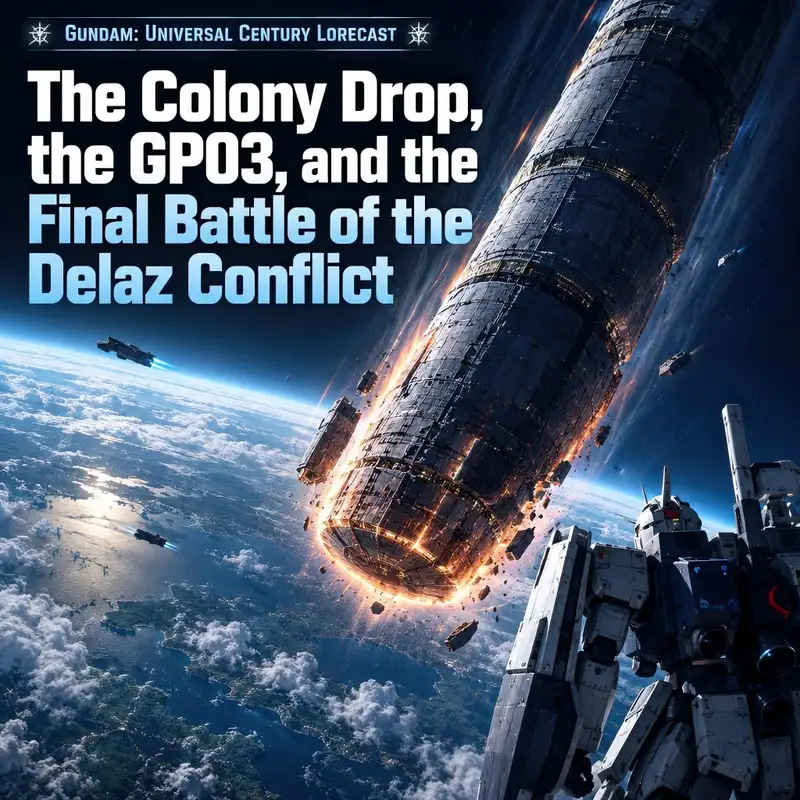
The Colony Drop, the GP03, and the Final Battle of the Delaz Conflict
By the time the Federation’s commanders understood that the colony was falling toward Earth, the central military question was no longer whether they possessed enough firepower to destroy its escorts. They did. They had a pursuing fleet, a purpose-built prototype called the GP03, and, soon, Solar System Two, a strategic weapon capable of erasing a large volume of space. But the colony had already crossed the decisive point in its approach. Its momentum, route, and proximity to Earth had turned interception into a shrinking set of terrible choices. The Federation could still fight around the colony. It could still destroy the Delaz Fleet. It could still inflict catastrophic losses. What it could no longer do easily was restore the time it had lost.
That is the final military problem of the Delaz Conflict. The Federation’s failure was not caused by a shortage of weapons, courage, or individual skill. Kou Uraki had an exceptional machine. The fleet had substantial destructive power. Officers and crews continued fighting under conditions that were increasingly confused, politically compromised, and physically unforgiving. The problem was that military power had arrived after the operation’s true objective had nearly been achieved. Operation Stardust was designed so that its decisive success would occur before its final battle.
A colony on an Earthbound trajectory is not simply a very large target. It is a habitat, an industrial structure, and a mass of immense scale moving through a constrained orbital environment. Once it is committed to a route that ends in atmospheric entry, the defender cannot assume that destroying nearby ships will change its course. Towing, redirecting, breaking it apart, or vaporizing it all demand time, position, equipment, and a degree of control that the Federation no longer possessed. The point of no return was not a dramatic phrase invented for the benefit of frightened crews. It was the operational reality around which the entire Delaz plan had been constructed.
The Federation did possess a counterweight of remarkable power. The GP03 was a product of the Gundam Development Project, a program conceived in the unsettled years after the One Year War. Its purpose was not simply to build an impressive machine. It was to test and field advanced systems that might give the Federation an advantage in a new kind of conflict, one in which the old wartime assumptions about mobile suits, fleet defense, and strategic mobility no longer held.
The core of the GP03 was the Stamen, a mobile suit built to operate as the pilot’s control and combat element. In battle, however, the Stamen was designed to dock with the Orchis, an enormous armed base carrying the weapons, propulsion, missile capacity, and defensive systems that gave the whole system its exceptional reach. The concept combined mobile-suit flexibility with mobile-armor-scale firepower. It was intended for space operations, especially the defense of a major installation or fleet area where a rapid and heavily armed response might be decisive.
In practical terms, the GP03 could concentrate destructive power that would normally require several separate platforms. Its large beam weapon and missile load allowed it to engage clusters of enemy forces. Its mobility enabled it to move through a space battle more aggressively than a conventional warship. Its defensive systems gave it a chance to survive in an environment where a single successful strike could disable an ordinary mobile suit. When Kou Uraki finally brought it into the fight, the machine could clear space around the colony with alarming speed.
But GP03’s strengths were also its limitations. It was not a standard Federation mobile suit. It was not a machine that could be issued to every carrier, operated by any competent pilot, or maintained at an ordinary depot. The Stamen and Orchis combination required specialized support, a docking environment, parts, technicians, ammunition, and a pilot able to manage a demanding system under combat pressure. Its weapons could destroy defenders. They could not substitute for intelligence, a fleet screen, a coherent command relationship, or an interception plan made early enough to matter.
The machine’s very existence also depended on politics. The Gundam Development Project had become entangled in Federation factional struggle. John Cowen’s circle had supported the project as part of a postwar military modernization effort. But the crisis created by Operation Stardust gave rival interests an opportunity to undermine Cowen’s position, discredit his programs, and shape the Federation’s future security structure in their own image. The question of whether GP03 should be deployed was therefore not decided purely by the military emergency. It was decided within a bureaucracy in which control of information and control of assets had become weapons.
The Albion reached Anaheim Electronics’ dock ship, La Vie en Rose, on November eleventh, Universal Century eighty-three. There, the crew found that access to GP03 was contested. Nakaha Nakato, acting in the context of the project’s suspension, attempted to prevent the machine from being used. In another circumstance, that might have been described as a straightforward security measure. A classified prototype had become politically vulnerable. Its deployment risked exposing a project that powerful people preferred to contain.
But the colony was already moving toward Earth. Captain Eiphar Synapse and the Albion crew understood the military reality. They were close enough to the danger, possessed the ship and personnel needed to employ the system, and had no confidence that the normal chain of command would respond in time. Their decision to leave with GP03 was unauthorized. It was also operationally understandable. The crew was not stealing a weapon for private gain. They were removing a weapon from political paralysis and taking it toward an emergency that official procedures were failing to meet.
Lucette Audubie, the systems engineer who helped Kou gain access to the GP03, paid for that decision with her life. Her death is important not because it adds one more tragedy to a battle already full of them, but because it shows where the Federation’s crisis had reached. At the moment a colony threatened Earth, internal control over a suspended weapons project could still take priority over deploying the available defense. The institutional conflict was no longer distant from the battlefield. It had entered the hangar deck, the engineering space, and the chain of custody around the one machine that might still make a difference.
Anaheim Electronics was part of this story because it built and maintained the GP03 system. La Vie en Rose represented the industrial support that made the prototype usable at all. Yet Anaheim should not be treated as an omniscient architect of the crisis. The company was a major military contractor operating amid government pressure, classified programs, and competing customers. It had influence because it possessed industrial expertise and access to advanced systems. That does not mean it controlled the Federation’s political struggle or designed every disaster from behind a boardroom door.
The Albion’s departure with GP03 was therefore both a tactical gain and an institutional indictment. Synapse had found a way to put the Federation’s most powerful available prototype into the fight. But he had done so because the official system could not, or would not, align military necessity with political authority. By the time the Albion cleared La Vie en Rose, the campaign was no longer about preventing the colony’s capture. It was about whether a late pursuit could still alter a trajectory that had been carefully prepared by the enemy.
Kou’s mission was often framed by the immediate presence of Gato, and for understandable reasons. Gato was the most dangerous combatant between the Albion and the colony. The Neue Ziel had the speed, weapons, and defensive capability to challenge GP03 directly. Yet defeating Gato was not the whole mission. Kou needed to break through the defensive screen, reach the colony, and preserve some practical chance of changing its fate. Every battle around the colony had to be judged against that requirement.
This is where tactical and operational success diverged. GP03 could destroy mobile suits and ships in large numbers. Kou’s actions reduced the Delaz Fleet’s ability to protect the colony. But every engagement consumed time. Missile containers emptied. Damage accumulated. The pilot’s workload grew. The Albion had to remain close enough to support the machine while also surviving in a contested battlespace. A prototype can be formidable without being self-sustaining. In the final phase of Operation Stardust, GP03 was a powerful instrument operating under an unforgiving clock.
Minovsky conditions made that clock harder to manage. The Federation could not assume clear long-range detection, continuous communications, or a shared real-time picture of the battle. Commanders had to work with incomplete reports, visual identification, local initiative, and plans made before contact. The problem was not that every sensor and radio became useless. It was that uncertainty increased while the time available for correction disappeared. A fleet that is strong on paper can still fail if it cannot turn its strength into coordinated action at the right place and moment.
The Federation’s initial interception effort failed before the colony reached its final threshold. That failure cannot be assigned to one pilot, one ship, or one weapon system. The colony had been concealed behind a false strategic picture. The response had been delayed by uncertainty and political interference. The available forces were not organized around a single, transparent command intent. Once the colony passed the point where simple diversion was no longer realistic, the Federation’s choices narrowed to increasingly destructive measures.
While Kou and the Albion pursued the colony, another battle was unfolding inside the command structures surrounding the Delaz Fleet. Cima Garahau had joined Delaz’s operation, but she was never merely one more subordinate commander. She led an independent former Zeon marine force with its own history, grievances, and survival interests. Her loyalty to Delaz was conditional because her position was conditional. She had no reason to assume that a doomed remnant offensive would give her people a future.
Cima’s covert arrangement with Jean Coliny’s faction in the Federation gave her another option. In exchange for capturing or eliminating Delaz, she expected amnesty and incorporation into Federation service. This was not evidence that the entire Federation government had secretly orchestrated Operation Stardust. The OVA’s record supports something more troubling and more plausible: a faction within the Federation saw the crisis as an opportunity. Coliny’s side could use Cima’s defection to remove an inconvenient enemy leader, weaken political rivals such as Cowen, and demonstrate that the Federation required a harsher security apparatus.
Cima’s bargain was therefore an act of survival and opportunism, but it was also part of a wider institutional struggle. She was willing to betray Delaz because his cause no longer protected her interests. Coliny’s faction was willing to deal with her because expedient cooperation with a former enemy force could serve its own ambitions. Neither side needed to control every stage of Operation Stardust. They needed only to exploit the conditions it created.
Delaz understood too late that the Federation had brought Solar System Two into position. By then, the colony had already crossed the critical point in its path toward Earth. That realization changed his priorities. The survival of his flagship and the formal continuity of his command mattered less than ensuring that Gato continued the mission. Delaz sent Gato onward. The operation had become larger than the admiral’s personal survival.
Cima then seized the Gwaden and killed Delaz. His death was the end of the Delaz Fleet as a coherent political and military command. Gato answered by attacking the flagship’s bridge with the Neue Ziel before continuing toward the colony. The sequence was violent, personal, and chaotic, but its military meaning was clear. The remnant force had fractured at the top. Its commander was dead, its internal alliance had collapsed, and its remaining units were becoming expendable.
Coliny’s faction could view that outcome with considerable satisfaction. Delaz was removed. Cowen’s associated development project could be discredited. The unauthorized Albion and its crew could be made administratively inconvenient. And the ongoing threat to Earth could be cited as proof that ordinary Federation institutions were inadequate. The crisis had begun as an attack by a Zeon remnant. It was becoming the foundation for a new struggle over who would control the Federation’s security state.
Solar System Two represented the Federation’s final resort. Under Bask Om’s command from the Madagascar, it was deployed as an area weapon, intended to break up the colony and annihilate the forces protecting it. Its scale gave it enormous destructive potential. But scale is not the same thing as precision. Solar System Two could devastate a region of space. It could not guarantee a clean interception once the colony was already too close to Earth and moving along a committed path.
This was the grim logic of the weapon’s employment. The Federation had lost the chance to solve the problem through early detection, controlled diversion, or a properly coordinated interception. It now attempted to solve it through overwhelming destruction. The colony, Delaz’s defenders, Federation units, and GP03 all occupied the same dangerous operational space. Any attack powerful enough to cripple the target risked killing friendly personnel and damaging the assets still trying to reach it.
Solar System Two inflicted immense damage. Delaz forces were devastated. Federation units also suffered. GP03’s Orchis was heavily damaged, stripping the system of much of the external armored base and firepower that had made it so formidable. The Stamen survived comparatively intact, but it was no longer operating as the complete system that had left La Vie en Rose. The Federation’s greatest prototype had been reduced by the Federation’s own strategic weapon.
That outcome should not be explained away as simple incompetence. Bask’s decision reflected a command culture prepared to accept severe friendly-fire risk in the name of eliminating a threat. It was a brutal calculation, but not an irrational one in the narrowest military sense. The colony posed an existential danger to people on Earth. The problem is that this calculation emerged only after earlier failures had made clean options unavailable. A state that responds to its own loss of control by placing its personnel inside the blast zone of a last-resort weapon is revealing something about how it values command, accountability, and expendability.
Solar System Two changed the battlefield, but it did not settle the mission. The colony remained on course. The Delaz Fleet was shattered, but not yet incapable of resistance. Kou still had the Stamen. Gato still had the Neue Ziel. Cima was still attempting to secure the future promised by her bargain. The final battle narrowed from a fleet action into a series of violent encounters around and within a damaged colony that was continuing toward Earth.
The confrontation between GP03 and Neue Ziel is remembered because it brings together two of the most exceptional machines of the era. But it should not be mistaken for a normal picture of Federation and Zeon force structure. Neither system was a mass-produced answer to ordinary military problems. GP03 was a unique Federation prototype dependent on specialized support. Neue Ziel was a high-end mobile armor associated with the political and material assistance available through Axis. Their duel was a clash of rare systems operated by unusually capable pilots in a crisis neither machine had created.
Neue Ziel’s strengths were tailored to that crisis. It carried heavy firepower, high mobility, an I-field defensive system, and wired claw weapons that allowed it to threaten enemies from unexpected angles. It gave Gato a way to contest the space around the colony even against a heavily armed opponent. In another context, its complexity and specialized requirements might have limited its usefulness. Here, it existed for one mission: to keep the Federation away from the colony for as long as possible.
GP03, even damaged, still gave Kou a chance to contest that mission. The surviving Stamen retained the mobility and control needed to continue fighting after Orchis had been crippled. Kou’s ability to keep operating under those conditions mattered. Yet the loss of Orchis also demonstrates the prototype’s vulnerability. Its extraordinary power depended on a larger system that could be damaged, separated, and exhausted. The Federation had not acquired an invincible weapon. It had acquired a specialized capability whose effectiveness depended on circumstances that were rapidly disappearing.
Kou’s defeat of Cima was tactically significant. It removed a dangerous commander from the immediate battle and disrupted the force that had tried to turn betrayal into a secure future. But defeating Cima did not restore the colony’s lost interception window. It did not reverse the political bargains already made around the operation. It did not erase the damage caused by Solar System Two. The final conflict had become a struggle over local survival, immediate access, and the ability to impose losses on the enemy.
Kou then entered the colony to confront Gato. The setting mattered. Combat inside a colony is never merely a duel staged against an attractive industrial background. It occurs inside a structure built to sustain civilian life. Every exchange of fire, every damaged corridor, and every failed system carries a risk beyond the pilots involved. By this stage, however, the colony had already been transformed into a weapon by the people directing it. The men fighting inside it were contesting control of a civilian habitat whose original purpose had been obliterated by military use.
Nina Purple’s intervention in the confrontation between Kou and Gato further disrupted an already fractured situation. Her presence did not change the strategic facts of the operation, and it should not be used to reduce the final battle to a romantic triangle. What it did reveal was the degree to which personal relationships could intrude upon military decision-making at the worst possible moment. Kou had wounded Gato. Nina tried to protect him. Gato rejected that intervention and continued toward combat. The result was not resolution. It was another interruption in a battle where no one had enough time for uncertainty.
The duel mattered because Kou and Gato were both capable of shaping the immediate cost of the final phase. They could kill crews, destroy ships, protect or penetrate an approach route, and determine who survived the next minutes of combat. But neither pilot could undo the operational fact that the colony was committed to Earth. The drama of the confrontation should not obscure that larger failure. By the time exceptional machines met at close range, the campaign had already been decided at the level that mattered most.
Gato’s final decision made that distinction painfully clear. After the duel was interrupted, he returned to the broader fight and launched an attack against the Federation pursuit fleet. It was a final act of resistance by a pilot whose commander was dead and whose organization was collapsing around him. The attack could still inflict losses. It could still demonstrate that the Delaz Fleet had not been passively destroyed. It could not create a durable Zeon restoration or preserve the remnant force as a conventional military instrument.
Gato died in that final phase of the battle. His death has often been remembered through the image of the determined ace making one last charge against a stronger enemy. But military history is not improved by treating such a death as a strategic victory merely because it is memorable. Gato’s tactical ability had helped sustain Operation Stardust’s final defenses. His personal courage did not redeem the operation’s purpose, its methods, or the civilian disaster it imposed.
The Delaz Fleet was, in practical terms, destroyed. Delaz was dead. Cima’s force had been compromised by a bargain that did not protect her in the end. The remaining units could not sustain a conventional campaign against the Federation. Tactically, the Federation had won. It had destroyed most of the attacking force, survived a major mutiny and betrayal within the enemy camp, and demonstrated that it could still bring overwhelming weapons to bear.
Operationally, however, the Federation had lost. The colony reached Earth. Operation Stardust achieved the result around which all of Delaz’s sacrifices had been organized. The destruction of the remnant fleet did not matter enough because the colony had already passed the point at which its impact could be prevented. This is the difference between winning the battle in front of you and winning the campaign you were sent to fight.
The colony’s impact was meant to damage North American agricultural production and create wider economic disruption. Food is strategic infrastructure. It connects farms, transport routes, storage, markets, labor, public order, and political legitimacy. A blow against agricultural regions reaches far beyond the immediate destruction zone. It affects people who depend on stable supplies, governments responsible for distribution, and communities already vulnerable to economic disruption. Delaz’s plan aimed to force Earth into a more dependent relationship with the colonies. Its means were starvation pressure, dislocation, and terror by infrastructure destruction.
For that reason, the operation was more than a raid. A weaker force had demonstrated that it could destabilize a far stronger state without defeating its military in a conventional campaign. The Federation could not guarantee the safety of Earth. Its intelligence system had been deceived. Its military command had been divided. Its emergency response had been compromised by internal politics. Its final weapon had damaged its own forces while failing to prevent the strategic outcome. For every Federation official who wished to claim victory because the Delaz Fleet had been annihilated, the burning reality on Earth offered a different verdict.
The Federation’s response was not transparent accountability. It did not openly examine how a captured colony had been allowed to reach the point of no return. It did not publicly expose the factional maneuvering that had delayed the effective use of GP03. It did not elevate the Albion crew as the officers and sailors who had acted, however irregularly, to stop a catastrophe. Instead, the state moved to control the record.
The Gundam Development Project was erased from the official record. That decision removed not only embarrassing evidence of advanced weapons research but also evidence of the Federation’s divided response to the crisis. GP03 became politically dangerous because it showed what had been available, how it had been withheld, and how its deployment had required disobedience. The machine had proved its tactical value, but its very existence threatened the people who wanted the official story simplified.
Kou Uraki was imprisoned for his unauthorized use of GP03. The formal issue was real. He had operated a classified prototype without proper authorization and acted outside the chain of command. But the treatment of Kou also revealed the institutional convenience of prosecution. The pilot who had fought to stop the colony could be recast as a disciplinary problem. The crew that had acted when official command failed could be marginalized rather than celebrated. Later action removed the formal basis for Kou’s conviction, but that did not erase the political purpose of the punishment.
The Albion’s experience showed how postwar institutions can use legality selectively. Orders, classifications, and jurisdiction are necessary in a military system. Without them, armed forces become collections of private actors with access to weapons. Yet legality can also be used to punish the people who expose failures of higher authority. Synapse and his crew had violated orders because the orders were shaped by a political struggle disconnected from the immediate danger. Their decision was not proof that disobedience is always virtuous. It was proof that a command system which cannot respond to reality may force subordinates into choices that formal procedure cannot adequately judge.
The formation of the Titans in December of Universal Century eighty-three emerged from a real security crisis. Operation Stardust had demonstrated that Zeon remnants remained dangerous, that Federation defenses had failed, and that the postwar order was unstable. Any government facing such a disaster would be under pressure to improve intelligence, strengthen readiness, and create forces capable of responding quickly to renewed insurgency or sabotage.
But the Titans were not simply a neutral answer to that danger. Their creation also represented the political exploitation of fear. The same crisis that exposed the Federation’s command failures gave an emerging authoritarian faction the justification it needed to centralize power, expand emergency authority, and define colonial dissent through the language of security. The danger from Zeon remnants was real. That reality did not make every subsequent security measure wise, lawful, or humane.
The aftermath of the Delaz Conflict must therefore be understood at several levels. Tactically, the Federation destroyed the Delaz Fleet. Operationally, the colony struck Earth. Strategically, the Federation’s claim to provide stable postwar security was badly damaged. Politically, those who benefited from a harsher security apparatus gained leverage. Institutionally, Cowen’s approach and the Gundam Development Project were suppressed while the path toward the Titans opened. In historical memory, the public record was narrowed so that responsibility could be avoided.
Operation Stardust was not a triumph of superior Zeon firepower. It was a demonstration that a weaker force, using deception, timing, and a willingness to weaponize civilians, could impose strategic defeat on a stronger state whose leaders mistook possession of powerful weapons for control of events. GP03 and Solar System Two could destroy attackers, but they could not restore the lost interception window or repair a command system already divided by ambition. The Federation destroyed the Delaz Fleet, then used the disaster it failed to prevent to justify the Titans and bury the evidence.