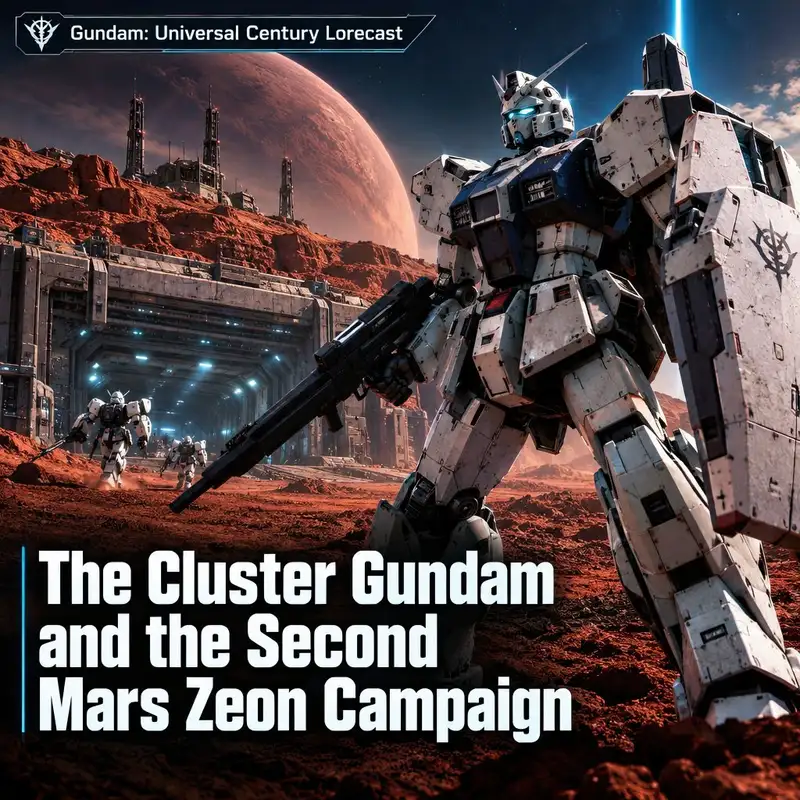
The Cluster Gundam and the Second Mars Zeon Campaign [Manga]
A compact Gundam is being tested to refine the Federation’s next generation of mobile suits. At nearly the same moment, Oldsmobile forces are reaching toward a lunar mass-driver base, an installation whose importance has nothing to do with its scenery and everything to do with movement. A mass driver can move cargo, equipment, personnel, and industrial material through the Earth Sphere’s transport network. Control it, damage it, or merely threaten it, and a local military action becomes a problem for every command dependent on that route.
That contrast defines this chapter of late Universal Century history. The Federation is trying to prepare for the future through smaller, more capable, more adaptable mobile suits. Oldsmobile is trying to make the political geography of the present ungovernable. One effort is a development program. The other is a campaign. The Cluster Gundam matters because it sits at the meeting point between them, a machine built to absorb lessons from earlier Formula projects while the institutions behind those projects are still struggling to understand the enemy they are meant to face.
The campaign named here as the Second Mars Zeon Campaign is identified in this manga record as the Second Oldsmobile War. That distinction matters. Mars Zeon is useful shorthand for the Mars Independent Zeon Forces associated with the earlier conflict, but it does not describe every faction, sponsor, sympathizer, or armed unit involved in the later resurgence. Oldsmobile itself began as a Federation label for forces whose machines evoked older Principality of Zeon designs. By Universal Century one hundred twenty-two, that label had become a warning sign. It suggested not simply nostalgia for an older war, but the survival of military networks, political memory, and unresolved grievances that could still be turned into organized violence.
To understand why the Cluster Gundam was built, and why it could not solve that security problem by itself, it is necessary to return to Mars. Mars is not just another colony front with red terrain. It is an interplanetary theater. A Federation force sent there needs ships able to cross the distance, fuel and propellant for maneuver, stores of ammunition, replacement parts, medical support, trained technicians, and a chain of command capable of functioning far from immediate reinforcement. Compact fusion reactors may give mobile suits abundant power compared with older military machines, but they do not create spare actuators, replacement armor, skilled maintenance crews, or reliable intelligence.
The First Oldsmobile War revealed how poorly the Federation had solved that problem. Mars Independent Zeon forces seized the second Gundam F90 unit and brought it to Mars. The capture of an experimental mobile suit was important for obvious tactical reasons. It placed advanced Federation technology in hostile hands. But its greater value was political and symbolic. A Federation development asset, designed as part of the Formula program, could now be displayed, modified, and used by a force claiming continuity with Zeon’s old military tradition. The machine became evidence that the Federation’s technological advantage was neither absolute nor secure.
The Federation identified the attackers as Oldsmobile because their equipment recalled the visual forms of the old Zeon military. That name was useful, but it was also limiting. It encouraged commanders to see the threat as a museum of defeated ideas, old machines driven by old loyalties. The actual danger was more modern. The movement had access to hidden infrastructure, technical competence, and the ability to exploit captured systems. It understood that old symbols still had political force. A machine need not be technologically current to be useful. It can train pilots, arm a local force, support an ambush, or tell a population that the history the Federation considers settled remains unfinished.
The Federation responded by sending the Thirteenth Experimental Battle Group toward Mars. Its later evolution into the Thirteenth Autonomous Corps reflects the scale of the challenge. An experimental group is organized around testing, evaluation, and unusual assets. An autonomous corps implies a formation expected to operate with greater independence in a distant theater. That transition is not merely a change in paperwork. It reflects a recognition that the Federation needed a more durable expeditionary structure. Mars could not be handled as a brief recovery operation in which a stolen prototype was retrieved and the security problem disappeared.
Even then, the central question was never only whether Federation forces could defeat an Oldsmobile mobile suit in combat. The Federation needed to know who had authorized the seizure, who had prepared the Mars facilities, which local actors were committed to the movement, what outside support existed, and how far sympathizers had penetrated Federation institutions. A captured Gundam can be tracked. A dispersed political network is harder to map. It does not carry a serial number large enough for headquarters to recognize from orbit. It moves through maintenance contracts, personnel connections, ideological loyalty, false assumptions, and information that reaches the wrong person at the wrong time.
The captured F90 Unit Two became central to the struggle on Mars. In Martian hands, it was identified as the Mars Gundam. That designation should not be mistaken for proof of a standard production line or a complete Martian equivalent to the Federation’s Formula program. It was a seized machine, altered for local use and shaped by the conditions of a specific conflict. Captured technology can be extremely valuable without being industrially reproducible. A force may have the expertise to modify one machine, cannibalize another, and keep a unique weapon operational through careful repair. That is very different from manufacturing hundreds of identical machines, training crews for them, and sustaining them across multiple fronts.
That environment is seen most clearly through Ivalu Dana. Ivalu is an engineer and pilot, but his importance is not limited to either role. He is also a third-generation descendant of Zeon remnants living on Mars. That places him within a community shaped by inherited history without making him a simple representative of every Martian or every former Zeon family. His initial concern is the protection of children and noncombatants. This is not a sentimental interruption of the military story. It is the military story. A conflict fought around isolated settlements, hidden facilities, and fragile communities turns civilians into sources of legitimacy, intelligence, labor, shelter, and political pressure.
For Ivalu, the war is not an abstract dispute between the Federation and a remnant army. It arrives among people who may have little control over the symbols being fought over their heads. Oldsmobile can invoke Zeon heritage as a source of unity and resistance. Federation security forces can interpret that same heritage as evidence of collective suspicion. Both approaches risk treating civilians as a resource rather than as a population with its own interests. The first militarizes memory. The second can criminalize it. Neither creates the conditions in which Martian communities can become ordinary civilian societies rather than permanent objects of security policy.
The presence of children and noncombatants also exposes the limits of a clean military narrative. A mobile suit battle may be decided by a pilot’s reaction time, a damaged thruster, or a well-timed maneuver. The political cost of that battle may be measured by whether homes are destroyed, whether families can evacuate, and whether survivors conclude that either side sees them as people rather than terrain. A remnant movement can exploit civilian fear. A state can deepen that fear through indiscriminate suspicion. The fact that Oldsmobile operates through coercive militarism does not make every Federation response wise, lawful, or effective.
Ivalu’s position gives the Mars conflict a perspective that Federation reports alone would struggle to provide. Military records can identify a stolen experimental unit, an enemy stronghold, and a hostile formation. They are often less capable of explaining why civilians endure the presence of armed groups, why old loyalties remain meaningful, or why a community distrusts the officials sent to protect it. That is not because military officers are uniquely incapable of understanding civilians. It is because institutions organize information around their missions. A recovery operation sees what must be recovered. A security bureau sees what must be secured. A family under threat sees whether anyone is likely to survive the night.
Bosch’s death marks a break in the first conflict, but not its resolution. Killing or losing a central figure can end a particular operation. It cannot automatically dismantle the relationships, resentment, facilities, and inherited myths that made the operation possible. In counterinsurgency and internal security work, there is a recurring temptation to treat the removal of a visible leader as proof that the movement itself has been defeated. Sometimes it is. Often it is merely the end of one command arrangement. If the movement’s underlying networks remain intact, another leader, sponsor, or symbol can take the place left behind.
The Mars Gundam illustrates this problem in mechanical form. Ivalu’s use of the captured F90 Unit Two does not turn him into a conventional Federation test pilot, nor does it make the machine a normal Mars Zeon asset. The mobile suit exists at the intersection of emergency, adaptation, and necessity. Its value comes from what it can do in the moment, not from any assumption that it represents a settled doctrine. It is a modified captured system operating under local conditions. Such a machine may offer flexibility and dramatic combat power. It may also impose a severe maintenance burden, depend on scarce parts, and require a pilot with unusual familiarity and determination.
The later combination of the captured F90 with the Haru Fighter produces the F90N, called Ursu Lagna in the manga record. That transformation should be understood as an improvised response to wartime conditions, not as a standard configuration that every Formula unit can adopt. Field combinations and emergency rebuilds are often impressive because they reveal technical skill under pressure. They are not necessarily evidence of a repeatable procurement solution. An army or fleet cannot build doctrine around a one-off machine unless it can document the modification, produce the needed components, train crews, establish maintenance procedures, and ensure that the result performs reliably beyond the circumstances that created it.
This is where the gap between battlefield ingenuity and institutional capability becomes most visible. Ivalu and those around him can make an extraordinary machine function because the immediate situation demands it. A formal development program must ask harder questions. Can this be tested safely? Can it be repaired by ordinary technicians? Can its parts be standardized? Can a pilot learn to use it without years of exceptional experience? Can it operate from existing carriers and bases? Can commanders trust its performance enough to plan around it? Improvisation may save lives in a crisis. It does not remove the need for procurement discipline afterward.
The end of the Mars struggle therefore does not represent a return to normal. Instead, personnel and experience move into the wider Formula-era system. Ivalu’s journey from Mars to Earth marks a change in the nature of the problem. On Mars, survival and civilian protection were immediate concerns. On Earth, the Federation tries to turn hard-won experience into controlled development. That means test facilities, telemetry, evaluation procedures, engineering teams, test pilots, secure hangars, and administrators able to protect a program from political pressure. A battlefield may reveal what a machine can do. It does not automatically explain what the institution should build next.
Lyle Wolf becomes important in this transition. He is a Federation test pilot and later an associate of Ivalu, connecting the experience of the Mars conflict to the formal world of mobile-suit testing. The characterization of Wolf as a problem child is useful as narrative color, but it should not be treated as a complete personnel file. Test organizations often need pilots willing to push an aircraft, ship, or mobile suit toward its limits. That quality can produce essential data. It can also create friction with safety procedures, supervisors, and the quiet administrative machinery that keeps test work from becoming a series of expensive disasters.
The relationship between Ivalu and Wolf is significant because it joins two different forms of expertise. Ivalu brings the perspective of someone who has seen a Formula machine become part of a political conflict on Mars. Wolf represents the Federation’s effort to assess machines under controlled conditions and bring their capabilities into a larger service structure. Neither perspective is sufficient alone. The battlefield user knows what breaks, what matters, and what civilian danger feels like when the fighting reaches home. The test pilot knows how a design behaves when it is measured, stressed, and compared. A serious development system needs both, along with engineers, maintainers, logisticians, and commanders who can turn technical results into doctrine.
That need helps explain the Cluster Gundam. The F90III-Y Cluster Gundam should not be understood as simply the next Gundam after the F90, nor as a redundant machine built because the F91 program was somehow inadequate. It belongs to a period when several Formula-related lines were converging around a common problem. The Federation and associated development institutions were moving toward smaller, higher-performance mobile suits. The question was not merely how to make a machine more powerful. It was how to make a new generation practical enough to test, integrate, support, and eventually place within a changing force structure.
The Cluster Gundam is a developmental bridge. It stands among the F90 line, the emerging F91 concept, and the Silhouette Formula tradition without collapsing them into one perfectly orderly design lineage. In a real procurement system, related programs often overlap. One machine tests a new structural approach. Another explores performance at the edge of what current technology permits. A third examines how to fit advanced systems into a more manageable frame. From outside, the result can look inefficient. From inside, the overlap may be deliberate insurance against failure, bureaucratic rivalry, or uncertainty about what future combat will actually demand.
Its comparatively plain configuration is part of that value. A test-bed does not need to look like the final answer to every battlefield problem. In fact, a relatively clear baseline can be more useful for evaluation than a machine overloaded with specialized equipment. Engineers need to know which system produces which result. Pilots need to feel how the airframe, control systems, propulsion, and weapons interact before the design is obscured by a dozen mission-specific additions. Maintainers need access. Analysts need reliable comparisons. A development platform that appears modest may be doing more important work than a spectacular prototype designed for one dramatic demonstration.
The Formula program had learned that mobile suits could no longer be treated as isolated weapon platforms. Smaller machines promised advantages in mobility, responsiveness, and potentially in transport and deployment. But smaller does not mean simpler. Compact high-performance systems place enormous demands on materials, controls, maintenance tolerances, pilot workload, and production quality. A machine can be small enough to fit more easily aboard a carrier and still be too delicate, expensive, or specialized for broad service. It can achieve remarkable performance in the hands of a test pilot and remain unsuitable for a line unit that must operate with ordinary crews and incomplete information.
The Cluster Gundam’s importance lies in institutional learning. It is an attempt to create a platform that can help the Federation understand where the next generation of mobile suits should go. That makes it valuable even if it never becomes the foundation of a mass-production force. Test programs are not failures merely because they do not produce thousands of identical machines. They can refine components, expose maintenance problems, train personnel, and prevent a larger procurement decision from being made on the basis of wishful thinking. In an age of shrinking mobile suits and increasingly complex systems, that kind of learning has strategic value.
But learning requires protected institutions. A test program depends on secure facilities, accurate data, trusted personnel, and information that stays where it is supposed to stay. It needs command relationships clear enough that engineers know who sets requirements, pilots know who can halt a dangerous test, and operational commanders understand what the machine can and cannot yet do. It also needs political protection. Advanced projects attract competing interests: military branches seeking prestige, corporations seeking contracts, officers seeking influence, and security agencies seeking access to classified systems. A machine may be technically sound and still be damaged by the bureaucracy meant to develop it.
That is the real weakness exposed by the renewed Oldsmobile threat. The Federation does not lack advanced machines. It lacks confidence in its own information environment. Intelligence concerns in the later campaign focus on infiltration, sympathizers, information leakage, and uncertainty over the relationships among apparently separate actors. This is not a problem that can be solved by adding more thrust, better armor, or another experimental control system. A superior mobile suit cannot tell headquarters which briefing has been compromised. It cannot determine whether a captured document is genuine, whether a contractor is reliable, or whether an apparently local attack is meant to draw defenders away from a more important objective.
Compartmentalization makes this worse. Security organizations compartment information for legitimate reasons. A research program cannot publish every detail of an advanced machine. Intelligence sources cannot be exposed casually. Operational plans cannot be distributed without limit. Yet compartmentalization also creates blind spots. One office may know that a facility is vulnerable. Another may know that a political network is active nearby. A third may possess technical evidence that Oldsmobile has outside support. If those pieces are not connected in time, each office can believe it has done its job while the enemy acts through the gaps between them.
The Federation’s difficulty is not simply that it is bureaucratic. Large states must be bureaucratic. They administer colonies, fleets, research projects, transport systems, and millions of people across immense distances. The problem is whether the bureaucracy can distinguish routine disorder from coordinated danger. Oldsmobile benefits when the Federation assumes every warning is an isolated incident, every inherited Zeon connection is merely sentimental, and every compromised official is someone else’s responsibility. The movement does not need to control the entire Federation. It needs enough access, enough confusion, and enough timing to make the Federation react late.
The Second Oldsmobile War makes that uncertainty operationally visible. In Universal Century one hundred twenty-two, the conflict develops beyond its earlier Mars-centered form. Attacks and military pressure now reach into the Earth Sphere’s broader infrastructure. This is a different kind of campaign from the first war’s struggle over Mars, captured technology, and local survival. It seeks reach. A distributed movement can threaten several targets without needing to hold all of them. It can force the Federation to spread forces, protect routes, investigate leaks, and decide whether each new incident is a raid, a diversion, or the opening move of something larger.
Available accounts associate the later movement with Charles Rochester, forces connected to Jupiter Phantom, Earth Sphere remnant networks, and support from the Buch Concern. These relationships should be treated carefully. Association does not automatically establish a single unified command structure. A sponsor may provide resources without controlling operations. A political sympathizer may share ideology without sharing plans. A corporate or industrial connection may reflect profit, coercion, opportunism, or divided loyalties rather than total commitment. The point is not that every actor is secretly the same organization. The point is that Oldsmobile can become more dangerous when several distinct interests find temporary advantage in the same campaign.
Coalitions like this are difficult to defeat because they are also difficult to define. A conventional army prefers an enemy with a known headquarters, an identifiable order of battle, and supply depots that can be struck. A networked campaign may have some of those things, but it can also distribute its functions. One faction may supply crews. Another may provide intelligence. Another may contribute old equipment. Another may open access to facilities. If one element is exposed, the others may deny responsibility. This does not make the coalition invulnerable. It does mean that tactical victories against its visible armed units may not reveal the full structure sustaining them.
The lunar mass-driver objective demonstrates why infrastructure becomes central in such a campaign. A mass-driver base is not merely valuable because it sits on the Moon. It is a mobility node. It connects industrial production, transport schedules, military deployment, and commercial movement. In a dispersed Earth Sphere, the side that can move material efficiently holds an advantage that cannot be replicated by a single heroic mobile suit. Disrupting that movement affects not only military reinforcements but repair schedules, economic activity, and the confidence of civilians who depend on stable transport to keep distant settlements supplied.
For Oldsmobile, an attempted seizure of such an installation offers several possible gains. It can interrupt Federation mobility. It can create bargaining leverage. It can generate propaganda by showing that the Federation cannot protect critical assets. It can force a military response into terrain and timing selected by the attacker. Even an unsuccessful attempt can be useful if it exposes weaknesses in the Federation’s defenses or compels the diversion of forces from other threatened areas. Infrastructure warfare is often less glamorous than a duel between prototypes, but it is usually more consequential. Armies and governments live or die by their ability to move people and material.
The lunar battle that follows must be understood at that level. The tactical fighting at a base can be intense, and the destruction or burning of the surrounding area carries immediate consequences. Yet the operational question is not simply who wins the visible exchange. It is whether the Federation retains usable control of the transport node, whether the facility can be repaired, whether personnel and civilians can be protected, and whether the attack has forced a wider change in deployment. Damage to infrastructure can outlast the battle that caused it. A repaired mobile suit may return to service. A disrupted route can affect an entire theater.
The humanitarian dimension remains present here as it was on Mars. Mass-driver facilities are military targets because they are also civilian infrastructure. Workers, transport crews, maintenance personnel, and local residents may be caught in the same crisis as the defenders. A government can justify protecting such a facility on strategic grounds, and it is right to recognize the strategic necessity. It must also recognize that its defense cannot treat the people living and working around it as an inconvenience. Oldsmobile’s willingness to threaten infrastructure reveals the coercive character of its campaign. Federation defenders are still responsible for how they conduct the response.
The Cluster Gundam cannot solve that problem, though it can help the Federation prepare for parts of it. It can refine the technical and operational understanding required for smaller mobile suits. It can provide a platform for testing equipment, control concepts, and performance expectations. It can help train pilots and engineers for a changing era. It can contribute to a force better able to deploy compact, capable machines from the ships and installations that sustain them. Those are meaningful contributions. They are not trivial, and the Federation would be wrong to neglect them.
What the machine cannot do is rebuild political trust on Mars. It cannot decide which remnant communities are threatened by Oldsmobile and which are supporting it. It cannot expose a compromised official merely by being more advanced than the machine used against it. It cannot make a long interplanetary supply line short. It cannot protect every research center, launch route, depot, and mass-driver base across the Earth Sphere. It cannot settle the question of whether people descended from Zeon’s defeated state are to be treated as citizens with a difficult history or as permanent suspects whose identity remains a security category.
That last question is essential. Oldsmobile’s old Zeon imagery remains useful not because older machines are inherently decisive, but because memory can be mobilized. The movement can tell Martian descendants that the Federation sees them only as a problem. It can invoke past defeat as proof that compromise is impossible. It can use captured Federation technology to claim that the old order is vulnerable. These claims may be manipulative, and Oldsmobile’s militarism may endanger the very communities it claims to represent. But propaganda does not need to be morally honest to be politically effective. It only needs to find an audience already prepared to distrust the state.
The Federation, meanwhile, risks confirming that distrust when its answer is limited to surveillance, recovery operations, and technological superiority. Security measures are not illegitimate merely because they are unpopular. A government facing armed infiltration and attacks on vital infrastructure has a duty to protect civilians and defend its institutions. The question is whether it can do so with enough precision to avoid turning every Martian family, former Zeon descendant, or politically dissatisfied worker into evidence against itself. A state that cannot distinguish opposition from insurgency eventually produces more of both.
The First Oldsmobile War taught the Federation that an experimental weapon could be captured, modified, and turned against its owner. The Cluster Gundam represents an attempt to learn from that lesson. It embodies a more mature understanding that mobile-suit development must be adaptable, integrated, and informed by real operational experience. It is not simply a more advanced Gundam waiting to replace everything that came before. It is a test-bed for a military entering an era in which performance, size, supportability, and system integration all matter at once.
The Second Oldsmobile War teaches a harsher lesson. Political isolation, historical memory, institutional penetration, and vulnerable infrastructure cannot be solved in a laboratory. They require intelligence that can see relationships rather than isolated incidents, security institutions that can protect without indiscriminate suspicion, and a political order capable of treating distant communities as more than frontier problems. The Federation’s future mobile suits may become smaller and more capable. Its strategic problems remain large.
The Cluster Gundam was valuable because it represented institutional learning, an effort to make the Federation’s next generation of mobile-suit capability more flexible and more useful. But Oldsmobile returned because the decisive weakness was never the absence of an advanced machine. It was the failure to resolve the isolation, memory, compromised institutions, and infrastructure vulnerabilities through which an apparently defeated remnant could become a renewed campaign.