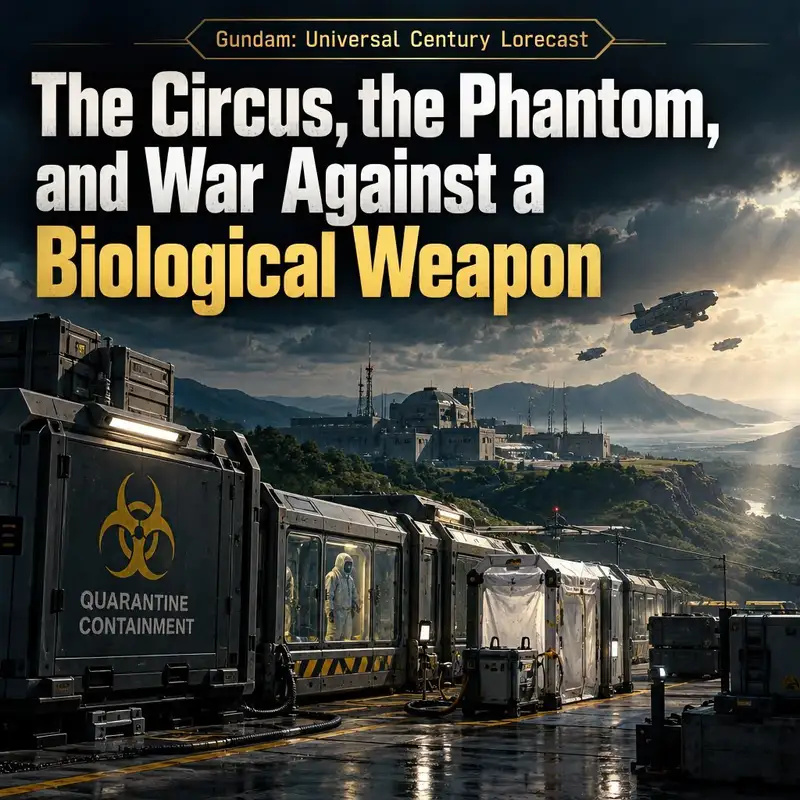
The Circus, the Phantom, and War Against a Biological Weapon [Manga]
A contaminated warship is not a prize. It cannot be boarded for intelligence, stripped for spare parts, brought into dock, or even approached with the ordinary instincts of rescue. If its crew and machinery carry Angel Call, then every hatch is a possible breach, every survivor a possible vector, and every successful capture a potential act of self-destruction. That is the operational problem at the center of Mobile Suit Crossbone Gundam: Ghost. In this manga-specific late Universal Century account, set in Universal Century fifteen fifty-three, Angel Call is a biological threat whose military value exists mostly in the imagination of people who believe they can control it.
The manga presents Angel Call as an extraterrestrial bacterium discovered in connection with a meteorite and a long-buried Jupiter secret. Its effects are horrific. Human contact produces rapid bodily liquefaction, and the practical answer available to the people confronting it is not treatment in the usual sense, but destruction by extreme heat. This is fictional biology, and the manga does not offer a complete scientific model that can be tested outside its own setting. What matters historically is the condition it creates. There is no dependable cure, no assured vaccine, and no comfortable distinction between a contaminated target and a contaminated rescue operation.
That makes Angel Call different from a weapon that can be stored behind a fence, loaded onto a missile, and used under a chain of command. It is dangerous to an enemy, but it is also dangerous to the people trying to possess it. A military organization can make plans around artillery ammunition or reactor fuel. It can count rounds, assign guards, and train operators. Angel Call does not allow that confidence. It punishes secrecy, rewards panic, and turns the normal incentives of warfare inside out. The more valuable the sample appears, the more likely someone is to hide it, steal it, transport it, or preserve it. Each of those acts increases the danger.
For that reason, Angel Call becomes strategically important even though it is unsuitable as a routine weapon. Its very uncontrollability makes it valuable to opportunists. A faction does not need to deploy it successfully to gain leverage from it. The threat of possession can influence negotiations. A sample can become black-market currency. Rumors of a stockpile can provoke preemptive violence. A commander can use access to it to frighten subordinates and rivals. The weapon’s operational weakness becomes a political strength for anyone willing to gamble with everyone else’s survival.
That gamble attracts the Circus.
The Circus, sometimes described as the Thousand Custom force, is not an ordinary Jupiter regiment. It is a Jupiter-linked irregular special-operations formation, associated with masked members, criminal backgrounds, and highly individualized mobile suits. Under Quo Gray, it operates according to a culture of contracts, opportunity, and specialized violence. That makes the Circus useful to institutions that want capability without public accountability. It also makes the Circus difficult to direct once its own interests diverge from those of its sponsor.
Its mobile suits embody this arrangement. The Circus does not represent a standardized army equipped for long campaigns of replacement and repair. Its machines are bespoke answers to narrow tactical problems. Such specialization can be formidable. A custom machine may exploit a particular environment, weapon, or method of attack more effectively than a general-purpose unit. It can surprise conventional forces and make a small formation appear more powerful than its numbers suggest.
But bespoke systems impose costs. They require specialized maintenance, unusual parts, pilots who understand their quirks, and commanders able to coordinate people whose equipment and methods are not interchangeable. A conventional force can lose a standard machine, replace it, and retrain around a common doctrine. A force built around individual custom assets loses more than hardware when one machine is destroyed. It loses a unique combination of pilot experience, technical support, and tactical function.
The Circus is therefore an excellent instrument for deniable intervention and a poor foundation for stable governance. It can raid, ambush, intimidate, and compete for a prize. It cannot easily become the regular armed arm of a durable political order. That limitation is not incidental. It is central to why the Angel Call crisis becomes a three-sided conflict rather than a clean contest between two governments.
Quo Gray’s interest in Angel Call is commercial, political, and strategic. The sample has value because it is rare, feared, and difficult for larger institutions to acknowledge openly. For a contract-driven irregular force, that makes it attractive. Yet the Circus’s pursuit of Angel Call is not evidence that every Jupiter institution shares the same objective. The Circus is linked to Jupiter power, not identical with it. Its members have their own incentives, and those incentives become sharper as the crisis expands.
A deniable force is often created because official institutions want distance from morally hazardous operations. That distance comes at a price. The sponsor cannot always be sure whether the force is executing policy, interpreting policy, or pursuing its own survival and profit. In ordinary times, ambiguity can be useful. In a biological crisis, it becomes lethal. Every independent actor believes that the weapon might be controlled, sold, or used before another actor takes it away.
Jupiter’s answer to the emergency is itself an admission of institutional failure. Curtis Rothko’s group, Serpiente Tacon, or Snake’s Feet, begins as an intelligence and intervention organization connected to the Jupiter Foundation. It is not a normal national military command with broad public authority. When Tetenith Dogatie authorizes its transformation into a revived Crossbone Vanguard, she does so because ordinary channels either cannot or will not respond adequately to Angel Call.
The reborn Crossbone Vanguard should not be mistaken for the resurrection of a complete historic army. It is an emergency formation built from surviving personnel, unusual machines, intelligence networks, and a willingness to act outside the paralysis of larger institutions. Its revival has practical value. It gives Curtis and his allies a name, a mission, and a framework for organizing resistance. But it also demonstrates how badly the political environment has fractured. When a crisis requires the return of a legacy force because normal authority cannot coordinate a response, the system has already failed before the first major battle begins.
The Manzana Flor becomes the operational center of that improvised response. It is more than a backdrop for mobile suits. It functions as transport, mobile base, intelligence platform, technical workshop, and later a containment asset. A ship in this kind of war must do more than launch combat machines. It must move people and equipment without spreading contamination. It must support repairs while deciding which damaged assets are too dangerous to recover. It must carry technical personnel who can make experimental machines function, and crews who understand that a rescue attempt may become a sacrifice.
Curtis brings experience and tactical judgment to this organization. He understands how to use rare assets without confusing them for a complete answer. His blindness does not make him mystical or omniscient. It changes the methods through which he operates and interprets the battlefield. His strength is professional judgment shaped by old conflicts, unusual sensory practice, and the ability to recognize when a mission’s real objective is not the destruction of an enemy machine but the prevention of a larger catastrophe.
Even so, the revived Vanguard needs more than experience. It needs technical adaptation. That requirement brings the Phantom Gundam to the center of the crisis.
The EMS-TC02 Phantom Gundam is a Jupiter Foundation experimental mobile suit built around an imperfect Minovsky Drive system. In theory, the drive offers extraordinary mobility and produces the phenomenon known as Phantom Light, an unstable precursor to the later Wings of Light concept. In practice, the Phantom is not a mature, standardized breakthrough. Its performance is exceptional precisely because it rests on a system that remains dangerous, complicated, and incomplete.
That makes the Phantom a useful symbol of late Universal Century military technology. It promises a dramatic increase in mobility, but it does not erase the burdens of operation. Experimental propulsion creates new pilot demands, new maintenance requirements, new risks of malfunction, and new limits on who can use it effectively. A system can be technologically advanced and institutionally immature at the same time. The Phantom’s difficulty is not an embarrassing flaw beside its speed. It is the central fact of its military significance.
Font Bow’s role in making the Phantom operational is therefore more important than a simple pilot upgrade. Working with Tres Mares, Font helps debug the Jupiter operating system and makes sense of a machine whose performance cannot be separated from software, procedure, and human adaptation. His contribution is analytical. He understands systems, identifies problems, and makes decisions under pressure. That does not turn him into a conventional ace, nor does it mean he can solve any machine problem by inspiration alone. It means that in an environment of unstable technology, technical competence becomes combat power.
The Phantom Light is powerful but hazardous. The machine can achieve effects that ordinary mobile suits cannot match, yet those effects are not free. They demand control, place stress on operators, and risk turning a high-performance asset into a danger to its own side. A standard army cannot build doctrine around a system that only a handful of people can safely manage. It may deploy such a machine for a narrow mission. It cannot assume that the machine represents a fleetwide capability.
This is the difference between a prototype’s tactical promise and its strategic value. The Phantom can change a local engagement. It can break a pursuit, reach a threatened area, or confront a specialized enemy. But the Jupiter sphere cannot simply order hundreds of Phantoms, assign them to ordinary pilots, and solve its security problem. The machine’s rarity is part of its weakness. It requires people like Font, technical support like that available aboard the Manzana Flor, and a crisis severe enough to justify risks that peacetime commanders would reject.
Angel Call and the Phantom are different kinds of danger, but they arise from the same political pattern. Both are capabilities pursued before they can be governed. One threatens to dissolve the bodies of the people around it. The other threatens to outrun the institutions that must maintain and control it. Kizo Dogatie sees neither danger as a warning. He sees them as opportunities for personal rule.
Kizo commands the Golden Eggs, a Zanscare-aligned force that eventually becomes associated with his breakaway El Zanscare faction. His project must be distinguished from the entire Zanscare Empire and from Maria’s larger religious-political movement. Kizo does not simply execute the policy of a coherent state. He builds a personal structure of coercion within a wider war, using the authority, fear, and military resources available around him.
His objective is centralization. Angel Call gives him the prospect of terror. The Circus offers specialized violence. Zanscare formations provide armed manpower and political cover. Experimental machines offer technological superiority. Kizo wants to place all of those assets beneath his own command and eliminate the independent decision-makers who might resist him. The result is what the manga frames as a kingdom of death, not because Kizo possesses one spectacular machine, but because his political model depends on making every other institution dependent, frightened, or expendable.
The Midas, Kizo’s personal mobile suit, illustrates that method. Its Midas Touch Flash is not ordinary electronic warfare, and it should not be treated as a universal late Universal Century capability. In this manga’s specific account, the system uses an optical signal carrying a computer virus to interfere with or immobilize other mobile suits. The effect is strategically significant because it changes the status of every machine in range. An allied formation can become compromised. A captured enemy machine can become a liability. A unit that believes it is fighting Kizo may find its own systems turned against its command.
That makes Midas more than a dueling machine. It is a command-and-control weapon. It attacks trust as much as armor. Militaries function through the assumption that orders, sensors, and equipment will remain usable under stress. Kizo’s system turns that assumption into a vulnerability. If commanders cannot trust the machines under their authority, they must slow operations, isolate units, restrict communications, or accept the risk of sudden paralysis.
Yet Midas also reveals the limits of coercive centralization. A ruler who controls through exceptional systems must continuously demonstrate that control. Subordinates obey because they fear the mechanism, not because they recognize legitimate authority or share a political purpose. That creates brittle command relationships. The Circus may work with Kizo while doing so serves its interests. Zanscare-associated forces may follow him while his power appears secure. But neither group has a reason to accept permanent subordination once Kizo’s ambitions become clear.
The break between Kizo and Quo Gray is therefore not a sudden outbreak of principle. It is the predictable collapse of opportunism. The Circus enters the crisis believing that Angel Call can be used as leverage. Kizo seeks to convert that leverage into a monopoly. The Circus recognizes that a ruler who can neutralize independent machines and treat biological terror as a personal asset will eventually treat its own members the same way.
The resulting conflict is not a simple alliance against evil. It is a three-sided struggle among the revived Crossbone Vanguard, the Circus, and Kizo’s forces. Each group holds partial knowledge. Each has specialized assets. Each understands that Angel Call is too dangerous to leave in another faction’s hands. But only the Crossbone side gradually reaches the harder conclusion: it is too dangerous to leave in anyone’s hands.
That conclusion is operational as well as moral. Capture requires transport. Transport requires security. Security requires trained personnel who can survive an accident. Any laboratory needs power, access control, disposal procedures, and political oversight. In a fragmented war zone, none of those conditions can be guaranteed. Every faction must assume that a convoy may be intercepted, a technician bribed, a commander betrayed, or a facility destroyed in combat. A weapon that depends on perfect custody is already unusable when no government can provide it.
The Circus’s customized machines can produce local advantages, but they cannot solve this problem. Kizo’s Midas can immobilize enemies, but it cannot create a vaccine or make contamination governable. The Phantom can outrun threats, but it cannot turn an infected ship into safe salvage. The crisis has reached the point where possession and victory are no longer the same thing.
The final operation against Angel Call is therefore not a conventional fleet battle. It is a sterilization campaign. Crossbone forces confront infected ships and mobile suits with specialized heat weapons, because destruction by heat is the practical means the manga establishes for neutralizing the biological danger. The mission is not to seize enemy hulls intact. It is to prevent contaminated material from reaching civilian populations, friendly ships, or any faction hoping to preserve it for later use.
This reverses the normal logic of military logistics. In ordinary warfare, a damaged mobile suit may be recovered for repair, intelligence, or spare parts. A disabled ship may be boarded for prisoners, documents, and equipment. In the Angel Call crisis, recovery itself becomes a threat. A maintenance crew must ask whether opening a hatch will expose the ship. A medical team must consider whether treatment is possible without endangering an entire facility. A commander must decide when to abandon valuable equipment because the cost of preserving it is too high.
Those are not secondary concerns. They are the campaign. Heat weapons, evacuation routes, quarantine discipline, technical labor, and the willingness to destroy contaminated assets matter as much as mobile-suit skill. The people who keep the operation moving are not only pilots. They are technicians, ship crews, engineers, support personnel, and civilians responsible for infrastructure that was never designed to become part of an emergency biological defense.
The civilian dimension is especially important because this operation occurs around colony infrastructure. Colonies are inhabited political communities, not empty pieces of terrain. Their reflectors, docks, and modules are parts of life-support systems and transport networks. Any attempt to use that infrastructure against Angel Call must account for residents, traffic, evacuation, and the risk of accidental damage. The defenders cannot simply fire through the area and declare success. The thing they are trying to save is the population that makes the infrastructure matter.
Individual destruction of infected targets is not enough. There are too many moving parts, too many possible vectors, and too much risk that one surviving contaminated vessel will carry the crisis somewhere new. The response has to expand from combat action into a distributed defensive system.
That system takes the form of an improvised solar operation. Reflectors distributed through colony infrastructure are used to concentrate sunlight against Angel Call. The concept resembles a makeshift Solar System, but its purpose is not straightforward annihilation of an enemy fleet. It is sterilization. The defenders need sufficient heat directed at the right targets, at the right time, while avoiding unnecessary damage to the colonies and people around them.
The manga does not provide a reason to pretend this is an easily calculated engineering exercise. What matters is the organizational demand. Reflectors have to be positioned and aimed. Crews must coordinate their actions. Targets must be identified despite battlefield confusion. Ships and mobile suits must hold or direct contaminated vessels long enough for the system to work. Civilian routes must be protected. Technical teams must keep the infrastructure functioning under wartime conditions.
Belle’s role in target guidance is significant in this operation. Her Newtype sensitivity helps the defenders coordinate against a threat that cannot be managed through ordinary information alone. But her contribution should not be treated as a complete scientific explanation or a guarantee of perfect awareness. The operation still depends on people, machinery, communication, and discipline. Newtype ability can sharpen coordination. It does not replace reflector crews, evacuation planning, or the difficult decisions of commanders who must choose which assets can be saved.
The Manzana Flor’s role becomes particularly stark in the final effort. The ship and its people do not merely observe the operation from a safe command position. They accept the possibility that a remaining contaminated vessel must be sent toward the Sun, using their own ship as part of the effort. This is not a triumphant expression of technological mastery. It is an admission that containment has become so urgent that preservation of a valuable vessel must yield to denial of the biological threat.
That sacrifice clarifies the strategic logic of the campaign. Victory is not measured by captured equipment, territory gained, or enemy machines displayed as trophies. It is measured by whether Angel Call can be prevented from becoming a reusable instrument of war. The defenders win only by accepting losses that ordinary military doctrine would try to avoid.
While the reflector network and sterilization effort proceed, the surviving mobile-suit forces still have to prevent Kizo from converting the crisis into a personal victory. Curtis Rothko’s X-0 Full Cloth confronts the Midas and compromised machines under conditions that expose both the power and limits of specialized design. Midas can interfere with conventional systems through its distinctive optical virus mechanism. Against an ordinary unit, that could turn advanced machinery into dead weight.
Curtis is able to remain partially functional because the X-0 Full Cloth and his own operating methods do not depend entirely on ordinary visual feedback. This is not invulnerability. It is resilience through difference. A command weapon designed around one avenue of control becomes less effective when the target retains another way to perceive and act. That does not make the Midas harmless, and it does not mean the X-0 can ignore damage. It means that Kizo’s attempt to impose total technical dominance encounters a form of adaptation he did not fully control.
The combat around Midas includes compromised machines such as the Chaosrel, but the larger point is not the sequence of strikes and counterstrikes. Curtis is fighting to keep Kizo from owning the operational center of the crisis. If Midas can paralyze the forces attempting containment, then Angel Call remains available as leverage. If Kizo can force the Circus, Zanscare assets, and Crossbone forces into helplessness, his personal regime gains the time it needs to turn catastrophe into authority.
The X-0 is ultimately destroyed. Its loss matters because the machine was rare, historically loaded, and not easily replaced. But Curtis survives through the Core Fighter. That survival is not a convenient dismissal of the machine’s destruction. It underscores the difference between preserving a person with experience and preserving a particular combat platform. The Crossbone Vanguard loses valuable hardware, yet it retains a human source of judgment and institutional memory.
Font’s repaired and modified Phantom then takes on the Ghost Gundam identity. Equipped with Crossbone-derived elements and anti-beam coating, the machine becomes a defensive tool shaped by necessity rather than prestige. Ghost Gundam is not the final proof that one perfect mobile suit can resolve a political crisis. It works because Font has learned how to adapt an unstable system, because others have provided the technical and organizational support around it, and because the mission is tied to a larger containment effort.
The Ghost Gundam’s significance lies in that adaptation. The Phantom began as an experimental Jupiter machine whose exceptional performance came with instability and risk. Under Font’s direction, it becomes part of a broader effort to deny Kizo control and eliminate Angel Call. The machine does not solve the crisis in isolation. It helps create the time and space in which the sterilization network, Crossbone forces, and civilian infrastructure can do their work.
Kizo’s defeat is therefore political as well as tactical. His Midas cannot substitute fear for legitimacy. His control over specialized technology cannot make Angel Call safe. His El Zanscare project cannot turn a fragmented battlefield into a durable state merely by destroying independent commanders. The more he tries to centralize force through coercion, the more clearly he reveals that his authority depends on the very chaos he claims to master.
The Angel Call crisis ends not because one faction succeeds in acquiring the weapon, but because the opposing forces finally stop treating it as a prize. That is the essential decision. The contaminated ships are destroyed or sterilized. The surviving danger is denied to every potential owner. Valuable assets are sacrificed. Rare machines are lost. People survive only because the operation accepts that preservation of the weapon is incompatible with preservation of the population.
At the tactical level, the crisis produces victories by pilots, crews, and specialized machines. At the operational level, it is contained through heat weapons, reflector coordination, evacuation, and the destruction of infected assets. At the strategic level, Angel Call is denied as a usable weapon. Politically, the crisis exposes how fragile late Universal Century authority has become. Jupiter institutions, Zanscare-aligned forces, irregular contractors, secret research programs, and revived legacy organizations all possess fragments of power, but none begins with the capacity to govern the whole emergency.
That fragmentation does not prevent mass destruction. It makes mass destruction more likely. Every faction believes it may control the secret, deploy the prototype, buy the contractor, or intimidate the rival before anyone else acts. Angel Call proves the opposite. Some capabilities cannot be safely monopolized because the act of monopolizing them creates the conditions for disaster.
The Circus, the Phantom, the Midas, and the Ghost Gundam each represent a different response to that fractured world. The Circus is deniable force with private incentives. The Phantom is exceptional technology without mature institutional control. Midas is coercive command seeking to turn systems and people into obedient instruments. Ghost becomes an improvised defensive tool, valuable not because it conquers, but because it helps destroy what no responsible government can keep.
In the end, Angel Call is defeated because the people opposing it accept a truth that Kizo and the opportunists around him cannot. A weapon that threatens everyone cannot become the foundation of anyone’s political order.