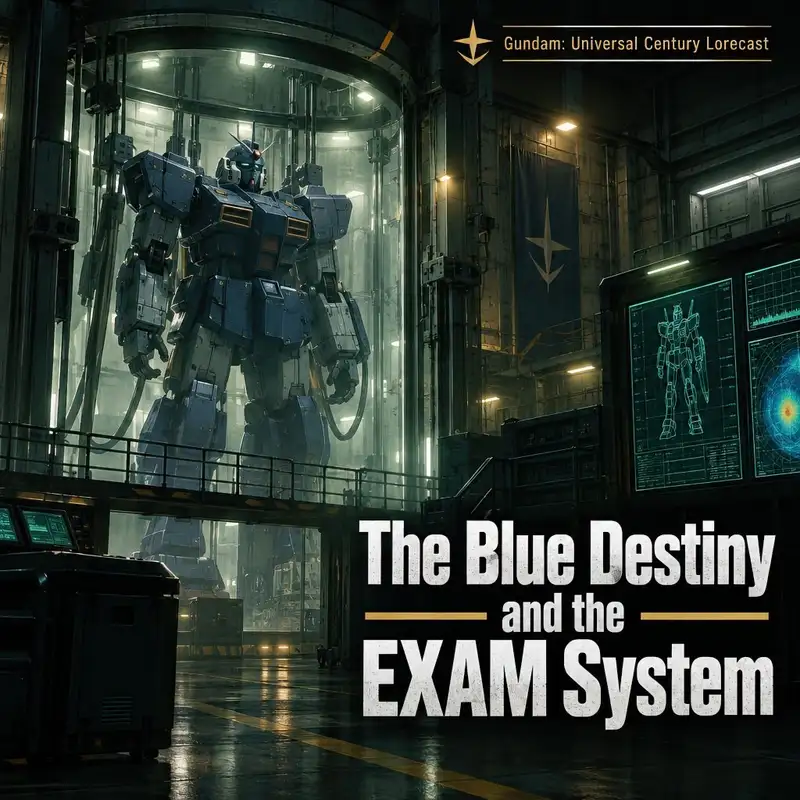
The Blue Destiny and the EXAM System [Game]
A blue mobile suit has gone out of control. It is supposed to be a test machine, a carefully watched experiment, but it is behaving less like a weapon under evaluation and more like a weapon that has chosen its own fight. The Earth Federation’s answer is revealing. It does not immediately lock the machine away, dismantle it, or declare the program too dangerous. Instead, it looks for a pilot who can survive it.
That pilot is Yuu Kajima, a young Federation soldier assigned to the Eleventh Independent Mechanized Composite Corps. The name of his unit is Guinea Pig Team. It is not a name that leaves much room for illusion. These are frontline personnel, but they are also a testing instrument. They fight Zeon forces, gather combat data, report on equipment performance, and accept risks that regular units might reasonably refuse. Their mission is to discover what works in war. Sometimes that means discovering what should never have been sent into combat at all.
The machine is Blue Destiny Unit One. It is not introduced as a polished answer to the Federation’s problems on Earth. It is a malfunctioning and dangerous prototype carrying the EXAM System, a project built around one of the One Year War’s most unsettling military questions. If Newtypes might possess extraordinary awareness in combat, could an institution reproduce that advantage in machinery? Better still, from the perspective of a frightened military establishment, could it create a weapon that would defeat Newtypes before they became too powerful to control?
The Blue Destiny story, in the original Sega Saturn game trilogy, is not really about whether one special mobile suit is stronger than another. It is about the attempt to turn uncertainty into doctrine. Both the Earth Federation and Zeon see Newtype potential as a possible military revolution. Neither side fully understands it. Neither side can reliably produce it. Yet both are willing to build secret weapons around it. EXAM promises Newtype-like performance without requiring its operators to trust Newtypes, understand them, or grant them political or personal autonomy. That promise proves powerful. It also proves poisonous.
Yuu’s selection matters because Blue Destiny cannot simply be assigned like an ordinary GM. A standard mobile suit may still demand unusual skill, especially in late-war conditions, but it remains part of a recognizable military system. It is issued to a unit, maintained by technicians, supplied through a depot, and employed according to a mission. Blue Destiny Unit One has all of those requirements, but it adds another. Its pilot must contend with a system whose behavior may not fully belong to him.
That distinction is central. Yuu is a skilled pilot. His service record and simulator performance indicate that he possesses considerable ability, including a background as a fighter pilot. But skill alone does not make him the master of EXAM. The system can sharpen a machine’s reactions and drive it toward sudden, violent performance. It can alter the tempo of combat. It can push a pilot into a battle that is no longer governed solely by training, mission orders, or caution. Yuu’s success is not that he turns into an all-powerful warrior. It is that he remains capable of judgment while operating a weapon designed around the possibility that judgment may be too slow.
Against that uncertainty, Chlust Moses becomes important. Moses had been associated with the Flanagan Institute, one of Zeon’s Newtype research organizations. He did not simply treat Newtypes as a promising source of military talent. He came to believe that they could become a threat to humanity. That belief is ideological, scientific, and fearful all at once. It reflects an old pattern in military history. When institutions encounter a human ability they cannot classify or control, they often stop asking what it means and start asking how to neutralize it.
Moses’s answer was EXAM. The system was intended to address Newtype capability not through better command structures, better training, or political restraint, but through technological substitution. If a Newtype could react more quickly, perceive a threat more completely, or gain an advantage in close combat, EXAM might give an ordinary pilot access to something similar. It might also identify, pursue, and defeat the very people whose emergence Moses feared.
That makes EXAM different from a conventional targeting computer or performance upgrade. A better sensor suite can improve what a pilot sees. A more powerful engine can improve a machine’s acceleration. A new rifle can change engagement range. EXAM reaches toward something more ambitious. It seeks to create a combat relationship between pilot and machine that resembles the battlefield advantage associated with Newtypes, while making that relationship available to an institution that remains suspicious of Newtype autonomy.
Later materials and later branches expand the connection between EXAM and Marion Welch, a young Newtype who assisted Moses during the system’s development. Those later interpretations can be useful in understanding why the project carries such ethical weight, but they should not be used to pretend that the original game provides a complete metaphysical explanation. The Saturn narrative leaves important questions unresolved. It gives the listener enough evidence to see that EXAM is bound to Marion’s role in the project. It does not provide a simple technical diagram of where one person ends and the system begins.
The first practical problem was not philosophical. It was mechanical. EXAM demanded more from a mobile suit than the project’s initial platform could endure. The system began on a GM Ground Type test platform, a logical choice in one sense. The Federation was fighting a ground war, and the GM family represented the basis of its expanding mobile-suit force. A GM-derived testbed offered a familiar maintenance environment and a plausible route toward operational use.
But the original frame could not withstand what EXAM demanded of it. That failure matters. It demonstrates that the system was not a software package that could be installed casually across a fleet. It imposed stresses on the host machine severe enough to force a redesign. The project shifted to a heavily modified machine based on the Gundam Ground Type. That gave the developers a more capable foundation, but it did not make Blue Destiny an ordinary Gundam, and it did not solve every integration problem.
Blue Destiny Unit One retained the head of the earlier GM-type platform. That unusual feature was not simply an aesthetic decision. Transferring EXAM itself proved difficult. The project had to preserve a component associated with the system because the system could not be cleanly moved into a wholly new configuration. In military procurement, that is a warning sign. A weapon may appear impressive in a test range or a brief engagement, but if a critical subsystem cannot be transferred, repaired, standardized, or understood, then its performance is tied to a tiny number of fragile machines.
The result was a mobile suit built for high-mobility, close-range combat. Blue Destiny Unit One carried multiple built-in weapons and had the ability to fight with sudden violence once EXAM took hold. That armament made sense for its intended mission. Minovsky conditions and the cluttered terrain of the Earth front could compress engagements. A machine that could close distance rapidly, identify an enemy, and overwhelm it before the opponent could respond would have clear tactical value.
That is where Guinea Pig Team enters the story. The Eleventh Independent Mechanized Composite Corps is not merely Yuu and a blue machine. It is a small operational network built around experimental warfare. Philip Hughes and Summona Fulis serve alongside Yuu. Maureen Kitamura operates the communications and information link that helps bind the team together. Alph Kamra provides the technical connection between the machine’s designers, its maintenance needs, and the field reports that determine whether EXAM can be considered usable.
These people matter because no experimental weapon operates alone. The pilot may receive the attention, especially when the machine is as dramatic as Blue Destiny, but the pilot’s decisions depend on information moving through the team. Maureen’s role is not decorative. In a Minovsky environment, where communications and long-range detection are degraded rather than erased, reliable local coordination becomes more valuable. A pilot needs warnings, route information, target updates, and confirmation that a mission still makes sense after conditions change.
Alph’s presence matters for a different reason. He represents the technical chain between laboratory theory and battlefield reality. A system may look coherent in a research facility, where its operating conditions can be controlled and its failures can be documented. Combat removes those protections. Dust, damage, hurried repairs, incomplete reports, enemy action, fatigue, and command urgency all distort the clean logic of development. The technical officer must translate between what the system was supposed to do and what it is actually doing to soldiers.
Yuu’s command role does not erase that imbalance. He can make tactical decisions. He can protect his teammates where circumstances allow. He can learn how to resist the system’s worst impulses. But he does not control the political decision to pursue EXAM. He does not decide how much has been withheld from him. He does not set the research priorities that placed a dangerous prototype in his unit. He is a capable professional operating inside a project designed by people who have already decided that the risks are acceptable.
The California Base operations show why the Federation was willing to accept those risks. Late in Universal Century seventy-nine, the Federation is conducting a broad counteroffensive on Earth. Zeon’s early successes had placed forces and infrastructure across large parts of the planet, but holding territory is different from taking it. Zeon could land mobile suits, establish bases, and threaten key routes. Sustaining those positions against an increasingly mobilized Federation was another matter.
That is a mission with a clear operational logic. Missile-control infrastructure is a force multiplier. The launchers, missiles, and mobile suits may be dispersed, but the systems coordinating them can be vulnerable. Destroying the command and control element does not mean every weapon disappears. It means an enemy loses the ability to employ those weapons as effectively at the moment they are most needed. It can reduce the danger to advancing formations, transport routes, staging areas, and the troops trying to establish a foothold.
For Blue Destiny, this is the kind of mission that justifies a specialized machine. The objective is urgent. The target is defended. The assault force cannot wait for a leisurely reduction of every Zeon position. A high-mobility mobile suit capable of fighting through opposition and striking the control facilities can create a window for the larger operation to proceed. In that context, EXAM’s burst of performance has genuine value.
The California operation also proves that EXAM is no longer only a Federation concern. Yuu repeatedly encounters Nimbus Schterzen, a Zeon test pilot operating the MS-08TX EXAM Efreet Custom. Nimbus is not simply an enemy ace inserted to give Blue Destiny a rival. He is the other face of the same institutional obsession. Both sides have become convinced that EXAM might decide something important about the future of combat. Both have put exceptional machines into the hands of chosen pilots. Both are trying to turn a dangerous research project into battlefield advantage before the other side can do the same.
The Efreet Custom is the Zeon machine identified in this record as carrying EXAM. Its existence tells us several things. First, the project is not securely controlled by either government. Moses’s defection to the Federation did not erase Zeon’s relationship to the research. Knowledge, personnel, hardware, and institutional ambition do not move cleanly when one researcher changes sides. Second, EXAM has become an object of competition. Each side sees not only a potential weapon, but also a dangerous secret that the enemy must not possess.
Nimbus interprets that competition in personal terms. To him, the struggle becomes a contest over worthiness. Which pilot deserves EXAM? Which man can prove himself superior through the system? That attitude is familiar in ace culture. War gives institutions a tendency to turn complicated technical and organizational problems into stories about exceptional individuals. A skilled pilot becomes a symbol. A prototype becomes an extension of personal identity. The battle stops being about whether a program is sound and becomes a test of who is strong enough to master it.
The Efreet Custom also exposes EXAM’s operational limitations. The system can produce a sudden and frightening advantage, but it places tremendous stress on the machine. The available record identifies overheating as a serious problem for the Efreet Custom after a short period of EXAM operation. That is not a minor engineering inconvenience. It changes how the weapon can be used.
A mobile suit that can dominate a brief engagement may still be a poor tool for a prolonged operation. Thermal stress means the pilot and commander must choose when to activate the system. Mechanical wear means the machine may need inspection and repair after a single intense fight. An enemy who survives the first burst of performance may gain an opportunity once the system’s operating window closes. A unit depending on EXAM must plan its approach, its target priority, its extraction, and its recovery. The weapon is powerful precisely where it is least sustainable.
The same principle applies to Blue Destiny. Its value is real, but conditional. It can break through a defended position, pursue a dangerous opponent, or strike a high-priority target. It cannot replace a formation. It cannot establish a supply line. It cannot guard every route. It cannot make up for weak intelligence. And if it is damaged or destroyed, the Federation cannot simply request another from a standard depot.
The confrontation between Blue Destiny Unit One and Nimbus’s Efreet Custom brings those weaknesses into focus. The engagement is often remembered as a clash of two extraordinary machines, but its real importance lies in what is lost. Both machines are destroyed or rendered unusable. Blue Destiny Unit One’s head, the component carrying the EXAM system and associated data, is destroyed. Nimbus survives, and the rivalry continues. But neither side emerges with a clean, intact victory.
In immediate combat terms, the destruction of the machines ends that immediate fight. At the intelligence level, the loss is much greater. Experimental programs depend on more than blueprints. They depend on test results, damage reports, pilot observations, maintenance records, calibration data, and the physical hardware that allows engineers to learn what their theories missed. When Unit One’s EXAM-related component is destroyed, the Federation loses more than a mobile-suit head. It loses part of the evidence needed to understand what it had built.
That struggle reaches the Federation’s EXAM facility. The attack on the installation is strategically important because it turns research security into battlefield violence. Facilities like this are not just buildings. They contain records, specialized equipment, test hardware, maintenance tools, and people with knowledge that cannot be replaced quickly. A program may possess a prototype, but if it loses the technicians who understand how to service it, then the prototype becomes a shrinking asset.
During the attack, Chlust Moses is killed, and Blue Destiny Unit Two is stolen. The theft is not simply the capture of a valuable mobile suit. It is the seizure of a surviving path into EXAM research. Unit Two represents hardware, technical continuity, and potential insight into what the Federation has managed to preserve. For Zeon, recovering it offers the possibility of regaining an advantage. For the Federation, losing it means that the project is no longer merely unstable. It is compromised.
The death of Moses matters in the same way. He was not just a scientist whose work could be inherited by anyone reading a file. He was one of the people who understood the project’s assumptions, fears, and compromises. His belief that Newtypes might threaten humanity had shaped EXAM from the beginning. That belief did not make him a simple villain or a madman. It made him a researcher whose technical work was inseparable from a political and ethical judgment about other human beings.
Moses’s death also reveals the irony at the heart of the project. He had tried to create a system that would protect humanity from the threat he perceived in Newtypes. Yet the program he built becomes a source of violence, theft, and further militarization. It does not contain fear. It organizes fear into a weapon. It gives rival militaries a new secret to pursue, a new reason to risk their personnel, and a new justification for treating people as components in a weapons system.
Marion Welch stands at the center of that ethical problem. She is fourteen years old, a Newtype who worked with Moses during EXAM’s development and fell unconscious when the system was completed. The original game does not settle every question about the exact internal nature of the system. It does not allow us to say with certainty that EXAM is simply Marion’s consciousness installed in a mobile suit. But the available facts are disturbing enough without reaching for a simpler supernatural explanation.
A child’s Newtype ability is connected to a military project intended to imitate, control, or counter Newtype performance. The project’s completion coincides with her collapse into unconsciousness. That alone raises a question the engineers and commanders around EXAM seem poorly equipped to answer. Can a system still be called a machine when its function may depend upon the experience, perception, or suffering of a person who cannot meaningfully consent to its use?
Military institutions are often good at assigning labels that make difficult questions easier to store. Subject. Asset. Test case. Interface. Data source. Those terms can describe part of a reality while concealing the whole of it. Marion is not merely a source of technical information. She is a young person whose involvement reveals that EXAM may be built upon a boundary the project refuses to acknowledge. The system wants Newtype capability without Newtype autonomy. Marion’s condition suggests that this separation may never have been possible.
After the raid, the remaining EXAM story moves beyond the California theater and toward space. Yuu is assigned Blue Destiny Unit Three, described as the last remaining Federation EXAM machine. The assignment reflects both confidence and desperation. The Federation has lost Unit One, lost its chief developer, lost Unit Two to theft, and seen its research facility attacked. It still has one more machine, one more pilot judged capable of using it, and one more chance to prevent the project from falling completely into enemy hands.
The move toward space increases the stakes without turning the story into a broad fleet campaign. Unique prototypes are difficult enough to sustain on Earth, where a unit can at least hope to reach a workshop, depot, or friendly base. In space, they depend even more visibly on transport, hangar support, spare parts, recovery capability, and secure movement between ships and stations. The game does not provide a complete order of battle for this pursuit, and none should be invented. The essential point is that EXAM’s scarcity makes every transfer and every engagement dangerous.
Yuu’s task is not simply to defeat Nimbus in a final duel. He must confront the fact that Blue Destiny Unit Two and Unit Three are the surviving embodiments of a project that has already consumed machines, personnel, and institutional trust. The pursuit becomes a struggle over whether either side can still possess EXAM as a usable weapon. It is also a struggle over whether the system can ever become controllable enough to justify its existence.
The final conflict brings Yuu, Nimbus, Blue Destiny Unit Two, Blue Destiny Unit Three, and the surviving EXAM legacy into direct confrontation. The precise choreography is less important than the result. The EXAM-equipped machines are destroyed, and the immediate rivalry ends. Neither side retains a force of deployable EXAM mobile suits. Neither side emerges with a mature program ready for standardization. The system that promised control over Newtype-like combat performance ends by consuming the few machines built to carry it.
In immediate combat terms, that is the destruction of rare prototypes. For the wider operation, it ends the possibility of either military fielding EXAM as an organized combat capability during the One Year War. A small number of specialized machines, no matter how formidable in a brief fight, cannot influence a war at scale unless they can be repaired, reproduced, supplied, and assigned within a larger doctrine. EXAM never reaches that stage in this story.
For the war as a whole, the system does not decide the war. The One Year War is determined by far larger forces: industrial capacity, territorial control, fleet operations, ground campaigns, political leadership, the Federation’s expanding mass-production effort, Zeon’s overextension, and the catastrophic choices made by governments on both sides. EXAM may be terrifying in a cockpit. It is not a substitute for factories, trained personnel, transport networks, or political legitimacy.
At the industrial level, EXAM fails the test of replication. Its first platform cannot tolerate the system’s demands. The later machine requires a heavily modified Gundam Ground Type-derived frame. Critical components prove difficult to transfer. The Efreet Custom suffers from extreme thermal stress. The known machines are prototypes, dependent on specialized knowledge and specialized maintenance. Nothing in this record supports the idea that either the Federation or Zeon could have turned EXAM into ordinary equipment before the war’s end.
At the intelligence level, the project is crippled by the very secrecy that makes it valuable. Both sides seek to capture or destroy EXAM hardware because they understand that it may hold an important advantage. But secrecy also narrows the pool of people who can maintain and interpret the system. When the facility is attacked, when Moses is killed, and when machines are destroyed, the program loses not only equipment but continuity. Classified knowledge cannot protect a project if the people and places holding that knowledge are vulnerable.
At the institutional level, EXAM shows the Federation and Zeon responding to Newtype uncertainty in much the same way. Their political systems differ. Their military structures differ. Their immediate objectives differ. But both are willing to turn a poorly understood human phenomenon into a weapons-development race. Neither begins by asking how to protect Newtypes from exploitation. Neither begins by asking whether the fear surrounding Newtypes has been distorted by ideology, war, and institutional self-interest. Both begin by asking how to gain an advantage.
That does not mean the two sides are morally or politically identical. Zeon’s dictatorship, aggressive war, and atrocities remain distinct from the Federation’s own failures and abuses. But EXAM reveals a shared military logic. When faced with uncertainty, each institution reaches for control. When control is not available through ordinary command, it seeks control through technology. When the technology depends on a vulnerable person, the person is treated as a means to an end.
Nimbus represents the personal version of that logic. He treats EXAM as proof of worth, a machine through which he can demonstrate superiority. Yuu represents a more restrained alternative. He uses the machine because the war and his command place it in his hands, but he does not need to surrender his judgment to it. His competence matters. His refusal to become merely an extension of the system matters. Yet his survival does not redeem EXAM’s assumptions.
A good pilot can operate a dangerous machine more responsibly than a bad one. That does not make the machine sound. A disciplined unit can limit some of the damage caused by an experimental program. That does not make the program scalable. A technical officer can gather better data. A communications operator can keep a team connected. Teammates can support one another. None of these necessary acts of professionalism can solve the deeper problem that EXAM tries to solve a human and political question with a secret weapon.
The Blue Destiny units therefore stand as more than unusual One Year War machines. They are evidence of a particular kind of institutional fear. They are built because Newtype potential appears to threaten established military assumptions. They are driven by pilots who must prove they can survive their own equipment. They are sustained by teams asked to turn combat into research. They are pursued by an enemy pilot who mistakes technological possession for personal destiny. And they are linked, however incompletely the original record explains it, to a fourteen-year-old Newtype whose humanity cannot be separated cleanly from the system’s origin.
EXAM fails not because it lacks tactical power. It fails because tactical power is the smallest part of the problem. The system can create a brief and terrifying advantage, but it cannot make Newtype capability predictable. It cannot remove human judgment from war. It cannot make a secret program durable when its knowledge is concentrated in a few machines, a few facilities, and a few vulnerable people. And it cannot escape the moral cost of treating human potential as something to be extracted, copied, and weaponized.
Blue Destiny’s real legacy is not a superior mobile suit. It is a warning that when governments fear a new kind of human possibility, they often build machines to control it before they understand what they are controlling.