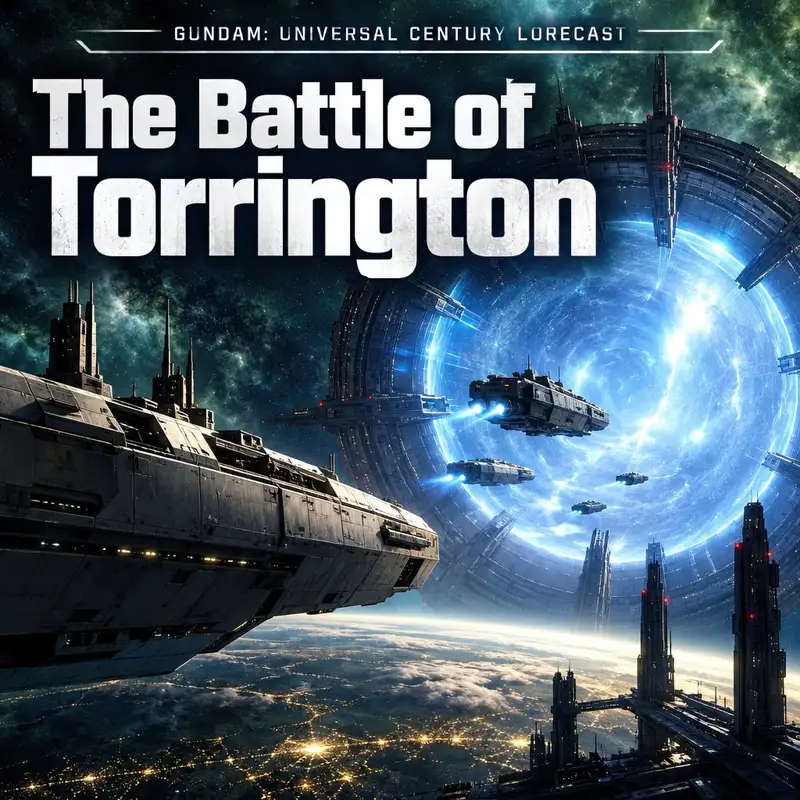
The Battle of Torrington
The first warning at Torrington did not come from a new weapon. It came from old silhouettes moving with purpose. Zeon machines from wars that were supposed to be over appeared against an Earth Federation base that had become accustomed to being important mainly on paper. Their armor was old. Some of their designs belonged to the One Year War. Their operators, however, had not become harmless with age, and neither had the networks that kept them supplied, hidden, and ready.
That is the central fact of the Battle of Torrington. Obsolete is not the same as irrelevant. A machine can be decades old and still kill if it has ammunition, maintenance, a trained pilot, and an enemy caught without warning. A low-priority garrison can possess mobile suits and defensive works, yet still fail because its forces are dispersed, its readiness is uneven, and its commanders do not understand the size or direction of the threat until the attack is already underway.
Torrington was not a front-line fortress in Universal Century ninety-six. It was an Earth Federation installation in Australia, carrying a long institutional memory but not the concentration of modern forces associated with the Federation’s major fleets or strategic space bases. That distinction mattered. The defenders faced the kind of danger that peacetime bureaucracies routinely underestimate: not an invasion announced by fleets on long-range sensors, but a force assembled quietly from personnel, equipment, and grievances that had survived in the gaps between wars.
The attack came during the Laplace Incident, at a moment when Federation authority was already under political strain. The assault on Dakar had shown that the crisis surrounding Laplace’s Box was not confined to secret negotiations, private corporate interests, or distant space colonies. It could reach the Federation’s political center. Torrington, meanwhile, became significant because the La+ Program directed Banagher Links and the Garencieres toward it as the next location connected to the Box.
That made the base more than a military objective. Torrington was a coordinate in a hidden historical record, but it was also a place where old violence, current insecurity, and contested political memory converged. The La+ Program did not lead Banagher to a neutral archive. It led him toward a base surrounded by people for whom the history of Zeon, Federation rule, defeat, occupation, and abandonment was still very much alive.
For Banagher, the journey to Torrington began as part of an attempt to understand what Laplace’s Box was and why so many powerful institutions feared it. For others, the same location offered a chance to settle accounts by force. That difference in purpose would become decisive. The battle was never controlled by a single, uncomplicated plan. It involved the Sleeves, the Earth Federation, the Garencieres, and Earth-based Zeon remnants with their own veterans, memories, loyalties, and resentments.
Yonem Kirks led the remnant force that struck Torrington. His people were connected to the wider anti-Federation world represented by Full Frontal and the Sleeves, but they should not be treated as one centrally administered army. The animated record shows cooperation, support, and shared interest. It does not show a clean command chart in which every surviving Zeon veteran on Earth takes orders from the same headquarters. That ambiguity was not merely bureaucratic. It shaped the operation’s limits.
Loni Garvey stood at the center of those limits. Her anger toward the Federation was personal, political, and inherited. Her family’s history and the accumulated bitterness of the remnant community gave the coming attack an emotional force that formal military orders could not easily restrain. She was not simply an irrational combatant who appeared from nowhere to create a tragedy. She was the product of a political environment in which real grievances had been preserved, sharpened, and handed down through the memory of war.
But grievance is not a command system. It can motivate people to fight. It can sustain loyalty after defeat. It can help veterans hide weapons, preserve old machines, and wait for an opportunity. It cannot by itself provide strategic direction, industrial depth, reliable discipline, or a political program capable of governing what violence destroys. Torrington would demonstrate both sides of that truth.
The Earth-based remnants possessed capabilities that were easy to dismiss from a distance. They had veterans who understood mobile-suit warfare. They had local contacts and concealment. They had workshop knowledge, parts scavenged or preserved over years, and access to equipment that the Federation had apparently failed to locate or considered no longer worth serious concern. They also had the psychological cohesion created by a common story of defeat and injustice.
Some of their machines made that history visible. The Dom Tropen, for example, was an old tropical and desert variant rooted in the One Year War. In another context, it might have been treated as a relic, an aging machine maintained for local defense, training, or ceremonial value. At Torrington, it was a functioning combat system in the hands of a force that had selected its time and place. Its importance was not that an old Dom could somehow defeat history. Its importance was that history had left weapons, technicians, and trained people behind.
Other machines showed that the remnants had not been frozen in the past. The Zee Zulu was a Sleeves-developed amphibious mobile suit supplied to Kirks’s terrestrial force. That support mattered because it gave the attackers access to a more modern capability suited to their environment. It also revealed the coalition’s character. The remnants could preserve inherited matériel and maintain older systems. The Sleeves could provide selected newer assets. Together, they could create a dangerous striking force without becoming a self-sustaining conventional army.
That distinction is essential. A force can be capable of launching a raid, infiltrating an area, and overwhelming an unprepared garrison without being capable of conducting a prolonged campaign. The remnants did not demonstrate a secure industrial base. They did not demonstrate a replacement pipeline for pilots and machines. They did not demonstrate the ability to hold territory against a determined Federation counterattack. Their strength was episodic. They could concentrate for a blow. They could not easily recover from the losses that followed.
Concealment was therefore as important as firepower. A machine hidden for years is not strategically useful merely because it still exists. Someone must protect it from discovery, maintain it, fuel it, arm it, and preserve the knowledge required to operate it. The remnant force’s appearance at Torrington implied a social infrastructure of survival. Former soldiers, sympathetic communities, private workshops, caches, and channels of communication had endured beneath the Federation’s formal control of Earth.
That should have concerned the Federation long before the first shots were fired. An armed remnant network is not defeated simply because its former state has surrendered, its major fleets have been destroyed, or its symbols have been driven from public power. If the political conditions that supported the network remain unresolved, the military problem survives in a quieter form. It becomes a problem of intelligence, policing, reconciliation, legitimacy, and the difficult work of distinguishing a defeated enemy from a defeated population.
At Torrington, the remnants used surprise to turn those latent strengths into immediate local superiority. The defenders had to identify the threat, determine its direction, organize communications, and commit available units while under attack. In a Minovsky-era battlefield, that process was never effortless. Particle interference did not make every sensor blind or every radio silent, but it reduced the comfort of long-range awareness and made local observation, visual identification, and prearranged command relationships more important.
A base caught in that condition does not need to be defenseless to be vulnerable. It only needs to be unable to concentrate effective force quickly enough. Torrington’s local garrison had mobile suits and defensive capacity, but it did not begin the battle with the advantage of preparation. Its equipment was uneven. Its personnel were reacting to an assault rather than executing a rehearsed defense against a known enemy plan. The attackers, by contrast, had already chosen their avenues of approach and arrived with a clearer sense of immediate purpose.
The early fighting exposed the difference between possessing military hardware and possessing readiness. Federation units could fight, but they were drawn into a confused defensive battle in which the attackers controlled tempo. Remnant machines pushed into the base area, forcing local defenders to divide their attention among threats from different directions. Under those conditions, older equipment still had value. A Zaku, Dom, or amphibious machine did not need to be technologically superior to disrupt command, threaten installations, and create enough confusion for a larger plan to develop.
This was not proof that the Federation had abandoned Earth or that every Federation ground unit was obsolete. It was proof of something more specific and more believable. The Federation had a layered military system, but its layers were unevenly distributed. A regional installation could be underprepared even while advanced mobile suits and experienced task forces existed elsewhere. Strategic power is not measured only by what a government owns. It is measured by what it can place at the decisive point before the enemy achieves his objective.
The remnant assault briefly demonstrated that the Federation’s security presence was thinner than its political authority suggested. The Federation governed vast territory, fielded fleets, maintained advanced research programs, and retained powerful mobile-suit forces. Yet a hidden network of veterans could still choose a vulnerable base and force the government to react. That was a tactical success, and it had political meaning. It showed that the old wars had not been fully contained.
But penetration of a base is only the beginning of an operation. The next question is whether the attacker can exploit that penetration. Can the force destroy or seize a specific asset? Can it withdraw in good order? Can it bring reserves forward? Can it hold a captured position? Can it prevent enemy reinforcements from changing the balance? At Torrington, the answer to those questions became increasingly unfavorable to the remnants as the Federation shifted from local defense to a broader response.
The Ra Cailum and Londo Bell represented that broader response. Bright Noa’s force was not the same institution as Torrington’s local garrison, and treating them as one undifferentiated Federation force would conceal the battle’s main lesson. Torrington had been caught unready. Londo Bell arrived as a mobile, experienced task force with better coordination, more capable units, and a command structure accustomed to operating amid political uncertainty and mobile-suit combat.
Londo Bell’s intervention showed that the Federation retained substantial military capacity. It also showed that capacity had arrived late. The Ra Cailum did not prevent the attack through perfect warning, intelligence, or deterrence. It helped reverse the attack after the danger was visible. That is an important distinction in any military system. Reactive strength can win a battle. It does not necessarily mean the security architecture that allowed the battle to begin was sound.
Among the responding units were the Tri-Stars, a Jesta team led by Nigel Garrett, with Daryl McGuinness and Watts Stepney. Their Jestas were associated with the Federation’s stalled U.C. Project, but the important point at Torrington was not a model designation. It was the combination of modern machines, trained operators, coherent employment, and support from an experienced task force. The Jestas were not simply stronger pieces on a battlefield board. They belonged to an organization capable of bringing them into the fight effectively.
Modern equipment matters when it is connected to training, maintenance, command, and a clear mission. A capable mobile suit without a prepared pilot, reliable communications, ammunition, and tactical coordination is merely expensive hardware waiting to become wreckage. The Tri-Stars mattered because they arrived as part of a functioning combat system. Their presence helped restore the Federation’s ability to identify threats, coordinate fires, and impose pressure on remnant units that had expected to exploit a collapsing defense.
The Federation recovery was not a parade of technological inevitability. It was a restoration of operational coherence. Once the attackers lost the advantage of surprise, their mixture of old machines, limited newer support, and decentralized organization became more difficult to manage. They could still fight hard. Individual remnant pilots could still use terrain, experience, and local familiarity. But they could not easily absorb the arrival of a more coordinated force with better mobility and more secure access to reinforcement.
The battle changed again when an exceptional local Federation asset entered the fight. The RX-160S Byarlant Custom was not an ordinary garrison mobile suit. It possessed a degree of atmospheric mobility that gave it a major advantage over many of the remnant machines operating around Torrington. In practical terms, it could attack from angles and elevations that ground-bound units could not easily answer. It changed the geometry of the engagement.
That kind of mobility is especially valuable in a confused defensive battle. A fast, airborne mobile suit can move between threatened sectors, strike exposed attackers, and exploit gaps before an enemy force can reorganize. It can turn terrain and altitude into defensive assets. At Torrington, the Byarlant Custom’s performance disrupted the remnants’ momentum. It imposed losses and made it far more difficult for the attackers to turn their initial breakthrough into control of the base.
Its success should not be misunderstood. The Byarlant Custom did not prove that the Federation had fully modernized its terrestrial mobile-suit forces. It did not mean every Earth base possessed an atmospheric mobile suit of similar performance, or a pilot able to use such a machine effectively. The very fact that this particular unit stood out demonstrates the opposite. It was an exceptional capability, locally available at a moment when the base needed something exceptional.
The same caution applies to the Jestas and to Londo Bell itself. Their intervention proved that the Federation could recover. It did not prove that Torrington had been adequately defended. In fact, the battle required the Federation to reveal an uncomfortable truth about its own security posture. It had the means to defeat the attack once it recognized the threat. It had not done enough to prevent the threat from assembling in the first place.
As the assault on the base began to lose momentum, the operation’s political instability became more dangerous than its original military objective. A disciplined attack against a military installation can be evaluated in military terms, even when its broader cause is unjust or its methods are unlawful. Once violence shifts deliberately toward civilians, the character of the operation changes. It becomes not merely a contest over territory or military power, but an act of punishment directed at people who may have no meaningful control over the historical wrongs being invoked.
That was the significance of the Shamblo. The Shamblo was a powerful amphibious mobile armor, and its deployment took the conflict beyond the fight for Torrington Base. Its weapons and mobility made it a devastating instrument in an urban environment. Used against military positions, it represented a formidable escalation. Used against civilian infrastructure and population centers, it transformed the battle into a catastrophe.
Loni Garvey’s role in that catastrophe must be understood accurately. Her hatred of the Federation did not emerge from a vacuum. It was rooted in personal loss, in the legacy of her father, and in the broader political memory carried by the Earth-based remnants. She had inherited a world in which defeat had not brought reconciliation, and in which many people treated past suffering as proof that future suffering could be justified.
That inheritance helps explain her actions. It does not excuse them. The people threatened by the Shamblo were not abstractions called the Federation. They were civilians living inside the institutions and landscapes left by previous wars. Many had no more control over the Federation’s failures than Loni had over the decisions that destroyed her family’s world. Once the Shamblo began attacking civilian areas, the remnants lost the ability to present their violence as a disciplined challenge to military authority.
This was the operation’s decisive political failure. The remnant force had exposed a real weakness in Federation security. It had shown that armed networks survived beneath the surface of postwar order. It had demonstrated that old resentments remained militarily dangerous. But the Shamblo’s assault converted those facts into a spectacle of indiscriminate revenge. Instead of building support, it confirmed every Federation argument that remnants had to be treated as a permanent security threat.
That result was not inevitable in the narrow military sense. The remnants could have withdrawn after the base assault. They could have focused on a defined military objective. They could have tried to preserve combat power for future operations. Such choices would not have solved their strategic weakness, but they might have prevented the operation from collapsing into a massacre. Instead, anger, memory, and enormous firepower came together without sufficient political discipline to control them.
The Shamblo was therefore not simply a larger machine entering the battle. It was evidence of a movement losing control of its own purpose. The more the operation centered on civilian destruction, the less it mattered whether the remnants had achieved surprise at Torrington. The raid’s military logic was overtaken by the emotional logic of vengeance. At that point, stopping Loni became a humanitarian necessity, a tactical necessity, and a political necessity.
Banagher Links understood that necessity differently from many of the soldiers around him. He did not see the destruction of the Shamblo as the only imaginable answer. He tried to reach Loni. That effort was often treated by those around him as impractical, even dangerous, because the Shamblo was actively killing people and remained an immediate battlefield threat. In one sense, those objections were entirely reasonable. A commander cannot allow a weapon of that scale to continue firing while waiting indefinitely for a personal breakthrough.
But Banagher’s intervention was not simply naïve refusal to confront military reality. He recognized that Loni was not only the pilot of an enemy mobile armor. She was also a human being shaped by the same cycle of violence that had brought everyone to Torrington. If the battle was reduced to destroying targets, then the Federation could remove the Shamblo while learning nothing about why another young person had been turned into a weapon of inherited hatred.
Empathy, however, is not a technical solution. It does not stop incoming fire by itself. It does not repair a collapsed command structure, rebuild trust, or undo years of political manipulation. Banagher’s attempt to reach Loni failed to save her. That failure is central to the battle’s tragedy. He was right to see a person where others saw only a target, but recognition did not give him the power to reverse the conditions that had already brought the Shamblo into the city.
Riddhe Marcenas entered the engagement from a different position. Operating the Delta Plus, he faced an immediate military threat that had to be contained. His role at Torrington placed him between professional duty and the political weight of his family background. The Marcenas name was already bound to the wider crisis around Laplace’s Box, and Riddhe’s participation made the battle more than a simple clash between soldiers and remnants. It connected the violence on the ground to the legitimacy crisis unfolding at the highest levels of Federation society.
In practical terms, the pilots confronting the Shamblo faced competing imperatives. They could attempt to disable it. They could try to communicate with its pilot. They could seek to contain its movement and limit harm to civilians. Or they could destroy it before it caused further devastation. None of those choices was clean. The longer the Shamblo remained active, the greater the civilian danger. The more force used against it, the more likely the battle would end with Loni’s death and further destruction.
The final outcome was not a victory in any satisfying human sense. The Shamblo was destroyed. Loni was killed. The immediate threat ended, but Banagher’s effort to save her did not succeed. The Federation prevented further destruction, yet it did so only after a remnant force had penetrated a base, exposed its vulnerabilities, and turned a local military operation into an urban tragedy. The surviving participants were left with a battlefield secured, but no political problem solved.
The confrontation involving the Unicorn, the Delta Plus, and the Banshee followed in the immediate aftermath of Torrington, but it belongs to a different phase of the Laplace Incident. The battle for the base and the Shamblo crisis had already revealed their essential lessons. Torrington was not decided by a single duel between exceptional pilots. It was decided by surprise, readiness, reinforcement, mobility, fragmented command, and the disastrous political consequences of directing violence at civilians.
The Shamblo made that strategic failure worse. Violence against civilians may produce terror, but terror is not the same as political power. It can harden the enemy, isolate potential supporters, and hand an established government a compelling justification for security measures. The Federation did not need to invent a narrative about the danger of remnant violence after Torrington. The Shamblo provided visible evidence. The tragedy is that this evidence did not erase the Federation’s own failures. It merely made those failures easier to ignore.
Grievance can recruit. Memory can motivate. Shared loss can create a fierce sense of solidarity. None of those things can substitute for political discipline. A movement that cannot distinguish military pressure from collective punishment eventually destroys the moral ground beneath its own claims. Torrington showed how quickly a remnant force can move from exposing a genuine weakness in state power to confirming the state’s most convenient story about why dissent must be crushed.
Operationally, the arrival of the Ra Cailum demonstrated the value of mobile reserve forces. Bright Noa’s command could move capable units toward a crisis and impose order on a confused battlefield. That is a genuine strength. A government facing dispersed threats needs forces able to respond rapidly across wide distances. But the value of a reserve force should not be confused with proof that the broader security system is working. If every crisis requires an elite mobile unit to rescue an underprepared local garrison, then the system is relying on emergency response in place of prevention.
The Federation won the battle without being vindicated by it. It restored control, but control is not settlement. It destroyed the Shamblo, but destruction does not erase the memories that made Loni vulnerable to remnant ideology. It repelled an attack on Torrington, but it could not claim that the attack emerged from nowhere. The battle exposed both the danger of remnant violence and the fragility of an order that had failed to resolve the war’s political aftermath.
Torrington carried historical weight long before Universal Century ninety-six. During the Delaz Conflict, it had been associated with the theft of the nuclear-armed Gundam Prototype Two. That earlier event belongs to a different conflict, with different commanders, institutions, and objectives. It should not be merged into the later battle as though the same operation had simply continued for more than a decade. The U.C. 0083 crisis and the Laplace Incident were distinct historical episodes.
Still, the earlier association matters as institutional memory. Torrington had already become a place where Federation security failed in a way that carried consequences far beyond the base itself. The theft of Gundam Prototype Two helped set in motion the chain of events that led toward Operation Stardust and the political conditions exploited by the Titans. By Universal Century ninety-six, the base again became a symbol of a government discovering that it had not safely buried the past.
The pattern was not that Torrington was cursed. Military history rarely needs curses when institutions will do. The pattern was that victories had been followed by incomplete settlements. Old infrastructure remained. Old resentments remained. Veterans remained. Political myths remained. Weapons survived in caches, depots, and private networks. A state that mistakes the defeat of an enemy formation for the resolution of an enemy cause may find that the war returns through a different organization, in a different decade, wearing different insignia.
That does not mean every remnant movement is identical, or that every later anti-Federation force descends directly from a single hidden chain of command. The Earth-based fighters at Torrington were not simply the Delaz Fleet reborn, nor were they an entire government in exile. Their coalition had its own circumstances, its own links to the Sleeves, and its own internal fractures. The historical continuity lies less in formal organization than in unresolved political conditions and recurring failures of security policy.
Torrington therefore cannot be understood as a simple victory for either side’s preferred narrative. It was not proof that old Zeon machines could defeat modern Federation power. The remnant force achieved surprise, but could not sustain its operation. It was not proof that Federation technology had rendered old grievances irrelevant. The Federation prevailed, but only after its underestimation of those grievances had become a military problem.
The Dom Tropen and the Zee Zulu represented different forms of remnant capacity. One reflected the preservation of old matériel and old expertise. The other reflected limited modernization through Sleeves support. The Jestas represented a more advanced and organized Federation response. The Byarlant Custom represented exceptional local capability. The Shamblo represented what happened when political rage acquired a weapon too destructive for the movement using it to control.
None of those machines, by themselves, explains the battle. Machines do not choose targets, preserve supply networks, neglect intelligence warnings, or decide that civilians should pay for inherited crimes. People and institutions do those things. Torrington was shaped by a Federation that had allowed an old base to become vulnerable, remnants that had preserved enough capacity to exploit that vulnerability, and a political culture in which suffering was repeatedly converted into another reason to inflict suffering.
The remnants proved that the Federation could still be surprised. They did not prove that they could replace it. The Federation proved that it could still concentrate force and recover from attack. It did not prove that it had created a durable peace. Between those two incomplete truths stood Loni Garvey and the Shamblo, the battle’s most terrible political fact.
Once the attack became revenge against civilians, it ceased to be a credible challenge to military authority and became evidence of a movement consumed by the past it claimed to avenge. Torrington was not a triumph of old Zeon machines or modern Federation technology. It was a demonstration that unresolved war memory remains militarily dangerous when institutions mistake suppression for settlement.