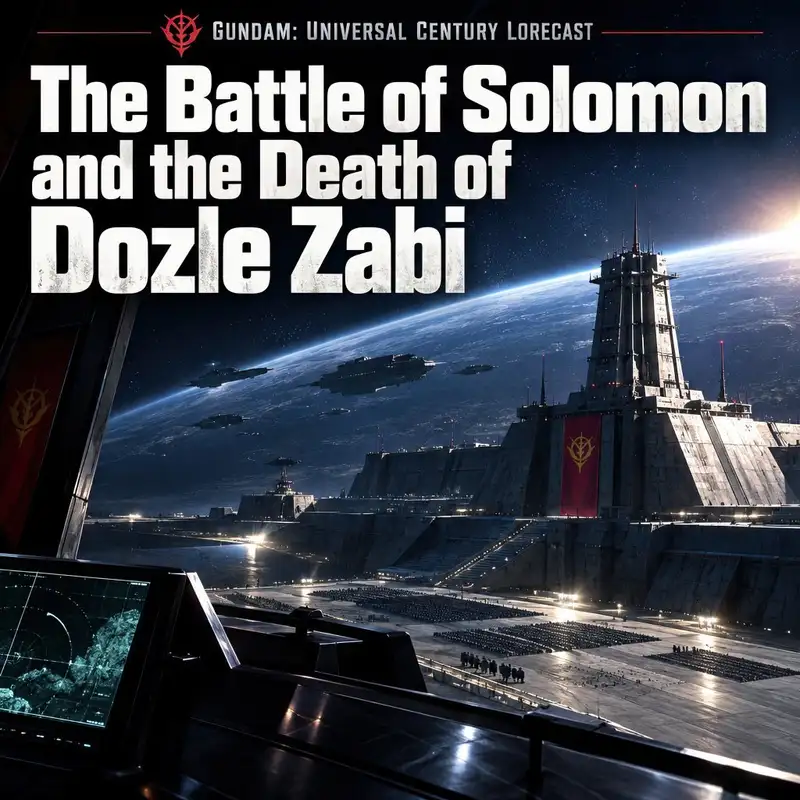
The Battle of Solomon and the Death of Dozle Zabi
Before the Federation fleet fired on Solomon, two supply chains told the story of the coming battle. Columbus-class transports replenished the White Base and the wider assault force with the ordinary requirements of sustained combat: provisions, ammunition, replacement stores, and the support needed to keep ships and mobile suits operating after the first exchange of fire. At Solomon, a Papua-class transport arrived carrying components of the Big Zam, a new mobile armor that had not arrived as part of a settled defensive system, but as an urgent answer to a crisis already approaching. One side was preparing an offensive that could absorb losses and continue. The other was receiving a singular weapon in pieces, hoping that it could restore a position that broader events had already made difficult to hold. Logistics rarely offers the drama of a mobile suit launch, but it has a habit of revealing what commanders can sustain, rather than merely what they can display.
Solomon was not simply another asteroid base on the Federation’s route through space. It was one of the Principality of Zeon’s major forward strongpoints, a fortified position in the former Side One region and part of the defensive structure shielding the remaining centers of Zeon power. Its docks, hangars, weapons, and protected interior spaces gave Zeon a place from which to stage mobile suits, shelter ships, repair equipment, and threaten any Federation advance toward the homeland of the Principality. In a war shaped by orbital routes and limited staging points, such a fortress mattered because it anchored operations. It gave defenders a fixed base, known defenses, and a position from which to force an attacker to pay for every approach.
But a fortress is only as strong as the forces that can support it. Solomon could concentrate firepower and protect a garrison. It could not move away from danger. It could not create new ships, trained pilots, or replacement machines once its stocks had been consumed. It could not guarantee that reinforcements would arrive through a contested battlespace. And it could not remain secure if the enemy achieved the ability to suppress its outer defenses, penetrate its defensive envelope, and cut the fortress off from the operational role it had been built to perform. By the final weeks of Universal Century seventy-nine, those were no longer abstract concerns for Zeon.
The Federation had entered the One Year War at a severe disadvantage in mobile-suit warfare. Zeon possessed the initiative, a mature mobile-suit arm, and the confidence that came from early victories. The Federation still possessed deeper reserves of population, industry, territory, and production capacity, but those advantages took time to organize. Armies do not appear merely because a government has factories. They require designs, machine tools, transport, trained crews, officers, repair facilities, ammunition, and a command system capable of using new equipment without simply adding confusion to an already difficult war.
By the time of the Solomon operation, the Federation had recovered enough of that capacity to conduct a major space offensive. Its victory on Earth had changed the balance, but it had not ended the war. Zeon still held formidable positions in space, and its asteroid fortresses remained barriers between the Federation and the final military centers of the Principality. The Federation could not simply ignore Solomon and proceed. A hostile fortress in the rear or on a flank could threaten transport routes, disrupt resupply, shelter mobile-suit forces, and complicate every movement forward. A campaign toward Zeon’s remaining defenses required more than passing through space. It required reducing or neutralizing positions that could turn that route into a killing ground.
The Federation’s problem was therefore operational, not merely tactical. It had to approach a fortress built to fight in the conditions of Minovsky particle warfare. Long-range radar and communications could not be treated as perfectly reliable. Commanders could not assume they would observe every maneuver in real time or issue detailed corrections after battle had begun. Plans had to be prepared in advance. Subordinate commanders had to understand their missions. Ships, assault craft, mobile suits, and support units needed enough coordination to act on a common intent even when the battlefield became confused.
The attacking force also had to survive the practical work of closing on Solomon. Warships needed to maintain formation, defend themselves, launch mobile suits, recover damaged machines when possible, and keep their crews supplied. Mobile suits needed carriers, hangars, technicians, propellant, weapons, and pilots who could still function after repeated sorties. Assault craft had to move into dangerous areas where fixed defenses could engage them. The Federation did not solve these problems with one famous machine. It solved them by assembling a force capable of doing several things at once: suppressing defenses, opening routes, protecting the fleet, launching mobile-suit formations, and continuing the attack after casualties began to mount.
The White Base was part of that larger system. By this stage of the war, it had become a remarkably experienced combat vessel, carrying pilots and crew members who had endured campaigns from Earth orbit to the surface and back into space. Lieutenant Bright Noa commanded the ship, and his authority over its crew was real. But he was not the architect of the Solomon offensive, nor was the White Base an independent navy operating outside Federation command. It was one combat-capable formation within a much larger assault. Its importance lay partly in its ability to contribute experienced personnel and unusually capable machines to a Federation effort that was no longer dependent on it alone.
For Dozle Zabi, the situation was different. He was a senior Zeon commander, a member of the ruling Zabi family, and the officer responsible for Solomon’s defense. Those facts gave him authority, prestige, and access to resources that an ordinary fortress commander would not have possessed. They did not give him control over the entire Principality’s war effort. Dozle did not command every Zeon fleet, every industrial concern, or every decision made by his brothers and sister in the wider Zabi leadership. He had a fortified position and local forces. He had responsibility for their employment. But he was operating inside a strategic situation shaped by losses elsewhere, pressure from the Federation, and a shrinking margin for error.
A fortress commander begins with certain advantages. Solomon’s defenses could concentrate fire from prepared positions. Its interior facilities protected maintenance crews, stores, and mobile-suit units from the immediate hazards of open space. It gave Zeon pilots a known point of return and allowed defenders to sortie under the cover of fixed weapons. In the best case, the fortress forced the attacker to approach through constrained avenues while suffering losses from guns, mobile suits, and counterattacks. The attacker had to expose ships and assault forces. The defender could make each advance expensive.
Yet those same strengths could become weaknesses after a breach. A fixed position has no room to maneuver when an enemy develops a way to suppress its defenses. Its hangars and docks are useful only while it can safely launch and recover forces. Its prepared weapons are valuable only while their fields of fire remain intact and their crews can communicate and receive power, ammunition, and direction. Once the outer defensive system began to fail, Solomon would no longer be merely a fortress. It would become an isolated military community trying to evacuate personnel, preserve what equipment it could, and decide which forces would remain behind to cover the withdrawal.
The Federation’s opening assault was designed to bring Solomon toward that point. Assault craft and fleet elements pressed against the fortress defenses, seeking to disrupt defensive fire and force Zeon’s mobile suits into battle beyond the safest cover of the asteroid. The objective was not to win a parade-ground duel in open space. It was to make Solomon’s defenders react. Every sortie committed mobile suits to a contested volume of space. Every defensive weapon forced to engage a decoy, an assault craft, or a screening force had less freedom to fire on the main body of the attack. Every local response created information that Federation commanders and pilots could use to judge where the defense was strongest and where it might be strained.
In Minovsky conditions, that contest depended heavily on local initiative. Communications could become uncertain. Visual observation, prearranged orders, short-range coordination, and individual judgment mattered more than in a battle where a distant headquarters could track every unit continuously. This made combat more dangerous, but it did not make command irrelevant. Quite the opposite. It increased the value of the planning done before the first shot. A force whose pilots, ship crews, and commanders understood the larger mission could continue acting even when the battlefield became fragmented. A force depending on one central voice to direct every movement was likely to lose coherence when that voice could no longer reach everyone.
The Federation’s most important prepared instrument at Solomon was the Solar System. It was not a mobile suit, a ship’s main gun, or an improvised battlefield trick. It was a large-scale solar-energy weapon, using mirrors positioned in the debris field to concentrate sunlight against the fortress. Its value came from the fact that Solomon could not evade it. A ship might maneuver. A mobile suit might dodge, accelerate, or seek cover. An asteroid fortress could alter neither its position nor its silhouette quickly enough to escape a weapon designed around its fixed nature.
The Solar System mattered because it changed the terms of the battle. Solomon’s defenses had been built around the expectation that attackers would have to endure their fire while closing range. Concentrated solar energy damaged and suppressed parts of that defensive system, creating the opportunity the Federation needed. It did not erase every Zeon weapon, vaporize the fortress, or end resistance by itself. It weakened the defensive structure at the moment when the Federation was prepared to press forward. The weapon was effective not because it existed in isolation, but because ships, assault elements, and mobile-suit formations were already positioned to convert damage into momentum.
This is the practical meaning of a siege weapon in a space war. It does not have to destroy every target to matter. It has to alter the defender’s ability to organize resistance. It can blind, suppress, damage, disrupt, or force a withdrawal from key positions. But once it has done that, ordinary military work resumes. Forces must advance. Strongpoints must be cleared or bypassed. Routes must be secured. Casualties must be treated. Damaged ships and machines must either be recovered or left behind. The attacker must maintain enough coherence to avoid turning an initial advantage into a confused and costly stalemate.
After the Solar System created that opening, Federation mobile-suit forces became central to the penetration. This was one of the battle’s largest historical meanings. The Federation had moved beyond the stage when a handful of prototypes and improvised crews represented its entire answer to Zeon’s mobile-suit arm. GM units and Balls entered the battle alongside the White Base’s more famous machines. They did not all possess the Gundam’s performance, and they did not need to. Their importance was organizational. They gave the Federation a broader body of units able to screen ships, engage Zeon mobile suits, carry the fight into contested space, and absorb missions that could not be assigned to one prototype team.
The Ball, in particular, illustrates the difference between a weapon’s glamour and its military function. It was not a replacement for a high-performance mobile suit. It was a simpler combat machine suited to a force expanding under wartime pressure. Its presence showed that the Federation was willing to field systems of different capability for different roles within a larger battle. A navy that can only use elite equipment in tiny numbers remains brittle. A navy that can pair capable mobile suits, simpler auxiliary machines, warships, transport, and repair support has a better chance of sustaining a campaign.
The GM formations represented the same broader shift. A mass-deployed mobile suit does not need to equal a unique prototype in every respect to transform a war. It needs to be built in sufficient numbers, issued to units, maintained by available technicians, supported by available ships, and operated by pilots who can be trained and replaced. That is a far less romantic process than the debut of a singular machine, but it is how military power becomes durable. At Solomon, the Federation’s mobile-suit program was becoming part of a fleet system rather than a collection of experiments.
The Gundam remained unusually capable, and Amuro Ray remained an exceptional pilot. Neither fact should be minimized. But the larger battle had changed around them. The Gundam was no longer the sole visible proof that the Federation could fight in the mobile-suit era. It operated amid a growing structure of ships, launches, sorties, GM formations, Ball units, and coordinated assault forces. That was a strategic problem for Zeon. Its early superiority had depended not only on possessing mobile suits, but on possessing them before the Federation could respond at scale. By Solomon, the response had arrived.
As the Federation pressed inward, Dozle faced a different kind of command decision. The question was no longer simply how to defeat the attacking fleet. It was how much of Solomon’s military community could be preserved. His order to evacuate Zenna Zabi and their daughter, Mineva, carries importance beyond the family connection. It indicates that the fortress commander understood the position might not be held. A commander preparing only for victory does not make arrangements to remove dependents from a collapsing base.
That evacuation also reminds us that Solomon was inhabited. A military fortress in space requires more than pilots and gunners. It contains technicians, medical personnel, administrators, transport crews, maintenance workers, support staff, and families connected to the garrison. The historical record does not provide a complete account of every person evacuated or left behind. It would be wrong to invent one. But the presence of Zenna and Mineva makes the larger truth impossible to ignore. Fortresses are not abstract icons on a strategic map. They are communities built around military purpose, and when they become battlefields, civilians and dependents are drawn into the consequences of decisions made far above them.
The weapon available to him for that purpose was the Big Zam. It is important to name it accurately. The Big Zam was a mobile armor, not a mobile suit. Its size, armament, and defensive systems placed it in a different category from the standard fighting machines being launched from ships and hangars throughout the battle. It was a concentrated instrument of shock, designed to bring enormous firepower and specialized defense into a sector where the enemy had massed ships and mobile suits. In the conditions around Solomon, that made it extraordinarily dangerous.
The Big Zam’s anti-beam defensive system and heavy weapons gave it a powerful local advantage. Against a dense Federation attack, it could inflict serious damage, disrupt formations, and force commanders to reconsider how closely their ships and mobile suits could press the battle. Its sortie was not a routine deployment of a mature weapons program. It was the commitment of a single exceptional machine at the point of crisis. That distinction shaped both its strength and its limitations. As a battlefield shock weapon, it could change the immediate situation. As a strategic answer to Solomon’s fall, it was far too late and far too singular.
Dozle personally entered the Big Zam and launched into the battle. This was a courageous act, but it was also a measure of desperation. A senior fortress commander taking personal control of a unique mobile armor can inspire troops and concentrate decision-making. It can also reveal that there are no sufficient reserves left to commit. The Big Zam’s mission was not to reconquer the entire operational situation. Its practical purpose was to punish the Federation assault, disrupt the fleet, protect the remaining withdrawal, and make the capture of Solomon as costly as possible.
In that role, it succeeded for a time. The Federation had achieved a breach, but the breach did not guarantee an easy advance. Big Zam forced the attackers to adapt under fire. Ships and mobile suits that had been advancing against a damaged fortress now faced a weapon built to dominate the immediate battlespace. This is the point at which tactical history can become misleading if viewed too narrowly. It is tempting to say that Big Zam nearly turned the battle around because its arrival was so dramatic and its effects so severe. But a local counterattack, however destructive, is not the same thing as restoring a defense that has already been penetrated.
The Big Zam could destroy targets. It could not repair Solomon’s defensive network. It could not reopen secure lines of reinforcement. It could not replace the mobile suits and crews already lost. It could not remove the Federation fleet from the region or undo the preparations that had brought the Solar System into action. It could not produce a second Big Zam, or a squadron of equivalent machines, from the resources available during the battle. And it could not change the fact that the Federation had assembled forces able to take losses and continue fighting.
Its anti-beam protection also did not make it invulnerable. Defensive systems have geometry, limits, and vulnerabilities. A weapon designed to blunt one form of attack may be exposed to another angle, another range, or another method of engagement. The Battle of Solomon demonstrates this without requiring unsupported claims about exact technical performance. The Federation did not defeat Big Zam by discovering a universal formula for defeating every mobile armor. It defeated it through a costly, improvised concentration of effort at a moment when the machine’s local advantages could be challenged.
Sleggar Law’s attack was central to that moment. Sleggar had joined the White Base late in the war, bringing experience and a hard-edged professionalism to a crew composed largely of people who had been forced into war before they were ready. At Solomon, he understood the danger posed by Big Zam and chose to attack despite the likelihood that he would not survive. In the television version of the battle, the action is tied to the G-Fighter-associated equipment of that continuity. The later compilation films use a different presentation. The distinction matters because the accounts should not be silently blended, even though the military meaning remains similar.
Sleggar’s sacrifice created an opening. It did not destroy Big Zam by itself, and it did not win Solomon as an isolated act of heroism. It changed the immediate tactical problem. The mobile armor had forced the Federation onto the defensive in its vicinity. Sleggar’s attack disrupted that advantage long enough for Amuro to exploit the opportunity. Amuro’s destruction of Big Zam ended the counterattack and killed Dozle Zabi. The sequence is rightly remembered because individual decisions mattered under extreme pressure. But its significance becomes clearer when placed within the battle that had already been underway.
Amuro’s success was meaningful because the Federation assault had created a situation in which Big Zam was fighting alone against an enemy able to keep applying pressure. Sleggar’s action mattered because the Federation still had another capable pilot and machine positioned to act on the opening. The larger fleet mattered because the battle for Solomon did not depend entirely on the outcome of one encounter, even though that encounter was decisive for the immediate survival of the attacking force. Heroism mattered. It simply did not replace the ships, mobile suits, logistics, siege preparation, and operational pressure that made the final result possible.
Dozle’s death marked the end of the Big Zam sortie, not the instant at which Solomon became lost. The fortress had already been brought to the point where its commander was ordering evacuation and committing his last extraordinary reserve. His final counterattack inflicted major losses and bought time. Those are real military effects. A delaying action can matter greatly, especially when people are trying to escape a collapsing position. But a delay is not a reversal. When Big Zam was destroyed, Dozle had no equivalent force left with which to restore the outer defense or drive the Federation away.
Solomon was abandoned or captured by the Federation and later became known under Federation control as Konpei Island. For the participants at the time, that later name did not answer the immediate question of survival. They were fighting for a fortress whose fall altered the next stage of the war. For the Federation, the victory removed a major Zeon defensive anchor and opened the route toward the remaining decisive theater at A Baoa Qu. For Zeon, it meant that another outer strongpoint had been lost at the moment when its ability to replace such positions was already failing.
Tactically, the battle showed how much damage a single well-employed mobile armor could inflict against an attacking force. Big Zam was not irrelevant because it was destroyed. It forced the Federation to pay a price and demonstrated that technological surprise could still produce severe local consequences late in the war. Sleggar’s death was part of that price. So were the losses suffered by the broader assault force. No serious military history should dismiss those casualties simply because the Federation eventually captured the fortress.
Operationally, however, Solomon was a Federation victory because the Federation achieved the objective that mattered. It broke through the fortress defense, neutralized the counterattack, and removed a major obstacle from the route ahead. This is why tactical damage and operational success must be kept separate. A defender can destroy enemy ships, kill experienced personnel, and still lose the position that made the battle strategically necessary. Conversely, an attacker can suffer serious losses and still gain the route, base, or political advantage for which the operation was launched.
Strategically, Solomon revealed that the Federation’s recovery had become more than a promise. It had built the capacity to concentrate fleets, sustain them through preparation, field expanding mobile-suit forces, employ a specialized siege weapon, and continue the attack after encountering an exceptional Zeon countermeasure. That combination mattered more than any single machine. It was the difference between possessing a technological answer and possessing a war-making system.
Zeon’s predicament was the reverse. The Principality still possessed skilled commanders, dangerous weapons, hardened troops, and fortified positions. Its forces could still fight with skill and determination. But local excellence could no longer compensate for the deterioration of the larger system. A fortress needed reinforcement. A prototype needed spare parts, trained maintenance personnel, doctrine, and follow-on production if it was to become more than a desperate intervention. A commander needed reserves and strategic depth if a delaying action was to become a counteroffensive. At Solomon, Zeon had courage and a formidable weapon. It did not have enough depth.
The political consequence was also severe. Dozle’s death removed one of the Zabi family’s principal military figures during the terminal crisis of their regime. That did not by itself cause Zeon’s defeat, and it would be too simple to make one family death explain the collapse of an entire war effort. The Principality’s problems were larger: aggressive war, strategic overreach, industrial imbalance, internal political rivalry, losses in the field, and the inability to turn early operational success into a durable settlement. Still, the death of a commander with Dozle’s authority narrowed the regime’s options at precisely the moment when it needed coherent leadership.
There is also a civilian meaning to Solomon’s fall. The evacuation of Zenna and Mineva makes visible the human population attached to military infrastructure, but it should not be treated as the only human cost that mattered. A fortress war places crews, technicians, dependents, and support personnel inside the path of destruction. The battle did not occur in an empty volume of space where only machines could be lost. Every damaged ship represented a crew. Every destroyed mobile suit represented a pilot and often the technicians who had kept it flying. Every evacuation order acknowledged that military positions are inhabited places, even when the narrative of war prefers to reduce them to objectives.
The Battle of Solomon was decisive because the Federation did not rely on a single superior machine or an irresistible weapon. It assembled supplies, ships, assault forces, expanding mobile-suit formations, and a prepared siege system into a coordinated offensive. Solar System created an opportunity. Fleet and mobile-suit forces converted that opportunity into penetration. The Federation then absorbed the shock of Big Zam and continued until Solomon could no longer remain a Zeon strongpoint.
Dozle Zabi’s final stand showed the other side of the equation. A determined commander, fighting personally in an exceptional prototype, could still impose terrible costs and protect a withdrawal. That courage was real. Its military effect was real. But it could not rebuild shattered defenses, create strategic reserves, reopen threatened routes, or reverse the balance between an emergency weapon and a functioning offensive system. Solomon fell because Zeon’s strongpoints could still fight fiercely, but no longer possessed the depth required to survive a coordinated Federation assault.