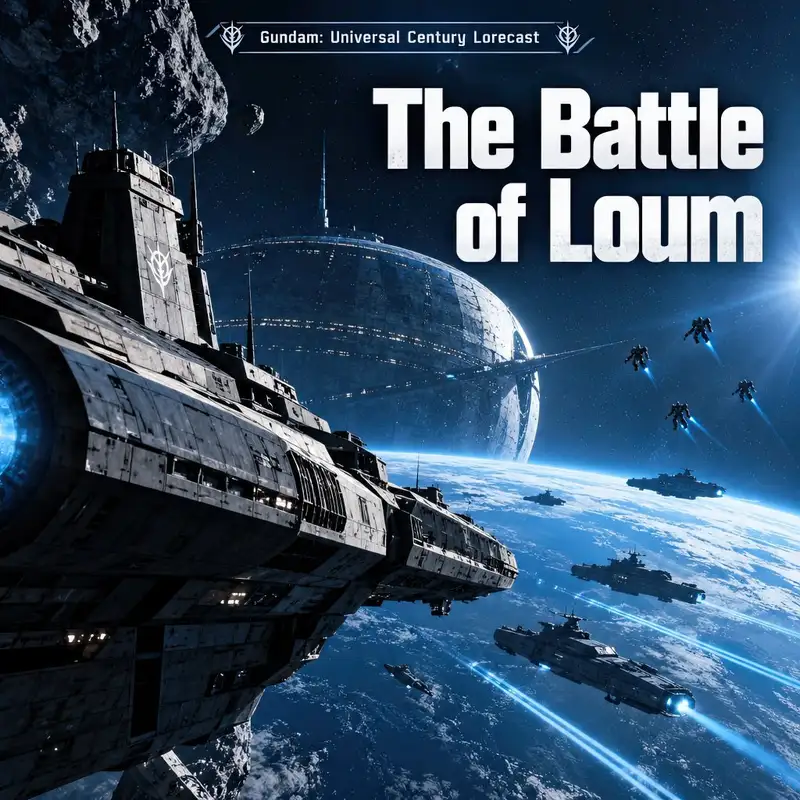
The Battle of Loum
A Federation warship at Loum faced a problem its designers had not solved. Its guns were built to engage other ships at range. Its officers expected to find the enemy, form a firing line, receive orders, and bring concentrated fire onto a target whose course could be plotted. Instead, Minovsky particle conditions weakened the radar, communications, and targeting assumptions behind that system. The ship was not blind. It could still see, detect, signal, and fight in limited ways. But it no longer possessed the clear, shared picture of the battlefield that conventional fleet doctrine required. Into that uncertainty came mobile suits. They did not approach as another battle line. They could attack from different vectors, close inside the most comfortable range of shipboard guns, and strike at propulsion, weapons, bridges, and exposed sections of hull. Loum was not simply a contest between old warships and new machines. It was a moment when a fleet built for one kind of battle discovered that the battle had changed around it.
The Earth Federation appeared, on paper, to hold the advantages that usually decide a major war. It possessed a larger population, broader territory, substantial industry, and a navy centered on powerful capital ships and cruisers. The Federation could build Magellan-class battleships, Salamis-class cruisers, fighter craft, transports, and the infrastructure needed to move them through the Earth Sphere. Zeon, by contrast, had begun the war from a smaller base. It could not expect to win an unlimited contest of replacement, industrial output, and manpower. Its strategy therefore depended on speed, shock, and the hope that the Federation’s political system would lose its will to continue before its larger resources could be fully organized for war. Loum was part of that calculation. Zeon did not need merely to sink ships. It needed to convince the Federation that continued resistance would cost more than compromise.
That political purpose gives Loum its place in the terrible opening of the One Year War. The One Week War and Operation British had already shown that Zeon’s leadership was prepared to use mass destruction on a scale that transformed the entire conflict. The war had become catastrophic before Loum began. The battle took place in the region of Side Five, among inhabited colonial space and vital infrastructure. This was not an empty ocean where fleets could trade fire without consequence for anyone else. Colony structures, transport routes, docks, civilian traffic, life-support systems, and communities existed in the same strategic environment as military formations. A damaged warship, a drifting wreck, or an uncontrolled attack could threaten far more than the uniformed personnel aboard combat vessels. The battle’s military purpose does not soften that reality. Zeon sought to preserve the initiative created by the war’s opening violence, cripple Federation military power, and improve its bargaining position. None of those aims made the larger war legitimate, and none guaranteed that military success would create a stable political outcome.
Zeon’s answer to its strategic weakness was not the mobile suit alone. It was the mobile suit as part of a system. The Zaku’s importance lay in its ability to operate in a Minovsky-disrupted environment where long-range fleet control had become less reliable. A mobile suit could maneuver independently, use visual identification at close range, exploit gaps between ships, and select vulnerable targets that a conventional cruiser duel might not expose so readily. It could attack a bridge, damage engines, destroy weapons, or force a ship to maneuver defensively at the wrong moment. Against a fleet trying to maintain formation and firing discipline, even a relatively small number of agile attackers could create confusion far beyond their own physical size.
But mobile suits were not self-sufficient knights drifting through space. They required ships to carry them into theater, hangars to launch and recover them, crews to arm and service them, technicians to repair battle damage, stores of propellant and ammunition, and commanders who could direct their employment. A Zaku could threaten a battleship, but it could not replace the cruiser, transport, tender, or command vessel that made its mission possible. Zeon’s innovation was doctrinal as much as technical. It understood that Minovsky conditions rewarded local initiative, close-range attack, and dispersed maneuver. It used fleet assets to place mobile suits where they could disorganize a larger enemy formation. Loum demonstrated the power of that combination. It did not demonstrate that logistics, warships, or command had ceased to matter.
The principal television-era history of Mobile Suit Gundam does not directly stage the Battle of Loum. It establishes the battle through its consequences. The Federation space fleet suffered a devastating defeat. General Revil was captured. Char Aznable emerged from the battle with a reputation that would follow him through the war. And the Federation, having seen what Zeon’s mobile suits could do, accelerated its own effort to develop comparable weapons. In that record, Loum is less a fully documented tactical narrative than an institutional shock. It is remembered because it changed what both sides believed about space warfare.
That indirect presentation matters. The television record does not provide a definitive combat map, a detailed sequence of every attack, or a complete order of battle. It does not authorize a historian to take every later depiction and paste it into one seamless account. Loum has been revisited by later works, and those works give different emphasis to its geography, participants, equipment, and chronology. Their value lies in the questions they illuminate. They cannot simply be treated as additional camera angles from the same uncontested historical record. The shared point is clearer than the disputed details. Zeon’s mobile suits helped turn a Federation fleet advantage into a major operational defeat. The effects of that defeat were felt across the war. How exactly particular ships fell, who struck first, and which unit performed each mission depend on the account being examined.
Mobile Suit Gundam MS IGLOO: The Hidden One-Year War offers one such account. Its Loum story follows the 603rd Technical Evaluation Unit aboard the Jotunheim, a vessel associated with testing and assessing Zeon military equipment. Through that unit, the battle becomes a procurement problem. The organization is connected to the Jormungand, a prototype fleet cannon designed to destroy Federation battleships. It represents a very understandable response to the naval problem Zeon faced. If enemy capital ships possess heavy armor and powerful weapons, then a weapon capable of killing those ships at long range appears valuable. In a more conventional naval war, such a system might have been central to the fleet’s doctrine.
MS IGLOO does not present the Jormungand as meaningless. A weapon with sufficient destructive force can matter, especially when aimed at a ship that cannot evade or defend effectively. Yet the battle reveals the difference between destructive power and operational utility. A cumbersome anti-battleship weapon depends on a suitable firing position, preparation, protection, targeting information, and time. It is dangerous in the narrow circumstances for which it was designed. It is not necessarily flexible when the battle becomes fluid, crowded, and confused. A mobile suit could move through the battlespace, alter its approach, exploit damage, and pursue opportunities faster than a fixed or specialized firing system could respond.
That contrast is the real importance of the MS IGLOO account. Zeon did not simply choose the weapon with the largest gun. It confronted competing answers to the same problem. One answer was a powerful but constrained system designed to kill ships from a favorable position. The other was a weapon that gave individual pilots mobility and local decision-making in the spaces between fleets. The mobile suit did not make heavy guns obsolete. It changed the circumstances under which heavy guns could be brought to bear. The 603rd Technical Evaluation Unit also reminds us that technological change is not produced by famous pilots alone. Engineers, evaluators, gunners, support crews, and test organizations determine whether an idea becomes a useful weapon or remains an impressive answer to a problem that has already changed.
Mobile Suit Gundam: The Origin presents a different and much more expanded retelling of Loum. It should be treated as its own version of the period, not as an unaltered reconstruction of the original television history. In The Origin, the battle is linked directly to the short-war logic of Gihren Zabi’s leadership. Zeon seeks not merely a battlefield success, but a decisive blow that will make continued Federation resistance appear futile. Dozle Zabi commands Zeon’s space forces in the engagement from the modified Musai-class flagship Valkyrie. Char Aznable leads a special assault formation. The Black Tri-Stars, Gaia, Ortega, and Mash, also play a prominent role in the operation. This is a planned fleet action in which mobile suits are employed as offensive instruments against the Federation’s cohesion and command structure.
The Federation forces in The Origin include the familiar broad categories of its early-war space fleet: Magellan battleships, Salamis cruisers, Saberfish fighters, and support vessels. These ships are not helpless or poorly armed. Their vulnerability is more specific. Their doctrine assumes that detection, command, formation, and long-range firepower can be made to work together. Minovsky particles interfere with that integration. Zeon’s mobile suits exploit the resulting friction. They are able to close with the Federation formation and attack ships where their defensive systems are least prepared for a threat that can maneuver at close range and from multiple directions.
The Origin’s account also gives great attention to command relationships and the political theater surrounding the battle. That emphasis is useful because it shows how a mobile-suit attack can serve a larger operational plan. The mobile suits are not simply released into space to seek personal victories. They are part of a force directed by fleet command. Musai-class vessels transport and support the assault elements. Senior commanders remain necessary to coordinate the engagement, judge the enemy’s response, and convert local destruction into operational advantage. The battle is a fleet operation, not a collection of duels happening near warships.
In this retelling, General Revil’s flagship, the Ananke, is destroyed, and Revil is captured by Zeon forces. The Black Tri-Stars are closely associated with that capture. These details belong specifically to The Origin’s version of Loum and should not be transferred without qualification into every account of the battle. The Origin also provides its own chronology, geography, and sequence of events. What carries across more safely is the operational interpretation. Zeon’s mobile suits attack the Federation fleet not merely to destroy hulls, but to break the system that allows those hulls to function as a fleet. Once command is disrupted, formations scatter, defensive fires lose coordination, and the numerical advantage of the larger force becomes much harder to use.
That was the central reason Federation firepower failed to decide Loum. A battleship may possess powerful guns, but it must know where to aim them, distinguish enemy from friendly movement, maintain its own course, communicate with escorts, protect vulnerable areas, and avoid creating additional danger for nearby ships. Under normal conditions, fleet doctrine turns individual ships into a coordinated weapon. Under Minovsky interference, the connection between those ships becomes less reliable. Orders take longer to reach their destination. Sensor information becomes incomplete. Identification grows harder. A commander sees fragments of the battle instead of the whole. The more urgently a fleet tries to restore order, the more exposed it may become to an enemy already prepared to exploit disorder.
Mobile suits made that problem worse because they imposed defensive demands on every ship at once. A Federation formation could not concentrate entirely on distant enemy cruisers if Zakus might appear against its flanks, above or below its plane of movement, or near a vessel already attempting emergency maneuvers. Shipboard weapons designed for fleet engagements were not necessarily optimized for rapidly changing close-range targets. Fighters could contribute, but fighter pilots faced their own difficulties in identifying, tracking, and attacking mobile suits amid a dense and confused fleet action. A damaged ship also became a burden on the formation. It might need protection, evacuation, towing, or rescue. It might drift into dangerous positions. It might block movement or force neighboring vessels to alter course.
None of this means Federation crews were cowardly, foolish, or incapable of fighting. They were caught in a doctrinal transition during the opening days of a war. The Federation had encountered Zeon mobile suits before Loum. Technical surprise was not the same as total ignorance. The greater failure was institutional. The Federation had not yet built a complete counter-system of its own. It lacked the integrated doctrine, purpose-built mobile suits, trained pilots, maintenance organization, and fleet procedures needed to meet Zeon’s new method at scale. A military can know that an enemy possesses a weapon and still fail to understand what that weapon does to the entire battle. Loum was proof of that distinction.
The battle also demonstrated the danger of technological determinism. Mobile suits did not win because humanoid machines possess some automatic superiority over ships. They won because Zeon employed them under conditions that favored their strengths. The enemy fleet faced degraded detection and command. Zeon had trained personnel familiar with mobile-suit operations. It had carrier support and a concept for using mobile suits as fleet disruptors. The Federation had not yet adapted. Change any of those conditions, and the outcome might have been less dramatic. A mobile suit without maintenance, fuel, ammunition, intelligence, or a route home is not a revolution. It is an expensive piece of debris.
Loum created legends because battlefields often compress complex institutional achievements into recognizable faces. Char Aznable became the most famous example. His red mobile suit and aggressive fighting style helped establish the image of the Red Comet, an ace whose speed and skill seemed to embody Zeon’s advantage. In the original Gundam character tradition, a later official profile credits Char with destroying five battleships at Loum. That figure is best understood as a profile-level claim and part of the historical reputation built around him, not as independently verified battlefield telemetry. The battle was too confused, and the surviving presentations too different, to turn such a number into a precise measure of what one pilot accomplished.
Char’s reputation was nevertheless militarily and politically important. A successful ace can raise morale within a force that needs proof that its doctrine works. He can frighten enemy crews, influence planning, and offer propagandists a human symbol for an otherwise complicated victory. The Red Comet gave Zeon a story it could tell about Loum. One skilled officer, in a distinctive machine, appeared to make the new age visible. That story was useful precisely because it simplified reality.
Behind Char stood a much larger system. Somebody built and maintained the mobile suit. Somebody carried it into the battle area. Somebody loaded its weapons, monitored its condition, communicated orders, recovered damaged machines, and made decisions at the fleet level. Other pilots attacked other ships. Commanders created the conditions for the assault. Intelligence personnel helped identify the enemy’s likely movements. A reputation for individual brilliance can obscure all of that. It can also encourage overconfidence. If a state begins to believe its victories come from exceptional men rather than from institutions, training, logistics, and sound strategy, it may fail to notice when those institutions are stretched beyond their limits.
That danger was especially acute for Zeon because the capture of General Revil gave Loum a political value greater than any ace claim. Revil was a senior Federation commander. Losing him was not simply a personal blow. His capture threatened command continuity, damaged morale, and appeared to demonstrate that Zeon could defeat not only Federation ships but Federation leadership. In The Origin’s distinct version of the battle, the destruction of Revil’s flagship and his capture by the Black Tri-Stars sharpen this point dramatically. In the broader television-era tradition, the essential fact remains that Revil was taken prisoner after Loum, and that his capture became part of Zeon’s leverage.
For a brief period, Zeon could reasonably believe that the Federation might accept highly unfavorable terms. The Federation had suffered appalling losses in the opening of the war. Its fleet had been badly damaged. Its senior commander was in enemy hands. Zeon’s mobile suits had revealed a capability the Federation could not yet match. In those circumstances, political leaders might conclude that a compromise was necessary to preserve what remained. Revil’s capture contributed to that atmosphere. It was not the sole cause of subsequent negotiations, and Loum alone did not force the Antarctic Treaty. The larger devastation of the war’s opening phase, the fear of escalation, and the fact that both sides had already paid a terrible price all shaped the political environment.
Yet the very scale of that opening offensive concealed the limits of Zeon’s position. Zeon had won a major fleet battle, but it had not destroyed the Federation state. It had not erased the Federation’s population base, industrial capacity, territorial depth, or administrative structure. It had not occupied Earth. It had not permanently broken the Federation’s ability to raise new forces, train new crews, build new ships, or adapt its technology. A smaller power can sometimes win a decisive campaign by striking before a larger opponent mobilizes. It must still convert that shock into a durable settlement. Loum did not do that.
Zeon’s own war effort was also under strain. The opening phase had consumed personnel, ships, matériel, and political capital. A strategy based on rapid decision is inherently vulnerable when the decision does not arrive. Every day the war continued, the Federation had more opportunity to turn its greater industrial resources toward the problem Zeon had exposed. The Federation’s eventual mobile-suit programs were not an instant answer to Loum. Developing prototypes, refining designs, training pilots, organizing maintenance, and creating mass-production systems all took time. But the direction of change mattered. Zeon had revealed the future of the battlefield to an opponent with the capacity to build its own version of that future.
Loum also did not make fleets obsolete. Zeon’s mobile suits had achieved their effect because they were integrated with fleet operations. They depended on ships for transport, command, supply, and recovery. They needed a broader operational plan. A mobile suit could kill a warship, but it could not replace the transport network that sustained a war across the Earth Sphere. It could not govern occupied territory. It could not manufacture spare parts. It could not persuade a hostile population to accept a political settlement. Zeon’s early victories were real. So were the strategic tasks they left unfinished.
The political reversal associated with General Revil’s return exposed those unfinished tasks. Later historical tradition presents Revil as making a crucial assessment after his escape from Zeon captivity: Zeon had struck with extraordinary force, but it was exhausted. The exact wording and procedural details vary in later accounts, so the point is better understood as a strategic judgment than as a single perfect speech. Revil challenged the image of Zeon as an unstoppable power. He argued, in effect, that its victories had not placed it in a position to sustain unlimited war against the Federation’s deeper reserves.
That assessment mattered because wars are fought as much through expectation as through weapons. If Federation leaders believed Zeon could not be resisted, then Loum might have produced a political decision favorable to Zeon. If they believed Zeon had overextended itself, then the same battle could be seen as a costly blow that had to be endured while the Federation rebuilt. Revil’s return helped shift the Federation from shock toward mobilization. It did not repair the fleet overnight or erase the trauma of the war’s opening. It changed the political interpretation of the crisis.
The Federation’s response would eventually include its own mobile-suit development, including the projects that produced the Gundam and the mass-production machines that followed. That response was not merely imitation. It was institutional adaptation. The Federation had to learn how to design, build, support, and employ mobile suits in numbers. It had to integrate them with naval forces, ground operations, logistics, and command systems. Loum had shown that a fleet without an answer to mobile suits was vulnerable. The Federation’s later recovery showed that technological surprise is not permanent when the surprised state retains industrial capacity and political cohesion.
The Battle of Loum was therefore a genuine military revolution, but not a complete strategic revolution. Tactically, it proved that Federation warships could be vulnerable to close-range mobile-suit attack in Minovsky conditions. Operationally, Zeon used that vulnerability to disrupt and defeat a major Federation fleet formation. Politically, Revil’s capture briefly strengthened Zeon’s coercive leverage and reinforced the sense that the Federation had been outclassed. Industrially, however, the battle gave the Federation a powerful reason to accelerate its own mobile-suit programs. Strategically, Zeon failed to convert battlefield shock into a durable Federation capitulation.
Loum also left a civilian lesson that military histories can too easily overlook. Side Five was inhabited infrastructure, not a convenient backdrop for fleet maneuvers. The war turned colonial space into a battlespace where ships, mobile suits, debris, and strategic objectives moved among communities whose survival depended on fragile systems of pressure, transport, food, power, and order. A victory measured in destroyed warships still carried risks for people who had no command over the fleets fighting around them.
Loum demonstrated the new power of mobile suits, but the machines mattered because Zeon had integrated them into doctrine, fleet operations, training, and command before the Federation had an effective answer. That combination let a smaller force disrupt the cohesion of a larger fleet and made older assumptions about long-range space combat dangerously unreliable. Yet Loum did not abolish the requirements of war. Ships still carried forces, industry still replaced losses, and governments still had to convert battlefield success into political results. The battle announced the mobile-suit age, but it also exposed the difference between changing how a battle is fought and deciding how a war ends.