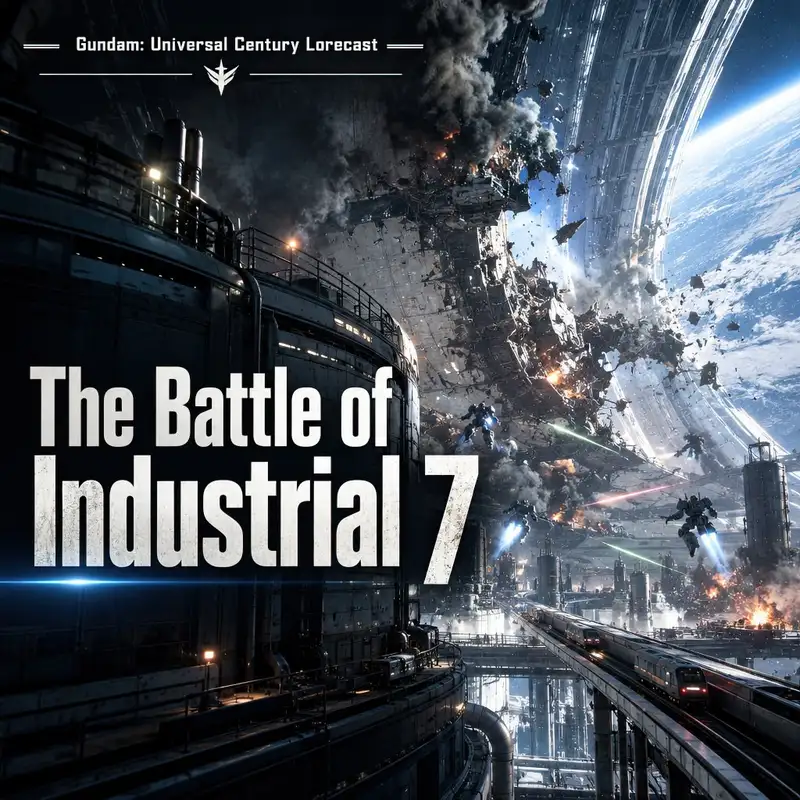
The Battle of Industrial 7
Industrial 7 was still being built when it became a battlefield. Its construction spaces had not yet settled into the quiet routine of a mature colony. There were unfinished sections, industrial corridors, open structural volumes, docking areas, classrooms, maintenance systems, and inhabited spaces connected by infrastructure that was still incomplete. Students attended the Anaheim Electronics Industrial College. Workers and technicians kept the colony functioning while other sections remained under construction. It was not a fortress, and it was not an empty weapons range.
That distinction mattered the moment mobile suits entered the area. A battle outside a colony threatens ships, cargo, and personnel. A battle inside or immediately around an unfinished colony threatens atmosphere, power, transit routes, life-support systems, and people with no part in the military objective. Every damaged bulkhead can become a pressure hazard. Every blocked corridor can become an evacuation problem. Every confused security response can turn a secret operation into a public crisis.
The military problem at Industrial 7 was therefore larger than defeating an enemy mobile suit. The combatants were trying to identify one another, secure a political secret, protect or seize critical personnel, and keep control of a fragile civilian-industrial environment. They failed at most of those tasks. The result was a short, violent engagement whose importance came not from the number of machines involved, but from what those machines were fighting over.
The secret had begun at the start of the Universal Century itself. In Universal Century one, during the ceremony inaugurating the new calendar, the orbital residence known as Laplace was destroyed in a terrorist attack. Among the survivors was Syam Vist, a young man who came into possession of material connected to that catastrophe. Over the following decades, that material became known as Laplace’s Box.
By Universal Century ninety-six, the Box was not a public archive whose contents were understood across the Earth Sphere. Its value lay partly in uncertainty. Powerful people believed it contained information capable of damaging the political legitimacy of the Earth Federation. That did not mean every official knew what it was, or even accepted the same account of its significance. It meant that the possibility of disclosure had become dangerous enough to shape military decisions.
A secret of that kind is not merely historical. It becomes strategic. It can affect alliances, public loyalty, constitutional authority, corporate contracts, military obedience, and the credibility of institutions that have survived by controlling the official record. The Box mattered because it appeared to connect the founding of the Universal Century to a century of political exclusion and managed memory. Whoever controlled it might gain leverage. Whoever revealed it might destabilize the system that had concealed it.
Industrial 7 mattered because the Vist Foundation chose to move that secret there. The colony was associated with Anaheim Electronics and its industrial and educational infrastructure. That gave it technical resources, private security, transport connections, and access to advanced military development. It also placed a politically explosive transaction inside a civilian environment whose residents had not volunteered to become custodians of a century-old constitutional crisis.
Cardeas Vist, head of the Vist Foundation, intended to hand over the key connected to Laplace’s Box. His decision was not a routine transfer of weapons or supplies. It was a political act conducted through private power. The Foundation had preserved the Box for generations, but Cardeas no longer seemed willing to accept permanent concealment as the price of stability. He was prepared to put the secret into motion.
That did not make Cardeas the spokesman for every Vist interest, much less for Anaheim Electronics as a whole. The Foundation was a family institution with its own competing loyalties, ambitions, and fears. Anaheim’s presence on Industrial 7 demonstrated the overlap between private industry and military capability, but it did not prove that one corporation controlled every decision made there. Universal Century politics often encourages that sort of simple explanation. The reality is usually more fragmented, and more dangerous.
Private control was the first weakness in Cardeas’s plan. A foundation can store information. It can finance research, maintain security, and arrange discreet meetings. It cannot reliably manage the consequences once a secret becomes important to states, armed organizations, and public legitimacy. The more valuable the Box became, the less likely it was that the Vist Foundation could decide its fate alone.
Cardeas’s intended recipients were the Sleeves, a Neo Zeon remnant organization operating from the disguised freighter Garencieres. The Sleeves were not the entire political tradition of Zeon, and they were not identical with every anti-Federation movement in the Earth Sphere. They were an armed remnant force, carrying Zeon symbolism and pursuing leverage against the Federation in the aftermath of Char’s Rebellion.
For the Garencieres group, the immediate mission was clear enough. They had come to Industrial 7 to receive the key to Laplace’s Box. Captain Suberoa Zinnerman had to bring his people into an unfamiliar and politically sensitive environment, complete the exchange, and depart without allowing the operation to become a major engagement. That required discretion, security, reliable communications, and above all, control of the people involved.
Then Mineva Lao Zabi disrupted the mission. Using the name Audrey Burne, Mineva entered Industrial 7 independently. Her purpose was not simply to help the Sleeves acquire the Box. She feared that its transfer would become the pretext for another war. Mineva understood that symbols can be as dangerous as weapons in the Universal Century. A document, a name, or an inherited claim can mobilize people who have spent decades waiting for a reason to fight again.
Her intervention created a second crisis inside the first. The Sleeves had to think not only about securing the Vist handover, but also about finding Mineva and preventing her from altering the operation. Cardeas had to proceed while the person whose political identity could transform the meaning of the exchange was moving through the colony outside his control. The Federation, meanwhile, was approaching a situation whose full political meaning it could not safely allow to unfold.
Secrecy had acquired too many custodians and no trusted referee. The Vist Foundation wanted to determine when the secret would move. The Sleeves wanted possession of the key. Mineva wanted to prevent the transaction from becoming a spark for renewed conflict. Federation authorities wanted to stop the transfer and preserve political security. None of these objectives could be pursued without threatening the others.
For that reason, the battle was already taking shape before the first mobile suit fired a weapon. It was not caused by a simple misunderstanding. It grew from incompatible political objectives being pursued inside the same confined space, under conditions of mistrust, compartmentalization, and incomplete intelligence. Once armed forces entered the equation, the colony itself became the ground on which those contradictions would be settled, at least temporarily.
Banagher Links represented the human geography of that crisis. He was a student at Industrial 7, not a military pilot, intelligence officer, corporate negotiator, or political heir. His life was connected to Anaheim-associated education and the technical culture of the colony. He belonged to the generation expected to live among the machinery of the Earth Sphere without necessarily knowing who owned its secrets or how often those secrets were defended by force.
His encounter with Audrey brought him into contact with a political struggle far larger than either of them could control. From Banagher’s perspective, the situation began with a mysterious girl in danger. From the perspective of the institutions closing in around them, she was Mineva Lao Zabi, a figure with enormous symbolic value. That gap between private encounter and public consequence is one of the central facts of Industrial 7.
A secret operation becomes unstable when it occurs in a functioning community. There are witnesses. There are security personnel with partial instructions. There are civilians who see unusual movement, hear alarms, lose access to transit routes, or find that armed strangers have turned familiar spaces into contested terrain. Even if the original plan depends on silence, a colony cannot simply be emptied because powerful people have decided to negotiate over its future.
The Earth Federation intervened because it knew enough to recognize the handover as a threat. What it knew exactly, who had passed the information, and how much each level of authority understood about Laplace’s Box remain less clear in the animated record than the decision to act. That uncertainty matters. Identifying an enemy meeting is not the same thing as understanding the political consequences of the meeting.
Federation forces associated with Londo Bell and the special-operations organization ECOAS moved to secure the situation. These were not interchangeable institutions. Londo Bell existed within the Federation’s military response to postwar instability, while ECOAS was a specialized formation suited to sensitive operations. Their presence showed that the Federation did not treat Industrial 7 as an ordinary policing matter. It was a seizure and containment operation directed at a political danger.
But the Federation’s effort contained its own contradiction. To suppress a secret transfer, it had to use armed force near civilian infrastructure. To prevent a political crisis, it risked creating a visible military incident. To secure the Box, it had to confront people who possessed information it did not fully control. The operation could succeed tactically and still make the wider problem worse.
This is a familiar failure in intelligence and security work. A government may correctly identify a threat while misunderstanding its meaning. It may know that an object, person, or meeting is dangerous without knowing which relationships are genuine, which factions are divided, or which participants are trying to prevent escalation rather than cause it. Industrial 7 exposed precisely that problem. Federation forces arrived prepared to stop a transfer, but not prepared to resolve the political crisis that made the transfer possible.
The first major military clash came in the space around the colony. The Sleeves deployed Marida Cruz in the Kshatriya, a high-performance Newtype-use mobile suit built around mobility, heavy armament, and control of engagement geometry. Its four large binders carried weapons and funnels that allowed it to threaten targets from several directions at once. In open space, that created a problem more serious than raw firepower.
A conventional formation wants to establish orientation. It wants to know where the threat is, assign targets, preserve spacing, and use mutual support. The Kshatriya disrupted those assumptions. Its binders gave it a broad physical and tactical presence. Its funnels threatened aircraft and mobile suits beyond the direction Marida herself faced. A pilot confronting it could not assume that closing on the main body of the machine meant escaping its weapons envelope.
Marida’s performance demonstrated the value of a specialized system operated by an experienced and unusually capable pilot. It did not demonstrate that every Sleeves unit possessed such capability. The Kshatriya was exceptional. It required rare equipment, a compatible operator, extensive maintenance, and an organization capable of protecting and supplying it. In military terms, it was a concentration of capability, not a representative sample of the Sleeves’ ordinary order of battle.
The Federation machines facing it included Jegan variants and the Stark Jegan. The Stark Jegan encounter is important because it prevents the battle from becoming a simple story of superior technology crushing inferior technology. The Federation pilot pressed the attack aggressively, used close-range judgment, and found narrow opportunities against a machine that was plainly more dangerous on paper and in practice.
That aggression did not reverse the outcome. But it showed that tactical quality still mattered. A high-performance machine can widen the margin for error. It cannot erase surprise, pilot judgment, geometry, or the risks of fighting in close proximity to an enemy. The Stark Jegan’s challenge forced the Kshatriya to respond to a threat rather than merely execute a firing solution. In a less compressed and more balanced engagement, that kind of pressure could have created opportunities for other Federation units.
At Industrial 7, however, time favored neither side. The Sleeves needed to complete their mission and preserve their withdrawal route. Federation forces needed to stop the transfer before it could occur. The Kshatriya’s opening success created local tactical superiority, but tactical superiority was not the same as control of the colony. Marida could dominate an engagement. She could not make the political problem disappear, protect every access point, locate Mineva instantly, and guarantee that the Vist Foundation would remain coherent under pressure.
As the battle moved toward Industrial 7, the colony ceased to be background scenery and became terrain. The unfinished areas provided open internal volumes and irregular routes that could be used for maneuver, concealment, and approach. Construction gaps altered lines of sight. In zero gravity, a passageway, shaft, or incomplete structure could become a route from several directions at once. A defender could not assume that walls and floors established the same tactical boundaries they would on Earth.
But those same features made command more difficult. In a Minovsky-era environment, forces cannot rely on perfect long-range awareness. Communication, identification, and coordination become more local and more fragile. Pilots and teams must operate on partial information. They must decide whether a contact is hostile, whether an escape route is clear, and whether a damaged section will become a larger hazard before higher command can provide a clean answer.
Inside a colony, that uncertainty carries a civilian cost. An unfinished industrial zone may appear empty from a tactical perspective, but it is connected to the rest of the habitat. Damage can affect access, power, structural integrity, and emergency movement. People may be trapped behind sealed routes or forced into unfamiliar evacuation paths. A mobile suit commander thinking only in terms of pursuit may find that the enemy is using the colony’s infrastructure as both cover and hostage.
The battle did not become a conventional colony assault with a clear front line. It was a rapidly shifting security crisis. Federation personnel were trying to intercept the Sleeves and contain the Vist facility. The Sleeves were trying to preserve the handover, recover Mineva, and avoid becoming fixed inside hostile territory. Civilians and students were caught near the margins of an operation that neither side could fully isolate from the colony around it.
For that reason, Industrial 7 revealed the weakness of treating colonies as mere strategic locations. A colony is a home, an industrial system, and a pressure vessel. It has inhabitants whose lives depend on predictable access to air, transit, power, and safety. Once mobile suits fight through its infrastructure, the military objective cannot be separated cleanly from the human environment. Even a limited engagement becomes an attack on confidence in the institutions responsible for keeping that environment secure.
At the center of the crisis stood the Unicorn Gundam. The machine was part of the UC Project, and it was tied to the La+ system connected to Laplace’s Box. Its significance was not limited to combat performance. The Unicorn was a weapon, a research platform, a political mechanism, and a key to a larger historical secret. That combination made it unusually valuable and unusually dangerous.
A normal military prototype is already difficult to manage. It may require specialized parts, trained technicians, secure facilities, and a small circle of pilots and engineers capable of operating it safely. The Unicorn carried all of those burdens, along with an additional political function. Possession of the machine was linked to possession of information that could affect the legitimacy of the Federation itself.
This made Industrial 7 an industrial battlefield in a deeper sense. The colony’s connection to Anaheim-linked infrastructure was not simply convenient scenery for a Gundam launch. Advanced weapons do not emerge from isolated hangars. They depend on research institutions, supply chains, specialized labor, secure data, test facilities, financing, and political protection. The Unicorn existed because private and public power had cooperated, competed, and concealed their roles over a long period.
Cardeas had attempted to keep that system under personal and family control. But the battle made that impossible. Once Federation forces attacked, once the Sleeves deployed the Kshatriya, and once Mineva’s presence disrupted every calculation, the Unicorn could no longer remain a protected asset hidden inside the Vist Foundation’s arrangements. The machine had become part of the crisis rather than an instrument Cardeas could direct from outside it.
Banagher’s role changed at the same moment. Amid the collapse of security and the revelation that Cardeas was his father, he received the Unicorn. The personal revelation mattered because it explained why the machine passed into Banagher’s hands, but it did not make him a prepared military solution. He had little or no conventional pilot training. He was not an ace waiting in reserve. He was a civilian student placed inside an emergency by the decisions of older institutions.
That is a dangerous way to field any weapon system, particularly one as specialized as the Unicorn. Military organizations normally train pilots before they are given experimental machines. They establish maintenance procedures, command relationships, authentication systems, and rules for employment. Industrial 7 offered none of that order. The crisis simply put an extraordinary machine in the hands of a young man whose responsiveness to it exceeded the expectations of the people around him.
Banagher’s effectiveness cannot be explained by personal will alone. The Unicorn’s psycho-frame, its N T D activation, the immediate threat from the Kshatriya, and Banagher’s emerging Newtype responsiveness all shaped the encounter. So did Marida’s own experience and the constraints of fighting near a colony. None of those factors can be isolated into a simple formula, and the animated record does not present them as fully understood science.
The important military point is that the Unicorn did not represent ordinary Federation capability. It was not a machine that could be issued across the fleet, operated by any trained pilot, or maintained by a normal frontline unit. Its appearance altered the local balance because it was exceptional. That is not the same thing as saying it offered a general solution to the Federation’s security problem.
When the Unicorn confronted the Kshatriya, the battle became an encounter between systems that were impressive precisely because they were difficult to reproduce. Marida’s machine depended on psycommu-linked remote weapons, a demanding pilot-machine relationship, and the resources to sustain a high-performance mobile suit. The Unicorn depended on psycho-frame technology, the N T D system, the La+ mechanism, and an operator whose response to the machine was itself outside routine planning.
Neither side had produced a reliable mass solution. Both had produced concentrated capability around rare people and specialized hardware. That can be militarily valuable in a crisis. It can also create serious institutional vulnerability. If a system depends on one pilot, one machine, one research program, and one chain of classified maintenance, its loss or defection can have consequences far beyond the tactical battlefield.
The Unicorn’s activation interrupted the Sleeves’ freedom of action. It forced the Kshatriya to confront a threat that could not be dismissed as another Federation security unit. Banagher’s launch changed the immediate calculations around the Vist facility and the colony. But it did not decide the political struggle over Laplace’s Box. A duel, even an extraordinary one, cannot settle a conflict rooted in constitutional secrecy, corporate power, historical grievance, and the unresolved legacy of war.
The encounter also showed the limits of calling such machines deterrents. A deterrent works when opponents understand its capabilities and believe it can be used predictably. The Unicorn was not predictable. Its systems were not fully transparent even to the people who had built and protected it. Its pilot was not a conventional military asset. Its political role was concealed. Rather than stabilizing the situation, the machine made the crisis more volatile because every participant understood that it mattered without fully understanding why.
The immediate battle ended without a clean victory. The Sleeves withdrew from Industrial 7 rather than completing a secure handover. Federation forces disrupted the exchange and gained control of Banagher and the Unicorn. But the objective of containment had failed. The Box was no longer safely confined within the Vist Foundation’s private structure. Its key, its machine, and its human witnesses had been scattered among competing institutions.
Cardeas Vist died during the collapse of his plan. With him went the possibility of a controlled transfer managed through his authority alone. The Vist Foundation itself was fractured by the events at Industrial 7, revealing the danger of treating an institution with state-level secrets as though it were still a private family concern. Its internal divisions were no longer private once armed forces had entered its facilities.
Mineva was separated from her original attempt to prevent escalation. The Sleeves had failed to complete their mission cleanly and had lost the advantage of secrecy. The Federation had seized physical assets but had not secured political certainty. Banagher, who had begun the day as a student, became the pilot and custodian of a machine linked to the central secret. The crisis had not been resolved. It had become mobile.
The Nahel Argama became important at this stage because mobile suits do not operate independently of ships and institutions. Recovering the Unicorn meant more than putting it behind a guarded door. The machine required hangar space, technicians, command authority, security, maintenance, and a way to transport both the hardware and its pilot through a contested political environment. Banagher’s custody was also not simply a personal matter. He was now tied to a weapon system and a secret that several powers wanted to control.
A warship can provide protection, but it also concentrates responsibility. The Nahel Argama could recover the Unicorn, house its crew, and carry Federation authority into the next phase of the crisis. It could not erase the reasons the battle had occurred. Ships are effective instruments for moving forces, sustaining mobile suits, and imposing temporary custody. They are poor substitutes for legitimacy when the problem is a century of concealed political compromise.
At the tactical level, the Federation prevented the Sleeves from completing an uncontested exchange and took control of Banagher and the Unicorn. At the operational level, the covert handover was disrupted, but Industrial 7 was damaged and the situation was dispersed rather than contained. The combatants left with new burdens, new witnesses, and a deeper awareness that the Box could no longer remain a rumor known only to a few custodians.
At the strategic level, no participant secured the larger objective. The Sleeves did not obtain clean control of the key to Laplace’s Box. The Federation did not remove the political threat represented by the Box. The Vist Foundation could no longer manage its inheritance as private property. Mineva did not prevent conflict simply by entering the colony, because the institutions around her were already prepared to use force rather than trust one another.
The civilian consequence was equally important. Industrial 7 absorbed the danger created by organizations competing over a secret that its residents had not chosen to hold. Students, workers, and ordinary colony inhabitants lived beside an industrial and political infrastructure whose true importance had been hidden from them. When that secrecy failed, they faced the risk of battle in the place where they worked, studied, and lived.
The Battle of Industrial 7 was not caused by one machine or one secret alone. It was the moment when a century of concealed political compromise collided with the institutions built to preserve it. The Federation could seize a pilot and a prototype, the Sleeves could withdraw to fight another day, and the Vist Foundation could lose control of its inheritance, but none of them could put Laplace’s Box back into silence.