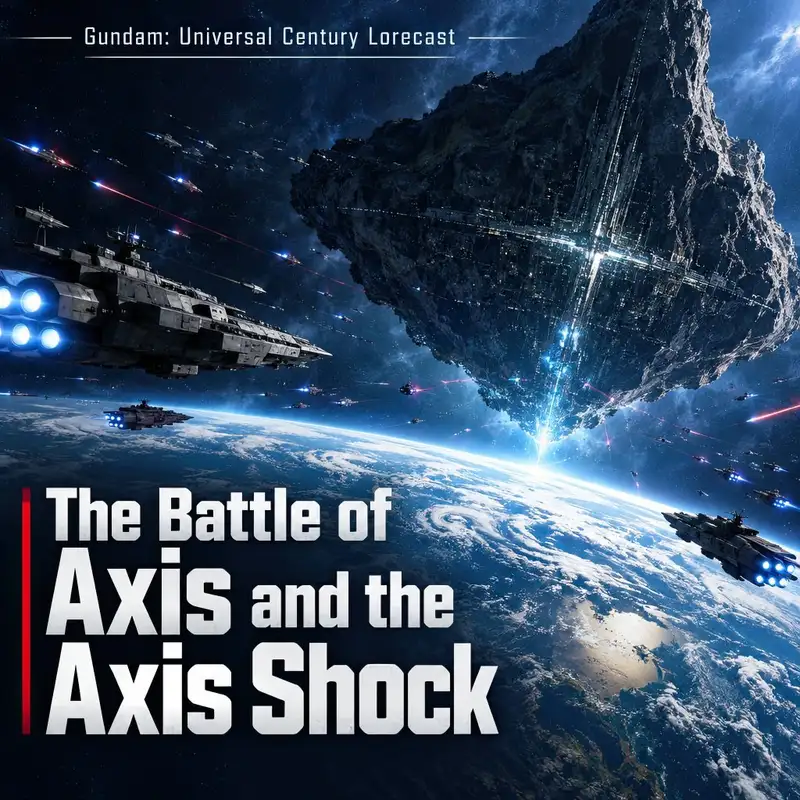
The Battle of Axis and the Axis Shock
The surviving fragment of Axis is falling toward Earth, and the machines trying to stop it were never designed for this job. Mobile suits can intercept warships, break formations, raid installations, and fight inside the cluttered geometry of an asteroid fortress. They cannot normally shove a descending mass of rock, metal, machinery, and debris away from a planet by force of will and thruster output. Yet that is where the Battle of Axis ends. Federation and Neo Zeon pilots, men who had been shooting at one another minutes earlier, gather behind the Nu Gundam and try to push. Their effort appears hopeless because, by any ordinary military standard, it is hopeless. The conventional plan has already failed. Nuclear weapons did not eliminate the threat. Demolition broke Axis apart, but did not guarantee that its fragments would miss Earth. Char Aznable has been defeated in combat, but the weapon he set in motion is still moving.
That final image matters because it reveals the real nature of the battle. This was not simply the last duel between Amuro Ray and Char. It was not a contest settled by which mobile suit had the better reactor, armor, or remote weapons. The battle was the end point of a political deception, an intelligence failure, a late and improvised interception, and a weaponization of strategic geography so extreme that normal military tools could only partly contain it. Axis had begun as a fortress and a political asset. Char turned it into an instrument of planetary coercion. By the time the defenders were physically pushing at its remains, every ordinary solution had run out.
The question, then, is not merely why Axis failed to strike Earth. It is how Char’s plan, which had been prepared with such care and supported by some of the most advanced machines of its era, became a military defeat followed by an event no one could properly claim to understand. The answer begins with the warning the Federation had already received, and failed to act upon with the seriousness it required.
Before Axis, there was Fifth Luna. Char’s Neo Zeon movement had already demonstrated that it intended to use large celestial bodies as weapons. The asteroid was directed toward Earth and struck Lhasa. Londo Bell attempted to stop the operation, but it could not do so in time. The details of that earlier action matter less here than the lesson it should have imposed on the Federation government. Char had established both his capability and his intent. He was not merely threatening military installations, bargaining for territory, or trying to force a favorable diplomatic settlement. He was willing to make Earth’s population and environment the target of his strategy.
Londo Bell’s failure to prevent Fifth Luna was not proof that its personnel were passive or incompetent. It was proof that recognizing danger is not the same as having the authority, forces, readiness, and time required to stop it. A special formation can identify a threat, launch interceptors, and fight with skill. It cannot manufacture warning time after an enemy has already prepared a strategic weapon. It cannot replace a government’s decision to delay, compartmentalize, or hope that a crisis can be managed through diplomacy after military facts have already changed.
Fifth Luna should have ended any assumption that Char could be contained by paper guarantees. Instead, it became the prelude to one of the most consequential failures of political judgment in the Universal Century. The Federation government treated Axis as something that could still be negotiated over. Char treated it as the next weapon.
The transfer of Axis to Neo Zeon was framed as part of a disarmament arrangement. In principle, such an agreement offered the Federation an attractive answer to an expensive and dangerous crisis. Rather than fight over a major asteroid fortress indefinitely, the government could accept Neo Zeon’s formal commitments, transfer Axis, and expect Char’s forces to disarm. It was a political solution to a military problem. Or at least, it looked like one.
The difficulty was not that diplomacy itself was foolish. Governments have to negotiate, even with hostile powers, because war consumes lives and resources with remarkable efficiency. The difficulty was that the agreement did not match the character of the threat. Char had already shown that he was prepared to weaponize celestial infrastructure against Earth. A transfer arrangement, without credible verification, control, or contingency planning, gave him access to exactly the asset he needed. The Federation did not need perfect knowledge of every Neo Zeon plan to understand the risk. It needed to take the risk seriously enough to prevent Axis from becoming operationally available for another descent toward Earth.
Char understood that weakness. He did not view the transfer of Axis as the basis for peace. He viewed it as operational deception. The formal condition of disarmament gave Neo Zeon time, access, and political cover. Once Axis was in his hands, the decisive issue was no longer the wording of an agreement. It was whether the fortress could be prepared, defended, and sent toward Earth before the Federation could respond.
Char’s stated justification gave the operation an ideological vocabulary. Earth, in his view, had become the center of a stagnant political order. Humanity would not develop so long as powerful people could remain on the planet, protected from the consequences of colonial inequality and environmental decline. His solution was to make Earth uninhabitable, forcing humanity into space and, he believed, accelerating the emergence of a new kind of human consciousness.
There was a real grievance inside that argument. The Earth-centered political order had repeatedly failed to address colonial exclusion, unequal power, and the concentration of privilege. But identifying a genuine injustice does not make every proposed remedy legitimate. Char’s method was not representation, reform, self-determination, or even conventional conquest. It was environmental coercion on a planetary scale. He proposed to compel migration through fear, destruction, and mass death. The civilians of Earth would be punished not because they had collectively chosen the political system he condemned, but because their suffering was useful to his design.
Axis mattered because it gave Char the means to attempt that coercion. It was not merely a very large asteroid. It was a fortress, a staging point, a military installation, and a political object with a long history of strategic value. Possession of Axis altered the geometry of the conflict. It gave Neo Zeon a protected platform from which to organize forces and a physical mass that could be transformed into a threat against Earth itself.
A fortress in space is never just a gun platform. It is a place where ships dock, supplies move, machinery is maintained, personnel are housed, and command decisions become operational action. To use Axis as Char intended required engineering work, planning, labor, security, navigation, defense, and a chain of command capable of carrying out orders under pressure. The operation was not an impulsive act of vengeance. It was prepared violence on an immense scale.
For Char, Axis combined military utility and political symbolism. It demonstrated that Neo Zeon could seize the initiative from a Federation government that remained larger, wealthier, and more deeply rooted across the Earth Sphere. It also made his threat visible. A fortress descending toward Earth did not require subtle propaganda. It was a message written across the sky. But visible terror has a weakness. It commits the aggressor to an outcome. Once Axis was moving, Char had less room to bargain, less room to retreat, and less room to pretend his campaign had any limited purpose. The operation became an all-or-nothing attempt to transform political grievance into irreversible disaster.
Bright Noa and Londo Bell faced that attempt with a familiar problem in Federation history. On paper, the Earth Federation possessed vast resources. It had a larger industrial base than Neo Zeon, broader access to trained personnel, established military institutions, and far more territory to draw upon. In practice, the forces available at the moment of crisis were limited by readiness, political hesitation, dispersed deployments, and the simple fact that strategic capacity is not the same thing as combat power already positioned for action.
Londo Bell was a specialized force, not the entire Federation war machine. Bright had to coordinate an interception effort while confronting a threat that had already been allowed to mature. His command could launch ships and mobile suits, direct pilots toward critical objectives, and organize an attack under difficult conditions. It could not instantly concentrate every Federation fleet, erase the consequences of prior delay, or guarantee that a weapon as large as Axis would be stopped cleanly.
The interception also required tools beyond ordinary mobile-suit combat. Nuclear weapons were committed against Axis because the target demanded effects that rifles and sabers could not provide. Ships had to hold together long enough to launch and support their forces. Engineering and demolition work became necessary because damaging Axis from outside was not enough. Pilots had to fight through Neo Zeon defenses, then operate close to a structure whose destruction could itself create a new threat.
The machines deployed around Axis reflected both sides’ strengths and limitations. Neo Zeon fielded advanced mobile suits and specialized Newtype-capable systems. Char’s Sazabi was not a routine line machine. It was a high-performance command weapon tied closely to the pilot who could use it most effectively. The Jagd Dogas likewise represented an effort to exploit psycommu-based combat through selected pilots. The Alpha Azieru placed enormous destructive potential in the hands of Quess Paraya, a young pilot whose talent did not protect her from manipulation, emotional instability, or the pressures of war.
Neo Zeon also relied on Geara Dogas, more conventional machines that gave its forces usable combat mass. But a force possessing exceptional machines is not automatically a force with unlimited depth. Advanced units depend on specialized parts, trained technicians, and pilots who can survive the demands placed upon them. A Sazabi cannot be replaced as casually as a standard-issue rifle. A Cyber Newtype or an unusually gifted pilot cannot be treated as an interchangeable component, even though military institutions often try.
The Federation brought more standardized machines in the form of Jegans, along with the Re-GZ and the Nu Gundam. The Nu Gundam was Amuro’s advanced platform, built around the need to meet Char’s highest-end forces on terms that ordinary mass-production equipment could not guarantee. It carried psycho-frame material, which incorporated psycommu functions into the structure of the machine. That design improved responsiveness between pilot and mobile suit. It allowed the Nu Gundam to translate Amuro’s reactions and intent with extraordinary speed.
But psycho-frame was not a magic answer hidden inside a machine. It was a technological approach to the problem of Newtype-machine interaction. It could increase responsiveness. It could make a mobile suit more closely connected to the perceptions of its pilot. It did not provide a settled theory of consciousness, moral insight, or planetary defense. The Nu Gundam remained a combat system with a pilot, weapons, maintenance demands, and a mission. Its later role in the Axis Shock should not be used to pretend that every psycho-frame-equipped machine could reproduce what happened there.
The contrast between the opposing forces also reveals the limits of simple industrial comparisons. The Federation’s broader resources mattered, but only when those resources could be mobilized, deployed, and brought under coherent command. Neo Zeon’s advanced machines gave it sharp tactical tools, but not an unlimited ability to absorb losses or sustain a prolonged strategic contest. At Axis, both sides discovered that technology magnified their decisions without freeing them from the consequences of those decisions.
Char’s central failure was not a lack of courage or tactical competence. It was the substitution of catastrophe for strategy. He had a political diagnosis, however distorted by anger and despair. He understood that Earth’s institutions were insulated from the suffering of many people in space. He understood that the Federation had repeatedly survived crises without reforming the system that produced them. But he chose an instrument that could only destroy the political future he claimed to seek.
A serious strategy must connect military action to a plausible political end state. It must answer what happens after the operation succeeds. Who governs? By what authority? How are civilians protected? How are food, housing, transport, law, and representation organized after the old order is shattered? Char’s Axis plan offered no convincing answer because the destruction was itself the point. Earth would be rendered uninhabitable. Humanity would be forced outward. The suffering created by that act was supposed to generate transformation.
That is not a program of liberation. It is punishment elevated into doctrine.
Char’s personal authority made the problem worse. Neo Zeon’s operation was closely tied to his will, his symbolism, and his rivalry with Amuro. This gave the movement unity of direction, but it also narrowed its political imagination. A command system dominated by one leader’s historic grievance can move decisively. It can also become incapable of questioning whether the leader’s objective remains rational, achievable, or morally defensible. The more completely Axis became Char’s operation, the less room there was for Neo Zeon to become anything other than the machinery required to carry it out.
That does not mean every Neo Zeon soldier shared Char’s full ideological vision. Armies contain professionals, opportunists, loyalists, frightened subordinates, believers, and people who have simply run out of other places to go. But the strategic purpose of the operation came from the top. The plan to use Axis against Earth was not an accidental consequence of battlefield confusion. It was deliberate policy.
The plan also confused shock with political change. Terror can force immediate decisions. It can make governments panic, split alliances, and impose emergency measures. It can even produce temporary obedience. But fear does not create durable legitimacy. A people forced into space by environmental devastation would not emerge automatically as a more enlightened political community. They would emerge traumatized, displaced, angry, and dependent on whatever institutions had survived the disaster. Char sought to end Earth’s domination by creating a catastrophe that would likely centralize power, militarize society, and deepen the very wounds he claimed to address.
Once Londo Bell attacked, that political failure became a military problem. The defenders were not simply fighting to preserve Federation prestige. They were trying to prevent an operation whose success would make every later political question subordinate to survival.
The first conventional answer was nuclear force. Against a target like Axis, nuclear weapons were not used for spectacle. They were used because the target was too large and too consequential for ordinary weapons to solve quickly. But the use of such weapons against a descending asteroid fortress carried its own danger. Destruction is not the same as neutralization. Breaking a massive body apart can change its shape, its trajectory, and the distribution of debris without ensuring that the hazard is gone.
Neo Zeon’s defenses prevented the initial strike from producing the clean result the Federation needed. That was a tactical success for Char’s forces, but it did not make their strategic situation secure. The battle shifted into a more desperate form of combined-arms action. Fleet weapons, mobile-suit engagements, close defense, infiltration, and demolition all became part of the same effort. The objective was no longer merely to defeat Neo Zeon units in space. It was to interfere with Axis itself before its descent became irreversible.
The fighting around and inside Axis illustrates the limits of treating space combat as a series of isolated duels. The mobile suits had to operate in support of larger tasks. Some defended access routes. Some engaged enemy machines. Some created openings for teams attempting to reach critical interior areas. Some protected ships that remained essential for command, launch, recovery, and fire support. The target was not a single enemy pilot. The target was an engineered strategic weapon embedded inside a fortress.
Minovsky conditions complicated command and control, though they did not reduce every participant to blind improvisation. Ships still coordinated their forces. Pilots still received objectives. Sensors, visual identification, local communication, and prearranged intent still mattered. But interference and battlefield confusion increased the importance of judgment at lower levels. A pilot could not always wait for perfect instructions. A commander could not always see the same picture as the people closest to the fight. That is why the quality of preparation mattered so much. When a battle becomes confused, forces fall back on their training, their mission understanding, and the trust they have in the people beside them.
The conventional operation achieved something substantial. Axis was broken apart. But it did not achieve enough. One surviving fragment remained on course toward Earth. The Federation had succeeded tactically in damaging the weapon and operationally in penetrating its defenses. Yet Earth was still in danger. The battle had entered the stage where victory and failure could no longer be separated by a simple count of destroyed machines.
At the center of that battle was the confrontation between Amuro and Char. The duel mattered, but not for the simplistic reason often attached to famous rivalries. Char was not merely another ace in a custom machine. He was the political leader and principal commander behind the Axis operation. His Sazabi represented Neo Zeon’s most capable individual mobile-suit threat, but it also carried the man whose presence held together the operation’s ideological and symbolic core.
Amuro’s victory therefore had real military significance. It removed Char from direct control at a critical moment. It prevented him from personally influencing the final defense of his plan. It helped collapse Neo Zeon’s ability to turn the battle back in its favor. But the duel did not, by itself, stop Axis. No matter how decisive the fight between Nu Gundam and Sazabi became, the falling fragment remained a separate problem. The asteroid did not care which pilot had won.
The same restraint is necessary when discussing the machines themselves. The Nu Gundam and Sazabi were exceptional systems, built for exceptional pilots. Their performance reflected advanced design, psycommu-related technology, and the accumulated experience of two men who had fought through much of the Universal Century’s most violent history. But neither machine was a complete military system. Neither could replace fleets, political authority, logistics, engineering, or collective action. Their duel mattered because it occurred inside a larger operation. Outside that context, it becomes a misleading symbol.
The costs around the duel also matter. Chan Agi’s death underlines the vulnerability of the people who make advanced machines possible. She was associated with the Nu Gundam’s development and support, part of the industrial and technical labor that remains mostly invisible once a machine enters combat. Her loss was not a side note. It was a reminder that weapons programs are sustained by people, and that the people closest to a prototype may be placed in danger when the crisis reaches its final stage.
Quess Paraya and Gyunei Guss reveal another cost. Neo Zeon’s use of Newtype-capable pilots gave it access to capabilities ordinary forces could not easily match. Yet those capabilities were bound to people who were young, vulnerable, and subject to enormous psychological pressure. Quess was not simply a weapon platform for the Alpha Azieru. Gyunei was not simply an available replacement for another gifted pilot. Both were people shaped by manipulation, insecurity, ambition, and an organization willing to turn human instability into military utility.
That is one of the harshest truths of Newtype warfare. Institutions often speak of potential, evolution, responsiveness, and higher perception. In practice, they may take emotionally vulnerable people and place them inside the most lethal machines available. The result is not transcendence. It is often exploitation with more sophisticated equipment.
Even after Char was defeated, even after Axis had been broken, the fragment continued toward Earth. This is where the Battle of Axis leaves normal doctrine behind. The remaining mobile suits from both sides moved to push the fragment away. It was an act of desperation, but not an irrational one. When every other option has failed, people will attempt the impossible because the alternative is to watch a catastrophe unfold.
The Nu Gundam became the focal point of that effort. Its psycho-frame resonated during the attempt to divert Axis. The film depicts luminous energy around the machine, a phenomenon later described as the Axis Shock. The fragment is diverted. Earth is spared. Mobile suits from opposing sides participate in the effort, and the visible result exceeds what ordinary mobile-suit propulsion, weapons, or engineering can explain.
That is what the film shows. It does not provide a complete scientific model.
It does not establish that the Nu Gundam’s engines alone physically pushed Axis away. It does not establish that psycho-frame can reliably manipulate any asteroid if enough Newtypes are present. It does not establish that every participant had the same understanding of what was happening. And it does not establish that human feeling, collective will, psycommu technology, and physical force can be separated neatly into measurable components. The event is extraordinary precisely because the military and scientific categories available to the participants do not fully contain it.
The psycho-frame clearly matters. It is not incidental decoration. The Nu Gundam’s structure was designed to incorporate psycommu functions in a way that made the machine highly responsive to Amuro. During the final effort, that material becomes part of a resonance that no one had planned as a weapon or a standard operating procedure. But to say psycho-frame mattered is not to say psycho-frame explains everything. A material can be necessary to an event without being a complete explanation of it.
The participation of Federation and Neo Zeon pilots also matters. In that moment, the immediate reality of Earth’s destruction overrides the war’s normal divisions. Men who had been fighting for opposed organizations act toward a common physical objective. That cooperation should not be romanticized into proof that the political conflict has been solved. It had not been solved. The men involved had not suddenly agreed on history, authority, or justice. But the sight of Axis descending toward Earth made one fact impossible to ignore. If the fragment struck, everyone’s arguments would be buried beneath the result.
The Axis Shock therefore suggests something important about the Universal Century’s Newtype question without settling it. It suggests that human consciousness, extreme emotion, psycommu technology, and crisis can interact in ways institutions have not mastered. It suggests that connection may become operationally significant under conditions where ordinary command, communication, and force are inadequate. But it does not prove that Newtypes are morally superior people. It does not prove that heightened perception produces political wisdom. And it certainly does not prove that a military can responsibly build doctrine around the expectation of another miracle.
A government cannot plan its planetary defense on the hope that, at the final moment, its pilots will generate an unprecedented resonance event. A fleet commander cannot write an operations order that ends with, and then the psycho-frame will save us. The Axis Shock saved Earth from an immediate disaster. It was not a substitute for prevention, verification, readiness, or political responsibility.
That distinction is why the event is both inspiring and deeply unsettling. It shows people acting together across the lines of a war at the edge of annihilation. But it also shows how close the Earth Sphere came to depending on something no institution understood and no commander could reproduce.
The immediate outcome was clear enough. Axis did not strike Earth. Neo Zeon’s mass-casualty operation failed. The Second Neo Zeon War ended on March twelfth, Universal Century ninety-three. Char Aznable and Amuro Ray disappeared after the battle. The historical record can establish their disappearance. It should not pretend to know more than the selected account provides about their final physical fate.
Politically, however, the victory was incomplete. Char’s campaign collapsed, but the failures he exploited were not automatically corrected. The Earth Federation survived, yet its government had exposed its willingness to treat a strategic threat as a negotiable inconvenience. Its greater resources had not prevented the crisis. Its institutions had required a small, hard-pressed formation to act decisively while official policy lagged behind events.
Institutionally, Londo Bell’s necessity was demonstrated. It had been able to respond where the larger system had hesitated. But the battle also demonstrated the danger of relying on emergency formations and exceptional individuals. A state that survives only because Bright Noa, Amuro Ray, technical personnel, ship crews, and ordinary pilots improvise under impossible conditions has not solved its security problem. It has merely survived another test.
And at the human level, the people saved by the Axis Shock were mostly absent from the battle itself. The civilians of Earth did not choose the agreement that gave Char access to Axis. They did not prepare the fortress, launch the attacks, or direct the interceptors. They lived under the threat anyway. Their survival was the purpose of the operation, even if they could not see the details of the final struggle or influence its outcome.
The Battle of Axis was a conventional military failure on every side before it became an extraordinary rescue. Char failed because mass destruction could not create political renewal. His advanced machines, personal skill, and ideological certainty could not turn atrocity into liberation. The Federation failed because it allowed expediency to replace preparedness, and because its leaders treated a demonstrated threat as something diplomacy could neutralize without sufficient control.
Londo Bell succeeded because its people acted when action was still possible, but even that success was not enough by itself. Nuclear weapons, fleet operations, mobile-suit combat, infiltration, demolition, and individual courage could damage Axis. They could not guarantee that Earth would be safe once the final fragment was falling. The Axis Shock prevented disaster, but it was not a doctrine, a weapon, or a political solution that any responsible government could count on.
What it revealed was not that technology had finally solved the Universal Century’s problems. It revealed the opposite. Psycho-frame resonance saved Earth only after political failure, strategic deception, and military delay had brought humanity to the edge of catastrophe. The battle stopped the falling asteroid. It did not stop the unresolved history beneath it.