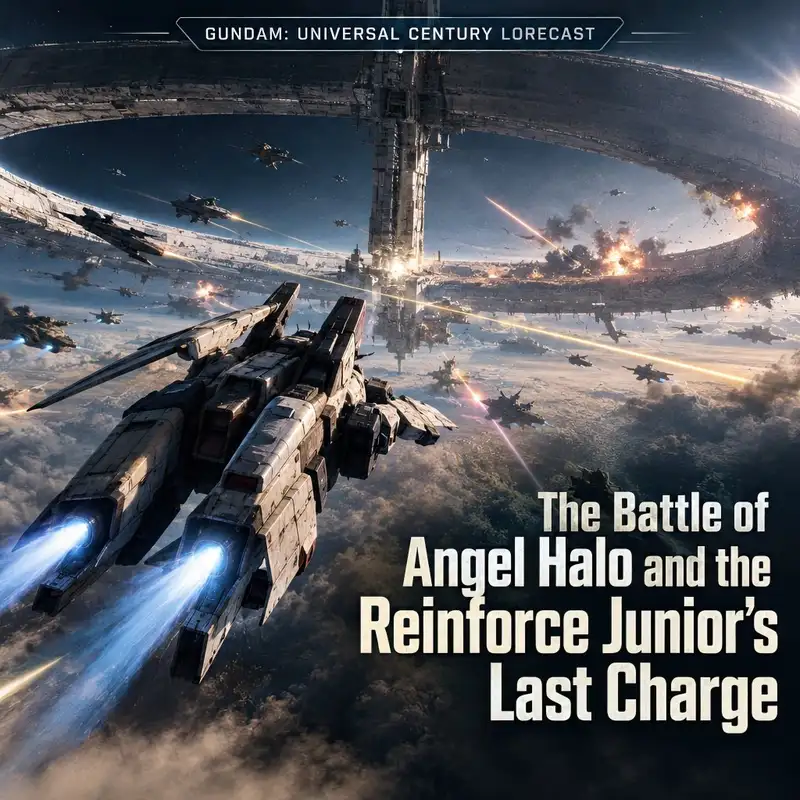
The Battle of Angel Halo and the Reinforce Junior’s Last Charge
The Reinforce Junior was already damaged when Captain Roberto Gomez ordered much of its crew to leave. That detail matters. The ship was not making a ceremonial final pass with a full complement aboard, and Gomez was not treating the people under his command as expendable decoration for a heroic ending. Evacuation acknowledged a hard military fact. The Reinforce Junior could no longer continue as a viable carrier, command platform, repair base, and refuge for the League Militaire’s remaining fighters. But it still had engines, a hull, weapons, and a route toward the Zanscare force blocking the approach to Angel Halo.
Gomez and the older personnel who remained aboard, including Jinn Jahannam, chose to use that remaining value in the one role the ship could still perform. The Reinforce Junior had been built around survival, adaptation, and improvisation. In its final minutes, it became an assault weapon. Its forward beam ram was not an accidental feature of a collision course. It gave the ship a means of concentrating its last offensive power against an Adrastea-class battleship at close range. The attack was deliberate, but it was also born of exhaustion. A force with spare ships, intact escorts, deep repair facilities, and trained replacements would have found another option. The League Militaire did not have those things.
Ahead of them, Angel Halo was descending toward Earth. Around it stood the Motorad Fleet, elite mobile suits, Imperial Guard units, and the remaining machinery of the Zanscare Empire’s final offensive. The battle had already become too large for any one ship, pilot, or commander to understand in full. The Reinforce Junior’s charge would destroy a major part of that defense. It would not destroy Angel Halo by itself. It would not settle the battle inside the installation. It would not repair the political order that had allowed Zanscare to rise. What it did was create a breach at the moment a breach was desperately needed.
Its descent toward Earth made the crisis larger than the fleets maneuvering around it. Angel Halo was moving toward a populated world whose inhabitants had no meaningful control over the battle above them. The installation threatened not only military forces but the political independence, psychological integrity, and physical safety of people far below the combat zone. Even if its intended influence had been less absolute than Zanscare imagined, deploying such a system over Earth would have marked a transformation in the character of the war. The objective was no longer merely to seize territory. It was to reshape the population that territory contained.
Angel Halo was therefore protected as the center of a layered military system. BESPA did not leave the installation alone in space and expect its extraordinary capabilities to secure it. Conventional power still mattered. The Motorad Fleet provided heavy battleships, mobile-suit support, and a barrier between the attacking forces and the installation. The Imperial Guard protected the political and personal center of the regime. Elite pilots remained available to strike at ships, disrupt formations, and force enemy mobile suits into separate fights. Zanscare’s final weapon depended on ordinary military assets because even a system intended to control minds could not safely operate without hulls, guns, escorts, fuel, crews, command posts, and people willing to defend it.
The Adrastea-class battleships were particularly suited to Zanscare’s late-war style of warfare. They were dual-environment vessels, designed to operate in space and in the atmosphere, and their huge tire structures gave the Motorad Fleet its distinctive appearance and its ability to function in ground operations. Their heavy armament and armored bulk made them formidable platforms. They were not merely transports with unusual wheels. They were warships built to carry violence from orbit to the surface.
Yet their strengths also imposed limits. The Adrastea was large, complex, and dependent on formation support. Its massive tire structures were valuable in the right environment, but they also made the ship a distinctive and vulnerable target. Its lower hull arrangement and launch methods differed from a conventional carrier’s catapult system. None of that made an Adrastea helpless. It meant that a damaged attacker which could reach close range, and which still had a weapon suited for a forward assault, could create a disproportionate effect. The Reinforce Junior did not need to defeat every Zanscare ship in the theater. It needed to break the Motorad formation at the point where that formation was still holding the outer battle together.
Neither side enjoyed a clear, stable command picture. Angel Halo, the attacking fleets, and many of the mobile suits were entering the atmosphere. Ships were damaged. Formations were dispersing. Individual pilots were fighting far from their commanders. In such conditions, information arrived late, incompletely, or not at all. A fleet commander might know that a flagship had been hit without knowing which subordinate units remained capable of action. A mobile-suit pilot might identify an enemy in visual range while knowing little about the larger tactical picture. The battle did not unfold as a clean diagram of opposing arrows. It fractured into local emergencies.
For that reason, the Reinforce Junior must be understood as more than a large ship with an unusual silhouette. It was an improvised capital asset assembled from damaged League Militaire vessels and captured Zanscare matériel, including the hull of the captured Squid One. Its construction reflected the political and industrial realities of the resistance. The League Militaire did not possess a secure shipbuilding empire with a standardized program for late-war carriers. It had salvage, captured components, skilled hands, urgent need, and whatever resources could be kept out of Zanscare control.
The resulting vessel was versatile. It could operate in atmosphere and space. It carried multiple mobile-suit catapults, substantial defensive armament, anti-aircraft weapons, and the forward beam ram that would define its final mission. It could transport mobile suits, serve as a command platform, and provide the maintenance and recovery support that mobile-suit operations required. A pilot such as Uso Ewin could not simply launch into a strategic campaign from nowhere. His machine needed ammunition, repairs, technical crews, launch facilities, communications, and a place to return to when damaged. The Reinforce Junior helped make those things possible.
But its mixed construction also tells us why it was irreplaceable. The ship represented a successful emergency adaptation, not the beginning of a mass-production line. Its systems came from different origins. Its continued operation depended on people who understood those systems, on spare parts that might not be readily available, and on a crew capable of keeping an unconventional vessel alive under combat conditions. The League Militaire had turned damage and capture into capability. That was an achievement. It also meant that losing the ship would be a permanent loss, even if the battle was won.
By the time of the final attack, Uso had reached Angel Halo in the V2 Assault Buster Gundam. The V2’s combined assault and buster equipment gave him exceptional firepower, protection, and flexibility for this one desperate phase of the campaign. But it was not a guarantee of success. The equipment was damaged in combat with Zanscare’s Imperial Guard. That damage mattered because the V2 was not an abstract symbol of invincibility. It was a weapon system operating at the outer edge of what one pilot, one machine, and one support network could sustain.
Uso entered Angel Halo and helped recover Shakti, but recovering her did not immediately solve the larger problem. The system remained active because her connection to the psychickers and the key room was still central to its operation. This is where the battle resists simple stories about a lone Gundam pilot saving the world. Uso’s actions were essential. He could penetrate defenses that others could not. He could make decisions at close range under immense pressure. But he was also thirteen years old, placed in a position where the failures of governments, armies, and adults had made him responsible for tasks no child should have been asked to carry.
The League Militaire did not win because Uso was somehow separate from the force around him. It survived long enough for him to act because ships launched him, crews sustained him, pilots screened him, mechanics kept his machine operating, and other people accepted risks that would otherwise have fallen on him alone. The V2 could open possibilities. It could not replace a fleet. It could not deactivate Angel Halo merely by arriving at its hull. And it could not give the coalition a coherent command structure once the outer battle began to collapse.
As Angel Halo and the opposing fleets descended into the atmosphere, the danger intensified. Atmospheric entry changes the operating problem for every vessel involved. Large ships must manage heat, control, structural strain, and changing maneuver conditions. Mobile suits must contend with gravity, air resistance, and reduced freedom of movement. Debris and wreckage become threats not just to combatants but to anything beneath the battle. A damaged ship can no longer be treated as an isolated loss when its destruction may occur on a path toward populated territory.
Chronicle Asher, flying the Rig Contio, struck the Federation flagship Jeanne d’Arc. It is easy to describe that moment as another display of ace-pilot skill. It was more consequential than that. A flagship is not merely a large target. It is a command center, communications node, symbol of authority, and point where the best available understanding of the battle is assembled. Damaging it disrupts coordination. It forces subordinate commanders to make decisions on partial information. It can separate surviving units from the larger plan at precisely the moment the plan requires cooperation.
Federation participation mattered in the battle for Angel Halo. The League Militaire did not face Zanscare entirely alone. But the Federation was not an immaculate and unified force arriving to resolve the crisis through superior organization. Its authority had already weakened across the Earth Sphere. Its military response came through a coalition relationship shaped by political neglect, local resistance, and the fact that the League Militaire had spent much of the war fighting where larger institutions had failed to protect people. At Angel Halo, Federation ships and League Militaire forces fought on the same side, but they did so amid damage, uncertainty, and dispersed control.
The outer battle became a contest over time and space. Could Zanscare preserve enough of its defensive ring for Angel Halo to continue its descent? Could the attackers keep enough ships and mobile suits functioning long enough to reach the installation and interrupt its purpose? Could commanders still direct their people after flagships were hit and formations broke apart? Those were not questions settled by the performance of any single machine. They were questions of endurance.
The Reinforce Junior’s damage answered one of them in the harshest possible way. As a carrier and command ship, it was becoming less useful. As a weapon, it still had one final opportunity. Gomez had to decide whether preserving the hull for an uncertain future offered more value than spending it against the immediate obstacle before him. The presence of an evacuation shows that he did not confuse sacrifice with command. He removed as many people as he could from a ship that was about to become a projectile. The people who remained did so because the mission required a crew to control the vessel to the end.
Gomez was a former Earth Federation captain, a professional officer who had become responsible for a force far less orderly than a regular service. The League Militaire was made up of people with very different backgrounds and levels of preparation. Some were experienced veterans. Some were technicians and support personnel. Some were civilians who had been drawn into war. Some were children and adolescents whose courage was demanded because the political system around them had failed. Command in such an organization is not only about issuing orders. It is about preserving the people who can still be preserved.
His final decision was therefore not a search for a noble death. It was an assessment of remaining military utility. The Reinforce Junior was damaged beyond its ability to continue its previous role. The Motorad Fleet still had immediate value to Zanscare. It could defend Angel Halo, engage approaching ships, and keep pressure on the coalition at a moment when that coalition was already fragmented. If the Motorad formation remained intact, surviving attackers would face a stronger conventional screen while trying to deal with the extraordinary threat inside Angel Halo.
The ship’s beam ram made the attack more than a blind collision. The Reinforce Junior could concentrate its forward weapon into the kind of close assault for which distance, trajectory, and commitment mattered more than a long exchange of fire. A damaged capital ship cannot always win a gun duel against a prepared battleship formation. But if it can reach the formation, absorb enough punishment to remain on course, and strike at the correct point, it can convert its own destruction into a wider tactical effect.
The Reinforce Junior rammed an Adrastea-class battleship, and the collision triggered cascading explosions that destroyed the Motorad Fleet. The result was devastating, but it should be described precisely. The charge destroyed the Motorad Fleet, not every Zanscare vessel in the entire battle. It removed a major conventional defense from the battle around Angel Halo. The success came from the impact itself and from the destruction spreading through nearby ships. It was a fleet-level loss created by one ship’s final attack, but it was not a magical erasure of all opposition.
Gomez and the older crew members who stayed aboard died in that attack. Their deaths cannot be separated from the people who survived because they were evacuated. Nor can they be separated from the younger fighters who were left to continue the battle without the ship that had carried, supplied, and protected them. The Reinforce Junior’s last charge was necessary in the immediate military sense. Necessary does not mean painless, clean, or free of cost.
At the tactical level, the charge destroyed the Motorad Fleet. That removed a powerful Zanscare formation and reduced the firepower and defensive depth available around Angel Halo. At the operational level, it created room for surviving coalition forces to continue their attack. It reduced pressure on ships and mobile suits that were already damaged, dispersed, and struggling to maintain contact. It helped prevent the outer defensive ring from closing around Angel Halo while the battle inside the installation continued.
But the attack could not complete the mission by itself. A ramming attack against battleships could not deactivate the system in Angel Halo’s key room. It could not decide what Shakti would do. It could not resolve the collapse of discipline and judgment among Zanscare’s remaining leadership. It could not guarantee that Chronicle would be defeated, that Uso would survive, or that the descending installation would lose coherence before reaching its intended theater.
The charge also imposed a severe logistical cost on the victors. The League Militaire lost an irreplaceable ship and experienced personnel at the very moment it might have needed both for the uncertain work after the battle. A military force does not stop needing transport, repair facilities, command crews, and shelter simply because it has won a climactic engagement. The destruction of the Reinforce Junior made immediate victory more possible, but it narrowed the League Militaire’s ability to shape what followed.
That is one reason the battle should not be treated as a simple exchange of sacrifice for triumph. The ship’s destruction bought operational opportunity. It did not restore the people already killed, rebuild the Shrike Team, or erase the trauma that had accumulated through the war. It did not create a durable political settlement. It made it possible for the remaining struggle over Angel Halo to continue under less pressure from Zanscare’s conventional fleet defense.
Inside Angel Halo, Shakti’s role revealed the deepest failure of the Zanscare project. She did not seek military victory. She did not seek to prove that one family, one faction, or one ideology had the right to rule the Earth Sphere. Her effort was directed toward stopping the killing. That aim placed her in direct conflict with the system built around her. Angel Halo required a human presence at its center, but the person most essential to the system did not accept the political purpose for which she was being used.
As Shakti returned to the key room, the nature of Angel Halo’s influence began to change. The series shows prayer, human connection, and extraordinary phenomena surrounding the system’s final response. It also shows figures from the past in imagery that cannot be reduced to a standard military technology report. The event is profound, but it remains only partly explained. It should not be converted into a routine capability of psycommu equipment, or proof that any similar machine could reproduce the same result under the same conditions.
What can be said is that Angel Halo’s original purpose began to fail. A system built to impose control depended upon a person who refused to make control its purpose. That was not merely a technical malfunction. It was a political collapse. Zanscare had tried to make human feeling and spiritual authority serve an apparatus of coercion. In the final crisis, the human element did not behave as the apparatus required.
Chronicle Asher’s final role reflects the same collapse at the level of command. He was a Zanscare officer, Maria’s brother, and Shakti’s uncle. By the last battle, those relationships could no longer be cleanly separated from his military responsibilities or from his growing fixation on Uso. He remained a dangerous combatant in the Rig Contio and continued to strike at the coalition’s ability to function. Yet his actions were increasingly shaped by personal conflict as much as by any coherent strategic objective.
That matters because Zanscare’s final defense needed disciplined command. Angel Halo was too important to be protected by officers pursuing private grievances. The empire needed its remaining leaders to coordinate fleets, preserve defensive positions, and understand the strategic stakes of a collapsing battle. Instead, its command relationships were fraying. Personal resentment, family loyalty, ambition, and fear increasingly displaced the institutional discipline required to defend a strategic weapon.
Katejina Loos showed a more brutal form of that breakdown. Her conduct in the final battle cannot be dismissed as ordinary battlefield aggression. By this point, she had become an increasingly prominent Zanscare combatant in the Gottratan, but her violence against Franny, Miliera, and Connie revealed something beyond professional military action. She killed people who interfered with her confrontation with Uso. The war had narrowed until other human beings became obstacles to a personal fixation.
The deaths of those League Militaire personnel also had military consequences. Every loss reduced the number of people available to screen Uso, relay information, assist damaged units, and protect the fragile network of surviving comrades. But the moral meaning should not be hidden beneath that operational analysis. Angel Halo had been built in the name of enforced harmony. Around it, the people defending Zanscare were demonstrating the opposite. The empire’s promise of order had produced coercion, fractured loyalties, and violence detached from any credible claim to peace.
By the time of the final confrontation, Uso and Chronicle were fighting amid the disintegration of the operation around them. Their duel mattered, but not because it became a simple contest to determine the entire war. Chronicle’s Rig Contio was a high-performance threat, and his removal eliminated one of Zanscare’s principal remaining combatants. Uso’s survival preserved the coalition’s most capable mobile-suit pilot at a critical point. Yet the engagement took place within a battle already shaped by fleet destruction, command disruption, Angel Halo’s internal failure, and the sacrifice of people who would never appear in a legend about a Gundam duel.
Chronicle was killed after the destruction of the Rig Contio. His death ended his immediate military role, but it did not provide a tidy resolution to the conflict that had consumed him. The final battle offers no clean comfort in that regard. Family relationships, military loyalty, resentment, and ideology had been entangled for too long. The destruction of one machine and the death of one commander could end a threat. They could not explain away the damage already done to everyone drawn into the struggle.
Angel Halo then lost structural coherence. The system that had been intended to descend upon Earth and impose a new order began to break apart. Shakti survived, and Uso was able to recover her. The visual and emotional force of that ending comes from the fact that the series does not pretend the collapse was caused by one simple switch being turned off. It was the convergence of several failures. The Motorad Fleet had been destroyed. Zanscare’s outer defense had been damaged. Federation and League Militaire forces had kept pressure on the installation. Command relationships had fractured. Shakti had refused the role assigned to her. And the system itself reacted in ways its builders had not mastered.
The battle therefore resists both technological triumphalism and spiritual simplification. Angel Halo was not defeated because a larger gun destroyed a larger target. Nor was it defeated solely because extraordinary human feeling overcame machinery in a way that can be diagrammed and reproduced. The installation failed because a coercive political project reached the limit of what force, technology, and manipulation could hold together. Its military defenses could delay the attackers. They could not supply legitimacy. Its psychological system could attempt to alter people. It could not guarantee the obedience of the person placed at its heart.
The destruction of Angel Halo was a tactical victory, an operational victory, and a political defeat for Zanscare. Tactically, the Motorad Fleet was destroyed, important Zanscare combat assets were eliminated, and Angel Halo itself disintegrated. Operationally, the coalition prevented the installation from completing its intended descent and broke the final defensive structure protecting it. The combined pressure of ships, mobile suits, and internal disruption succeeded where no single component could have done so alone.
Strategically, however, the result carried a more difficult meaning. Zanscare’s attempt to impose peace through coercive psychological control failed because peace without consent is not peace. A government may use fleets to occupy territory. It may use propaganda to cultivate loyalty. It may use terror to silence resistance. It may even attempt to make the human mind itself a battlefield. But none of those methods creates the durable political legitimacy that Maria-ism claimed to offer. Angel Halo was the logical extreme of a state that no longer believed it needed to persuade the people it ruled.
For the League Militaire, victory came at a cost that must not be romanticized. The resistance survived because exhausted crews kept damaged ships working, because mechanics maintained machines under impossible conditions, because veterans accepted missions from which they would not return, and because children were forced to bear strategic responsibilities. Gomez’s final charge was decisive precisely because the Reinforce Junior was no longer merely a ship. It was the last usable concentration of the League Militaire’s accumulated labor, ingenuity, and sacrifice.
The charge destroyed the Motorad Fleet and created the operational space needed for Angel Halo to fail. That is its direct military significance. Its deeper significance lies in what it revealed about the final battle. No invincible Gundam won this campaign alone. No single sacrifice settled it. The victory depended on fractured commands, improvised matériel, coalition pressure, exhausted crews, and Shakti Kareen’s refusal to let Zanscare’s promise of peace become a machinery of coercion.