The Battle of A Baoa Qu
The surviving Federation ships did not have the look of a victorious armada. Their formation had been torn apart before the main battle began. The Solar Ray had fired into the Federation concentration and turned a planned offensive into a catastrophe of wreckage, scattered survivors, and broken command. General Revil was dead. So was Degwin Sodo Zabi, the sovereign of the state the Federation had come to destroy. At the very moment Zeon appeared to have found the decisive stroke, the attacking force faced the most basic question in war. Was the operation still possible?
The Federation answer was yes. Not because the losses were minor. They were not. Not because surviving commanders possessed a clean picture of the battlefield. Under Minovsky conditions, with ships separated and senior leadership gone, nobody did. The assault continued because the strategic objective remained in front of them. A Baoa Qu was still Zeon’s principal remaining fortress. It still housed military infrastructure, defensive forces, command facilities, and the political authority of the Zabi regime. Turning away would have given Zeon time to recover, reorganize, and perhaps impose a different ending on the war.
That decision is the key to understanding the Battle of A Baoa Qu. The Solar Ray inflicted devastating tactical and operational damage. It destroyed ships and killed experienced personnel. It disrupted the Federation’s command structure at the most dangerous possible moment. But a weapon, however terrible, cannot substitute for a functioning state, a coherent chain of command, trained personnel, and a political purpose that survives its own leadership. Zeon could still destroy. What it could no longer do was convert destruction into durable victory.
The Federation, meanwhile, retained something more important than an intact first plan. It retained institutional depth. Its fleet had been badly damaged, but not eliminated. Its surviving commanders could continue the offensive because the objective had already been established, subordinate formations still existed, and the Federation had built enough military capacity to absorb losses that would have crippled a smaller state. That capacity did not make the Federation wise, humane, or immune from failure. It meant that its war effort was broader than the survival of one commander or one ship.
By this stage of the war, the Federation was also no longer relying on a single experimental mobile suit to confront Zeon. The Gundam remained exceptional. Its performance, Amuro Ray’s ability, and its symbolic importance had all shaped the war. But the Federation assault included mobile suits operating in growing numbers, particularly GM-type machines derived from the technological lessons of the Federation’s wartime programs. The television record does not provide a dependable complete production total, and it would be a mistake to assume every Federation machine or pilot was equally capable. What matters is that the Federation had begun turning mobile-suit combat into a repeatable military function rather than an isolated prototype experiment.
That transition gave the Federation resilience. A force built around one unique machine may win remarkable local engagements, but it cannot sustain a theater by uniqueness alone. It needs pilots, mechanics, replacement parts, carriers, transports, munitions, command staffs, and a system capable of generating new combat power after losses. The Federation had suffered horribly under the Solar Ray, but it still possessed enough of that system to press forward. Zeon, by contrast, still possessed highly dangerous equipment but was losing the human and institutional structure required to employ it well.
White Base illustrates the difference without representing the entire battle. By A Baoa Qu, the ship and its crew had become an unusually experienced combat formation. They had survived repeated engagements across Earth and space, absorbed losses, learned to operate under pressure, and developed habits of local judgment when larger command structures failed. White Base was not invulnerable, and it was not typical. Its value came from the accumulated experience of its pilots, bridge crew, mechanics, operators, and support personnel. A mobile suit does not launch itself, receive its own maintenance, or establish its own place in a fleet operation. White Base made Amuro’s sorties possible, just as the crew’s cohesion made the ship itself more capable than its material condition alone would suggest.
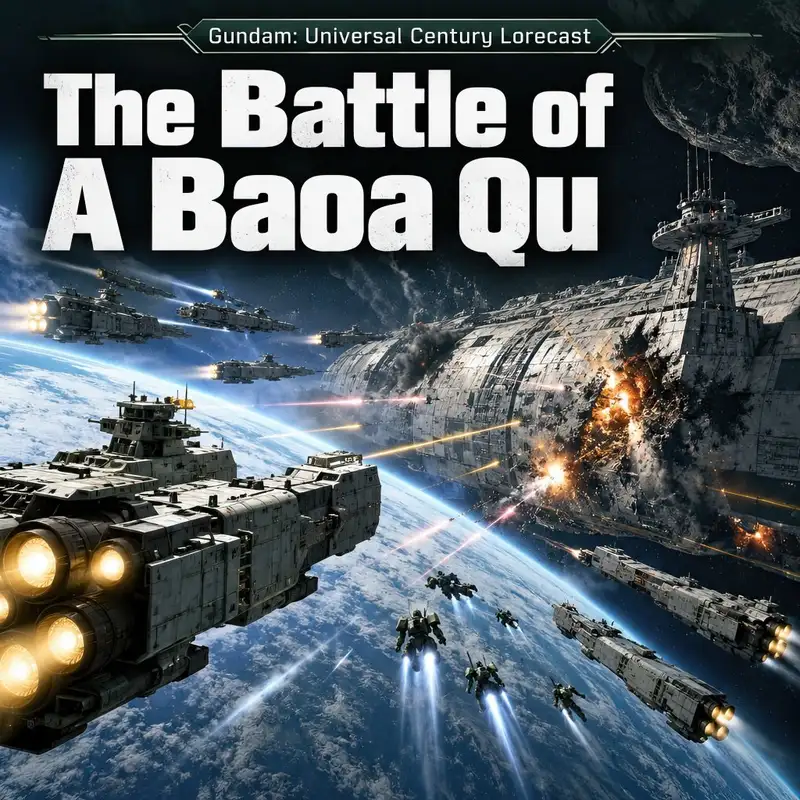
The assault on A Baoa Qu unfolded across more than one approach and more than one scale. Supporting reference material describes northern and southern attack axes, while the television presentation makes clear that the battle involved broad fleet contact, defensive artillery, missile exchanges, mobile-suit sorties, and penetration toward the fortress itself. The exact full order of battle is not securely established, and there is no need to invent one from a few visible ships or repeated background animation. The important point is that the Federation could not simply rush the fortress. It had to survive its outer defenses, contest the space around it, protect its own ships, and force openings into a system designed to kill attackers before they reached its vital interior.
Fixed defenses gave Zeon genuine advantages. Guns mounted in and around the fortress could fire from prepared positions. Launch facilities allowed defenders to send mobile suits into battle from protected areas. The fortress offered cover, storage, repair space, and a framework for coordinating local defense. Ships approaching too closely could be caught in concentrated fire. Mobile suits could intercept attackers, harass damaged vessels, and exploit the confusion of close-range fighting. In this environment, warships remained essential. They carried mobile suits, provided firepower, coordinated movement, received damaged machines when they could, and served as the physical backbone of the attacking force.
Mobile suits did not make ships obsolete. If anything, A Baoa Qu showed how closely the two depended upon each other. Warships needed mobile suits to screen approaches, respond rapidly to threats, and fight near structures where large ship weapons were difficult to employ freely. Mobile suits needed ships and fortress facilities for launch, recovery, maintenance, resupply, medical support, and command. A pilot who could defeat an enemy machine still had to return to something. In the final battle, that something was often a damaged carrier, a crowded hangar, or a fortress passage already under attack.
The limits of fixed power became apparent as the Federation pressed inward. A fortress can make attack costly. It cannot be everywhere at once. Its defensive guns are only useful if they retain power, ammunition, targeting information, and crews. Its mobile-suit defenses depend on trained pilots and functioning launch cycles. Its command center must receive reports, assess threats, assign reserves, and decide what can be sacrificed. Once attackers penetrate a defensive system, local crises multiply faster than a central command can always understand them. The fortress remained dangerous, but danger was no longer the same thing as control.
Zeon’s most serious late-war shortage was not imagination. It had produced some of the most advanced mobile suits of the conflict. The Gelgoog represented a high-performance machine intended to meet the Federation’s improving capabilities. The Zeong was built around psycommu technology for Newtype use, a system that extended the possibilities of remote attack and all-range combat. These were not trivial achievements. They demonstrated that Zeon’s scientists, engineers, and factories could still produce sophisticated weapons under immense pressure.
But advanced weapons are not self-employing. A Gelgoog in the hands of an inadequately trained pilot is not the machine its designers intended. A psycommu system does not compensate for a collapsing command structure. A mobile suit requires launch crews, armorers, technicians, fuel or propellant, ammunition where applicable, replacement parts, communication procedures, and a pilot who can process the chaos of battle without becoming another casualty. In the final defense of A Baoa Qu, Kycilia Zabi recognized that increasingly inexperienced personnel, including students, were being sent into combat. That is not simply a tragic detail. It is a strategic diagnosis.
A military can survive the loss of machines more easily than the loss of trained people. Machines can be built again if factories, materials, transport, and time remain. Skilled pilots and technical personnel take longer. They require instruction, practical experience, discipline, and the confidence to function when orders are incomplete. The One Year War had consumed Zeon’s experienced manpower at a pace its shrinking strategic position could not easily replace. By A Baoa Qu, the state was asking less prepared people to operate some of its most demanding systems in the most desperate battle of the war.
The disparity also helps explain why the Gundam’s role changed by the end. Early in the war, the Gundam had stood out as a rare and alarming Federation machine. At A Baoa Qu, it was still remarkable, but it operated within a Federation force that had learned from the kind of combat it represented. Amuro’s skill remained exceptional. His Newtype perception gave him an unusual ability to sense danger and respond in close combat. Yet even his performance did not make him omniscient. White Base’s crew understood that. Kai Shiden, who had watched Amuro survive situations that would have killed most pilots, still recognized that Amuro could not see everything, know everything, or carry every burden placed upon him.
The greatest rupture in Zeon’s defense came from inside its own command structure. Gihren revealed to Kycilia that Degwin’s death had not been an accident of battle. It was the result of Gihren’s own decision to fire the Solar Ray. Kycilia killed him. Seen narrowly, it is the climax of a family struggle. Seen historically, it is a command decapitation in the middle of a fortress battle. Zeon’s supreme leader was dead while the Federation was attacking its final major stronghold. The person who replaced him had to assume control amid chaos, incomplete information, and mounting military pressure.
Kycilia was not inheriting a stable command post. She was inheriting a collapsing political structure. Gihren’s death removed the figure who had directed Zeon’s war policy, however destructive and self-serving that policy had become. Degwin was already gone. The regime’s remaining authority was concentrated in a shrinking circle of people whose loyalties were uncertain and whose interests no longer aligned. Kycilia had military resources, but she did not have time to create a new government, rebuild trust, or establish a unified chain of command before the attackers reached deeper into the fortress.
This is the weakness of personal rule in wartime. A dictatorship can appear highly centralized because orders flow from a small number of powerful people. It may even act quickly when those people agree. But if authority rests on family power, fear, rivalry, and secrecy, the loss of one figure can expose how little durable structure exists underneath. Institutions that depend entirely on the judgment of a ruler are not resilient institutions. At A Baoa Qu, Zeon’s local units continued to fight. Its guns continued to fire. Its pilots continued to sortie. But continued resistance is not the same as coherent defense.
Kycilia’s assumption of command could preserve local action for a time. It could not restore a strategic direction that Gihren himself had undermined. The battle had become a contest in which the Federation’s surviving units pushed toward a clear objective while Zeon’s defenders increasingly fought isolated engagements without confidence that the political center behind them would survive. A fortress can absorb damage. A state whose leadership is killing itself cannot absorb that kind of damage so easily.
White Base entered this larger battle as a hard-used but still functioning combat unit. The ship had to move through a space crowded with hostile mobile suits, defensive fire, friendly formations, debris, and damaged vessels. Its crew had to decide when to launch pilots, when to recover them, how to protect the ship, and how to continue moving when the wider battle picture was uncertain. None of this is glamorous. It is also the work that makes mobile-suit operations possible. The Gundam’s combat record depended on crews who serviced it, armed it, launched it, tracked its likely position, and prepared to receive whatever came back.
By this point, White Base had developed a culture of practical adaptation. Bright Noa and the crew could not wait for perfect instructions. They had to act on partial information, judge immediate threats, and trust people who had already survived more than any ship’s crew should have been asked to survive. That experience gave White Base unusual value in a battle where formal command links were under strain. But it also came at a cost. The crew was exhausted. The ship was damaged. The people aboard were young, grieving, and increasingly aware that survival, rather than an ideal victory, might be the only realistic objective.
The final episode’s title, “Escape,” captures that reality. The battle did not end with an orderly surrender ceremony aboard an undamaged flagship. It ended with people fighting their way through a collapsing military environment. White Base was not merely participating in a grand offensive. It was trying to preserve enough of its crew to leave the fortress alive. That meant improvisation, mutual support, and the difficult recognition that not every person could be protected by skill or courage alone.
Within that chaos, Amuro’s battle with Char Aznable became the most personal confrontation at A Baoa Qu. Char sorties in the Zeong, an incomplete Newtype-use mobile suit built around psycommu technology. The Zeong’s design reflects Zeon’s late-war search for ways to turn Newtype ability into a military advantage. Its remote weapons could attack from angles that conventional mobile-suit combat made difficult, and its system demanded a pilot capable of handling an extraordinary sensory and control burden. It was dangerous precisely because it attempted to expand the geometry of battle beyond a pilot’s ordinary line of fire.
But the Zeong was not a magical answer to Zeon’s problems. It was incomplete. It was a demanding machine fielded in a desperate situation. Its advanced technology did not restore the fortress’s command system, replace lost pilots, or establish a political objective for the defense. Like the Solar Ray, it showed that Zeon still possessed technical imagination. Like the Solar Ray, it showed the limits of technical imagination when institutions are collapsing around it.
Amuro and Char were both exceptional pilots, but their confrontation should not be mistaken for the battle itself. Their machines met amid a much larger fight involving fleets, defensive positions, mobile-suit formations, command breakdowns, and thousands of people struggling to survive. Amuro brought the Gundam, his accumulated experience, his Newtype perception, and the support system of White Base. Char brought a formidable machine, immense skill, and a personal history that had long linked him to the Zabi family and to Amuro. Yet Char’s personal purpose had increasingly diverged from Zeon’s institutional need.
Zeon needed its surviving leaders to coordinate defense, preserve military cohesion, and decide whether any political future remained after the battle. Char needed something else. His deepest objective was not the survival of Gihren’s regime. It was the destruction of the Zabi family that had shaped and destroyed his own life. That made him a dangerous asset for Zeon, but not a reliable servant of its survival. A state in crisis cannot afford to confuse the goals of a gifted individual with the goals of the institution. Zeon did so repeatedly in its final hours.
The Gundam and Zeong eventually disabled one another. The duel did not produce a neat technological verdict. It did not prove that one type of machine or one kind of pilot would always defeat another. Both combatants had been pushed to the limits of their equipment and their bodies. The conflict then moved inside the fortress itself, where the scale contracted from mobile suits and fleet fire to individuals carrying handheld weapons through a structure already coming apart around them.
That shift is one of the most revealing images in the television ending. The war had produced strategic weapons, mobile suits, psycommu systems, space fortresses, and fleets capable of devastating entire populations. Yet the final confrontation between Amuro and Char became painfully direct. The great military systems had failed to resolve the political and personal conflicts that had fed them. The men left inside the fortress were no longer deciding the fate of the war through rational command. They were confronting one another in the ruins created by decisions made far above ordinary soldiers and civilians.
Char’s next action makes that divergence complete. Kycilia attempts to withdraw from the collapsing fortress. In military terms, withdrawal can be a rational effort to preserve a remaining command element, escape encirclement, and retain some capacity to shape events after a defeat. In political terms, Kycilia’s escape offered the possibility, however uncertain, of preserving a surviving center of Zabi authority. Char kills her during that attempt. With Kycilia’s death, the remaining political core of the Zabi regime is destroyed not by the Federation alone, but by the internal enemies the regime created.
This was not a Federation plan. It was not the inevitable product of battlefield attrition. It was the final consequence of a state whose ruling family had treated power as a private possession and violence as the solution to every succession dispute. Gihren killed Degwin. Kycilia killed Gihren. Char killed Kycilia. Each act had personal motives and immediate circumstances, but together they meant that Zeon lost the leadership structure required to transform continued military resistance into an organized political strategy.
Around them, White Base and its crew fought to escape. Their survival did not erase the losses already suffered. It did not make the battle clean, or restore the people killed by the Solar Ray, or resolve the trauma accumulated across the war. It simply meant that some individuals endured long enough to leave the place where the old regime had made its last stand. The escape was a military withdrawal through a collapsing battlefield, but it was also a human act of preservation. After a war that had repeatedly treated young pilots, ship crews, colony residents, and occupied populations as expendable, survival itself had become a meaningful achievement.
The civilian cost must remain part of the picture. The Solar Ray had been built from colony infrastructure, the product of a civilization that had turned inhabited space into an instrument of mass destruction. The One Year War had already imposed immense suffering through colony attacks, occupation, bombardment, forced movement, and the conversion of entire communities into strategic targets. A Baoa Qu ended the main military struggle, but it did not redeem the methods by which either side had reached that point. The dead crews around the fortress were not abstractions in a final score. They were people consumed by governments that had repeatedly failed to find political solutions before reaching for annihilation.
What, then, did the Federation actually win at A Baoa Qu? Tactically, surviving Federation forces penetrated and outlasted the fortress defense. They endured the Solar Ray strike, continued the assault, and broke the defenders’ ability to hold the battle space together. Operationally, they removed Zeon’s principal remaining military stronghold and destroyed its capacity to direct a coordinated final defense from that position. The immediate result was not simply a battlefield victory. It was the collapse of the central military structure sustaining the Principality’s war.
Strategically, A Baoa Qu forced the One Year War to its conclusion. Zeon could still possess scattered forces, surviving personnel, and communities beyond the fortress. The battle did not mean that every Zeon-held territory was instantly conquered, that every armed group vanished, or that the political grievances of the colonies had been solved. It did mean that the Zabi regime could no longer conduct the war from a position of centralized military strength. Its last major fortress had fallen, its senior leadership had destroyed itself, and its ability to dictate terms through organized force had been shattered.
The industrial lesson was equally important. Zeon’s late-war machines remained formidable. The Solar Ray, the Gelgoog, and the Zeong all demonstrated technical sophistication. But technical sophistication is not the same as strategic sustainability. The Federation’s victory rested on a broader capacity to replace losses, field mobile suits in growing numbers, sustain fleets, and continue an offensive after disaster. That capacity was imperfect and often wasteful. It had emerged only after severe early failures. Still, it gave the Federation a depth that Zeon could not match once the war became a contest of replacement, endurance, and institutional cohesion.
The command lesson is harsher. The Solar Ray killed Revil, yet the Federation assault continued. Gihren’s death killed Zeon’s supreme war leader, and Zeon’s defense lost its remaining coherence. The difference was not that Federation officers were immune to confusion or that Zeon commanders lacked courage. The difference was that the Federation retained enough distributed authority, surviving units, and shared operational purpose to keep moving toward A Baoa Qu. Zeon’s system was too dependent on a narrow and self-destructive ruling circle. When that circle broke, the fortress became a collection of local fights rather than an instrument of national strategy.
A Baoa Qu therefore was not won by Amuro alone, nor lost by Char alone. It was not a simple triumph of Federation numbers over Zeon technology, and it was not proof that the Solar Ray had failed. The Solar Ray did what it was built to do. It killed on a catastrophic scale and nearly broke the attacking force. Its failure was political and strategic. It could destroy a fleet concentration, but it could not create trained replacements, repair a broken command system, or give Zeon leaders a common purpose after they had turned against one another.
The battle marked the end of the One Year War because the Federation retained enough institutional depth to continue fighting after shock, while Zeon lost the trained personnel, unified command, and political authority needed to turn a fortress and a superweapon into lasting victory.