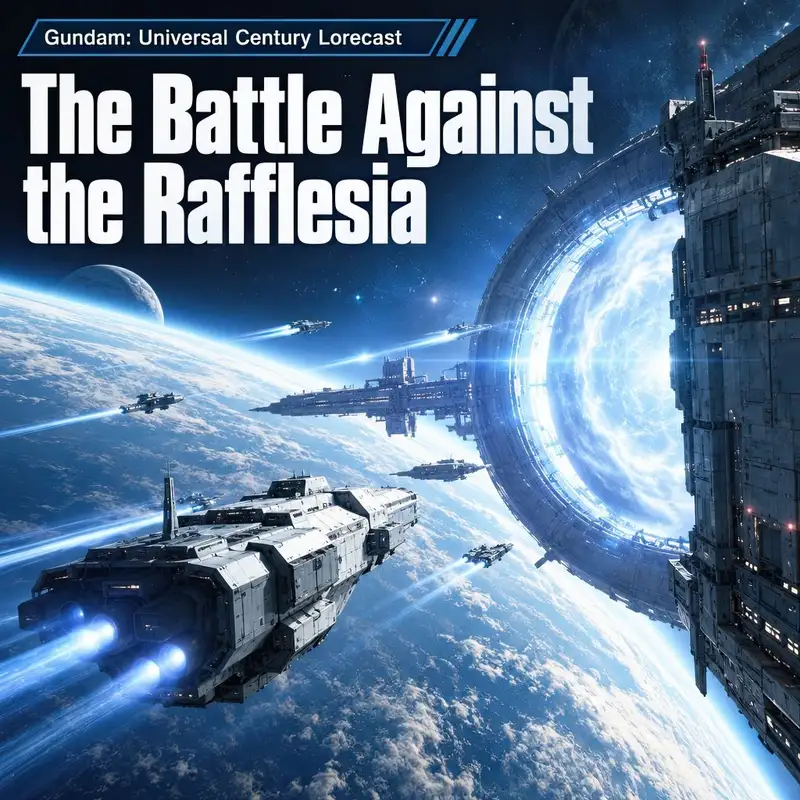
The Battle Against the Rafflesia
Frontier I was not an empty patch of space where two experimental machines could settle an argument. It was a colony, a place built to keep people alive inside a hostile environment. Its corridors, transit routes, pressure doors, utility systems, and shelters existed for ordinary life. By the time the Rafflesia entered the crisis, that ordinary life had already been shattered. Carozzo Rona’s Bugs were moving through the colony as autonomous killing machines, hunting human beings rather than opposing soldiers. Civilians were trying to escape through infrastructure never designed for a population under mechanized attack. Every blocked passage, damaged compartment, and panicked crowd made survival harder.
That is the setting for the final battle of Mobile Suit Gundam F91. The Rafflesia was not launched to win a clean military engagement against an enemy fleet. It was launched because the mass killing operation inside Frontier I had been challenged. The machine was the armed guardian of an atrocity. Its task was to restore Carozzo’s control, eliminate resistance, and preserve his right to decide who would live in the colony he claimed to be remaking.
That context matters because the Rafflesia is often remembered as a formidable mobile armor facing the smaller Gundam F91. It was formidable. It had the firepower to dominate conventional forces, defenses intended to frustrate direct attack, and a weapons layout built to strike across multiple angles at once. But combat power is not the same thing as political power, and neither is the same thing as operational success. A weapon can be terrifying and still be poorly employed. It can overwhelm a fleet and still fail when its commander misunderstands the battlefield, the enemy, and the purpose of force.
The battle against the Rafflesia asks a useful military question. Why did a machine built to overmatch ordinary mobile suits fail against a single prototype? The answer is not that the F91 was simply stronger. It was smaller, more agile, and equipped with extraordinary capabilities, but that alone does not explain the result. The Rafflesia failed because Carozzo tied a specialized weapon to a secret extermination mission, placed its employment under his personal authority, and then confronted an opponent whose movement disrupted the very process of target recognition on which the mobile armor depended.
The political crisis around Frontier Side had created the opening for this disaster. In Universal Century one hundred twenty-three, the Earth Federation still possessed formal authority across much of the Earth Sphere, but formal authority had become a poor substitute for reliable protection. Frontier Side was vulnerable because the Federation could not prevent the Crossbone Vanguard from seizing Frontier IV and threatening the neighboring colonies. That failure was not just a military embarrassment. It told colonists that the government claiming to protect them could not secure their homes when a disciplined armed movement arrived.
The Crossbone Vanguard did not present itself merely as a raiding force. It carried the political program of Cosmo Babylonia, a proposed new order associated with the Ronah family and its doctrine of Cosmo Aristocracy. The language of that project promised hierarchy, discipline, and leadership by an elite supposedly more capable than the compromised institutions of the Federation. It appealed to a real condition. Federation government had become distant, complacent, and unable to answer every colonial grievance with competence or representation.
But the failure of the Federation did not make every alternative legitimate. Political weakness creates opportunities for reform, separatism, opportunism, and conquest alike. The Crossbone Vanguard’s campaign showed how quickly a program claiming to restore order could become a military project imposed on civilians. Frontier Side was not asked, in any meaningful sense, to choose the terms of its political future. It was seized under armed pressure. The residents became subjects of a struggle conducted above them and around them by institutions that treated their safety as negotiable.
Carozzo Rona represented an even more dangerous development inside that wider movement. As the commander known as Iron Mask, he possessed military authority within the Crossbone Vanguard. He was also Cecily Fairchild’s biological father, which made the conflict inside Frontier Side both political and deeply personal. Yet it would be a mistake to treat him as merely a severe officer carrying out the public instructions of Cosmo Babylonia. His most extreme program was his own.
Carozzo developed the Rafflesia in secret, without the knowledge of Meitzer Ronah. That secrecy is important. It tells us that the machine was not simply a standard weapon of the Crossbone Vanguard, nor was the Bugs operation a normal extension of a universally accepted military doctrine. It was a personal radicalization of the Vanguard’s authoritarian politics. Carozzo took ideas about hierarchy, environmental decline, and the alleged unworthiness of ordinary people, then converted them into a program for deciding which populations could be eliminated.
His rhetoric gave this project the language of purification. Humanity, in his view, had become destructive, excessive, and unfit to govern itself. But military historians should be wary when leaders describe civilian populations as an ecological burden, a social disease, or an obstacle to a higher political order. Such language is rarely a technical diagnosis. It is a way to make murder sound administrative. It converts people from citizens into a problem to be solved.
Carozzo’s secret program also exposed the weakness of personal command. A commander who centralizes authority can move quickly. He can bypass debate, oversight, and institutional resistance. That may look efficient in the short term. It also means that errors become harder to correct, subordinates are forced into complicity or silence, and the entire operation rests on one person’s judgment. There were Crossbone Vanguard personnel who did not share Carozzo’s methods. Zabine Chareux’s opposition is evidence of internal fracture. It does not absolve the organization as a whole, but it does show that the Vanguard was not one perfectly unified machine.
The Bugs made Carozzo’s real mission unmistakable. They were separate weapons from the Rafflesia. They were not mobile suits, and they were not simply defensive drones released in the confusion of battle. They were automated devices intended to pursue and kill human beings inside the colony. Their operational purpose was population killing. The distinction matters because the Rafflesia later becomes the visible center of the battle, while the Bugs reveal what that battle was actually about.
Inside a colony, such a system creates a uniquely cruel kind of tactical environment. In open space, civilians may be endangered by debris, damaged ships, or the failure of life-support systems. Inside a habitat, the danger is immediate and intimate. People must move through corridors, elevators, maintenance tunnels, residential blocks, and transit nodes. Panic can turn an escape route into a trap. A damaged pressure seal can threaten everyone in a compartment. A weapon fired at a fleeing target may damage systems needed by hundreds of others.
The Bugs also made control of Frontier I impossible in any durable political sense. A force can seize a port, occupy a command center, and raise a new flag. It cannot govern a population by hunting that population through its own habitat. Terror can compel movement. It can empty streets, break families apart, and force immediate obedience. But it also destroys trust, legitimacy, and the administrative cooperation required to hold territory. A colony is not useful to a government if its people are dead, hiding, fleeing, or prepared to resist every order that follows.
This was the strategic self-defeat embedded in Carozzo’s plan. His weapons could kill efficiently. They could not create a political order. The more successfully the Bugs carried out their mission, the more clearly they demonstrated that Carozzo was not defending Frontier Side, liberating it, or restoring it. He was treating it as a laboratory for extermination. The operation was a test, but the people trapped inside it were not test subjects by choice. They were the intended victims.
Cecily Fairchild’s break with Carozzo therefore mattered at several levels. Publicly, she was associated with the Ronah family under the name Berah Ronah. She was politically valuable because her identity could lend legitimacy to Cosmo Babylonia. Privately, she was the daughter of the commander responsible for the Bugs operation. Her decision to oppose him was not merely a family dispute placed inside a battle. It challenged his claim to represent a coherent political future.
Cecily also brought military value. She had access to the Crossbone Vanguard’s Vigna Ghina, an advanced mobile suit and a symbol of the force now occupying Frontier Side. When she turned that machine against Carozzo’s operation, she demonstrated that his authority was no longer secure even among those closest to the political structure he claimed to serve. Her defection did not erase the damage already done, but it created a direct operational problem. The enemy now possessed not only resistance from outside the Vanguard, but resistance from within its own political family.
The force opposing Carozzo was small and improvised. The Space Ark was a Federation training ship, not a fully prepared task force arriving with a secure chain of command, reserves, and a carefully developed campaign plan. Its people were operating amid a collapsing local situation. They had limited means, incomplete information, civilian responsibilities, and no guarantee that larger Federation forces could arrive in time or restore control once the immediate danger was stopped.
Seabook Arno was at the center of that resistance because he could operate the F91, not because he commanded a fleet or represented a recovered Federation state. He had been a civilian before the assault on Frontier Side. The crisis pushed him into combat under conditions that would strain experienced military personnel. His survival and effectiveness say something about his ability, but they do not mean that civilian volunteers can casually replace an organized defense force. The Space Ark, its crew, the local resistance, and the people trying to save one another gave his actions their purpose.
The F91 itself was incomplete, a prototype developed by the Strategic Naval Research Institute. That matters because it limits the lesson we can draw from its performance. The machine was not evidence that the Federation had solved the problem of defending its colonies. One advanced prototype, operating from one threatened ship, did not repair decades of political neglect, weak readiness, or institutional failure. It was an exceptional asset in a crisis, not a mass-produced answer to the crisis.
Before anyone could confront the Rafflesia directly, the Bugs operation had to be disrupted. Cecily attacked the carrier associated with their deployment using the Vigna Ghina. Its destruction changed the situation immediately. The system carrying and supporting the automated killers was no longer able to continue in the same way. For the civilians of Frontier I, that mattered more than any argument about which mobile suit was superior. The immediate machinery of mass killing had been interrupted.
But destroying the carrier did not end the danger. It forced Carozzo to escalate. Until that point, the Bugs had allowed him to kill at a distance, using automated systems to turn the colony into a killing ground. With that operation under attack, he committed his personal weapon. The battle changed from a dispersed fight against machines moving through civilian infrastructure into a concentrated confrontation with the Rafflesia.
That escalation reveals something about Carozzo’s command style. He did not respond by reassessing the operation, rescuing civilians, or recognizing that his secrecy had produced a political catastrophe. He responded by attempting to impose control through overwhelming force. In military terms, he shifted from a distributed extermination system to a personal counterattack. In political terms, he made the operation even more clearly his own.
The Rafflesia was the XMA zero one mobile armor, a specialized combat system of far greater scale than the F91. Official reference material places it at roughly thirty-seven meters in length, with a mass far beyond that of an ordinary mobile suit. Those figures establish its category, not a neat equation of combat strength. A larger machine is not automatically better in every fight. But the Rafflesia was designed to exploit its scale through concentrated firepower, layered defense, and a broad ability to control nearby space.
Its armament included five mega particle cannons and numerous Tentaclar Rods. The cannons gave it the capacity to engage with powerful beam fire. The Tentaclar Rods gave it a different kind of threat. They extended its reach, allowed attacks from several directions, and turned close-range engagement into a problem of maneuvering through a field of cutting weapons. A conventional mobile suit attempting a direct approach could not focus only on the armor’s main body. It had to survive the weapons reaching outward from it.
The Rafflesia also possessed an anti-beam defensive system. That did not make it universally immune to beam weapons, and the film does not support treating it as invulnerable to every possible attack. What it did mean was that a straightforward exchange of beam fire favored Carozzo. A pilot who attacked from range, using ordinary assumptions about gunnery, would find that the mobile armor had both the protection and the weapons to absorb or frustrate that approach.
The fiber-linked neural control system was equally important. Carozzo’s helmet connected him closely to the Rafflesia’s weapons and movement. The arrangement reduced the distance between his perception, intention, and the machine’s response. It made the Rafflesia less like a conventional vehicle with a crew passing orders through separate stations, and more like an extension of its operator’s will. In the right conditions, that could be devastating.
Official mechanical profiles describe the Rafflesia as a system capable of overwhelming a Federation fleet near the Moon. That claim should be understood as a statement of intended battlefield dominance, not as precise evidence for a particular fleet engagement, casualty count, or firing range. The point is clear enough without false precision. Against conventional forces that it could identify, track, and engage, the Rafflesia was built to be overwhelming.
Its doctrine was simple and brutal. It could use heavy beam fire to punish ships and mobile suits at range. It could use the Tentaclar Rods to dominate close space and deny an enemy a safe approach path. Its anti-beam defense reduced the value of a direct counterattack. And its neural interface allowed Carozzo to employ those systems rapidly, with a degree of personal control few ordinary commanders could match.
That combination made it a serious mismatch for normal Federation mobile suits. A standard machine with standard weapons, operating under ordinary pilot workload, would struggle to find an opening. The Rafflesia could threaten it from multiple angles, survive attacks that might disable lesser machines, and force it into a reactive fight. But that was also the boundary of its advantage. The Rafflesia was optimized to dominate enemies it could perceive and classify. It was not a magical answer to every form of uncertainty.
The F91 approached the fight from the opposite direction. It was compact, high-performance, and built around systems that pushed mobile-suit capability beyond what its small frame might suggest. Its Variable Speed Beam Rifles, usually called V.S.B.R. weapons, offered powerful beam armament. It possessed a beam shield. It used a bio-computer. These details matter not because they make for an impressive inventory, but because they show the F91 as a research machine built to give one pilot unusual mobility, response, and survivability.
Yet the F91 was still a prototype. It was not a standard Federation weapon available across Frontier Side. It had not been fielded in sufficient numbers to create a new defense doctrine, train a generation of pilots, or replace the ships and garrisons that had failed to protect the colonies. The machine could influence this battle. It could not by itself solve the strategic problem that produced the battle.
Seabook’s position was equally limited. He was not a senior commander making decisions for an entire theater. He could not call in a relief fleet, negotiate the political future of Frontier Side, or repair the Federation’s broken relationship with its colonies. What he could do was operate the machine available to him, learn from the immediate fight, and keep moving under pressure. In the final engagement, those limited forms of agency became decisive.
The first exchanges made the mismatch clear. Cecily’s Vigna Ghina was destroyed by the Rafflesia, and she was forced to eject into space. Carozzo’s machine had demonstrated exactly why it was dangerous. It could bring its weapons to bear rapidly, control the engagement area, and punish an opponent before that opponent found a useful angle of attack. The loss of the Vigna Ghina also stripped the resistance of one of its most important assets.
For Seabook, the situation was now worse than a duel. He had to survive the Rafflesia, prevent Carozzo from resuming or expanding his killing operation, and remain aware that Cecily was adrift in space. A purely tactical calculation might have told him to disengage from an enemy with superior firepower and defensive protection. But the immediate mission did not allow a clean withdrawal. The Rafflesia’s existence kept Frontier I under threat. So the fight had to continue.
Direct attack was not working. The anti-beam defense reduced the value of simply firing harder. The Tentaclar Rods made a straight approach dangerous. The Rafflesia’s size and weapons coverage meant that it could turn its physical presence into a defensive perimeter. And Carozzo’s neural control system allowed him to react quickly. In a conventional engagement, these were the features that should have decided the battle.
But fast reaction is not the same as perfect understanding. The Rafflesia’s neural link gave Carozzo extraordinary control over his machine. It did not make him omniscient. He still had to distinguish the real target from misleading information. He still had to interpret movement under combat stress. He still had to decide where the F91 would be, what it intended, and which threat deserved immediate attention. The machine accelerated his decisions. It could not guarantee that those decisions were correct.
The turning point came through the F91’s maximum-operating condition and the effect later identified as M.E.P.E., the Metal Peel-off Effect. This is one of the most easily misunderstood elements of the battle. The F91 did not teleport. It did not become invisible. It did not create supernatural copies of itself. The effect is described as producing mass-bearing afterimages during an exceptional maximum-operating state. In practical terms, the F91’s behavior created multiple apparent targets that could be mistaken for the real machine.
That distinction is crucial. An ordinary visual decoy can confuse a human observer for a moment. A mass-bearing afterimage creates a more serious targeting problem because it appears as something with physical presence. In the chaotic geometry of a close-range battle, the Rafflesia now faced not one clear F91, but a field of apparent F91 positions. Its weapons were still powerful. Its rods were still dangerous. Its anti-beam defense was still functioning. But its ability to place those weapons on the correct target had been compromised.
The Rafflesia had been designed around control. Its cannon fire, its defensive system, and its Tentaclar Rods all assumed that Carozzo could identify the enemy and shape the space around that enemy. M.E.P.E. attacked that assumption. It changed the information environment of the fight. Instead of confronting a single mobile suit moving through a known threat field, Carozzo had to make rapid decisions against multiple apparent signatures while his actual opponent continued to maneuver.
The Rafflesia’s size made that problem more dangerous. A large mobile armor can carry more weapons and project control over a wider area. It also has more physical structure to protect, more angles to cover, and less margin for confusion when an enemy gets close. Its Tentaclar Rods were valuable because they extended its reach. But once their operator was uncertain which target was real, their reach became less useful. A weapon that can strike in many directions still needs a correct target.
This was not an automatic victory for Seabook. The F91’s maximum-operating condition was exceptional, not a routine doctrine that every mobile suit could reproduce. It placed unusual demands on the machine and the pilot. It did not erase the danger of the Rafflesia’s weapons, nor did it prove that every future opponent could be defeated by the same method. The significance of M.E.P.E. lies in its timing. It created uncertainty at the exact moment when Carozzo’s system relied most heavily on precise recognition.
Seabook then exploited the opening. The film establishes the result without requiring us to invent a precise engineering explanation for every moment of the final attack. Confused by the F91’s afterimages, the Rafflesia could no longer maintain the targeting solution that had protected it. Seabook reached the mobile armor and destroyed it. The Rafflesia’s immense firepower, armor, and reach had not vanished. They had become irrelevant for long enough to permit one successful attack.
That is the decisive military lesson. The F91 did not negate the Rafflesia’s strength. It did not prove that a smaller mobile suit is always superior to a larger mobile armor. It created a temporary condition in which the Rafflesia could not use its strength effectively. Mobility, deception, and persistence produced an opening. Seabook had the skill to recognize and use that opening. But the opportunity existed because Carozzo’s system had been forced into a fight it could not fully understand.
At the tactical level, the result was straightforward. The Rafflesia was destroyed. At the mission level, the result was more important. The Bugs operation had been disrupted, and Carozzo’s ability to continue the immediate extermination effort collapsed with his mobile armor. The civilians of Frontier I had not been saved from every consequence of the invasion, but the mechanism designed to hunt them through their colony had been stopped.
At the operational level, Carozzo’s private war had failed. He had invested secrecy, ideology, and personal authority into a system meant to guarantee dominance. Instead, that system exposed the limits of his command. He could not keep the Bugs operation secure. He could not compel Cecily’s loyalty. He could not prevent resistance from forming around the Space Ark. And when he personally entered the battle with his ultimate weapon, he could not adapt when the battlefield stopped behaving according to his assumptions.
The political consequence was equally severe. Carozzo’s program had already destroyed any credible claim that extermination could be the foundation of legitimate government. The destruction of the Rafflesia did not merely remove a powerful weapon. It shattered the immediate instrument through which he intended to impose his vision of social purification. A political movement can survive battlefield defeat. It has a much harder time surviving the revelation that its commander has made mass murder the practical expression of its ideals.
Cecily’s survival remains central to the meaning of the battle. After destroying the Rafflesia, Seabook searches for her and rescues her. That action prevents the story from becoming a sterile account of machine destruction. The purpose of stopping Carozzo was never simply to win a contest between the F91 and the Rafflesia. It was to protect people trapped inside a political and military catastrophe. Cecily was not only a pilot who had lost her mobile suit. She was a survivor, a daughter who rejected her father’s project, and a living challenge to the authority he claimed.
Still, the victory had clear limits. The Rafflesia’s destruction did not repair the Federation’s failure at Frontier Side. It did not erase the Crossbone Vanguard’s broader campaign. It did not settle the political future of Cosmo Babylonia. It did not restore those killed by the Bugs, nor did it remove the fear and trauma inflicted on a colony that had become a battlefield. The immediate extermination operation had been stopped, but the conditions that made Frontier Side vulnerable remained unresolved.
For that reason, neither machine should be treated as a normal representative of its side. The F91 was not the Federation at scale. It was a rare prototype, incompletely integrated into an institution already shown to be inadequate. The Rafflesia was not ordinary Crossbone Vanguard capability. It was a secret personal weapon created by Carozzo for a radicalized mission that even some within his own movement rejected. Treating their duel as a simple Federation-versus-Vanguard contest would hide more than it explains.
The Battle Against the Rafflesia was therefore not a fairy tale about the small machine defeating the large one. It was the failure of a weapon system whose political purpose, command structure, and targeting assumptions had all become liabilities. Carozzo possessed extraordinary firepower, but he used it to defend an atrocity. He possessed a neural interface, but it tied the battle ever more closely to his own perception and judgment. He possessed a machine built to dominate identified targets, but he faced an opponent able to turn uncertainty into survival.
The F91 succeeded because its exceptional maximum-operating behavior gave Seabook a brief but decisive advantage in information and maneuver. The Rafflesia lost because power without correct perception is only destructive potential, and destruction is not control. Carozzo could build a machine capable of terrorizing a colony and overwhelming conventional forces. He could not turn extermination into durable authority.