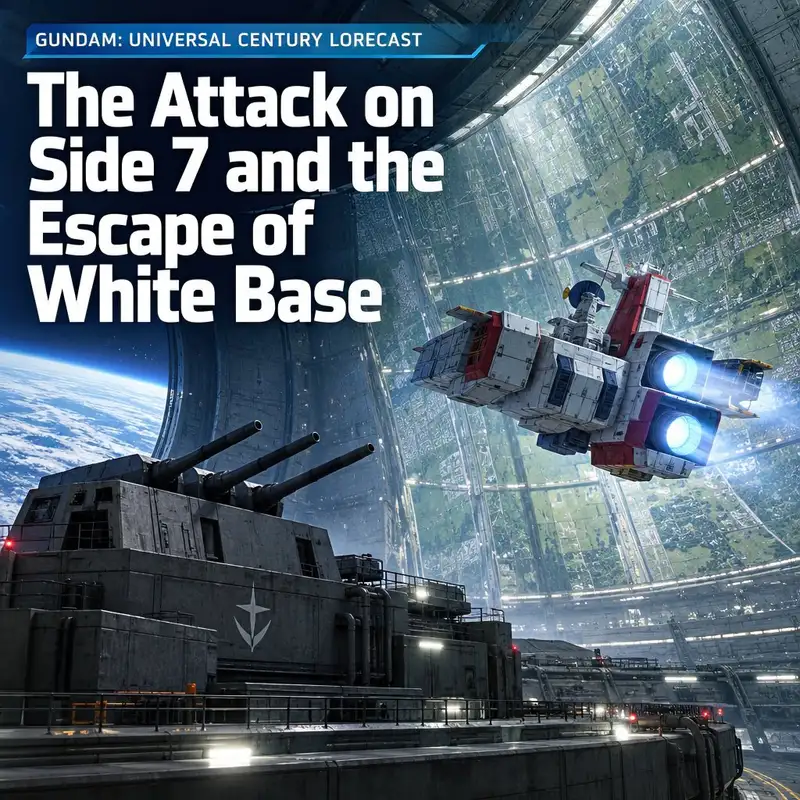
The Attack on Side 7 and the Escape of White Base
A Zaku’s rifle fire inside Side 7 did more than expose a secret weapons program. It tore through the boundary between a classified military installation and a civilian home. Side 7 was not a remote test range, empty except for engineers and guards. It was a colony, a pressurized habitat where military work, transport systems, family life, and ordinary routines existed in close proximity. Once Zeon mobile suits entered that space and began firing, the first question was not whether the Federation’s new Gundam could defeat them. The first question was whether anyone could stop a military emergency from becoming a disaster for the people living around it.
The answer, at least on September eighteenth, Universal Century seventy-nine, was no. The attack on Side 7 became one of those incidents in which every major institution preserved something important while losing control of the situation that made preservation necessary. Zeon confirmed that the Federation was developing a dangerous new mobile suit. The Federation saved critical prototypes and the assault carrier White Base. Amuro Ray entered the Gundam for the first time and proved that it could fight. Yet Side 7 was damaged, trained personnel were killed or incapacitated, civilians were displaced, and White Base left not as the finished centerpiece of a carefully planned program, but as a damaged evacuation ship carrying a prototype force that had never been meant to operate this way.
Side 7 was Federation-controlled, but it was not a major fortress prepared to absorb a determined attack. Its value lay in concealment and development. A colony could provide facilities, infrastructure, and a degree of distance from the larger fronts of the war. It could also place a sensitive project near civilians who had not agreed to become a shield for it. The Federation’s planners had created a technical opportunity. They had not created a secure military sanctuary.
Zeon’s interest in Side 7 therefore began as an intelligence problem. Char Aznable did not arrive to conduct a full-scale invasion of the colony. His small force was sent to investigate. That was a sensible mission in the circumstances. When electronic warfare and particle interference limit what can be learned from a distance, reconnaissance has to get close. A small team of mobile suits could approach, observe, identify installations, and report what it found. Such a force was useful because it was limited. It was supposed to gather information without provoking a battle large enough to destroy the very evidence it had been sent to examine.
Char’s reconnaissance team included Denim, Gene, and Slender. Their assignment required restraint, discipline, and patience. Those qualities are not glamorous, but reconnaissance lives or dies by them. An intelligence mission can be ruined by a single premature shot. The value of a suspected enemy installation lies not only in the equipment found there. It lies in the records, personnel, patterns of activity, security arrangements, and logistical connections that can be observed before the enemy realizes what has been discovered.
At Side 7, Zeon had suspicion and access, but not yet a controlled understanding of what the Federation was building. The reconnaissance force had entered the colony. It had found evidence of a major project. From Zeon’s perspective, that was already a significant success. A disciplined commander might then have faced an unpleasant choice. Withdraw with what had been learned, continue observing at great risk, or call for a larger operation designed around the new intelligence. None of those options guaranteed a clean result. But they preserved the essential purpose of reconnaissance, which was to learn before deciding how to strike.
Gene’s decision changed the nature of the mission. He attacked. In the immediate tactical sense, the impulse was understandable. He had encountered unfamiliar Federation equipment and may have judged that a potential threat should be destroyed before it could be used against Zeon. That is a common battlefield calculation. It is also one that can be disastrous when a subordinate substitutes his own immediate judgment for the mission’s actual purpose.
Gene’s escalation converted a covert penetration into an uncontrolled strike. The team lost the advantages of surprise and discretion at the same moment. The Federation personnel around the project were alerted. The prototypes that Zeon might have examined were now likely to be activated, moved, or destroyed by their owners. Facilities that might have yielded technical evidence were endangered by the fighting. The reconnaissance force had reached the objective, but it had destroyed the conditions that would have allowed it to exploit that success.
This was more than the mistake of one impulsive pilot. It was a command-and-control failure. Military organizations send small units forward because they expect those units to act within a commander’s intent. Local initiative can be valuable, especially when communications are uncertain. But initiative without discipline becomes freelancing. The point of a reconnaissance mission is not to let every pilot choose the war’s next objective. It is to provide higher command with the information needed to make that choice.
Char’s distinction from Gene matters here. Char had ordered reconnaissance. He had not ordered a colony assault. The difference does not excuse the danger posed by Zeon’s intrusion into Side 7. A military reconnaissance force entering an inhabited colony was already taking a serious risk with civilian lives. But the unauthorized attack made that risk far worse. It transformed a limited intelligence operation into a battle inside a pressure-dependent civilian habitat.
Once weapons fire began, the Federation could no longer protect either secrecy or normal procedure. Side 7 became a confused battlefield where military personnel had to think about prototypes, hostile mobile suits, damaged facilities, and civilians trying to survive the same crisis. A colony is not simply a large room in space. Its systems support air, transport, housing, work, and daily life. Damage inside one carries consequences beyond the immediate point of impact. A wall, tunnel, vehicle route, or industrial section may also be part of the infrastructure that keeps a community functioning.
That civilian reality is essential. Side 7 was not collateral scenery around the debut of a famous weapon. Its residents paid the immediate price for both sides’ failures. Zeon’s reconnaissance team violated the line between intelligence collection and uncontrolled violence. The Federation had embedded a high-value weapons project within an inhabited colony without being able to secure it once discovered. Neither fact cancels the other. The result was a community turned into an emergency zone.
The colony environment also changed the military problem. The Zakus could not treat Side 7 as open space. The Federation defenders could not simply use every weapon available without regard for the structures around them. Visibility, routes of movement, civilian congestion, and damaged infrastructure all complicated the situation. A mobile suit’s power could become a liability when the battlefield contained homes, evacuation paths, and life-support systems. The tactical issue was not merely which machine had the better weapon. It was whether anyone could use force without worsening the catastrophe already underway.
At the center of that emergency stood Operation V’s human vulnerability. Tem Ray and the technical personnel around him were not interchangeable figures in laboratory coats. They represented accumulated expertise. Advanced military systems depend on people who understand how they were designed, assembled, tested, and repaired. The loss of an engineer cannot always be made good by finding another person with the same job title. Specialized knowledge often lives in teams, habits, records, and practical experience that do not transfer quickly.
Tem Ray was injured during the attack. Other trained personnel were lost or incapacitated as the operation around Side 7 collapsed. The material assets of Operation V mattered. So did its technical data. But the program’s real strength was never contained in machinery alone. It depended on the people able to interpret the machinery and sustain it. When those people were scattered, wounded, or killed, the Federation preserved hardware while losing part of the human structure that made the hardware useful.
This is the difference between building a prototype and fielding a capability. A prototype can be remarkable and still be strategically fragile. It may require specialists who cannot be replaced quickly. Its spare parts may exist only at the original facility. Its maintenance procedures may still be incomplete. Its intended pilot may not yet be assigned, or may not be available. Its carrier may be present, but its crew may not be intact. A weapon system becomes a military capability only when all of those elements can function together.
At Side 7, the Federation’s program survived just enough to be forced into combat before it was ready. That was not an ideal test. It was an institutional crisis. The Gundam was available. Availability was not the same thing as having a trained combat pilot standing by. The machine existed. The chain of command around it was broken. The people who knew the most about it were under attack. The Federation had developed a response to Zeon’s mobile-suit advantage, but it had not yet deployed that response as an organized force.
Amuro Ray entered that gap. He was not a Federation pilot. He had not completed a military training pipeline, received formal combat instruction, or been assigned to a mobile-suit unit. He was a civilian resident of Side 7, and he was Tem Ray’s son. His proximity to the project and his technical literacy gave him access to information that most civilians would not have possessed. In the chaos of the attack, he reached the Gundam and its operating manual.
That manual matters. The Gundam was advanced equipment, but it was still a machine designed to be operated by human beings through procedures, controls, and systems that could be learned, at least in part, under pressure. Amuro’s ability to read, interpret, and act on the available instructions did not turn him into a finished soldier. It showed an unusual capacity for technical adaptation in a desperate moment. The Federation had not solved its pilot problem. It had encountered an exceptional individual at the exact point where its planned system had failed.
Amuro’s first use of the Gundam is often remembered as the moment when one young pilot abruptly changes the course of the war. That is too broad for what anyone at Side 7 could have known. At the time, it was first a local survival problem. Zeon mobile suits were attacking a vulnerable installation. Federation personnel were unable to respond through their intended command structure. A civilian climbed into a prototype because the alternative was to leave the machine unused while the crisis continued around it.
The Gundam’s performance in that engagement revealed why Operation V mattered. The machine combined mobility, protection, and powerful handheld weaponry in a way that allowed it to challenge Zeon’s Zakus directly. The beam rifle was particularly important. It gave the Gundam a weapon capable of rapidly changing the balance of a close-range engagement. Zeon had entered Side 7 expecting to investigate a Federation project. It found that the project could fight back.
But the Gundam’s success should not be mistaken for an uncomplicated technological triumph. The machine’s armor and weapons gave Amuro an advantage, but armor did not make the colony safe. Mobility did not restore the Federation’s shattered command structure. A beam rifle did not replace the engineers, mechanics, crew members, or civilians already lost to the attack. The Gundam could defeat immediate threats. It could not undo the organizational failure that had put Side 7 in this position.
The local tactical result was clear enough. The attacking Zakus were defeated, and the immediate danger to the surviving Operation V assets was reduced. Amuro had demonstrated that the Federation possessed a mobile suit capable of standing against Zeon’s established machines. That was an important revelation. It was not yet a mature force structure. One prototype, one civilian pilot, and a battle fought amid a damaged colony did not amount to a completed answer to Zeon’s military advantage.
Zeon’s surviving leadership had learned something dangerous. The Federation was no longer merely trying to copy Zeon’s mobile-suit concept in the abstract. It had produced a machine that could pose a serious threat. That intelligence had strategic value, even though the reconnaissance mission had failed to obtain it in a controlled fashion. Zeon had confirmation, not comprehension. It had seen the Gundam fight, but it did not possess a full account of its technical basis, its production prospects, its supporting systems, or the extent of the larger Federation program.
The Federation learned a different lesson. It learned that the Gundam could function under combat stress, but only through a chain of accidents. Its first effective operator was not a trained service member. Its first battle took place in a civilian emergency. Its supporting project had been damaged before the system could enter planned service. This was valuable combat data, but it was also a warning. A weapon that performs brilliantly in an emergency may still be difficult to reproduce, maintain, and integrate into ordinary operations.
The more important surviving asset may have been White Base. The Gundam could win a fight, but it could not sustain itself indefinitely in hostile space. It needed a ship that could move it, launch it, recover it, inspect damage, replenish weapons, provide technical support, and coordinate its operations with the rest of the force. White Base was not simply a large transport assigned to carry the Federation’s prototypes away from Side 7. It was an assault carrier, built around the operational reality that mobile suits depended on ships and crews.
A carrier is a system of systems. Its value lies in more than its guns or hull. It has to manage launch and recovery, maintenance, fuel or propellant, ammunition, medical care, navigation, communications, and the basic work of keeping exhausted people alive while they operate under threat. A mobile suit that returns with damage is not useful if no one can recover it. A powerful rifle is not useful once its ammunition is exhausted. A prototype pilot cannot be sent back into battle without someone to brief, monitor, and support him.
White Base had been intended to operate with a trained crew and a coherent mission. The Side 7 attack destroyed much of that plan. Captain Paolo Cassius was wounded. Other trained personnel were lost. The ship’s command structure did not vanish completely, but it became dangerously incomplete. Responsibilities fell onto survivors who had not expected to hold them, and who did not always possess the experience or authority that those responsibilities normally required.
Bright Noa emerged into that vacuum. His importance was not that he instantly became an ideal commander. The significance of Bright’s role was that the ship needed someone to make decisions while the formal structure around him had been damaged. Emergency command is rarely elegant. It is a matter of acting with partial information, limited personnel, damaged systems, frightened civilians, and little time to consult a proper chain of authority.
The surviving group around White Base reflected the same improvised character. Mirai Yashima, Ryu Jose, Sayla Mass, Kai Shiden, Hayato Kobayashi, Fraw Bow, and others became part of a shipboard community because the crisis had given them no clean alternative. Some had useful skills. Some had military connections or technical familiarity. Some were civilians who had simply survived long enough to be drawn into the evacuation. Their presence did not mean the Federation had intentionally created an innovative new crew model. It meant the intended crew model had been broken.
Here, the military and civilian dimensions of Side 7 became inseparable. White Base was carrying weapons, technical knowledge, wounded personnel, and survivors. It had to function as a warship and carrier while also serving as a refuge for people displaced by the attack. Those tasks could conflict. A commander trying to escape pursuit might prefer speed, secrecy, and clear decks. A commander responsible for wounded personnel and civilians also had to think about medical care, internal order, fear, food, shelter, and the simple fact that not everyone aboard understood military procedure.
The ship’s departure from Side 7 was therefore not a withdrawal in the clean language of a staff report. It was an evacuation and preservation operation. White Base had to get clear of the damaged colony before Zeon could return with a stronger response. It had to retain the surviving Operation V assets. It had to protect people who could not simply be left behind. It had to establish enough command authority to navigate, operate engines, maintain defenses, and manage a mobile-suit force that was already more important than the crew was prepared to handle.
Every one of those requirements imposed a burden. The Gundam had to be launched and recovered. Its weapons had to be supplied. Its pilot needed direction, even if he could not yet receive it through ordinary military channels. The ship itself required engineering, navigation, communications, and damage control. The wounded needed treatment. Civilians needed some measure of order and security. None of these demands disappeared because the ship was moving. In fact, leaving Side 7 made them more urgent. A damaged ship in open space had fewer places to hide and fewer people available to solve its problems.
White Base also carried a political burden. The Federation had hoped to keep Operation V concealed until it could be deployed on favorable terms. That option was gone. The prototypes now had to be moved through a war zone where Zeon had already become aware of them. The project was no longer a protected research effort. It was a mobile target. The Federation had saved its weapons, but the price of survival was exposure.
Char understood that change quickly. After the Side 7 battle, the Gundam was no longer a rumor inside a colony. It was an identified threat. The objective shifted accordingly. Zeon did not need merely to investigate the Federation project. It needed to destroy or neutralize the Gundam before White Base could reach a more secure Federation position, before the Federation could study combat results, and before this new weapon could be integrated into a broader campaign.
The pursuit shown in the second episode is therefore more purposeful than the original reconnaissance. Char was no longer dealing with an uncertain possibility. He had seen enough to know that the Federation’s prototype was dangerous. White Base, meanwhile, was vulnerable precisely because it had escaped rather than completed its intended mission. It was carrying vital equipment and personnel, but it was also damaged, undermanned, inexperienced, and burdened with refugees.
This was a difficult defensive posture. White Base had to protect itself while acting as a carrier. It had to launch mobile suits while keeping the ship alive long enough to recover them. It had to coordinate people who were still learning one another’s roles. It had to preserve civilian lives while remaining under military threat. A carrier cannot simply turn into a fortress because its mobile suits are outside. Its own survival remains the condition for the survival of the force it carries.
Char’s attack tested that condition. The Gundam could engage Zeon’s mobile suits, but the battle demonstrated that it was not self-sufficient. Amuro’s machine required the White Base as a base of operations. Its effectiveness depended on the ship’s crew, the people handling recovery and resupply, the officers trying to direct the defense, and the technicians attempting to keep unfamiliar systems running despite the losses at Side 7.
The beam rifle made this dependence especially visible. In the early fighting, the weapon had helped establish the Gundam’s frightening local advantage. But powerful weapons have material limits. Ammunition is finite. Energy weapons may appear to free a force from conventional magazines and shells, but they still require power systems, equipment, replacement components, and practical resupply. When the beam rifle’s ammunition was exhausted, the Gundam did not become useless, but its options changed. It had to return to the ship and depend on the support structure that made continued combat possible.
That is the material reality behind the Gundam’s first reputation. It was an extraordinary prototype, but it was not an independent strategic actor. It could not repair itself, rearm itself, navigate the larger campaign alone, or preserve the civilians aboard White Base. Its combat power existed within an organization, however improvised that organization had become. The survival of the Gundam and the survival of White Base were inseparable.
The same was true for Amuro. His technical ability and rapid adaptation mattered enormously. But he did not create a military force by himself. He needed a ship to launch from, people to recover him, officers to make operational decisions, and others to take responsibility for the wounded, the refugees, and the broader mission. The emergency had made him indispensable, but indispensability is not the same as institutional readiness. In fact, it was evidence of how fragile the Federation’s position had become.
Neither side achieved the result it originally sought. Zeon began with a reconnaissance mission and lost the discipline required to conduct reconnaissance properly. It confirmed the existence of the Gundam, but it failed to destroy the Federation project before that machine entered combat. The Federation preserved White Base, the Gundam, and key survivors, but it lost secrecy, trained personnel, and the security of its Side 7 base. The colony itself bore damage that no tactical success could erase.
The logistical lesson was stark. White Base mattered because the Gundam needed it. A mobile suit’s combat performance is only one part of its usefulness. The machine needed launch facilities, recovery procedures, ammunition, maintenance, spare parts, technical labor, and a crew able to coordinate all of those functions while under fire. The Side 7 incident did not prove that one advanced machine could replace fleets, bases, or institutions. It proved the opposite. A superior machine became strategically important only because a damaged ship and an improvised community kept it in the fight.
For the civilians of Side 7, that improvisation offered little comfort. Their colony had become a battlefield because a secret military program and an enemy reconnaissance mission collided inside an inhabited space. They did not need to understand the Gundam’s technical significance to understand that their homes were no longer secure. Their displacement was not an unfortunate footnote to the beginning of a military legend. It was the immediate human cost of a war in which states treated colonies as strategic terrain while ordinary residents continued trying to live inside them.
Politically, Side 7 exposed a recurring weakness of the Earth Federation. Its resources were vast, but resources did not automatically create readiness, legitimacy, or competent local security. The Federation could fund advanced research, construct a new carrier, and begin answering Zeon’s mobile-suit advantage. Yet it had not created a system capable of protecting that effort without placing civilians at risk. Industrial capacity remained a strategic advantage. It was not a substitute for sound planning.
The attack on Side 7 created White Base and the Gundam’s first reputation not because either side executed its plan well, but because a reconnaissance mission lost discipline and a secret Federation project survived through improvisation. The Federation saved the weapons, ship, and people that mattered most, but it did so by abandoning the illusion that its new mobile-suit force was ready. White Base departed not as a completed instrument of war, but as a damaged, improvised community carrying the consequences of a battle that should never have reached a civilian colony.