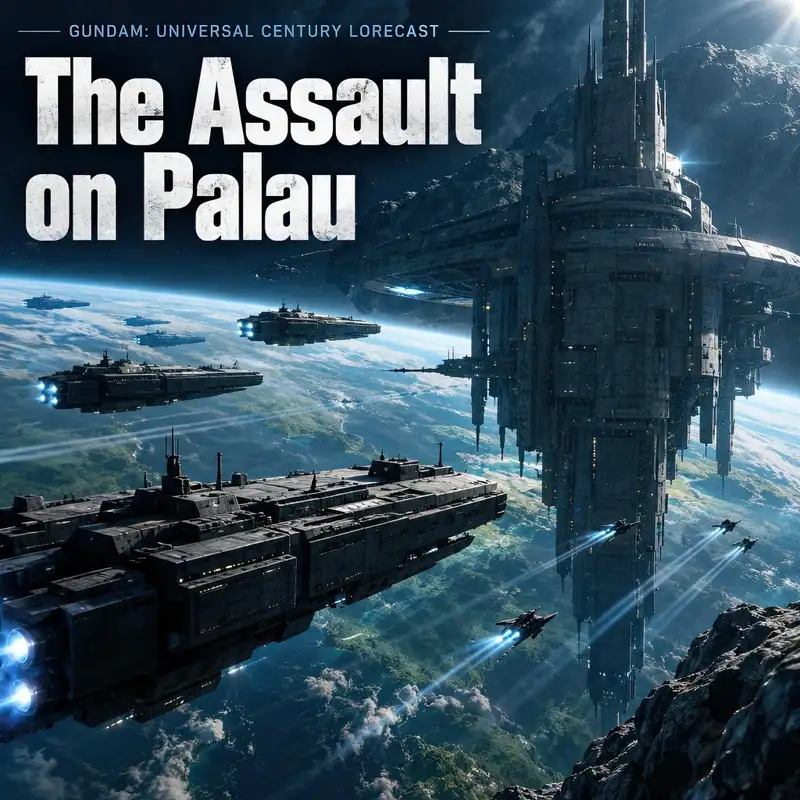
The Assault on Palau
The Nahel Argama’s Hyper Mega Particle Cannon was built for a kind of decision most commanders prefer to make at long range. It could break a warship, batter a fortress, or force an enemy fleet to reconsider its position. At Palau, it had to do something more difficult. It had to strike a fortified asteroid installation without destroying the prize inside it, without trapping the Federation personnel already operating within it, and without turning an inhabited refuge into a killing ground. Somewhere behind Palau’s defenses were Banagher Links and the Unicorn Gundam. The Sleeves held both. The Earth Federation could not allow them to remain there. Yet a conventional assault would have favored the defenders, endangered civilians, and risked destroying the very machine the operation was meant to recover.
That contradiction defines the assault on Palau. This was not an attempt to conquer an asteroid, destroy the Sleeves, or settle the political struggle surrounding Laplace’s Box. It was a raid. Its immediate objectives were narrow but urgent: recover Banagher, reclaim the Unicorn, deny the Sleeves control of both, and leave before the operation became a battle of attrition the Nahel Argama could not afford. The raid succeeded because it did not try to defeat Palau in the usual sense. Londo Bell and the Earth Federation special-operations personnel attached to it attacked the asteroid’s access routes, internal connections, and command cycle. They made the fortress temporarily unusable as a fortress. That was enough to create a window for recovery.
Palau was not merely a rock with guns attached. It was a resource satellite and a Sleeves stronghold, but it was also a functioning community. Its military harbor, docking spaces, maintenance areas, residential compartments, and industrial infrastructure existed together because they had to. The Sleeves were a remnant movement, but not a collection of isolated fugitives drifting from battle to battle. They had crews, pilots, technicians, families, children, supplies, and the routines of people trying to sustain a political and military organization after the old Principality of Zeon had been defeated and transformed into the Republic of Zeon.
That civilian and semi-civilian character did not make Palau innocent or demilitarized. It housed armed forces, protected military equipment, and served the strategic purposes of the Sleeves. But it did shape the problem confronting the Federation. A commander could not treat Palau as an empty orbital battery or an abandoned asteroid base. Any strike against it would threaten people who were not sitting in a cockpit or issuing orders. Even a carefully aimed raid could rupture compartments, disrupt life support, destroy workplaces, and leave families trapped amid a battle they had not chosen.
Palau became especially important because the Sleeves had captured more than a pilot. Banagher Links was the registered pilot of the Unicorn Gundam, a machine linked to the search for Laplace’s Box. The Box was not simply a piece of valuable information. It was a political weapon whose contents might challenge the legitimacy of the existing Earth Federation order. Whoever controlled the Unicorn, and whoever could make use of the program embedded within it, possessed leverage over a crisis that had already drawn in the Vist Foundation, the Federation establishment, Londo Bell, the Republic of Zeon, and the Sleeves.
For Full Frontal, the Unicorn was therefore not just an advanced mobile suit. It was an instrument that might open a path toward the Box. It was also a symbol. The machine carried the legacy of the One Year War and the promise, or threat, of Newtype technology. Frontal understood that control of such a machine could alter political calculations far beyond one battle. The Sleeves could not match the Federation in raw industrial capacity or territorial control. But they did not need to match it everywhere. They needed access to a strategic point of leverage, and the Unicorn was precisely that kind of asset.
Banagher himself complicated the military picture. He was not a disciplined Federation pilot assigned to a standard chain of command. He had arrived in the conflict through family history, accident, conviction, and the peculiar relationship between the Unicorn and its pilot. The Federation wanted the machine secured. The Sleeves wanted the machine activated for their purposes. Banagher wanted to understand what his father had left behind and why so many powerful institutions were willing to kill for it. None of those motives fit neatly into a standard recovery order.
Inside Palau, Banagher encountered a world that made the conflict harder to simplify. The Sleeves included committed soldiers, experienced officers, refugees from older defeats, and people whose connection to Zeon was personal rather than abstract. Suberoa Zinnerman, for all his harshness and political commitment, represented a form of paternal responsibility toward those under his protection. Gilboa Sant was not presented as a faceless raider. He had family ties and a life inside Palau. Those details matter because they show what military planners often prefer not to see: a base can be both a legitimate military objective and a place where ordinary people eat, work, raise children, and wait for someone to come home.
The Federation force approaching Palau had its own constraints. The Nahel Argama was a powerful ship, but it was not an independent fleet with unlimited reserves. It had recently endured hard fighting and carried the accumulated burden of damage, maintenance, depleted stores, exhausted personnel, and uncertain political support. A mobile-suit carrier does not recover from combat simply by having a reactor and a hangar. Damaged machines require parts. Pilots require rest. Weapons need ammunition. Propellant, seals, sensors, launch systems, medical supplies, and technicians all become operational limits long before a ship is visibly crippled.
Captain Otto Mitas held formal command of the Nahel Argama. His responsibility was enormous. He had to preserve his ship, execute the recovery mission, coordinate with Federation authorities, and make decisions under conditions where political consequences could be as dangerous as enemy fire. But formal command was only part of the picture. Daguza Mackle, leading the Earth Federation special-operations unit known as ECOAS, exercised practical authority over the infiltration and sabotage effort. The operation depended on Otto’s ship, Otto’s weapons, and Otto’s crew. It also depended on Daguza’s people reaching the right places inside Palau before the shooting began.
The Federation’s immediate mission therefore combined several purposes that could pull against one another. Banagher had to be recovered as a person. The Unicorn had to be recovered as a strategic asset. The Sleeves had to be prevented from using it. Intelligence had to be gathered where possible. The Nahel Argama had to avoid losses it could not replace. Palau’s civilian population could not simply be ignored. And Mineva Lao Zabi, whose identity carried political weight far beyond her physical safety, was also present within the larger crisis. The operation was not a clean military problem. It was a military operation conducted inside a political argument.
A prolonged siege was not a realistic answer. A siege requires time, sustained logistics, control of surrounding routes, reliable intelligence on the defender’s supplies and morale, and the ability to keep the besieging force safe from relief, breakout, or counterattack. The Nahel Argama did not possess those advantages in a secure form. It could not remain outside Palau indefinitely, waiting for hunger or pressure to force a surrender. The Sleeves could sortie mobile suits, relocate assets, reinforce defenses, or use the Unicorn as a bargaining tool. Full Frontal’s possible intervention made delay even more dangerous.
A direct assault was no better. Palau’s defenders knew the installation. They had prepared routes, hangars, docks, and defensive positions. A force attempting to storm the asteroid section by section would have to fight through narrow approaches and confined spaces where numbers and firepower become less decisive. In a colony or asteroid habitat, every damaged bulkhead creates a new hazard. Every missed shot can become a pressure loss, a fire, or a blocked evacuation route. Mobile suits may dominate open space, but they are awkward instruments for clearing inhabited infrastructure one compartment at a time.
The Federation instead adopted the logic of a raid. A raid does not seek to own the ground, or in this case the asteroid, after the operation. It seeks to enter, disrupt, seize, destroy, rescue, or recover, and then leave before the defender can organize a decisive response. The attacker accepts that the target will remain hostile. The purpose is to create a temporary advantage and exploit it quickly. The assault on Palau required infiltration, sabotage, a single major shipboard strike, mobile-suit screening, recovery of the objective, and withdrawal. If any one of those stages failed, the others could not compensate for it.
ECOAS was the key enabling force. It is tempting to look at special-operations personnel in Gundam and imagine that their significance lies in individual combat skill. Skill mattered, of course. But the real value of ECOAS at Palau was organizational. These were personnel trained and equipped to operate where ordinary fleet forces could not. They could infiltrate, move through restricted spaces, place explosives, identify access points, and work under tight compartmentalization. Their mission was not to win a mobile-suit duel. It was to create the conditions in which the Nahel Argama’s firepower and mobile suits could be used effectively.
The Loto mobile suits fit that mission. The Loto was not important because it was a superior frontline combat machine. Against the most capable Sleeves units, it would not have been the preferred weapon for open battle. Its usefulness lay elsewhere. Its compact profile, transformation capability, and capacity to support special-operations personnel made it suitable for infiltration and access. A conventional large mobile suit is a poor tool for every task. It needs space, support, and room to maneuver. The Loto could bring people and equipment into places where a larger combat unit would be conspicuous, cumbersome, or simply unable to fit.
The sabotage exploited the fact that Palau was not one solid, featureless body. Its usable military and industrial spaces depended on connected sections, internal routes, docking access, and harbor geometry. The attackers did not need to pulverize the whole installation. They needed to disrupt the relationships among its parts. If passages could be blocked, sections shifted, and access routes sealed, then the defenders would lose the ability to move forces and equipment efficiently. A fortress is not just walls and weapons. It is circulation. It depends on people, machines, supplies, and orders moving from one place to another.
That made timing everything. ECOAS personnel had to complete their work before the main strike. They then had to survive the consequences of the strike they had enabled. If the explosions occurred too early, Palau’s defenders could react, isolate damaged areas, and hunt the infiltrators before the Nahel Argama arrived. If they occurred too late, the ship’s fire might not produce the intended effect. If the cannon strike was mistimed, the infiltrators could be trapped behind newly sealed routes or caught in structural collapse. Special operations often appear elegant in planning documents. In practice, they are a chain of dependencies with very little margin for error.
The Nahel Argama’s Hyper Mega Particle Cannon provided the raid’s decisive calculation. The weapon was not employed as ordinary naval fire. The ship was not exchanging repeated broadsides with another battleship or conducting sustained bombardment against a distant target. The cannon had to be used once, against a carefully selected point, after the sabotage had made Palau vulnerable to the intended effect. Later descriptions sometimes use the name Operation Billiard for this concept. The useful part of that phrase is not the name. It is the image of one object shifting another into a position that changes the whole table.
The strike, combined with the sabotage, forced sections of Palau out of their previous alignment. The purpose was to obstruct or seal military access around the harbor and create confusion inside the Sleeves’ defensive system. It was an attack on geometry rather than annihilation. By changing how the asteroid’s components connected to one another, the Federation reduced the defenders’ ability to launch, recover, reinforce, and coordinate. The operation did not need every gun emplacement destroyed. It needed the defenders to lose their ability to use the base as a coherent system during the short period when Banagher and the Unicorn could be recovered.
Once the harbor and internal routes were disrupted, the operation entered its exploitation phase. The Nahel Argama launched mobile suits to screen the approach, intercept defenders, and capitalize on the temporary disorder. ReZELs, Jegans, ECOAS Lotos, the Delta Plus, and other available units performed different roles within the attack. The exact order of battle is not securely established by the animated record, and there is no value in pretending that background images provide a perfect roster. What matters is function. Some units protected the ship. Some pressed the opening. Some supported the recovery. Some were held ready for the counterattack everyone expected.
Minovsky conditions made this more difficult. The Universal Century’s battlefield environment does not permit commanders to assume that a distant headquarters sees everything. Long-range detection and communication are constrained. Local initiative becomes more important. Pilots and small-unit leaders often have to make decisions based on incomplete information, visual confirmation, and prearranged intent rather than continuous detailed orders. That helped the raiders, because confusion favors the side that has prepared for it. But it also created danger, because friendly units could become isolated or misunderstand the changing situation.
For Banagher, the assault appeared first as a custody crisis. He was not sitting safely in a Federation command center waiting to be extracted. He was inside a hostile base, surrounded by people who did not all agree on what should be done with him. His escape through Palau was not merely a dramatic dash toward the Unicorn. It represented the collapse of the Sleeves’ ability to keep control of their most valuable prisoner while under external attack. In any recovery operation, the objective is often easiest to secure when it is stationary. Once the captive begins moving, the operation becomes unpredictable.
Banagher’s choices were also shaped by what he had seen inside Palau. He had encountered Marida Cruz, Zinnerman, Gilboa, and the human reality of the Sleeves. That did not make him a Sleeves supporter. It did make it harder for him to accept the simple language of target, enemy, and asset. The Federation wanted him recovered. ECOAS needed him moved quickly. But Banagher was not cargo. He interpreted events, formed attachments, and resisted being treated as a weapon to be handed from one institution to another. That independence would repeatedly complicate the plans of people who believed they could control the Unicorn by controlling its pilot.
Daguza Mackle understood more of that complexity than many officers would have. He had spent time with Banagher and recognized that the boy was both central to the mission and vulnerable to the larger forces surrounding him. Daguza’s professionalism did not require him to become sentimental. It required him to understand the human terrain of the operation. Recovering Banagher meant more than reaching his physical location. It meant persuading him to move, protecting him from immediate threats, and preventing the mission from becoming an excuse for every armed participant to settle a personal score.
Gilboa Sant stood on the other side of that crisis. He was a Sleeves soldier defending his people, his command, and the base where his family lived. He was not wrong to see the Federation raid as a threat to Palau. But he was also part of an organization determined to use Banagher and the Unicorn for its own political purposes. The tragedy of their confrontation lies in that overlap. Both men acted from loyalty. Both believed they were protecting someone. Yet neither could separate the people in front of him from the larger war that had put weapons in their hands.
Daguza’s death during the breakout stripped away the raid’s clinical appearance. Until that moment, the operation could be described in terms of routes, phases, objectives, and timing. His death reminded Banagher, and the audience, that a rescue mission is still combat. Personnel who make the plan do not stand outside its consequences. Daguza was not a disposable escort whose only purpose was to move the protagonist to the next stage of the battle. He represented the specialized institutional competence that made the assault possible. Losing him weakened the operation even as it continued.
It also changed Banagher’s emotional position. The raid had come to recover him, but people were dying around him because he and the Unicorn had become strategic prizes. That burden does not make Banagher responsible for every decision made by the Federation or the Sleeves. It does explain why he resists being reduced to a military tool. The Universal Century repeatedly places young people inside conflicts created by older institutions, then asks them to carry moral responsibilities that governments and commanders have failed to meet. Palau is one more example of that pattern, though it is no less cruel for being familiar.
While Banagher fought to reach the Unicorn, Mineva Lao Zabi and Riddhe Marcenas pursued a different path through the same crisis. Mineva was not simply another person in need of rescue. Her identity connected her to the Zabi legacy, the Republic of Zeon, the Sleeves’ political claims, and the future of any negotiation involving Laplace’s Box. She could be used as a symbol by almost anyone. But she was also a political actor with her own judgment about what the crisis required. Her presence made the Palau operation more than a contest over one mobile suit.
Riddhe’s decision to take Mineva aboard the Delta Plus and move toward Earth reflected that political complexity. He intended to seek intervention through Ronan Marcenas, believing that access to the Federation’s political center might offer a route out of the escalating military confrontation. This was not simply another assigned task in the formal recovery plan. It was a separate calculation made within the confusion of the raid. Riddhe saw an opening and acted on it, but his action also demonstrated how fragmented Federation authority had become around the Unicorn and the Box.
Londo Bell wanted the Unicorn secure. ECOAS prioritized mission control and extraction. Mineva sought a political way to prevent the truth behind Laplace’s Box from being buried or exploited. Riddhe believed his family connection might influence events at a level military action could not reach. These objectives overlapped, but they were not identical. A military force can recover a person or a machine. It cannot automatically decide what that recovery means politically. Riddhe’s departure with Mineva exposed the gap between tactical success and political control.
Full Frontal understood this weakness. He did not need to defeat every Federation institution at Palau. He needed to keep the Unicorn from becoming securely controlled by any one of them. As the raid developed, he transformed what had been an engineering problem into a confrontation between exceptional weapons and exceptional pilots. The defenders had lost freedom of movement within their base, but they still possessed assets capable of changing the local balance. Frontal himself could intervene in the Sinanju. Angelo Sauper could support the Sleeves’ response. And Marida Cruz could sortie in the Kshatriya.
The Kshatriya was an extraordinary machine, but it should not be treated as a standard Sleeves capability. Its size, armament, remote weapons, and psycommu systems made it formidable, especially in the hands of Marida. Yet its effectiveness depended on a pilot subjected to the exploitation of the Cyber Newtype system. The Kshatriya was not merely a product of engineering. It was a product of institutions willing to turn trauma, conditioning, and exceptional perception into military power. That is part of what made it so dangerous, and part of what made its use morally revealing.
Marida’s deployment showed the limits of the Sleeves’ political rhetoric. The Sleeves could speak of Spacenoid dignity, Zeon memory, and liberation from Federation domination. Those grievances had real historical roots. But Frontal’s willingness to use Marida as a means of provoking the Unicorn’s N T D system revealed continuity with the very military cultures that had exploited Cyber Newtypes for decades. The uniforms had changed. The political language had changed. The underlying temptation remained the same: take a damaged person, place her in an advanced machine, and call the resulting violence strategic necessity.
Frontal’s purpose was larger than defending Palau. He wanted the Unicorn’s system activated and brought under conditions favorable to his own objectives. The N T D system, or Newtype Destroyer, is often described too simply. The animated record establishes that the Unicorn responds dramatically to Newtype-use mobile suits and psycommu-related systems. It does not establish that every aspect of its operation is fully understood by the people using it. The machine’s behavior, the role of psycho-frame technology, and the psychological effects of activation remain partly unresolved.
When Banagher and Marida confronted one another, the battle became more than a contest of weapons. Their resonance allowed Banagher to perceive elements of Marida’s suffering, her conditioning, and the violence done to her long before Palau. The scene should not be reduced to a simple telepathic exchange or a technical demonstration of psycommu capability. The animated work presents an experience that is personal, emotional, and difficult to measure. Banagher sees Marida not as an enemy machine’s pilot, but as a person shaped by coercion and pain.
That perception matters, but it does not cure her. Banagher does not undo the institutions that created her. He does not erase her trauma in the middle of combat. He does not resolve the political systems that made human experimentation acceptable to military planners. What he does is refuse, for a moment, to accept the category imposed on her. Marida is not merely a Cyber Newtype asset, a threat marker, or a trigger for the Unicorn. That refusal has tactical consequences because it changes how Banagher fights. It also has moral consequences because it challenges the logic of both sides.
The Kshatriya was eventually disabled, and Marida was captured. That is a tactical outcome, not a complete resolution. The Federation removed one of the Sleeves’ strongest immediate combat assets from the field. Banagher and the Unicorn were recovered. The raid’s central mission had succeeded. But the human cost remained unresolved. Marida’s capture did not automatically mean safety, freedom, or recovery. A person who has been treated as military property by one institution can easily be treated the same way by another. The battle ended. The system that produced her did not.
The Sleeves also survived. Palau had been disrupted, its harbor and internal access compromised, and its immediate usefulness as a secure operating base reduced. But a remnant movement is not destroyed merely because it loses one installation. The Sleeves retained leaders, personnel, mobile suits, political networks, and the ability to adapt. Frontal’s intervention ensured that the Federation could not turn the raid into a decisive annihilation. That was never the realistic objective, but it is important not to confuse a successful recovery operation with the end of a war.
At the tactical level, the assault was impressive. ECOAS infiltrated the target. Sabotage prepared the way. The Nahel Argama used its major weapon with unusual precision. Federation mobile suits exploited the opening. Banagher escaped custody. The Unicorn was recovered. The Kshatriya was disabled. These were real achievements, and they reflected disciplined planning under difficult conditions. The operation demonstrated that a smaller force can overcome a fortified position when it attacks infrastructure, timing, and movement rather than trying to destroy every defender.
At the mission level, Londo Bell achieved what it had set out to do. The Sleeves did not retain Banagher and the Unicorn. That mattered because control of the machine could not be separated from the struggle over Laplace’s Box. The Federation bought time. It denied Full Frontal an immediate opportunity to use the Unicorn as he intended. It also preserved the possibility that Banagher, Mineva, and other actors might influence the crisis before one faction imposed a permanent answer through force.
The political result was more ambiguous still. Mineva’s departure with Riddhe showed that the future of Laplace’s Box could not be decided solely by whoever possessed the Unicorn at the end of a battle. Political legitimacy, public knowledge, family connections, institutional secrecy, and the question of who had the right to speak for Zeon or the Federation remained unresolved. The raid recovered custody. It did not create consensus. In fact, it revealed how little consensus existed among the people nominally working on the same side.
Palau’s civilians were left with the consequences. Whatever one thinks of the Sleeves’ politics or military role, the residents of the installation experienced the raid as violence entering the place where they lived. Their harbor was disrupted. Their infrastructure was damaged. Their soldiers were killed or wounded. Their families were forced to confront the fact that a military base can be a home until the moment an enemy identifies it as a target. The Federation’s restraint mattered. So did the danger created by the attack. Both facts can be true.
The assault on Palau is therefore a model of limited military success in Universal Century ninety-six. Londo Bell and ECOAS did not win by overpowering the Sleeves. They won by recognizing that Palau’s strength depended on its connections, its harbor, its internal mobility, and its ability to coordinate a response. They broke that coherence just long enough to recover what mattered most. The raid was a rescue operation conducted with the methods of sabotage, naval firepower, and mobile-suit warfare.
But it also demonstrated the limits of that success. The Federation recovered Banagher and the Unicorn, yet it could not recover political unity. It disabled the Kshatriya, yet it could not erase the exploitation that had shaped Marida Cruz. It disrupted a Sleeves stronghold, yet it could not end the conflict over Laplace’s Box or determine what truth would mean once revealed. Palau proved that a fortified position can be defeated by attacking its infrastructure and timing. It also proved that no raid, however skillfully planned, can solve the political failures that made the fortress necessary in the first place.