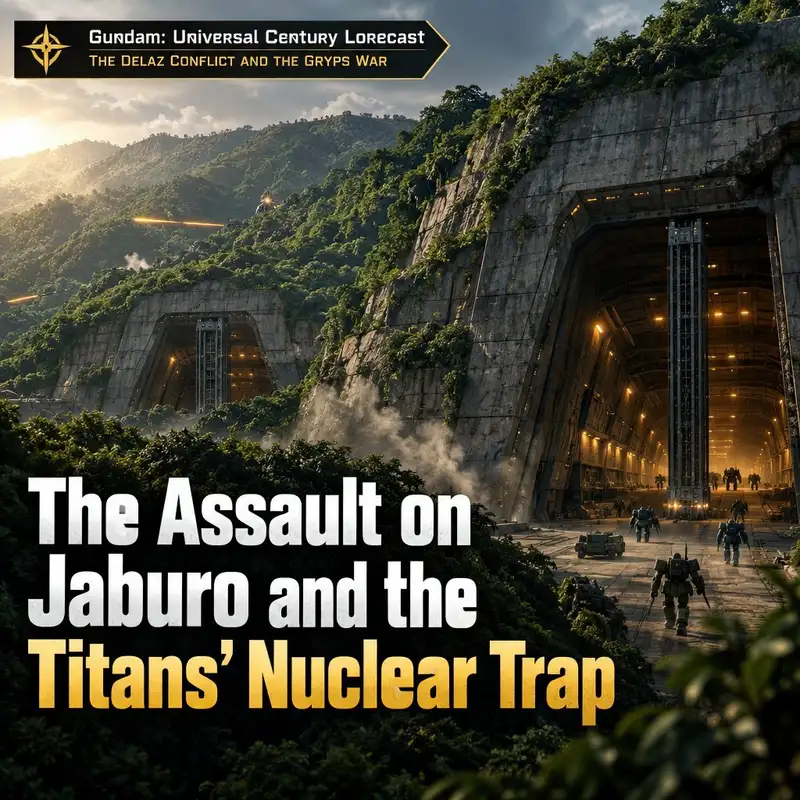
The Assault on Jaburo and the Titans’ Nuclear Trap
The mobile suits came down through Earth’s atmosphere under ballutes, their descent systems blooming against the sky as the Anti-Earth Union Group committed itself to a raid that could not easily be reversed. Reentry was only the first hazard. Once the pilots reached the lower atmosphere, they still needed to find their way through hostile airspace, assemble over unfamiliar ground, fight their way into a fortified installation, recover any personnel trapped inside, and somehow leave again. Their objective was Jaburo, the old subterranean headquarters of the Earth Federation. It was a place with enormous military weight and even greater symbolic weight. If the Titans were using Jaburo as a command center, striking it could disrupt their operations and expose their vulnerability on Earth.
But the first warning was not a barrage of anti-air fire or a determined defensive line. It was the absence of either at the expected scale. Jaburo had once been a fortress that attackers approached with caution. Now the AEUG found resistance that seemed too thin for a headquarters of its importance. That did not mean the base was undefended. It meant the defenders might have changed the terms of the battle before the attackers arrived. A quiet fortress is not necessarily a weak fortress. Sometimes it is a fortress whose owners have already decided that the building itself is expendable.
Jaburo’s reputation had been built during the One Year War, when its underground construction made it one of the Federation’s most valuable strategic assets. Beneath the South American jungle lay command facilities, maintenance areas, transport connections, military infrastructure, and hardened spaces capable of surviving attacks that would have devastated an ordinary surface headquarters. A subterranean base offers several advantages. It protects staff and equipment from bombardment. It conceals movement. It permits repair work and storage under cover. It can preserve command continuity even when the surrounding region is contested. In a war of national survival, such a facility becomes more than a military installation. It becomes proof that the state can endure.
By Universal Century eighty-seven, however, Jaburo occupied a different kind of war. The Gryps Conflict was not a straightforward invasion of Earth by an external enemy. The Titans, formally a Federation force created in the aftermath of the One Year War, were confronting the AEUG and other anti-Titans opponents across space and Earth. Their problem was political as much as military. They needed to suppress opposition, preserve their own authority, and prevent their enemies from turning Federation institutions against them. Under those conditions, a famous headquarters could become less useful as a command post than as a target, a trap, or a political symbol to be denied to the enemy.
That distinction mattered because the AEUG was not approaching Jaburo with the resources of a conventional state military. It had mobile suits, capable pilots, support from Anaheim Electronics, sympathetic personnel within Federation institutions, and links to Earth-based anti-Titans resistance. But it did not possess a secure global network of airfields, ports, depots, hospitals, and replacement pools. It could launch an ambitious operation. Sustaining it was another matter. The descent on Jaburo was therefore an act of force projection under severe constraints. The AEUG had to carry enough combat power to break into the installation, but it also needed a way to recover damaged machines, treat casualties, evacuate prisoners, and leave before Titans reinforcements could close the trap.
The ballute systems made the descent possible, but they did not make it simple. A ballute can slow a mobile suit enough to survive atmospheric entry. It cannot identify concealed defenses, clear a landing area, refill ammunition, repair combat damage, or provide an extraction plan. The pilots entering the atmosphere had limited visibility, uncertain intelligence, and little margin for error. Their machines were descending from the strategic level of war, from orbit, into the tactical confusion of a ground assault. Once they reached Jaburo, orbital mobility would no longer help them. Roads, jungle approaches, tunnels, aircraft, defenders, and the layout of the underground complex would decide what they could actually accomplish.
Quattro Bajeena directed the AEUG’s mobile-suit force during this operation. His experience and familiarity with the political and military meaning of Jaburo made him valuable, but his authority had limits. He was not the sole commander of every AEUG asset, much less every anti-Titans group operating on Earth. His immediate responsibility was more practical. He had to bring the assault force in, judge whether the mission remained viable, and preserve combat power if the situation changed. Jaburo was worth attacking because it might offer several gains at once. It might disrupt Titans command activity. It might yield documents or prisoners. It might provide a public demonstration that the Titans could be struck at the heart of Federation territory. And it might allow the AEUG to recover one of its own intelligence operatives.
That operative was Reccoa Londe. She had entered Jaburo ahead of the main attack to gather information from inside the base. In principle, this was exactly the kind of intelligence work the AEUG required. An assault force approaching a hardened headquarters needed more than maps and broad estimates of enemy strength. It needed current information. Which entrances were active? Which personnel remained? What units were on alert? Was the base preparing to fight, to evacuate, or to receive reinforcements? The difference between those possibilities could determine whether an assault became a raid, a siege, or a disaster.
Reccoa’s capture deprived the AEUG of timely answers. It did not mean the organization had been foolish to send an infiltrator. Jaburo was a controlled military environment, and any intelligence operation inside it carried serious risk. But once Reccoa was detained, the AEUG lost an important source precisely when the Titans’ plans were becoming most dangerous. The attackers knew Jaburo was important. They knew Reccoa had been inside. They did not know whether the apparent weakness of the defense reflected a collapsing garrison, a disorderly evacuation, or a deliberate deception.
Kai Shiden was caught in the same crisis. By this period, Kai was a journalist, not an AEUG mobile-suit commander. His earlier service with White Base gave him an unusual connection to the history of the One Year War, but at Jaburo his importance came from what he had seen and what he could report. He was another person caught between the Titans’ security apparatus and the AEUG’s need for reliable information. His presence also gave the episode a useful reminder that Jaburo was not occupied solely by elite combat troops and senior commanders. A headquarters contains staff officers, transport crews, technicians, guards, detainees, clerks, medical personnel, contractors, and visitors. In a concealed demolition plan, many of those people may understand far less than the planners do.
The Titans’ operation depended on that imbalance of knowledge. Their basic design was brutally simple. Remove what is valuable. Preserve enough activity to make the base look occupied. Leave enough defenders to delay and confuse the attackers. Then destroy the installation after the enemy has committed itself underground. The objective was not merely to abandon Jaburo. An ordinary withdrawal would have surrendered an important symbol and potentially useful infrastructure. The point was to convert Jaburo into a killing ground, one whose history and apparent importance would draw the AEUG into range of a prepared demolition.
Weak resistance was essential to the deception. A determined defense might have told the AEUG that the Titans still considered Jaburo indispensable. An empty base might have suggested an evacuation too obvious to trust. But a thinning defense could be read in more than one way. It could look like a garrison under pressure. It could look like the remnants of a command structure trying to hold on while key personnel fled. It could invite an attacker to press harder, believing that a breakthrough was close. The Titans did not need to convince the AEUG that victory was certain. They only needed to make continued penetration seem reasonable for long enough.
The final layer of the trap was nuclear demolition. The operational account indicates that two nuclear devices had been installed deep beneath the base. The exact yield, placement, and detonation schedule are not securely established in the television record, and they are not the central issue. What mattered was that the devices could not be treated as a problem for a small bomb-disposal team. The AEUG had entered a vast underground military complex during an active battle. It lacked detailed access to the site, lacked control of the base, lacked time, and lacked any reliable assurance that it could locate or neutralize the devices before detonation. Once the nuclear plan became clear, the assault was no longer about taking Jaburo. It was about getting out.
That was the true purpose of the Titans’ deception. They sought more than the destruction of obsolete facilities. They wanted the AEUG’s assault force inside those facilities when the bombs went off. A nuclear demolition could deny the enemy a headquarters, erase stores and command infrastructure, and inflict losses on an organization that could not easily replace experienced pilots or specialized mobile suits. For the Titans, this was a form of force preservation through denial. They would surrender the fixed base, save the people and equipment they considered essential, and attempt to destroy an enemy expeditionary force at the same time.
From a narrow operational perspective, the plan had logic. A headquarters that can no longer be held may still be used to impose costs on the attacker. A defender who controls the evacuation schedule can choose what to remove, what to abandon, and when to trigger demolition. Underground facilities are especially useful for this kind of trap because attackers must move through constrained approaches and cannot easily observe the full situation. Yet the same features that made the plan effective also revealed the Titans’ command culture. The operation required compartmentalization. Some people had to know the real plan. Many others had to be left with incomplete instructions, because too many informed personnel would increase the danger of a leak.
Compartmentalization is not automatically evidence of criminal intent. Militaries compartmentalize sensitive operations to protect intelligence sources, preserve surprise, and prevent panic. But secrecy always creates risk for one’s own people. At Jaburo, the continued presence of Federation and Titans personnel near the base made the trap believable to the AEUG. It also meant that not everyone in danger could have been fully informed of what was coming. The available evidence supports uneven knowledge, not a complete roster of who knew what. The difference becomes important here. It would be inaccurate to say every soldier at Jaburo knowingly participated in the trap. It would be equally inaccurate to treat all those soldiers as protected by the planners who used the base as bait.
The Titans had been created to defend Federation security after the One Year War. At Jaburo, their security logic had become detached from the public institution they claimed to serve. The old Federation headquarters, its personnel, and its symbolic importance were subordinated to the immediate survival of the Titans’ coercive apparatus. That was the moral hazard of an organization whose authority expanded faster than its accountability. A security force can begin by claiming that extraordinary measures are necessary to protect the state. It can end by treating the state’s infrastructure and personnel as disposable tools for protecting itself.
Quattro recognized the danger before he possessed every detail. The light defense was too suspicious. Jaburo was too important to be allowed to fall so easily. When the evidence of evacuation and demolition emerged, he made the essential operational judgment. The mission had changed. There was no value in winning access to a base that had become a timed nuclear hazard. The proper objective was no longer seizure. It was survival, recovery of personnel where possible, and preservation of the force for the larger conflict.
That decision is worth pausing over because withdrawal is often described too casually as failure. A commander who abandons an objective can certainly fail. But a commander who refuses to reassess a mission after its assumptions collapse may destroy the force entrusted to him. The AEUG could not afford to trade experienced pilots, rare mobile suits, and critical personnel for an empty headquarters. It did not have the industrial depth or established logistics network to absorb such losses easily. Preserving combat power was not an act of timidity. It was the only choice that kept the organization in the war.
The difficulty was that Reccoa and Kai were still inside. A withdrawal order solved the broader operational problem, but it did not immediately solve the human problem. Kamille Bidan continued searching for Reccoa during the confusion. His perception of her presence is presented as a localized Newtype experience, useful under immediate and personal circumstances. It helps direct him toward someone he is trying to find. It does not provide a complete map of Jaburo, identify the nuclear devices, reveal every enemy position, or transform the AEUG’s intelligence system into omniscient telepathy. Kamille still had to reach Reccoa physically, overcome resistance, and get her back out through a collapsing operation.
That limitation is important because Jaburo shows both the value and the limits of exceptional individuals. Kamille’s perception mattered. It gave the rescue effort a chance that conventional reconnaissance had not provided. But it did not erase the consequences of Reccoa’s capture or the AEUG’s incomplete intelligence picture. A Newtype insight can affect a moment. It cannot replace planning, communications, transport, or command judgment. In fact, the urgency of the rescue made the larger situation more dangerous. Every minute spent locating detainees was a minute taken from the evacuation clock.
Jerid Messa’s presence in a Marasai added to that danger. His confrontation with Kamille was tactically important because it threatened to delay the rescue and consume attention at the worst possible time. But the battle between the two pilots was not the decisive contest at Jaburo. No mobile-suit victory could restore the base as an AEUG prize once the nuclear demolition had been discovered. No personal success against Jerid could halt the wider evacuation. The most important clock was not the one in either cockpit. It was the countdown imposed by Titans planners who had already decided the fate of the installation.
This is where action and operations diverge. A pilot can win a local engagement. A squad can clear a corridor or destroy an enemy machine. But the force as a whole may still be losing time, fuel, ammunition, access to transport, or freedom of maneuver. Kamille’s rescue effort had tactical value because Reccoa and Kai were people the AEUG could not simply abandon. It also carried operational cost because the assault force had to remain exposed while the threat of detonation grew. The rescue succeeded only if the people found inside Jaburo could also be extracted from Jaburo.
Extraction required aircraft and transports as much as mobile suits. Once the mission became escape, the ability to move people rapidly across distance became decisive. The Garuda-class atmospheric transports provided that mobility. The Audhumla, in particular, became the principal transport available to the escaping anti-Titans force. The green Sudori remained associated with Titans operations. Their presence illustrates a basic reality that mobile-suit stories sometimes conceal. Combat machines can break through a defense, but they do not by themselves evacuate prisoners, carry wounded personnel, coordinate a retreat through the atmosphere, or create a sustained campaign base.
The practical burdens of the withdrawal were considerable. Rescued detainees had to be moved from the underground complex. Mobile suits had to leave the area, including machines that might be damaged or low on ammunition. Pilots needed orders that were clear enough to function amid confusion and incomplete communications. Transport crews had to take off under pressure, receive personnel, and avoid becoming targets during the escape. The AEUG also had to account for the possibility that Titans forces would use the evacuation itself as another opportunity to inflict losses. A successful raid is not complete when an objective is reached. It is complete only when the force can leave with enough of its people and equipment to matter afterward.
The Audhumla therefore represented more than a convenient escape vehicle. It gave the AEUG and its Earth-based partners a degree of mobility at the moment they had failed to gain a fixed headquarters. That was valuable, but it was not the same as securing Jaburo’s stores, workshops, communications infrastructure, or protection. The AEUG escaped with personnel and a mobile platform. It did not emerge with a stable terrestrial logistics system. That difference would shape the campaign that followed. Mobility can keep a force alive. It does not automatically solve the problems of maintenance, resupply, intelligence, or political shelter.
When the nuclear devices detonated, the effect was not merely physical destruction. Jaburo’s central operational role was destroyed or rendered unusable. The Titans had denied the base to the AEUG, but they had also denied it to themselves and to the Federation whose headquarters it had long been. The blast was immense, yet the historical significance of the event should not be measured in spectacle. The point was not that every tunnel, facility, or structure associated with Jaburo vanished beyond recovery. The point was that the base could no longer function as the great central command symbol it had once been.
There were also people still within or near the complex when the demolition occurred. Some were combatants. Others were support personnel, guards, staff, detainees, or workers caught in a plan whose full purpose they may not have understood. The television account does not support an exact casualty total, and one should not invent one. But it clearly establishes the human character of the decision. This was not a clean technical demolition of an abandoned building. It was a mass-casualty action conducted during an active military operation, with the attackers, the remaining defenders, and the base population exposed to the consequences.
The political symbolism was severe. Jaburo had been one of the great Federation sites of the previous war, associated with national survival against the Principality of Zeon. Now a Federation special force chose to destroy its central value rather than permit an anti-Titans organization to exploit it. The Titans could argue that denying Jaburo to their enemies was militarily necessary. They could claim that the AEUG had forced the issue by attacking the base. But those arguments did not erase the fact that the Titans had prepared the destruction in advance and used the installation as bait. The organization that claimed to be preserving Federation order had demonstrated that Federation institutions were expendable when they no longer served Titans control.
Jaburo also marks a change in the meaning of fixed headquarters. Fortification remains useful as long as the institution inside it is worth defending. Underground command centers can protect staff, equipment, and communications. They can preserve continuity in a crisis. But they can also become predictable targets, political liabilities, and traps. The deeper problem was not that Jaburo’s construction had become obsolete. The problem was that the Titans no longer treated Jaburo as the institutional heart of the Federation. They treated it as a tool to be expended in a struggle for their own survival.
That decision was militarily rational in the narrowest sense. The Titans denied an enemy a famous base, preserved selected personnel and equipment, and attempted to impose catastrophic losses on a force that had taken serious risks to reach Earth. But military rationality is not the same as political wisdom. Every act of coercion creates a record. Every abandoned soldier, destroyed institution, and concealed demolition teaches observers what kind of authority they are dealing with. Jaburo showed that the Titans could adapt operationally. It also showed that their adaptation depended on sacrificing the legitimacy they claimed to enforce.
The AEUG’s survival should not be romanticized. Its intelligence picture had been incomplete. Its operation depended on a perilous descent, uncertain local conditions, and an extraction plan that became improvised under pressure. It was saved not by a flawless plan but by a combination of command judgment, individual initiative, available transport, and the fact that the Titans’ trap did not close quickly enough. The AEUG emerged from Jaburo alive, but still vulnerable, still dependent on allies, and still unable to convert tactical survival into immediate control of Earth.
The assault on Jaburo became a trap because the AEUG attacked the headquarters Jaburo had once been, while the Titans had already decided it was more valuable as bait than as a command center. The AEUG’s escape denied the Titans their intended annihilation, but Jaburo’s destruction showed how far the Titans had moved from defending the Federation to defending themselves, even when the price was their own soldiers, their own infrastructure, and the political legitimacy they claimed to enforce.