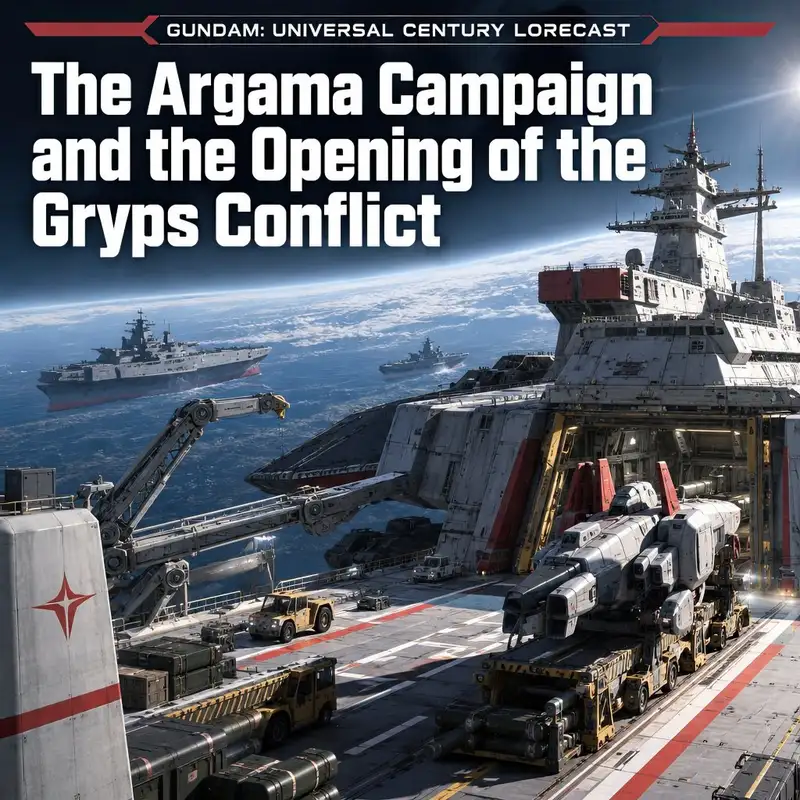
The Argama Campaign and the Opening of the Gryps Conflict
The Argama did not enter the Gryps Conflict as the flagship of a mature rebel navy. It approached Green Noa carrying a small AEUG assault force, Quattro Bajeena’s reconnaissance, and a narrow opportunity: learn what the Titans were developing, seize what could be seized, and escape before the colony became a trap. What followed turned a raid on three Gundam Mark Twos into the opening campaign of a much larger war, because the Argama left with more than machines. It carried away people, intelligence, technical leverage, and the beginnings of a force capable of surviving the Titans’ response.
The Anti-Earth Union Group, usually called the AEUG, understood the opportunity, but it also understood its limits. It was not yet a state, and it did not possess the Federation’s formal military depth. It was a political and armed movement opposed to the Titans, supported by sympathetic personnel, private networks, and industrial connections. Its immediate problem was not to conquer Green Noa. It was to learn what the Titans were building, deny them exclusive control of it if possible, and escape with enough evidence and capability to make resistance more than a slogan.
The operation that followed can be called the Argama campaign, although that was not a formal name used by the television record. It describes the opening sequence in which the AEUG assault cruiser Argama turned a raid into a surviving, expanding campaign. The central question is not simply how the AEUG stole three Gundam Mark Twos. The more important question is how a small force, operating from one mobile warship and depending on irregular networks, transformed that theft into the opening of a Federation civil war.
The answer begins with intelligence. Quattro Bajeena entered the Gryps area before the assault force moved in. His role was reconnaissance, not theatrical heroics. The AEUG needed to know what the Titans had, where it was being tested, how it was guarded, and whether the machines could be extracted before a local security response became a fleet pursuit. The Gundam Mark Two was valuable as a weapon, but it was also valuable as evidence. The Titans were developing a new generation of mobile suit at a time when their political authority rested partly on claims of security and technological competence.
The Mark Two represented more than an updated Federation design. Its movable-frame construction pointed toward a more sophisticated way of building mobile suits, one in which internal structure, responsiveness, and performance could be developed beyond the older, more rigid approach. The AEUG did not need a complete scientific understanding of every system in order to recognize the strategic importance of obtaining the machines. A captured prototype could reveal design choices, materials, engineering priorities, and weaknesses. It could also deny the Titans a monopoly on those advances.
Still, intelligence collection alone would not turn the AEUG into a viable military force. The raiders needed a ship capable of reaching the target, launching mobile suits, recovering them, carrying captured equipment, coordinating a withdrawal, and sheltering the people swept into the operation. That was the Argama’s importance. It was not invulnerable, and it could not defeat every Federation vessel sent after it. Its real strength was mobility combined with function. It was a command post, carrier, transport, repair base, communications node, and political refuge all at once.
The Argama gave the AEUG something a hidden cell or isolated mobile-suit team could not easily sustain. It allowed the organization to concentrate trained pilots, mechanics, intelligence officers, and command personnel without requiring it to hold territory. That was essential in the early phase of the Gryps Conflict. The Titans could draw on Federation facilities, military police authority, established chains of command, and the expectation that regular units would comply with their orders. The AEUG could not match that institutional weight. It had to preserve a mobile nucleus and keep moving until it reached places where its supporters could provide repair, resupply, and political cover.
Quattro did not lead the Green Noa raid alone. Apolly and Roberto provided the professional core of the mobile-suit assault force in Rick Dias machines. Their presence is easy to overlook because the opening campaign soon becomes associated with newer Gundams and more famous pilots. But experienced personnel mattered more than glamorous hardware in the first hours of the operation. A raid inside a colony required discipline. The objective was to seize specific machines and escape, not to wreck the habitat, occupy it, or turn every corridor into a battlefield.
That restraint was also political. A colony is not an empty fortification. It is a pressurized community with civilians, families, workers, transit systems, and essential infrastructure. The Titans had embedded military development inside that environment. Once the AEUG struck, the civilian and military spaces could no longer be cleanly separated. Every exchange of fire risked making residents hostages to a struggle they had not chosen. The AEUG needed speed because time inside Green Noa favored the Titans, whose local authority could convert security procedures into a wider armed response.
The raid achieved surprise, but surprise also introduced an element no planner had fully prepared for. Kamille Bidan was not an AEUG recruit reporting for duty. He was a civilian student with technical ability, a sharp temper, and a deeply personal grievance after an encounter with Jerid Messa. The Titans detained him during the crisis. When the assault created confusion inside the colony, Kamille escaped and reached one of the Gundam Mark Twos. His decision to take the machine was not the result of a mature personnel pipeline or carefully supervised pilot selection. It was opportunistic, angry, and enabled by the chaos around him.
The distinction is operationally important. Military organizations often benefit from unexpected talent. They also pay for it. Kamille’s ability to operate the Mark Two made him immediately useful, but usefulness is not the same as readiness. He had not been integrated into an AEUG unit. He had not gone through the organization’s discipline, received its political education, or developed the habits expected of a pilot working inside a carrier-based force. He was a teenager thrust into a conflict because the Titans had placed military coercion directly into his civilian life.
His actions helped the AEUG capture additional Mark Twos and escape the colony. Tactically, that was a remarkable gain. The AEUG had gone in seeking access to Titans technology and emerged with three prototype mobile suits. Yet the result was not simply three new combat units added to a roster. It also brought an inexperienced pilot, a rapidly escalating pursuit, and a personal crisis that would draw the Argama into decisions far beyond its original intelligence mission. The raid had succeeded, but it had become larger than its planners intended.
The Argama’s first achievement was therefore not battlefield dominance. It was extraction. The ship gathered the raiders, the captured machines, and Kamille, then withdrew before the Titans could seal the situation. This was the point at which the operation stopped being a local security breach and became a campaign. The Titans could no longer treat the incident as an isolated theft. The AEUG had taken highly visible prototypes from a major development center, demonstrated that Titans security could be penetrated, and carried the evidence away in a warship capable of operating across the Earth Sphere.
The Titans responded accordingly. The Alexandria became the central pursuit vessel, supported by regular Federation forces. That support needs to be understood precisely. The Titans were a Federation formation, but they were not the entire Federation military. Regular personnel could be ordered to cooperate with them, could share installations and ships, and could be drawn into their operations without necessarily sharing their political loyalties or methods. The opening of the Gryps Conflict was dangerous precisely because the line between security enforcement and civil conflict ran through the Federation’s own institutions.
The Argama now possessed the machines, but possession was not combat power. A captured Mark Two had to be inspected, maintained, fueled, armed, and understood. Its systems required technicians who could determine what had been damaged during the seizure, what parts could be supported, and what information the machines might provide to AEUG engineers. The Argama’s hangars were therefore as important as its launch catapults. A prototype in a cargo bay is intelligence. A prototype that can be serviced, flown, recovered, and repaired becomes a weapon system.
Even then, it remained a limited weapon system. The Mark Twos were not a mass-production answer to the Titans. The AEUG did not suddenly gain a standardized fleet of new mobile suits, a supply chain of replacement components, or an established training program for pilots. The value of the captured machines lay partly in their direct combat potential, but also in what their movable-frame technology could teach. The designs helped establish a foundation for later AEUG development, though the path from captured prototype to operational program was neither immediate nor simple.
This is one of the central military lessons of the Argama campaign. Technical intelligence matters when an organization can connect it to industry. The AEUG’s ability to exploit the Mark Twos depended on access to technicians, facilities, sponsors, and eventually lunar infrastructure. A prototype can demonstrate a possibility. It cannot, by itself, build the factory, train the mechanic, or organize the squadron needed to turn that possibility into sustained capability. The Argama carried the first part of that process with it, but it could not complete the process alone.
The campaign also exposed another kind of resource: personnel from inside the Titans’ system. Emma Sheen arrived under orders connected to Bask Om’s ultimatum. Her mission was not merely a delivery of terms. It was a test of authority. The Titans sought to compel the Argama through threats directed at Kamille and the people around him. Their approach revealed how they understood power. They did not merely want to recover stolen equipment. They wanted to demonstrate that civilian ties, family relationships, and personal vulnerability could be used as instruments of command.
That coercion had military consequences. An organization like the Titans depends on obedience, but it also depends on the willingness of personnel to believe that their orders serve a defensible purpose. Emma’s experience undermined that belief. Her decision to defect gave the AEUG a trained pilot and valuable knowledge of Titans procedures. More than that, it showed that the Titans’ authority was not universally accepted even among those who wore their uniform. The AEUG did not have to manufacture every accusation against its enemy. The Titans were creating evidence through their own conduct.
Defection is never a simple transfer of manpower. A defector brings skills, but also uncertainty. The receiving organization must decide what information is reliable, how much trust can be granted, and where the new arrival fits into an already strained command structure. Emma’s defection gave the Argama a capable officer, but it also required the crew to absorb another person whose recent loyalties had been shaped by the very institution they were fighting. That was the price of building a movement through fracture rather than through a settled national mobilization.
The pressure on Kamille’s family made the political crisis painfully direct. His mother was taken hostage by the Titans and killed during the failed rescue attempt. His father, Franklin Bidan, did not become a stable ally of the AEUG. His choices were shaped by fear, ambition, technical status, and a desire to recover control over a situation that had escaped him. His attempt to seize an AEUG mobile suit ended in a confrontation with Kamille and in his death. The episode is often remembered through the emotional violence of those scenes. Its historical meaning is broader.
The Bidan family lived near the boundary between civilian technical work and military development. That boundary collapsed when the Titans turned Green Noa into a coercive security environment. Technical expertise, family ties, and access to military systems became sources of vulnerability. The Titans could use relatives as leverage. Franklin could see the conflict as an opportunity to restore his position. Kamille could be drawn further into war not by a formal oath or political program, but by trauma and loss. In that sense, the family crisis was not a detour from the campaign. It showed what the campaign was doing to the society around it.
For the AEUG, this created a serious personnel problem. Kamille’s hostility toward the Titans made him committed in one sense, but grief and anger are not substitutes for training or welfare support. The Argama gained a pilot of exceptional potential while inheriting the burden of a young man who had lost both parents in the course of its operation. A conventional military with stable institutions might have procedures, however imperfect, for evaluating and supporting such a recruit. The AEUG was improvising under pursuit. Its flexibility was real. So was its fragility.
The Titans, meanwhile, made a strategic error common to coercive security organizations. They treated fear as a replacement for legitimacy. Fear can compel immediate compliance. It can secure a checkpoint, silence a witness, or force a family into a decision. It does not necessarily produce durable loyalty. By using hostages and escalating violence inside a colony environment, the Titans gave the AEUG a political narrative grounded in experience. The movement could now present itself not only as an opponent of authoritarian military power, but as a refuge for those whom that power had harmed.
The Argama had to leave before the pursuit tightened. Its departure from the Green Noa area was not a simple retreat scene. Withdrawal was the operation. The ship’s objectives were clear: preserve the command nucleus, protect the captured Mark Twos, keep its newly acquired personnel alive, evade the Alexandria, and reach infrastructure where the raid’s gains could be converted into lasting strength. Remaining to fight a decisive battle would have favored the Titans. The AEUG had achieved its immediate objective. Its next task was to avoid losing everything it had just taken.
The Argama moved through the Earth Sphere using a pattern that would define its early employment. It relied on limited strikes, deception, reconnaissance, and changes of direction rather than on prolonged fleet engagements. During its movement toward Earth orbit, the ship used a diversionary attack against a solar power satellite while Reccoa Londe conducted reconnaissance connected to conditions on Earth. The exact details of every route and interval are less important than the operational logic. The Argama was creating time and uncertainty. It needed the Titans to react to more than one problem at once.
Reccoa’s mission showed that the campaign was already expanding beyond the stolen prototypes. The AEUG needed intelligence about Titans power on Earth, especially the political and military significance of Jaburo. A raid at Green Noa had exposed Titans vulnerability and provided technology. It had not changed the balance of power across the Federation. For that, the AEUG would need to identify targets that mattered beyond one colony cluster. It needed to connect its mobile force with a wider political challenge to the institutions that protected the Titans.
The Argama’s ability to coordinate these tasks was as important as its firepower. Under Minovsky conditions, long-range detection and communications could be restricted or unreliable. That did not mean every sensor was blind or every message impossible. It meant commanders could not assume that a distant headquarters saw the same situation as a pilot near the target. Prearranged plans, local initiative, visual confirmation, and trusted subordinates became more valuable. The Argama provided a place where separate strands of the campaign could be connected, even if imperfectly.
Its movement through Side One demonstrated the limits of mobility as well as its advantages. The ship could change destination and use the complexity of colonial space to evade pursuit. But mobility depended on propellant, maintenance, information, safe docking, and the willingness of friendly or sympathetic networks to take risks on its behalf. A warship cannot remain permanently at high readiness simply because it has a compact reactor and a determined crew. Mobile suits require inspection after sorties. Pilots need rest. Damaged equipment needs parts. Intelligence must be updated before the next maneuver becomes an informed decision rather than an escape in the dark.
The AEUG’s early campaign therefore depended on a kind of operational economy. Every sortie had to justify the risk. Every diversion had to create an opening. Every contact with potential supporters had to be weighed against the possibility of compromise. The Titans had greater institutional resources, but they also had a problem of political overreach. Their authority could bring ships and personnel into the hunt, yet their methods created resistance and hesitation within the Federation system. The Argama survived by exploiting that gap between formal power and actual consent.
The Moon offered the AEUG what constant movement could not: sanctuary with industrial depth. When the Argama reached lunar space and approached Amman, it had escaped the most immediate danger of the Green Noa crisis, but it had not escaped the war. The Alexandria remained a threat, and the tension between Kamille and Jerid continued in combat. Kamille’s success against Jerid demonstrated real talent, especially under the extreme pressure of recent events. It did not prove that he had become a finished ace pilot or that the AEUG had solved its training problem.
A talented pilot can make a difference in a short engagement. That does not automatically translate into discipline, command judgment, or reliable unit performance over a campaign. Kamille was learning in combat, which is one of the most expensive forms of education any military can impose. The Argama’s officers had to balance the immediate value of his ability against the risk of relying too heavily on an emotionally unstable, still-developing pilot. The Mark Two gave him a capable machine. It did not give him maturity, and it did not give the AEUG an institutional replacement if he were lost.
Amman changed the campaign because it was not merely a destination. It was a node of support. The lunar city offered repair facilities, resupply, personnel coordination, and access to the political and industrial networks that sustained the AEUG. The movement had survived long enough to reach people who could help transform a raid force into something more durable. For that reason, lunar infrastructure mattered. The Moon was not neutral scenery between Earth and the colonies. It was an industrial and political theater whose cities, facilities, and connections could shape the conduct of war.
Anaheim Electronics was central to that support, but its role should not be overstated. Anaheim was a powerful contractor and supplier with access to advanced engineering and relationships across the Earth Sphere. It could enable the AEUG through equipment, technical knowledge, and logistics. It was not an all-seeing hidden government that controlled every side of the conflict. Its influence depended on commercial interest, political access, and the ability of its separate networks to act without being shut down. Corporate support gave the AEUG options. It also made the movement dependent on interests that did not necessarily align with a simple moral cause.
The captured Mark Twos became more useful at Amman because the Argama was no longer trying to sustain them alone. Technicians could examine the movable-frame technology with better facilities and access to a broader industrial base. The AEUG could begin asking the right questions. What parts were unique? Which systems could be adapted? What would it take to develop a successor rather than merely maintain captured machines? Those questions define the difference between a tactical windfall and a technological program. The answers were not immediate, but the AEUG now had a place from which to pursue them.
Amman also allowed senior AEUG personnel to think beyond escape. The next major objective was Jaburo, the Federation’s important terrestrial military center and a potent political symbol. An attack there would mean something very different from the Green Noa raid. At Green Noa, the AEUG had struck a Titans development site and withdrawn. At Jaburo, it would challenge infrastructure connected to the Federation’s military authority on Earth. The planned operation indicated that the AEUG no longer intended simply to survive as an underground opposition force.
Before that larger move, however, the AEUG needed more ships. A carrier-centered movement cannot become expeditionary on courage alone. It needs hulls to transport personnel and equipment, launch and recover mobile suits, carry supplies, coordinate operations, and absorb losses. The raid on Granada addressed that problem. The objective was to seize Titans and Federation warships and expand the force available for the coming Jaburo mission. Again, the purpose was not destruction for its own sake. It was force generation.
The Granada operation revealed both the promise and danger of the AEUG’s method. While important pilots were committed to the seizure operation, the Argama itself became vulnerable. Kamille and Emma had to defend the ship. This was a reminder that a carrier is never just a platform from which more exciting units depart. It is a vulnerable center of gravity. If it is disabled, the pilots may have nowhere to recover, the captured technology may be lost, and the command structure holding the campaign together may collapse.
The defense of the Argama during the Granada raid also showed the changing nature of its crew. Kamille, the accidental participant from Green Noa, and Emma, the former Titans pilot, were now helping protect the ship that had become their common base. Their cooperation did not erase their different backgrounds. It showed how the Argama converted people from separate institutional worlds into a working combat team. That process was necessary, but it was never effortless. A movement built from defectors, irregular recruits, career officers, technicians, and political allies has to create trust while already under fire.
The seizure of additional ships gave the AEUG a larger fleet and opened the possibility of sustained operations against Earth. Yet more hulls did not instantly create a coherent navy. Ships require crews, officers, maintenance teams, ammunition, spare parts, charts, communications procedures, and command relationships. A force can capture a warship faster than it can train a crew to use it effectively. The AEUG gained capacity at Granada, but it also gained a larger administrative and logistical burden. Expansion was an achievement. It was also a new vulnerability.
This is where the Argama’s role becomes clearest. It had begun as the assault cruiser that made the Green Noa raid possible. By the time the AEUG prepared to depart the Moon, it had become the center around which captured equipment, defecting personnel, lunar support, intelligence missions, and newly acquired ships could be organized. It was the connective institution of the campaign. Without it, the Mark Twos might have remained isolated prizes, Kamille an unmanageable fugitive, Emma a single defector without a place to go, and the AEUG a collection of contacts without an operational center.
The force that left lunar space for Jaburo was therefore larger in ambition than the one that had approached Green Noa. It had more ships, more personnel, more intelligence, and a clearer target. It also encountered signs that the conflict was widening beyond the immediate contest between the Argama and the Alexandria. The attack on a shuttle by a mysterious mobile armor was a warning that new actors, weapons, and agendas were entering the field. The Gryps Conflict was becoming too large to be understood as one ship’s pursuit or one pilot’s rivalry.
Still, the planned Jaburo operation should not be mistaken for the moment when the AEUG became equal to the Federation. It remained an escalating conflict inside the Federation order. The Titans held legal authority, access to military institutions, and the ability to frame their opponents as threats to security. The AEUG possessed growing military capability and increasing political credibility, but it relied on fragile networks. Its ships were newly assembled. Its personnel came from uneven backgrounds. Its industrial support was substantial but not identical to sovereign control of production or territory.
That is how the Argama campaign opened the Gryps Conflict. It converted a narrowly planned theft into a durable political and military challenge because the Argama preserved the things a raid normally loses once the alarm is raised: people, intelligence, captured technology, mobility, and the ability to reach support. The ship did not win the war in its opening weeks. It gave the AEUG the means to survive long enough to make war possible.
Its success also exposed the movement’s weakness. The AEUG could seize advanced machines and acquire ships, but it still depended on irregular personnel, corporate and lunar support, uncertain loyalties, and the political failures of its enemy. The Argama was not an unstoppable weapon. It was a moving institution, held together by skilled crews, improvised trust, and the refusal to let a tactical victory become an isolated act of defiance.