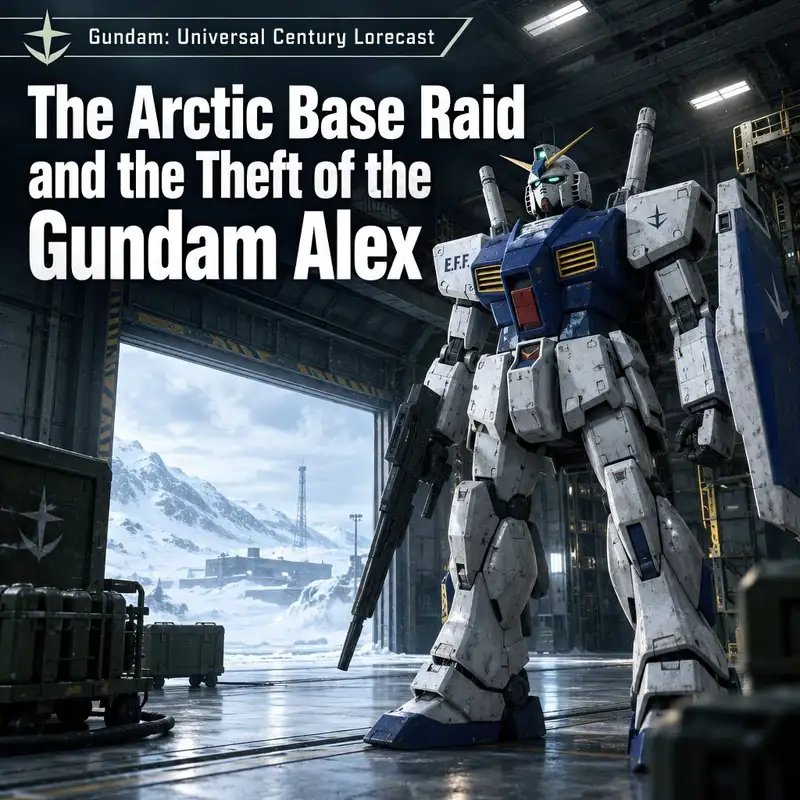
The Arctic Base Raid and the Theft of the Gundam Alex
Arctic water is an unforgiving approach route for a military raid. It conceals movement, punishes mistakes, and leaves little room for a damaged machine or a delayed extraction. In the final weeks of the One Year War, Zeon’s Cyclops Team uses that route to strike a Federation installation holding one of the most valuable prototypes in the Earth Sphere. Amphibious mobile suits rise from the sea, local defenders are caught under pressure, and the base becomes a battlefield almost at once. But the decisive contest is not taking place at the perimeter. It is taking place around a launch sequence. The Federation’s Gundam Alex is already being prepared to leave. Zeon can breach the base, destroy defenses, and still fail if the machine escapes into space before the raiders reach it.
That distinction is the key to the Arctic base raid. The mission is often remembered as an attempt to steal the Alex, and that was indeed Zeon’s objective. But the Alex is not stolen at the Arctic base. It is evacuated. The Cyclops Team achieves surprise at the tactical level, yet cannot convert that surprise into control of the target. The raid demonstrates a hard military truth. Access to a defended facility is not the same thing as possession of the objective inside it. A raid succeeds only when its force reaches the target, secures or destroys it, and survives long enough to make that result matter.
The prize was the RX-78NT-1 Gundam NT-1, better known as the Alex. It was not a standard Federation mobile suit, and it was not evidence that the Federation had already solved the problem of Newtype warfare. It was a late-war prototype developed around an exceptional requirement. Amuro Ray, the pilot of the original Gundam, had demonstrated a level of speed, perception, and reaction that conventional mobile suit controls could no longer fully accommodate. The Alex represented an attempt to build a machine responsive enough to keep pace with him.
That requirement mattered because it exposed the gap between a successful combat machine and a usable military system. The Federation had learned that an extraordinary pilot could push the original Gundam beyond the assumptions built into its design. The answer was not simply more armor or a larger gun. The answer was a machine intended to respond faster, maneuver more aggressively, and place fewer delays between pilot judgment and mobile suit action. The Alex incorporated highly sensitive controls, enhanced attitude-control capability, magnetic coating, and advanced cockpit concepts that pointed toward the panoramic monitor and linear-seat arrangements of later machines.
Those features were not merely decorative improvements. They reflected a development program trying to reduce the time between perception, decision, and movement. In Minovsky-era combat, where long-range sensing and communications could be unreliable, that advantage had real military value. A pilot who could identify a threat and maneuver before the enemy completed an attack run might survive an encounter that would destroy an ordinary machine. But high responsiveness also imposed a cost. A mobile suit that reacts too quickly can become difficult to control. Faster response is not automatically better if the pilot cannot process the machine’s behavior or recover from an error.
Christina Mackenzie, the Alex’s designated test pilot, illustrates that problem. She is not presented as incompetent. She is an experienced test pilot assigned to an advanced Federation program. Yet the Alex’s responsiveness is excessive even for her. The machine was being tuned toward a particular operational ideal, but that ideal depended on a pilot with unusual capacity. The Alex therefore was not a finished answer to the Federation’s late-war needs. It was a promising, difficult, and still incomplete experiment. It represented what the Federation hoped to field, not what it had already fielded across its forces.
That is why the Alex mattered to Zeon. A single prototype could not reverse the wider industrial balance of the war. It could not replace the Federation’s growing production of mass-production mobile suits, ships, transports, ammunition, trained personnel, and repair capacity. But a prototype designed around Amuro Ray could be important in a different way. If it reached its intended pilot and became operational, it might improve the effectiveness of one of the Federation’s most dangerous combat assets during the war’s final phase. It also revealed the direction of Federation research. Capturing it would produce intelligence. Destroying it would deny the Federation a potential advantage. Either outcome had value.
Cyclops Team was built for exactly this kind of problem. It was a small Zeon special-operations force under the command of Hardy Steiner. Its members included Mikhail Kaminsky, Gabriel Ramirez Garcia, and Andy Strauss. They were not a conventional field army, nor were they equipped to seize and hold territory. Their purpose was to conduct a focused operation against a high-value objective. Such teams depend on planning, cohesion, surprise, and local initiative. They are designed to enter where a larger force would be detected, strike before the defender can organize, and leave before the enemy’s superior numbers can matter.
That kind of unit can appear larger than it is. A handful of skilled personnel, operating specialized equipment against an unprepared target, can produce an effect far beyond their numbers. But the same conditions that make a raiding team effective also make it fragile. A conventional force can absorb losses, commit reserves, rotate damaged units, and maintain pressure over time. A small special-operations unit usually cannot. Every casualty removes not only a weapon, but also training, experience, technical skill, and flexibility. Every delay consumes the narrow margin on which the mission was built.
The Cyclops Team’s equipment reflected its intended environment. The raid used amphibious mobile suits, including Hygoggs and a Z’Gok-E. These were not simply exotic machines selected for visual distinction. The Arctic approach required mobile suits capable of moving through cold water, operating near a coast, and emerging into a land battle without relying on a conventional overland advance. Their mobility gave Zeon a chance to approach from a direction that local base security might not have treated as the most immediate threat. In a raid, the route of approach is often as important as the weapon carried at the end of it.
The Federation installation itself was vulnerable because it was part of a transfer operation. A prototype in a secure laboratory is difficult to reach. A prototype being moved is harder to protect. It must be loaded, guarded, checked, prepared for transport, and transferred through a chain of personnel and infrastructure. Those activities create predictable moments of exposure. The machine has to leave concealment. Its custodians must coordinate with a ship, transport container, launch facility, or recovery system. Security must remain tight while movement remains fast. The more urgent the transfer, the more difficult it becomes to do all of those things perfectly.
That does not mean the Federation simply left the Alex undefended. The Arctic facility had local forces, including GM Cold Districts Types suited to the conditions. The Gray Phantom was associated with the transfer, providing the connection between the isolated Arctic site and the wider space war. The exact size of the garrison and the precise configuration of the supporting force are less important than the task they faced. The Federation did not need to destroy every Zeon raider in open combat. It needed to preserve the transfer process long enough to move the Alex beyond reach.
The Federation’s security problem was therefore shaped by competing demands. It needed secrecy, because the Alex was not an ordinary machine. It needed speed, because the war was nearing its end and the machine’s intended purpose was time-sensitive. It needed protection, because Zeon would naturally seek to capture or destroy such a prototype. And it needed transport, because the Alex could not fulfill its purpose while sitting at an Arctic base. Every security arrangement involved tradeoffs. A larger visible defense might deter attack, but it could also advertise the target’s importance. Greater compartmentalization could preserve secrecy, but it could complicate coordination during an emergency.
Zeon intelligence had succeeded in one important respect. It had identified that the Federation possessed a new Gundam prototype of unusual significance. That was not a trivial achievement. A hidden research machine, especially during a war shaped by secrecy and Minovsky interference, was difficult to track. But intelligence is only useful when it arrives in time to shape operations. Knowing that a target exists is not the same as knowing exactly when it will move, who will guard it, how it will be loaded, or how long the attacker has before it escapes. Cyclops Team had the target location. What it lacked was time.
The maritime approach was designed to compensate for that weakness. A submarine brought the raiders toward the installation under cover of the Arctic sea. From there, the amphibious mobile suits could exploit the coastline and the confusion created by an attack from an unexpected direction. In an era when long-range electronic detection was constrained by Minovsky particles, a defender could not depend entirely on radar screens and remote warning. Local observation, patrol patterns, visual identification, and prepared response procedures all mattered. A force that appeared suddenly at close range could create a crisis before the defender understood the scale or purpose of the attack.
The Cyclops Team’s initial assault works because its concept is sound. It bypasses a more obvious landward approach, brings appropriate machines into the environment, and attacks a target whose defenders are busy with an urgent transfer. The base is not facing a prolonged invasion. It is facing a sudden attempt to reach one specific object. That distinction shapes every decision. The Zeon raiders do not need to occupy the installation. They need to penetrate it, identify the Alex’s location, and seize or destroy it before the Federation can launch it.
At first, this is exactly the kind of situation in which a small force can outperform a larger one. The Federation defenders are reacting. They must protect the base, maintain order, determine what the attackers are after, and continue a launch process under fire. The raiders, by contrast, begin with a narrow mission and a prepared approach. They know their target matters. They have a direction of advance. They can concentrate their effort. This is the advantage of surprise. It forces the defender to solve several problems at once while allowing the attacker to focus on one.
But surprise is not a substance that lasts. It is a brief condition. Once the alarms sound, the defender begins to adapt. Local units move to delay the attackers. Personnel responsible for the transfer accelerate their work. The target becomes mobile. And once it becomes mobile, the geometry of the raid changes. The Cyclops Team is no longer attacking a machine inside a facility. It is racing an evacuation process. Every minute spent fighting a defending GM, navigating damage, locating the transport, or covering a wounded teammate is a minute in which the Alex moves closer to space.
That is why the battle at the Arctic base cannot be understood as a simple exchange between superior Zeon raiders and weaker Federation defenders. The defenders have a different win condition. They do not have to clear the battlefield. They do not have to capture the enemy’s submarine. They do not even have to preserve every part of the base. They must keep the launch sequence alive. A delaying force can succeed even while taking losses. It can be defeated tactically and still accomplish the mission if it creates enough time for the high-value asset to depart.
For Cyclops Team, the operational sequence was unforgiving. The raiders had to breach the outer defenses, move through the installation, confirm the target, reach it before launch, and then either secure it for extraction or destroy it. Those were not interchangeable tasks. Capturing a Gundam prototype would have required more than touching it. The team would need to control the immediate area, assess the machine’s condition, prevent the Federation from launching or destroying it, and establish some method of withdrawal. Destruction, if treated as a fallback, would still require reaching the target with enough time and firepower to ensure that the result was final.
The team had no visible second echelon waiting to take over if the first assault stalled. It had no large reserve force ready to replace damaged mobile suits or seal every route through the base. It had no capacity for a long siege. That was normal for the mission type. A special-operations raid is built around speed and precision, not sustained combat. But it means that the force’s apparent strength can vanish quickly once the timetable begins to slip. The longer the battle lasts, the more the defender’s advantages in local knowledge, prepared infrastructure, and simple physical proximity begin to matter.
Andy Strauss’s death shows the cost of that slippage. During the Arctic assault, Andy pushes aggressively toward the departing target and is killed. The loss should not be treated as a romantic final charge or as the one event that explains the entire operation. The mission was already under severe time pressure. The Federation was already moving the Alex. But in a force as small as Cyclops Team, a single casualty is operationally significant. There are fewer people to observe, fewer weapons to apply, fewer machines to cover movement, and fewer options when the original plan breaks apart.
A larger unit can sometimes redistribute its tasks. One squad covers an approach while another advances. A reserve can replace a loss. A damaged formation can withdraw while another continues the mission. Cyclops Team has much less room for that kind of adjustment. Andy’s death reduces the team’s ability to maintain momentum at precisely the moment when momentum is its most valuable asset. The mission does not fail because one man is lost. It fails because the team’s margin for delay and loss was already extremely narrow, and the loss makes that margin narrower still.
There is a tendency to judge such battles by visible destruction. By that standard, Cyclops Team looks formidable. Its amphibious mobile suits breach the installation, engage Federation defenders, and create disorder around a highly sensitive transfer. But raids are not evaluated by spectacle. They are evaluated by the condition of the objective when the force withdraws or is forced to withdraw. The Arctic base is damaged. The Federation has suffered disruption and loss. Yet the Alex is not in Zeon hands, and it is not destroyed. The essential task remains incomplete.
The Federation launches the Alex in its transport container before the raiders can seize it. That launch is the decisive event of the operation. It is not as visually dramatic as the amphibious assault, but it matters more. The Federation has transformed the Alex from a fixed target into a moving one. It has moved the machine out of the immediate reach of the raiding force and into the relative protection of spacebound transport. The Arctic battlefield can no longer decide the machine’s fate.
The result must be described at several levels. Tactically, Zeon achieves a successful penetration of a defended installation and inflicts real disruption. At the mission level, however, the Cyclops Team fails to capture or destroy the Alex. Operationally, the Federation succeeds because the prototype leaves the Arctic theater. Strategically, the Federation retains a potentially important development asset, though it has not yet delivered that asset to its intended pilot or integrated it into combat operations. The Alex remains a possibility, not a finished weapon in the final campaign.
Zeon’s failure at the Arctic base does not end the pursuit. It changes its form. The first operation establishes that the Federation has a valuable prototype and that the prototype is moving through a vulnerable, secretive logistics chain. It also leaves Zeon with an urgent problem. The Alex has escaped, but it has not vanished. A prototype in transit still requires testing, storage, technical personnel, and a destination. If those links can be identified, the mission can be attempted again under different conditions.
The intelligence breakthrough comes through an unlikely source. Alfred Izuruha, known as Al, is an eleven-year-old resident of Side Six. He is not a soldier, intelligence officer, or political decision-maker. He is a child fascinated by the war from a distance that seems safe. His accidental recording of the Alex’s transport container provides information that helps reveal where the machine has gone. The significance of that recording is not that a child somehow becomes a master spy. It is that military secrecy can be undone by ordinary civilian presence, chance observation, and the simple fact that large equipment must move through inhabited space.
That information restores direction to the Zeon effort. The first intelligence success had identified the Alex but had not produced a timely seizure. The later recording gives the pursuit a new lead after the Arctic failure. This is an important distinction. Intelligence collection is not the same thing as operational success. Zeon had correctly understood the importance of the target. It had mounted a capable raid. But it had failed to arrive early enough, or move quickly enough once combat began, to secure the machine. The new evidence did not erase that failure. It created the possibility of another attempt.
The follow-on effort becomes known as the Rubicon Plan. Its aim is again to capture the Alex. But the operational environment has changed completely. The machine is no longer associated with an Arctic military installation. It has been moved to Ribo Colony in Side Six, a nominally neutral civilian habitat. That relocation protects the Federation from a repeat of the first raid in one sense. Zeon cannot simply send amphibious mobile suits through Arctic waters and attack an isolated transfer point. But it also creates a different set of problems. The Federation has placed a military secret inside a civilian environment.
Neutrality in the Universal Century is never as simple as a flag or a diplomatic declaration. Side Six is not empty space between two armies. It is a community of residents, workers, families, children, schools, businesses, and infrastructure built around life support. A colony cylinder is a home as much as it is a strategic location. It contains atmosphere, power systems, transit routes, docks, and densely inhabited spaces. Any covert military operation inside such a place carries risks that go beyond the immediate objective. A firefight can threaten civilians. A damaged structure can become a pressure hazard. A secret military program can compromise a population that never agreed to host it.
The Federation’s decision to conceal the Alex in Ribo Colony is understandable as a security measure. The machine needs continued testing and technical support. It must be kept away from obvious Zeon attack routes. It may be easier to hide a project within the routine movement of a large civilian habitat than at a conspicuous military base. But concealment is not the same as safety. By bringing the Alex into Side Six, the Federation places the colony within the orbit of a military contest. The residents may not know the full nature of the secret, but they will bear the danger if that secrecy fails.
For Zeon, the new location creates a political and tactical constraint. A direct assault on an Arctic base can be presented as a normal act of war between declared enemies. An operation in a neutral colony is different. It requires infiltration, deception, local knowledge, and a willingness to accept risks to civilians and neutrality. The Cyclops Team can no longer rely on surprise from the sea. It must work in a confined habitat where every movement is more visible, where the environment itself is vulnerable, and where a military action can rapidly become a civilian disaster.
The movement from the Arctic base to Side Six is therefore not merely a change of scenery. It is the consequence of the first raid’s failure. Because Cyclops Team does not capture the Alex at the point of transfer, the pursuit enters a more politically dangerous environment. The Federation preserves the machine, but cannot remove the need to protect it. Zeon loses the clean opportunity for an overt strike, but gains a new intelligence trail. The prototype remains valuable enough to justify continued operations. That value draws the war into a place that was supposed to stand apart from it.
The second attempt does not turn the first failure into a success. The Cyclops Team again fails to capture the Alex intact. The ensuing conflict damages the machine, and the war ends before it can reach White Base or Amuro Ray. This outcome is often described as a kind of partial Zeon success, and there is truth in that. The Federation does not receive the late-war deployment it intended. The Alex does not enter the final campaign as the Newtype-oriented successor envisioned by its developers.
But denial is not capture. Zeon does not secure the prototype, exploit its technology, or return with the intelligence prize that an intact seizure would have provided. The mission’s central objective remains unfulfilled. The Federation, meanwhile, loses the practical value of a costly and advanced machine. Yet it also prevents the Alex from falling into enemy hands. Neither side gets what it originally planned. Zeon does not steal the Gundam Alex. The Federation does not deliver it to the pilot for whom it was being prepared.
The civilian cost of that outcome cannot be separated from the military analysis. The struggle over the Alex brings armed conflict into Ribo Colony, where people like Al are close enough to witness fragments of the war but too far from real authority to influence the decisions that endanger them. Military institutions make choices about secrecy, research, and target priority. Special-operations teams act on orders and intelligence. Test pilots carry the burden of an unfinished machine. Children and residents encounter the consequences without being given the information needed to understand, much less consent to, the danger around them.
War in the Pocket is especially clear about that gap in knowledge. Adults and soldiers may understand that the Alex is strategically important. Al initially sees mobile suits and covert activity as exciting evidence that the war has reached his neighborhood. But the military meaning of the machine is inseparable from the human cost of pursuing it. The Alex is not only a prototype. It is also the reason armed men enter a civilian colony, why secrets accumulate around ordinary families, and why people who never chose to join the war are made to live inside its consequences.
The Arctic raid remains the center of this history because it established the pattern. Zeon’s raiders demonstrated real competence. They selected an effective approach route, used specialized equipment suited to the environment, penetrated a defended site, and placed the Federation under immediate pressure. It would be a mistake to dismiss the operation as amateurish simply because it failed. The initial assault was well conceived. The Cyclops Team succeeded at the first and most difficult part of many raids: getting close enough to matter.
But getting close enough was not enough. The operation failed because the team achieved access without gaining control. The Federation’s local defenders did not need to win a clean tactical victory. They needed to delay the raiders while the launch continued. The Alex had already entered a transfer process, and that process gave the Federation a path to mission success even as the base came under attack. Once the prototype became mobile, Zeon’s assault force was trapped in a race against time that its small size and limited depth could not sustain.
Andy Strauss’s death sharpened that problem, but it did not create it. The critical weakness was structural. Cyclops Team had no room for a prolonged fight, no visible reserve to absorb delay, and no second assault echelon to exploit a breach once the first wave became engaged. Its machines were appropriate for the approach, but the team’s mission depended on a narrow sequence proceeding almost exactly as planned. When the Federation preserved enough order to launch the Alex, the raiders’ tactical advantage began to evaporate.
The Federation’s Arctic success was also limited. It saved the prototype from immediate seizure, but it did not transform the Alex into a ready weapon. The machine remained difficult to operate, dependent on testing, and vulnerable during transport. Its concealment in Side Six protected it from one threat while exposing civilians to another. The Federation had won the race at the Arctic base, yet it had not solved the broader security problem. It had merely moved that problem into a more complicated political and human environment.
The final irony is that the Alex never fulfills the clean military purpose imagined by either side. Zeon never captures it. The Federation never delivers it to Amuro Ray. The machine becomes a symbol of late-war technological ambition constrained by secrecy, timing, and human limits. Its advanced controls promise a new kind of combat performance, but its very sophistication makes it difficult to integrate into an actual force. Its value attracts a special-operations raid, but the raid’s failure turns the prototype into the center of a covert conflict among civilians.
The Arctic base raid failed because Cyclops Team confused penetration with possession. Zeon’s raiders reached the defended installation, disrupted the local force, and proved that a small, skilled unit could exploit surprise and specialized mobility. But the Federation had already begun turning the Alex from a fixed target into a moving one. Once the launch sequence was underway, access to the base no longer meant control of the machine. A force with no reserve, no time margin, and no capacity to replace losses could not win that race.