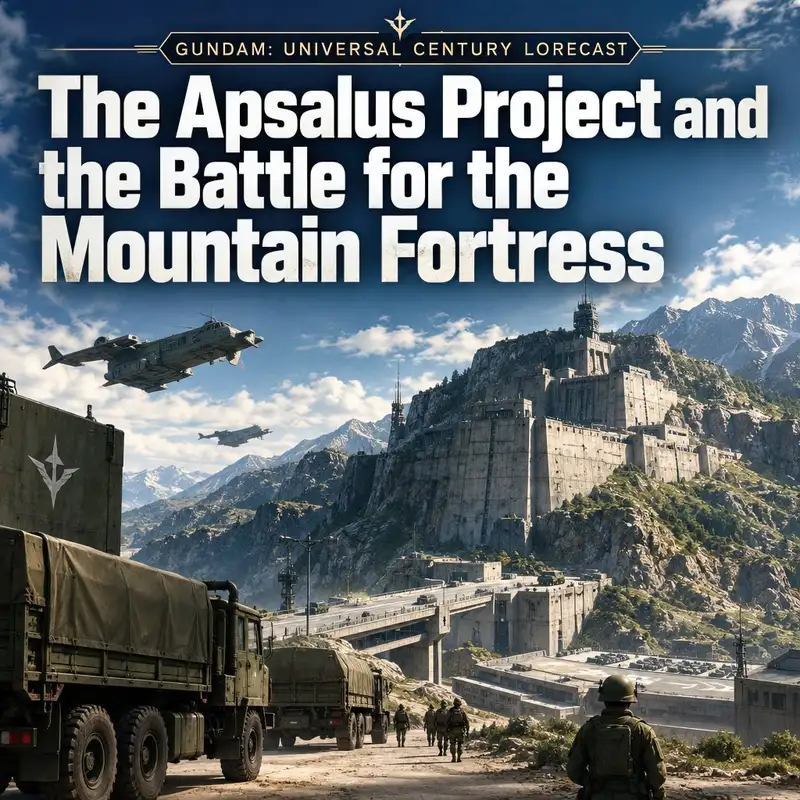
The Apsalus Project and the Battle for the Mountain Fortress
Apsalus Three rose out of the mountain with the sky open above it, a mega particle cannon capable of turning a local battlefield into a killing ground, and the apparent freedom to fly toward the target for which it had been built. Yet below that machine, the evacuation ship Kergeren was still struggling to escape. Federation artillery had not been fully silenced. Zeon personnel were trapped between a collapsing fortress and an advancing enemy. And Ginias Sahalin, the technical director who had brought the weapon this far, was about to fire on the very people his project was supposed to protect.
That is the central contradiction of the Apsalus Project. It was conceived as a way to bypass the ordinary burdens of war. It would fly where ground forces could not easily reach, strike a target that ordinary formations could not easily approach, and give Zeon a weapon of strategic leverage against Jaburo, the Earth Federation’s principal headquarters. But the project itself could not bypass logistics, intelligence, command, personnel, or political purpose. Those burdens followed it into the mountain, and in the end they destroyed it.
In the late stages of the One Year War, Jaburo was more than a headquarters. It was a command center, a base, a symbol of Federation continuity, and a reminder that the Federation still possessed deep reserves of territory and infrastructure on Earth. Zeon had achieved extraordinary early victories, but controlling portions of the planet was not the same as defeating the Federation’s ability to wage war. Jaburo represented that remaining capacity. It sat behind layers of defense, protected not only by military forces but by geography, infrastructure, and the sheer difficulty of reaching it with a concentrated strike force.
The Apsalus concept offered a different approach. Instead of fighting through conventional ground defenses, the mobile armor was intended to use atmospheric mobility and its mega particle cannon to approach from an unexpected direction. The OVA presents the feared operational concept through a Federation simulation. The point of that simulation is not that the Apsalus had already proved it could destroy Jaburo. It had not. The point is that Federation officers could see the danger. A weapon that could penetrate toward Jaburo from the air created a threat their existing defensive assumptions were not built to ignore.
This was a strategic requirement, but it was not yet a strategic capability. That distinction matters. A machine can demonstrate that a mission is physically possible. It can even frighten an enemy into changing plans. But a military system becomes strategically useful only when it can be deployed, controlled, sustained, repaired, protected, and, if necessary, replaced. The Apsalus was a remarkable technical achievement. It was never allowed to become a durable military institution.
That dependence gave the mountain base immense importance. The base was not simply a hangar concealed in remote terrain. It was the industrial center of gravity for the entire project. It held the machinery, workers, technicians, research staff, maintenance arrangements, command authority, and accumulated knowledge needed to complete the weapon. If the base remained hidden, the project had a chance. If the base was found, the Apsalus was no longer just a breakthrough weapon. It was a prototype trapped inside its own supply chain.
Ginias controlled much of that system. His sister Aina served as the project’s test pilot and operational representative. Her role was not merely ceremonial. The Apsalus required someone who could operate it under dangerous conditions, understand its limitations, and carry the project from experiment toward military employment. But even at this stage, the program had a dangerous concentration of authority. Technical expertise, command influence, family prestige, and personal ambition were becoming inseparable.
The Federation did not need complete blueprints to understand that the project was dangerous. Its earlier contact with the Apsalus and the evidence surrounding its intended mission gave Federation personnel enough information to recognize the threat to Jaburo. What they lacked was location. They knew that Zeon was developing an atmospheric assault weapon. They did not initially know where the machine was being completed, what defenses surrounded it, how many personnel supported it, or how close it was to operational use.
That changed the Federation mission. The immediate problem was no longer simply defeating a mobile armor in combat. It was finding the development base before the weapon could leave it. Intelligence had converted a technical concern into a search operation. Once the Federation understood that the Apsalus depended on a fixed site, that fixed site became more vulnerable than the machine itself. A mobile weapon can maneuver. A mountain workshop, launch area, storage complex, and technical staff cannot.
Shiro Amada and the 08th Mobile Suit Team entered this process as part of the Federation’s larger ground effort in Southeast Asia. Shiro commanded the team within Kojima Battalion, and his unit was used for reconnaissance, fighting, and pursuit in territory where Zeon forces still retained local positions. The team’s role was important, but it was not independent of the battalion. The search for the Apsalus was a formation-level problem involving scouts, commanders, infantry, artillery, air support, mobile suits, and the ability to hold ground long enough to exploit what intelligence revealed.
Shiro’s previous connection with Aina complicated his position, but it did not erase the military reality around them. He knew that she was tied to the project. He also knew that the Apsalus represented a threat beyond either of them. His decisions were shaped by personal knowledge, but they took place inside an operation where commanders were trying to locate and destroy a strategic weapons program before it could be used. The relationship mattered because it affected judgment and loyalty. It did not replace the battle’s larger purpose.
The search for the mountain installation unfolded while Zeon’s wider situation on Earth was deteriorating. The collapse of the Odessa front placed pressure on Zeon forces far beyond the immediate battlefield. Units that had expected to hold territory now faced withdrawal, isolation, and the loss of secure routes. A secret development project can survive in a stable rear area. It becomes much harder to protect when the front is moving toward it and the broader army is trying to preserve whatever personnel and equipment it can still extract.
Yuri Kellarny represented that larger military problem. Associated with the Sahalin family and senior enough to grasp the changing situation, he sought to move surviving Zeon personnel toward the mountain installation and arrange their withdrawal. His priority was not the perfection of one experimental machine. It was the preservation of people, expertise, and whatever could still be carried away from a losing position. That was not cowardice or a lack of vision. It was a recognition that a military organization cannot fight future battles if it abandons all of its surviving personnel to a collapsing front.
The Kergeren was central to that effort. It was not just an escape ship placed in the story to create a dramatic launch sequence. It was the project’s logistical exit. It offered a means to remove staff, wounded personnel, surviving troops, and potentially the technical knowledge embodied in the program. If the mountain base had to be abandoned, the Kergeren could preserve part of its human and institutional value. In war, equipment can sometimes be rebuilt. Experienced technicians, trained crews, and people who understand a difficult prototype are much harder to replace.
For Ginias Sahalin, however, the project had become something else. He was not simply a scientist driven beyond reason by pressure. That description is too easy, and it obscures the real danger. Ginias was a technical director with practical authority over a strategic program. He understood that Apsalus Three was extraordinary. He also came to treat its completion as a personal vindication, a restoration of family standing, and proof that his judgment outweighed the judgment of the military around him.
That shift changed the meaning of command at the mountain base. A technical director can provide vital expertise. But a strategic weapons project cannot safely become the private domain of one man, especially when that man begins to treat personnel, allies, and military orders as obstacles to his own control. Ginias increasingly viewed withdrawal as betrayal, evacuation as weakness, and outside authority as an attempt to steal what he had created. The weapon ceased to be a means toward Zeon’s larger military objectives. It became the object of Ginias’s loyalty.
His conflict with Yuri exposed the collapse of command discipline. Yuri saw the need to preserve people and withdraw. Ginias saw the need to finish the machine and keep it under his own authority. When Ginias killed Yuri, he did more than eliminate a rival voice. He destroyed the possibility of a rational compromise between the project’s technical ambitions and the wider military situation. He also helped unravel the secrecy that had protected the base. A hidden installation depends on disciplined security. Internal violence, disorder, and conflicting movement create traces that an enemy can follow.
The Federation’s discovery of the mountain base transformed the terrain. Until then, the mountains had concealed the project, shielded construction, and limited easy approach. Once the Federation knew where to focus, the same terrain became restrictive. Fixed facilities could not move. Roads, clearings, launch areas, and exits became predictable. The defenders had fewer routes for evacuation. The attackers could use artillery and air power against known positions. A fortress in difficult terrain is only as strong as its ability to maintain supply, command, and a route of withdrawal.
Kojima Battalion’s assault was therefore a combined-arms operation, not a series of private duels between famous machines. Federation forces brought pressure through air attack, artillery, mobile suits, ground troops, and command coordination. Their purpose was to suppress the base, prevent escape, and destroy the Apsalus before it could become operationally free. The battle was difficult because the installation was defended and because mountain terrain limited movement and visibility. But the Federation had achieved the most important advantage first. It had located the enemy’s center of gravity.
The 08th Team fought inside that larger effort. Shiro, Karen Joshua, Terry Sanders Junior, Eledore Massis, and Michel Ninorich had to operate amid artillery fire, Zeon counterattacks, confusion, and the pressure of a fortified position beginning to collapse. The team’s mobile suits gave it mobility and firepower, but those machines did not exist in isolation. They depended on the battalion’s wider assault, on communications that remained possible under combat conditions, and on the ability of other Federation elements to keep the base under pressure.
The mountain battle forced the Apsalus program into a defensive posture. That was exactly the opposite of the weapon’s intended role. The mobile armor had been designed to escape ordinary ground approaches and threaten a distant strategic target. Now the project had to defend its own facilities, protect its own transport, and survive long enough to launch. The Federation had not defeated the Apsalus merely by matching its firepower. It had made the weapon answer the ordinary problems it had been built to evade.
At the center of those problems was the Kergeren. For the transport to escape, Zeon needed time, a viable launch route, suppression of Federation artillery, and protection from mobile suits operating around the base. A ship attempting to depart under those conditions was not simply moving from one point to another. It required a withdrawal corridor. It needed defenders to hold the enemy back long enough for personnel to board, engines to engage, and the route to remain open.
Norris Packard’s sortie in the Gouf Custom must be understood in that light. Norris was an experienced Zeon officer and a loyal retainer to the Sahalin family. But his mission was not a ceremonial final stand, and it was not simply a chance to prove the superiority of a customized mobile suit. He was sent to create time. That meant attacking the Federation’s artillery threat, disrupting the units closing on the base, and forcing the 08th Team into a fight costly enough to delay its pursuit.
The Gouf Custom was well suited to that kind of action in the hands of a capable pilot. Norris used terrain, speed, surprise, and the Federation’s dispersed positions to strike at the systems threatening the evacuation. His attack was not an abstract display of skill. It had a clear operational objective. Artillery can dictate the tempo of a siege by making fixed positions and escape routes untenable. If Norris could suppress or destroy the Federation guns, he could give the Kergeren and the personnel around it a better chance to get away.
He succeeded in part. The 08th Team was forced into a hard engagement. Federation artillery pressure was reduced. Norris created a local opening that a less capable defender might not have achieved. This is the value of tactical skill in war. A skilled officer can change the timetable. He can impose delay, cause losses, disrupt an enemy plan, and buy a force precious minutes when minutes are all that remain.
Norris was killed in combat with the 08th Team. The event is memorable because it is fought with exceptional determination and skill, but its meaning should not be reduced to an honorable death. He died conducting a protection and delay mission. His actions had real military value. They opened space for the Kergeren’s departure and weakened the immediate pressure on the evacuation. Yet his loss also removed one of the few people at the site still acting according to a coherent mission: protect the withdrawal, preserve the people, and keep the project from being destroyed with everyone inside it.
By the time Apsalus Three emerged, it demonstrated the extraordinary local capability that had justified the project’s existence. It could move through the atmosphere. It possessed immense firepower. It was a weapon unlike the ordinary mobile suits fighting around the mountain. For a moment, the machine appeared to have broken free of the siege. The technical promise was real. Whatever else can be said about Ginias’s decisions, he had brought a formidable combat system into being.
But the Apsalus did not emerge into strategic freedom. It emerged from a known location under fire, above a battlefield crowded with retreating Zeon personnel and advancing Federation forces. It had one commander whose priorities had become unstable, one test pilot whose loyalty to the project was no longer unconditional, and one immediate crisis involving the Kergeren. It was not flying toward Jaburo with a secure route, an escort system, a reserve force, a follow-on production plan, or a stable chain of command. It was escaping a fortress already falling apart beneath it.
Aina’s actions show the difference between operating a weapon and controlling its political purpose. She had served the project and understood the machine’s potential. But she also recognized the human reality below it. The evacuation mattered. The people on the Kergeren mattered. The project could not claim to serve Zeon if it consumed the very personnel and institutions that gave it meaning. Ginias did not accept that distinction. To him, the survival of the machine had become more important than the survival of those who had built, protected, and depended on it.
His decision to fire on the Kergeren was the final proof of that collapse. The ship was attempting to escape with Zeon personnel, including people already wounded and people who represented the surviving human core of the installation. By attacking it, Ginias destroyed the project’s own evacuation arrangement. He denied others the chance to preserve the program’s knowledge, and he showed that he no longer viewed the weapon as an instrument serving a military organization. The organization existed only to serve the weapon, and the weapon existed only to serve him.
Federation fire then destroyed the Kergeren. The result was not a clean military success. A transport carrying retreating and wounded personnel is not an empty target simply because it belongs to the enemy. Captain Isan Ryer’s willingness to destroy the ship reflected the harshest logic of the operation: eliminate any possible escape, remove any remaining threat, and accept the human cost as necessary. But that logic was contested within the Federation command structure. Kojima rejected the idea that military necessity erased responsibility or justified every act available to the victor.
With the Kergeren destroyed and the mountain base collapsing, the battle narrowed to control of Apsalus Three itself. Aina resisted Ginias’s priorities. Ginias responded by shooting her. That act was not merely a personal betrayal between siblings. It showed that the project’s command system had reached its final point of failure. The pilot was no longer a partner in a military mission. She was another person Ginias was willing to discard in order to preserve possession of the machine.
Shiro intervened in the Ez8 and caught Aina as she fell. His choice was personal, but it had operational consequences. He could not remain a detached pursuer once the command crisis inside the Apsalus had become visible. The struggle over Aina, Ginias, and the cockpit determined whether the mobile armor would remain able to fire at full power. It also affected the already strained relationship between Shiro and Federation command, which had reason to question whether his judgment had been compromised by his connection to Aina.
The Apsalus was damaged by Federation fire and crashed back into the mountain. In the final struggle, Shiro destroyed the cockpit and prevented Ginias from carrying out another full-power attack. Yet the destruction of the mobile armor did not produce a harmless ending. Its final discharge destroyed the Federation command post, killing Captain Ryer and others. Even a defeated strategic weapon could still inflict devastating local damage. The mountain battle closed not with a clean victory parade, but with losses on both sides, a shattered installation, and surviving personnel left to account for what the project had cost.
On the battlefield, the result was straightforward. Apsalus Three was destroyed. The mountain base collapsed. The Federation eliminated the immediate weapon system and denied Zeon a functioning assault platform. At the mission level, the Federation prevented the Apsalus from attempting the projected strike against Jaburo. The feared scenario remained a scenario. It was never tested against Jaburo’s actual defenses.
At campaign scale, Zeon lost far more than one mobile armor. It lost a fortified research and production site, technical personnel, a transport route, key defenders, and the chance to withdraw the project in an organized fashion. The destruction of the Kergeren was especially damaging because it removed the possibility of preserving the human infrastructure behind the machine. Apsalus had required specialists, experience, and a hidden support system. Those assets could not be recovered simply by remembering that the prototype had once flown.
At the human level, the battle was equally destructive. Zeon personnel trying to escape were caught between Ginias’s betrayal and Federation attack. Federation troops and staff officers were killed when the command post was destroyed. Shiro and Aina appeared to be lost in the collapse at the end of the OVA’s immediate account. The fortress had been built to concentrate technological power. In practice, it concentrated people into a place where command failure made their survival increasingly impossible.
So why did the Apsalus, a weapon intended to threaten Jaburo, become the center of a decisive local battle rather than a war-changing strategic system? First, because its strategic mission created a single, detectable center of gravity. To strike Jaburo, the machine needed development, testing, concealment, specialized support, and a launch site. Those requirements could not be scattered across an entire army. They were concentrated in one remote mountain installation. Once the Federation identified that installation, the project could no longer use mobility to escape its own infrastructure.
Second, the Apsalus was a prototype, not a force. It demonstrated technical possibility, but there is no evidence in the OVA that Zeon possessed a secure system for building, sustaining, or deploying such weapons at scale. One machine with an exceptional cannon is not a strategic arm. A strategic arm needs trained crews, replacement parts, protected routes, standardized maintenance, secure command arrangements, and enough institutional depth to survive the loss of any one person or facility. The Apsalus had none of that resilience.
Third, the project failed from within. Ginias Sahalin’s technical achievement was real, but technical brilliance did not make him a reliable commander or political custodian of the weapon. He increasingly subordinated Zeon’s wider military purpose to personal control. He killed Yuri Kellarny rather than accept a competing judgment. He treated evacuation as an obstacle. He fired on the Kergeren rather than preserve the people who might have carried the project’s knowledge away. By the time Apsalus Three was ready to fly, its director had already destroyed the command relationships that could have made its survival meaningful.
Fourth, the Federation was able to turn partial intelligence into sustained combined-arms pressure. This does not mean the Federation was uniformly competent or morally uncomplicated. The conduct around the Kergeren proves otherwise. But at the mountain fortress, the Federation identified the decisive vulnerability, located the installation, brought air power, artillery, mobile suits, ground forces, and local command together, and kept enough pressure on the site to prevent the Apsalus from translating technical achievement into strategic action.
The battle also shows why mobility alone does not solve the problem of war. Apsalus was designed to leap over defenses, yet it could not leap over the need for a secure base. It was designed to threaten a distant headquarters, yet it could not escape the immediate demands of evacuation. It possessed enormous firepower, yet its own commander turned that power against allies. It was built as a strategic instrument, yet it became trapped in a local battle because the organization behind it was too brittle to support the weapon it had created.
The mountain fortress did not fail because Apsalus was weak. It failed because no weapon, however formidable, can compensate for a collapsing command system, a shrinking technical cadre, a vulnerable transport route, and an institution that has lost sight of what it is trying to save.