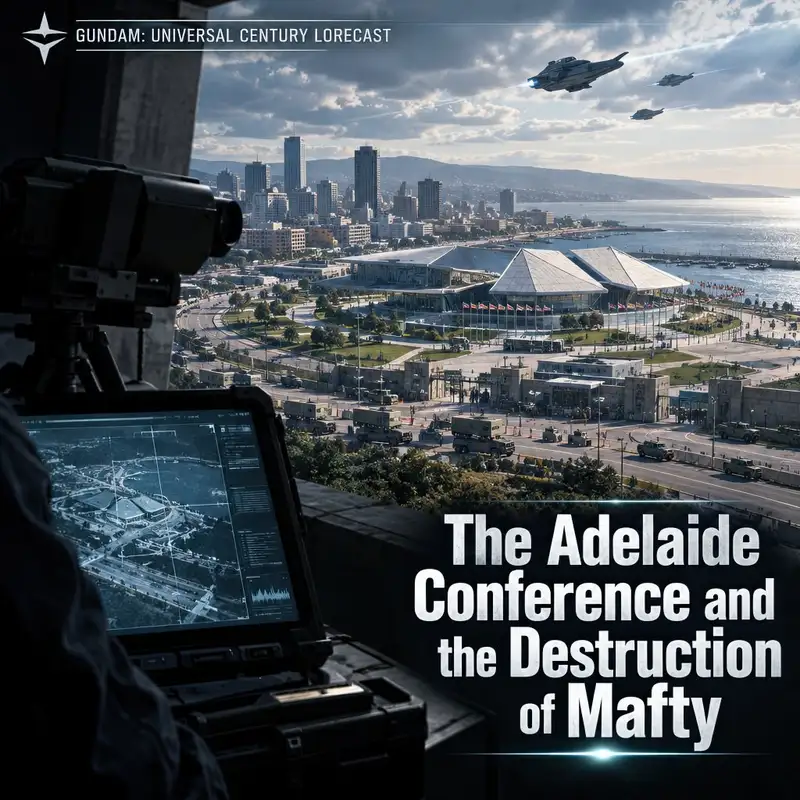
The Adelaide Conference and the Destruction of Mafty [Novel; Awaiting Final Film]
Adelaide was placed under lockdown before Mafty fired a shot. The city had been chosen for a meeting of the Earth Federation’s central cabinet, a gathering meant to advance policy over who could live on Earth and who could be removed from it. Security cordons, military patrols, controlled roads, and evacuation warnings transformed a city into a guarded political enclosure. The immediate danger was obvious. Mafty Navue Erin had threatened the conference. The deeper danger was less convenient. The government was preparing to make Earth still more exclusive while claiming to protect it.
The original Hathaway’s Flash novels make Adelaide more than the site of a final battle. It is the physical expression of the argument at stake. Its terrestrial landscape and surviving colonial architecture appealed to the Federation’s governing class because they represented an Earth increasingly treated as a protected inheritance. Environmental preservation, in itself, was not the problem. Earth had been damaged by centuries of industrial pressure, migration, and war. The problem was who would bear the cost of protecting it, and who would receive the right to remain.
Under the Federation’s Earth cleansing policy, environmental management became bound to residency restrictions, forced removal, and expanding administrative control. The people pushed from Earth did not all possess the wealth, influence, or political access of the officials meeting in Adelaide. Security organizations, including the Man Hunters and the Criminal Police Organization, gave coercive force to policies that could otherwise be described in the language of conservation and public order. That gap between official language and lived experience was precisely where Mafty found support.
Hathaway Noa understood the political hypocrisy. He saw a Federation government that had survived war after war without reforming the unequal relationship between Earth and the colonies. It had inherited the rhetoric of universal government while allowing Earth to become an increasingly exclusive preserve. Those who had access to the planet could speak of ecological responsibility. Those removed from it experienced the policy as exclusion backed by armed authority.
That indictment had force. It cannot be dismissed merely because Hathaway became Mafty. The Federation’s environmental policy was not politically neutral. It protected land, but it also protected privilege. It turned residence on Earth into a mark of status and made ordinary people vulnerable to removal by institutions they could not meaningfully control. Hathaway’s anger came from a real political failure of the Universal Century. Humanity had expanded into space, but it had not built a fair system for deciding who belonged where, who governed, and who paid for the damage done to Earth.
Mafty gave Adelaide’s civilians a period in which to evacuate. After that deadline, people and vehicles attempting to leave the city could be treated as targets. From an operational perspective, the warning had a cold logic. Hathaway needed to clear the battlespace, separate officials from the population, and reduce the uncertainty that always surrounds a strike in a major city. A mobile suit assault against a conference center could not distinguish easily between a civilian vehicle, a government convoy, a military reinforcement, and an evacuation column in the middle of a panic.
Politically, however, the ultimatum was disastrous. The people Mafty claimed to defend were now subject to Mafty’s own deadline. A family unable to leave, a worker trapped by blocked roads, a patient dependent on care, or a frightened person who delayed too long could become part of the threat. The organization’s message of liberation became inseparable from its willingness to dictate where civilians could go and when they could move. Mafty had forced attention onto the Federation’s Earth policy, but it had also surrendered moral ground.
Mafty possessed formidable equipment, but equipment was not the same thing as strategic depth. The organization fielded Messer mobile suits, Galcezon transport carriers, reserve weapons and ammunition, dispersed support personnel, and Hathaway’s Xi Gundam. The Xi was an extraordinary combat machine, built around high mobility, advanced weapons, and Minovsky flight capability. In Hathaway’s hands, it gave Mafty a tool that ordinary Federation units could not easily match. But it was also a rare system dependent on specialized maintenance, trained personnel, supply access, and a pilot who could exploit its capabilities.
The Messers gave Mafty a heavier conventional striking arm, but they did not turn the organization into a conventional military. The insurgent force was improvised and heterogeneous. It was held together by clandestine networks, personal loyalty, political anger, and access to equipment that was difficult to replace. Its personnel could disperse, hide, and reappear. That made Mafty difficult to eradicate. It did not make the organization well suited to sustaining an open battle against concentrated Federation defenses.
The suspected connection between Mafty and Anaheim Electronics must be understood in that context. A movement capable of operating the Xi Gundam clearly had access to industrial knowledge, supply channels, or sympathetic intermediaries beyond the resources of an ordinary underground cell. That indicates a relationship between insurgency and the military-industrial world. It does not prove that Anaheim controlled Mafty, directed the Adelaide attack, or possessed a master plan for every conflict in the Earth Sphere. Corporations can profit from instability, serve competing clients, and preserve deniability without becoming omniscient governments.
The Galcezons exposed the practical limits of Mafty’s mobility. They could carry mobile suits and supplies toward Adelaide, but a carrier burdened by mobile suits could not simply sustain supersonic flight and vanish into the horizon. The assault force had to choose its route carefully. It needed cover, timing, deception, and enough fuel and ammunition to fight after arrival. A carrier that reaches the target area is only useful if it can release its mobile suits, avoid destruction, recover survivors if possible, and withdraw through a defended airspace.
Mafty approached Adelaide with roughly six Galcezon carriers. Some carried Messers. Others carried reserve weapons and ammunition. Personnel associated with the Oenbelli area helped disperse Minovsky particles along the projected route. The particle field complicated long-range detection and communications, but it did not make the attackers invisible. It reduced certainty. It forced the Federation to rely more heavily on local reconnaissance, visual reporting, fixed defenses, and commanders who could act with incomplete information.
That was the environment Hathaway intended to exploit. Mafty created decoy activity around Stonewall, used radio interference, shifted mobile-suit movements, and sent false signals across a wide enough area to divide Federation attention. The goal was not to make every defender look in the wrong direction forever. It was to create hesitation at the decisive moment. If the Federation committed too many forces to a diversion, the main attack might reach Adelaide before the defense could concentrate.
This was a real operational success. Mafty penetrated the outer defensive problem. It forced the Federation to interpret incomplete reports under Minovsky interference and political pressure. The attackers gained access to the city’s approaches and brought their most valuable machine into position. Hathaway’s planning demonstrated that a clandestine force with good intelligence, advanced technology, and disciplined timing could still threaten the core of Federation authority.
But penetration is not the same thing as victory. Entering defended airspace is only the beginning of an operation. Mafty still needed to strike the conference target, survive the response, preserve its carriers and mobile suits, evacuate or disperse its personnel, and turn the attack into a political success. Every minute spent over Adelaide increased the danger. The closer Mafty came to the cabinet, the more tightly the battle became connected to civilian infrastructure, panic, and the Federation’s prepared defenses.
Kenneth Sleg understood that problem. By the time of Adelaide, he had been promoted from captain to commodore and placed in command of the Circe Unit’s defense. His task was not merely to protect a group of ministers. He had to defeat Mafty in a way that restored confidence in the Federation’s ability to govern. The earlier anti-Mafty effort, the Kimberley Unit, had failed to destroy the insurgency. Its campaign had also become associated with abuses around Oenbelli, damaging the government’s standing and demonstrating how badly counterinsurgency can go when force outruns political judgment.
Kenneth was not free of the Federation’s system, and he was not an innocent observer of its violence. He commanded the operation that would destroy Mafty’s striking force and lead to Hathaway’s death. But he was more aware than many of his superiors that military force could not erase the political conditions behind the rebellion. He understood that a victory achieved through indiscriminate punishment or obvious deception could create more enemies than it removed.
His immediate objectives were more concrete. He had to protect the Adelaide conference, defeat Hathaway’s Xi Gundam, prevent Mafty from creating a symbolic triumph, and preserve the credibility of the Federation forces under his command. The Circe Unit had access to the Penelope, piloted by Lane Aim, along with Gustav Karl mobile suits, Kessaria support vessels, fixed defenses, intelligence reporting, and a defense network tied to Davao Air Force Base. Unlike Mafty, Kenneth could draw upon the resources of a state.
That advantage did not mean the Federation could simply form a line and wait. The attack was too complex, the city too vulnerable, and the Minovsky environment too uncertain. A rigid defense might be pulled apart by decoys, false reports, and the Xi Gundam’s speed. Kenneth instead accepted apparent weakness. He allowed Hathaway to see an opening that looked exploitable. The purpose was not to stop the first movement of the attack at the outer edge of the city. It was to shape the second movement, to draw the Xi into a place and time where its advantages could be constrained.
At the center of that plan was a newly installed ground-based beam barrier. The system was not an ordinary field weapon used under routine conditions. Kenneth intended to concentrate its power beyond its normal operating level, even at the risk of damaging its resonator. The barrier was a countermeasure designed for a particular problem. The Xi Gundam could outmaneuver many threats in open air. It could not easily escape a prepared defensive system that turned its maneuver corridor into a controlled kill zone.
The approach to Adelaide showed both sides working under uncertainty. Minovsky particles degraded radar and other long-range electromagnetic systems, but they did not erase every means of detection. Forces could still observe visually, report locally, follow movement patterns, and use whatever communications remained practical. The problem was not blindness. It was delay, ambiguity, and the difficulty of building a common picture quickly enough to make good decisions.
For Mafty, that environment rewarded deception. A decoy force did not need to destroy a Federation unit. It only needed to convince a commander that a threat might be real. Radio interference did not have to silence every transmission. It only needed to create doubt about which report deserved priority. The movement of mobile suits around Stonewall, the dispersal of particles, and the advance of carriers from the west or northwest all contributed to a wider picture of threat.
For Kenneth, the answer was not perfect information. It was preparation. He had to decide which risks to accept, which routes to leave exposed, and when to commit the Penelope. That required confidence that Hathaway would interpret the defense as intended. It was a dangerous form of command. If Mafty had chosen a different target, broken off earlier, or concentrated more effectively against the conference facility, the trap might have failed. A deliberate weakness can become a real weakness if the enemy refuses to cooperate.
Hathaway did cooperate, at least in part, because the political logic of his mission drove him toward the center of Adelaide. Mafty’s target was not the indiscriminate destruction of the city. The organization sought the conference facility, especially the central white building where political authority had assembled. Hathaway needed the attack to be legible. Killing ministers in a remote ambush would not carry the same message as striking the very place where Earth policy was being decided.
That need for symbolic clarity constrained the operation. The Xi Gundam had to be seen. The attack had to reach Adelaide. The ministers had to understand that Mafty could threaten them despite the Federation’s security apparatus. A clandestine movement can sometimes survive by remaining hard to locate. Hathaway’s political strategy required him to reveal himself at the moment of maximum danger. He was using surprise, but he was also sacrificing concealment for spectacle.
Once the attack reached the city, the distinction between a precise political strike and a wider urban disaster began to collapse. Mafty had stated its target, but intent could not control the effects of missiles, mobile suits, carriers, defensive fire, and panic in a populated area. The airport came under missile attack and suffered major destruction. Aircraft facilities, runways, transport routes, and the evacuation system all became part of the battlefield. A city attempting to empty itself under threat was now being damaged at the very points needed for people to leave.
The combat also placed Mafty’s own equipment at risk. Messers could provide firepower and support, but they were operating around a defended city under pressure from Federation mobile suits, missiles, and fixed defenses. A mobile suit is not a self-contained weapon in any meaningful strategic sense. It carries a reactor, weapons, propellant, ammunition, and a pilot. When it is destroyed near civilian infrastructure, the consequences can extend far beyond the loss of one machine.
A Messer was destroyed over or near Adelaide, and the resulting fusion-reactor explosion intensified the catastrophe. The novel does not treat that destruction as background spectacle. It is the point at which Mafty’s effort to control the political meaning of the battle becomes impossible. The city is no longer merely the setting for an assassination attempt. It is a damaged civilian environment in which both the insurgents and the government will try to assign blame.
The Federation could point to burning infrastructure, disrupted evacuation, and civilian fear. Mafty could point to the government’s refusal to change its policy and to the militarization of Adelaide itself. Both claims contained elements of truth. But political conflict is not judged by abstract arguments alone. It is judged by what people experience. For those trapped in the city, the difference between a missile intended for an airport, a defensive interception, and a mobile suit wreck falling nearby may have been of little comfort.
At the tactical center of the battle stood the Xi Gundam and the Penelope. Their confrontation is often remembered as the defining image of Adelaide, but treating it as a clean duel misses the point. The Xi had an initial advantage in agility. Hathaway’s machine could exploit Minovsky flight, rapid changes in direction, heavy weapons, and the pilot’s own exceptional ability. In open maneuver, the Xi was difficult to contain. It was exactly the kind of system a clandestine organization would value: a machine capable of creating an outsized effect in a short period.
The Penelope was not an identical counterpart. Lane Aim’s machine had been altered by the removal of external equipment. That change improved its close-combat responsiveness, but it also reduced protection and changed its flight configuration. Lane was also carrying the burden of earlier combat damage and the pressure of facing Hathaway again. He entered the engagement with rivalry, professional pride, and a desire to prove himself. Over time, however, he had gained enough experience to become more than a pilot chasing a famous enemy.
Lane’s contribution mattered. So did the damage already sustained by his machine. So did the presence of Gustav Karls, Kessarias, Mafty’s Messers, missile attacks, funnels, command direction, and the city below. Neither the Xi nor the Penelope fought in an empty sky. They fought within a coordinated battle in which other units shaped escape routes, created threats, and imposed decisions on the two pilots.
The Xi’s mobility gave Hathaway the initiative. It allowed him to press the attack and initially place Lane under severe pressure. But initiative is not the same as control. A fast, agile machine can choose where to strike for a moment. It cannot automatically control every sensor, every supporting unit, every ground defense, and every line of withdrawal. Kenneth’s plan was built around that limitation. He did not need the Penelope to win a perfectly equal contest. He needed Lane to keep Hathaway engaged long enough for the larger defensive system to act.
This is where the apparent weakness in Adelaide’s defense revealed its purpose. Hathaway had penetrated the city’s approaches and brought the Xi into the battle Kenneth wanted. The first phase had made the Federation look vulnerable. The second phase turned that vulnerability into a trap. The decisive weapon was not another ace pilot or a more dramatic mobile suit. It was a fixed defensive system prepared in advance and used at the moment when the Xi was most committed.
The beam barrier activated while Hathaway was engaged with the Penelope. Its power was concentrated beyond ordinary operating conditions. The system may have damaged its own resonator in the process, but that was acceptable to the defenders. A weapon does not need to survive indefinitely if it succeeds in the mission for which it was built. The barrier converted the engagement from a contest of maneuver into a controlled zone where the Xi Gundam could not simply fly away.
The significance of the barrier is institutional as much as technical. Mafty had invested heavily in one exceptional machine and one exceptional pilot. The Federation had invested in a network: intelligence, fixed defenses, mobile suits, support vessels, a command structure, and a prepared battlefield. The Xi could outperform individual opponents. It could not easily defeat the entire system once that system had concentrated at the right place.
Hathaway was immobilized. He lost consciousness. The immediate tactical result was the defeat of the Xi Gundam. The operational result was much larger. Mafty’s assassination effort had collapsed. Its most valuable machine was neutralized, its leader was exposed, its forces were scattered, and the organization could no longer claim that it had dictated the terms of the Adelaide confrontation.
Lane discovered that the pilot he had fought was Hathaway Noa. The revelation did not produce a simple moment of triumph. Hathaway was not an anonymous terrorist in the abstract. He was the son of Bright Noa, a name inseparable from the earlier wars of the Universal Century. He was also a man Lane had known in another context, a rival, an unsettling presence, and now the hidden leader of the movement they had been ordered to destroy. The discovery made the victory morally and politically more complicated, not less.
Hathaway survived the immediate defeat because the Xi’s cockpit protection and the effects of the beam barrier did not kill him at once. He was badly injured and taken to a hospital. At that point, the Federation possessed something more dangerous than a captured pilot. It possessed a political problem. A public trial might expose Mafty’s organization, reveal the inadequacy of the government’s Earth policy, invite reprisals, and create a platform for Hathaway’s arguments. A genuine interrogation might generate intelligence, but it could also produce records that officials preferred not to have.
Kenneth told Hathaway that there would be no meaningful interrogation. The cabinet and General Staff had already decided on an expedited execution. They did not seek a full accounting of Mafty’s network, the organization’s industrial support, the political grievances behind the movement, or the failures of the Federation’s own policy. Their objective was containment. Hathaway had to disappear quickly enough that he could not become the center of a public political crisis.
There is a difference between formal authority and justice. The Federation could claim emergency powers, military necessity, security concerns, and the need to prevent further violence. Those arguments were not invented from nothing. Mafty had attacked Adelaide, threatened ministers, and endangered civilians. But the decision to deny a meaningful trial was not simply a response to danger. It was a choice to replace investigation with administrative finality.
The state did not want truth because truth would have been untidy. It would have required officials to explain why the Earth residency system had produced such anger. It would have required scrutiny of the Man Hunters and other coercive institutions. It might have raised uncomfortable questions about the battle itself, the cabinet deaths, the destruction of Adelaide, and the extent to which the Federation’s own political choices had created Mafty’s constituency. Execution was simpler. It could turn a complicated enemy into a closed case.
Kenneth recognized the character of that decision. He had won the battle in the military sense. The Xi was defeated. Hathaway was in custody. Mafty’s coherent striking capacity had been broken. Yet victory did not bring him confidence in the institution he served. The Federation’s leaders were prepared to claim the benefits of his success while avoiding responsibility for the political disaster that had unfolded under their protection.
Kenneth submitted his resignation, officially accepting responsibility for the cabinet deaths and the failure to defend Adelaide. On paper, this was the expected act of a senior commander after a catastrophic attack. In practice, it was also a form of scapegoating. The government needed a responsible officer. It needed to demonstrate that failure had been identified, punished, and contained. Kenneth’s resignation allowed the system to present itself as accountable without asking whether its broader policy had made the battle inevitable.
General Headquarters accepted his retirement but reduced his pension rank. Even departure had to be turned into an administrative penalty. It was a small detail compared with the destruction in Adelaide and Hathaway’s coming death, but it revealed the mentality of the system. Bureaucracies often find it easier to discipline the visible official than to confront the policies that produced the crisis. The paperwork can move faster than reform.
Bright Noa then arrived to assume command responsibilities in the South Pacific district. He did not know that Mafty was Hathaway. That ignorance was not accidental. Kenneth understood what the Federation’s public narrative might demand if Bright were made part of the execution. Bright was both a senior officer and Hathaway’s father. Making him kill his own son would create a powerful image of loyalty to the state. It would also be an act of calculated cruelty disguised as discipline.
Kenneth chose to take responsibility for the execution himself. That decision does not make him a secret ally of Mafty, nor does it absolve him. He remained part of the military machinery that defeated Hathaway and delivered him to death. But he refused to allow Bright to be turned knowingly into the instrument of his son’s killing. In a system increasingly concerned with appearances, that refusal was one of the few attempts to preserve a boundary between duty and political theater.
Hathaway was executed by firing squad before dawn. Bright was kept from witnessing it. The private nature of the killing was itself revealing. The Federation did not want a transparent legal process. It did not want the public to hear Hathaway speak. It did not want Bright to know enough to challenge the story being prepared around him. The state wanted a death that could be managed, edited, and distributed in the form most useful to authority.
Then came the public account. The Federation identified Mafty as Hathaway Noa and published a distorted story in which Bright was presented as the father who had executed his own son. Hathaway was framed as a terrorist who accepted punishment. Bright became an emblem of loyal Federal discipline, a commander supposedly willing to place the state above blood. The story was powerful because it simplified everything. It removed the secrecy, the lack of trial, Kenneth’s intervention, and the government’s fear of public scrutiny.
This was not transparent justice. It was an information operation. The Federation needed to deter other dissidents, reassure elites, stabilize public confidence, and convert a costly battle into a story of order restored. A father executing his terrorist son was more useful to that purpose than a senior officer quietly preventing the father from learning the truth. The published account did not merely misstate events. It reorganized their moral meaning.
The real Adelaide story was harder to control. The government had defeated Mafty’s most visible military capability. It had captured and killed the movement’s leader. It had prevented the assassination operation from achieving its stated objective. In tactical and operational terms, that was a Federation victory. But it was a victory purchased in a damaged city, amid civilian fear, cabinet deaths, institutional panic, and a political system still unwilling to address the grievances Mafty had exploited.
Mafty, meanwhile, had failed in the most immediate sense. Hathaway could not force the Federation to abandon its legislation. He could not protect Adelaide from the consequences of his own assault. He could not turn the Xi Gundam’s extraordinary performance into durable political control. His organization lost its leader and its ability to act as a coherent striking force. Surviving personnel disappeared into hiding, but dispersion is not the same as strength. A network can survive underground while losing the capacity to shape events openly.
Kenneth understood that danger. He and Gigi Andalucia left the region because official attention was no longer necessarily protection. People who knew too much about a managed execution, a false public narrative, or the weaknesses of the government’s account could become inconvenient. Their departure was not a romantic escape from politics. It was an acknowledgment that institutions capable of manipulating a death for public consumption might also decide that witnesses were liabilities.
Adelaide therefore answers the question of why Mafty loses with more than the destruction of the Xi Gundam. Mafty loses because infiltration, deception, and exceptional technology cannot substitute for strategic depth. Hathaway could penetrate the defense. He could force the Federation to react. He could bring the political crisis directly to the cabinet. But he could not protect civilians from the consequences of urban warfare, control the meaning of destruction, replace the losses his movement suffered, or compel a state to reform through assassination.
The Federation wins because it can concentrate defenses, absorb damage, capture the narrative, and use institutional power after the battle. Yet that victory is incomplete in the deepest sense. The government does not resolve the contradiction that Hathaway identified. It does not create a fairer relationship between Earth and the people excluded from it. It secures itself by secrecy, scapegoating, and propaganda, then calls that security order.
Hathaway Noa recognized a real failure of the Universal Century political order. He also chose a form of violence incapable of creating the just order he claimed to seek. At Adelaide, Mafty’s attack destroyed lives and damaged the cause it meant to advance. The Federation buried responsibility beneath a carefully managed story. Hathaway died, Mafty lost its leader, and the system survived, but the injustice that made Mafty possible remained alive.