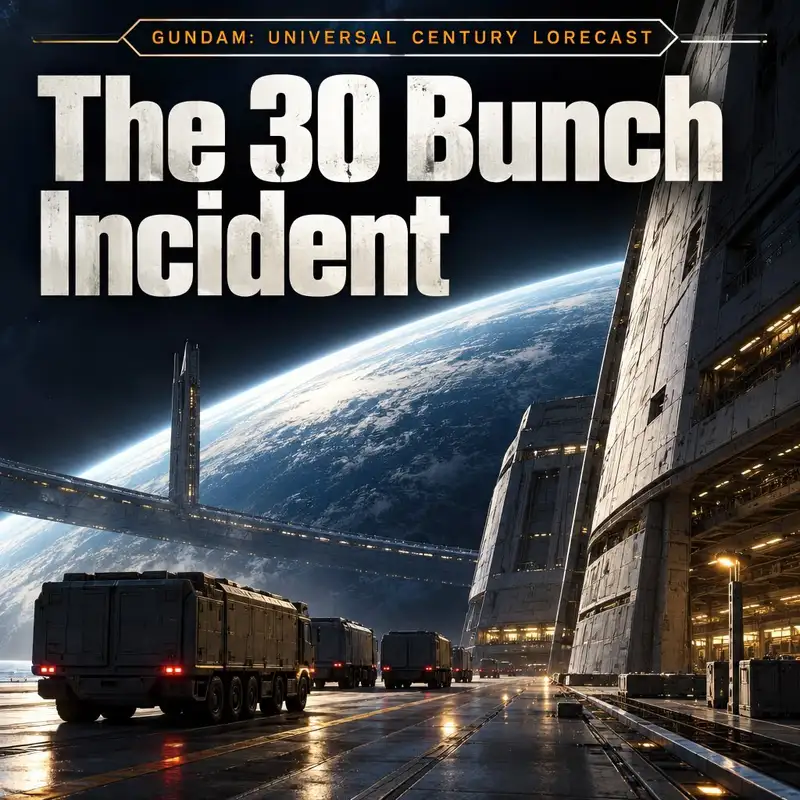
The 30 Bunch Incident
In March of Universal Century eighty-seven, the Argama entered a colony that should have been noisy. A functioning cylinder carries the ordinary sounds of a city and a machine at the same time. Traffic moves through its streets. Air systems hum behind walls. Workers report to shifts. Families eat, argue, sleep, and plan for tomorrow. Colony Thirty at Side One had none of that. It was silent because the population had been killed by the atmosphere it depended upon. The habitat remained, but its political community had been erased.
For Kamille Bidan, the colony was evidence that the war around him had begun long before he climbed into a mobile suit. For Emma Sheen, still trying to understand what service in the Titans had demanded of her, it was harder evidence still. Reccoa Londe knew enough of the hidden record to lead them there. Quattro Bajeena understood the political value of making witnesses see the place itself. An accusation can be denied. A classified report can be buried. An abandoned colony, with the remains of its residents still inside, is more difficult to explain away.
This was the 30 Bunch Incident, the Titans’ poison-gas massacre at Colony Thirty on July thirty-first, Universal Century eighty-five. Official character material associates Colonel Bask Om directly with the introduction of poison gas into the colony and identifies the dead as approximately fifteen million residents. The event was not battlefield collateral damage, nor was it an operation against a remote military installation. A Federation security force used the infrastructure of a civilian habitat to destroy the civilians living inside it.
The military question is not merely how the Titans carried out the attack. The deeper question is how an organization created to preserve order after the Delaz Conflict came to treat a colony population as an enemy to be eliminated. And then, having done so, why did the massacre not secure obedience? Why did it instead become one of the clearest symbols of Federation tyranny, a catalyst for organized resistance, and a burden carried into the Gryps Conflict?
Colony Thirty was not an abstract point on a strategic map. It was an inhabited habitat at Side One, a place where people depended upon the same systems for air, transport, food distribution, work, and shelter. Anti-Federation opposition gathered there. The surviving television-series record does not provide a reliable complete order of battle, a precise count of participants, or a neat list of political demands. That absence matters. It means we should not invent a riot, a rebellion, or a military threat in order to make the Titans’ response appear proportionate.
What can be said is that the Titans treated the gathering as a security crisis. In doing so, they collapsed several different categories into one enemy label. Political dissent became hostile activity. Anti-Federation sentiment became proof of enemy influence. The presence of opposition became grounds for collective suspicion. Once that logic takes hold, the question is no longer who is responsible for a threat. The question becomes who happens to live near it.
That is the point at which counterinsurgency ceases to be counterinsurgency and becomes collective punishment. A security force may argue that it faces danger, infiltration, or unrest. It may even face some of those things in reality. But its legitimacy depends on whether it can identify targets, distinguish civilians from combatants, and remain accountable for the methods it uses. The Titans did not solve the political problem at Colony Thirty. They converted the colony itself into a target.
Colonel Bask Om stands at the center of the operation. Official material identifies him as the commander responsible for introducing poison gas into Colony Thirty. That establishes operational responsibility. It does not give us a fully documented chain of orders from every level of the Titans to every level of the Federation government, and it would be careless to invent one. Jamitov Hymem’s political responsibility for the Titans is not the same thing as proof that he personally issued a specific operational order for the gas attack.
But uncertainty about each signature on a chain of command does not erase institutional responsibility. Bask had the authority, personnel, and freedom of action to direct the operation. The Titans had developed an environment in which extraordinary coercion could be treated as security policy. Federation institutions either failed or refused to impose meaningful accountability afterward. Those facts explain more than a simple story of one brutal commander acting alone.
Bask’s later conduct reinforces the broader pattern. He was not merely a conventional officer applying unpleasant but limited force under strict civilian control. He embodied the Titans’ growing belief that necessity excused restraint, and that political opponents could be managed through fear. In an organization built around emergency authority, officers like Bask become especially dangerous. They do not need to overthrow the system. They only need a system that rewards aggression, obscures responsibility, and treats the people under its protection as a potential fifth column.
The weapon chosen for Colony Thirty reveals the nature of the operation with unusual clarity. Poison gas was introduced into the colony environment. The precise chemical designation varies across later reference traditions, so the secure fact is simply poison gas. What matters militarily is not the label on the canister. It is the use of a sealed civilian habitat’s own environmental dependence as the means of attack.
A colony cylinder is vulnerable in ways that open ground is not. Its residents live within a controlled atmosphere. They rely upon circulation systems, enclosed transit routes, regulated access points, and life-support infrastructure that cannot simply be abandoned when danger appears. There are no open horizons to run toward. There is no countryside into which a population can disperse. Escape routes are limited, and every part of the habitat depends on systems designed to keep people alive under artificial conditions.
Using poison gas in that environment offered the Titans an operational shortcut. They did not need to conduct a conventional assault through streets, docks, residential sectors, or public facilities. They did not need to separate armed opponents from civilians one building at a time. They did not need to hold terrain in the ordinary sense. Control of the colony’s infrastructure allowed them to impose death on a population at scale.
That may have been efficient in the narrowest and most terrible sense. It was not riot control. It was not a raid. It was not a precise counterterrorism action against an identified armed cell. It was mass killing. Approximately fifteen million residents died. The population of Colony Thirty was treated not as a community whose political conflict needed to be understood, but as a hostile environment to be sterilized.
The Titans achieved immediate physical control. They silenced the gathering. They removed the population that might oppose them. They demonstrated that they possessed the means and willingness to impose terror. Tactically, the operation was devastatingly effective. For the mission itself, it eliminated the immediate problem as the Titans had defined it. A staff officer focused only on a map and a short-term order could call that success.
But military history is full of operations that succeed at one level and fail at the levels that matter most. Colony Thirty was not empty territory. Killing its residents did not govern Side One. It did not resolve the political causes of anti-Federation sentiment. It did not persuade other colonists that the Federation could protect them. It did not strengthen trust in Federation law. It did not isolate radical opponents from the broader population. It gave those opponents a fact that could not easily be absorbed into ordinary factional politics.
The incident was a massacre. It was also collective punishment, because the method made no meaningful distinction between individual guilt and collective presence. Modern legal language can describe such conduct in severe terms, but the essential historical point does not require a later courtroom to be understood. A force claiming to defend public order killed an entire civilian community by turning its life-support environment against it. No security rationale can make that a normal instrument of governance.
The Titans’ next task was informational. Mass coercion of this scale cannot be reconciled easily with a public claim to lawful security. The event was concealed through official pressure and information control. The exact mechanics of the public cover story are not fully secure in the television account, and it is not necessary to invent them. What matters is that the Federation system did not openly acknowledge, investigate, or punish the act in a way proportionate to what had occurred.
Secrecy was not an afterthought. It was part of the operation’s political logic. If the Titans had been able to admit publicly that they had killed a colony population and still retain credibility, they would not have needed concealment. The need to hide the massacre demonstrated that even its perpetrators understood the gap between their official mission and their actual conduct.
Classification can delay consequences. It can protect a chain of command for a time. It can confuse civilians, isolate witnesses, and turn fragments of truth into rumors. But secrecy has limits. There are records. There are personnel. There are intelligence operatives, rival institutions, defectors, local networks, and physical sites. A colony does not disappear just because its inhabitants have been killed. In fact, the empty colony becomes a kind of evidence archive, one too large to destroy without creating another crime.
Information control also damages the force attempting it. A military organization depends on more than weapons and orders. It depends on professional trust. Officers and enlisted personnel must believe that the authority above them has a defensible purpose, or at least that unlawful conduct will be investigated rather than protected. When a chain of command hides atrocities, it asks its own members to obey without knowing what their obedience serves.
That was one reason the 30 Bunch Incident became politically explosive. Resistance to the Titans did not begin in a vacuum, and it did not emerge from a single massacre alone. The Earth Sphere already contained colonial grievance, postwar resentment, anti-Federation opposition, former Zeon networks, and Federation personnel disturbed by the Titans’ expanding authority. But Colony Thirty gave those dispersed concerns a common center. It was proof that could not be dismissed as mere nostalgia for Zeon, routine interservice rivalry, or a disagreement over policy.
Blex Forer recognized that significance. He did not create opposition to the Titans from nothing. Rather, the incident helped convince him that quiet dissent, private complaint, and reliance on internal correction were no longer sufficient. Official material connects the massacre with increased activity by the Anti-Earth Union Group, the AEUG. The organization became more open, more coordinated, and more willing to prepare for armed resistance against the Titans.
That development requires some precision. The AEUG was not a spontaneous uprising assembled in one meeting after Colony Thirty. It drew upon Federation dissidents, Spacenoid opposition, lunar networks, former Zeon personnel, political contacts, and material support from Anaheim Electronics. These groups did not all share the same past, ideology, or desired future. Some opposed the Titans because they feared Federation militarism. Some were driven by colonial politics. Some had histories tied to Zeon. Some saw opportunity. Some saw necessity.
Anaheim’s role should also be kept in proportion. The corporation’s technical and industrial support mattered because resistance needs equipment, ships, maintenance, access to production, and political connections. A movement cannot challenge a heavily armed security organization with speeches alone. But Anaheim did not invent every grievance that fed the AEUG, nor did it control the entire movement as though the conflict were simply a corporate project. Material support enabled resistance. It did not substitute for the political conditions that made resistance credible.
The 30 Bunch Incident gave the AEUG something especially valuable: a cause grounded in documented institutional conduct. Anti-Titans opposition could point to the empty colony and say that the issue was no longer merely whether Federation policy was ineffective or unfair. The issue was whether a security force operating under Federation authority had become a threat to the people it claimed to defend.
That argument did not make the AEUG morally uncomplicated. Resistance organizations can commit errors, rely on uneven alliances, and develop their own blind spots. Opposition to atrocity does not grant automatic wisdom. But the Titans had made a real crime central to the political landscape. The AEUG’s credibility grew because its warning about Titan repression was not abstract.
The colony’s significance was particularly sharp for Emma Sheen. Emma began the television series as a Titans officer and test pilot who believed that the organization served a legitimate purpose. That belief was not irrational in the abstract. The Titans had been created amid genuine fear of renewed violence. A disciplined officer could plausibly see them as a necessary response to a dangerous postwar environment.
Her disillusionment did not begin and end with Colony Thirty. The Titans’ treatment of Kamille Bidan’s family, including hostage-taking, had already shown her that the organization could use abusive methods against civilians. That experience created doubt. But doubt can remain private. An officer can tell herself that one commander acted badly, that an emergency produced excess, or that reform remains possible from within the institution.
Colony Thirty made such explanations much harder to sustain. Reccoa Londe’s role was crucial. As an AEUG intelligence operative and a veteran of irregular conflict, Reccoa helped turn hidden history into direct evidence. She did not merely tell Emma that the Titans had done something terrible. She helped bring Emma into the place where the consequences remained visible.
Quattro’s role was political as much as personal. By taking Emma and Kamille into the colony, he forced them to confront a question that military institutions often encourage their members to avoid. When does obedience become complicity? A professional soldier cannot always know every act committed by an organization. But once evidence becomes clear, the claim of ignorance begins to fail. Emma had to assess whether the Titans’ authority could still be regarded as lawful, defensible, or worthy of service.
Her response matters because it was not simply an emotional conversion. Emma did not abandon the Titans because she suddenly preferred the AEUG’s rhetoric. Her decision emerged from a professional and moral judgment. A security organization loses the loyalty of conscientious personnel when they can no longer distinguish service to the public from participation in abuse. The Titans’ failure was not that every member immediately recognized the truth. The failure was that the truth, once encountered, made continued faith in the institution increasingly difficult.
Lila Milla Rira adds another layer to the problem. Her presence in or near the abandoned colony during the television-series sequence shows that the meaning of Colony Thirty did not belong only to committed AEUG personnel. Lila remained a Federation officer, not a simple extension of Titan ideology. Her encounter with the colony and with the people moving through it demonstrates that the massacre had implications for those who still saw themselves as serving the Federation.
The distinction is operationally important. It is too easy to describe the Gryps Conflict as a clean contest between an evil Federation and heroic rebels. The Titans were a Federation security formation, but they were not the entire Earth Federation Forces. Many Federation personnel had limited knowledge of Titan crimes, conflicting loyalties, or sincere beliefs about security. Their dilemma was made worse by the Titans’ conduct. They had to ask whether the institution they served could restrain its own most powerful security arm.
Military cohesion depends on that question. An armed force can endure disagreement. It can endure unpopular orders. It cannot indefinitely endure the belief that its command structure protects atrocities while demanding loyalty from everyone else. The 30 Bunch Incident weakened the Titans not because it immediately destroyed their weapons or their command posts, but because it made the purpose of their authority suspect.
For that reason, mass coercion so often produces the opposite of its intended political result. The Titans appear to have assumed that fear would substitute for legitimacy. They assumed that political opposition could be physically eliminated. They assumed that censorship could preserve the official story. And they assumed that anti-Federation sentiment was primarily a matter of enemy infiltration, rather than a political condition with social roots.
Each assumption was flawed. Fear can silence people temporarily, but it does not necessarily make them loyal. Killing identified opponents may remove immediate organizers, but collective punishment creates relatives, witnesses, sympathizers, and future recruits. Censorship can fragment information, but it also makes later revelations more damaging because every concealed fact becomes evidence of a larger system of deception.
Most importantly, the Titans misunderstood the political meaning of Spacenoid grievance. Not every Spacenoid supported Zeon. Not every critic of the Federation favored violence. Not every anti-Federation movement was an armed insurgency. By treating these distinctions as irrelevant, the Titans made their own propaganda more believable to their opponents. They transformed a security campaign against alleged subversion into a demonstration that colonial populations could be treated as disposable.
The strategic paradox is harsh but familiar. Terror can remove people from a map while widening the political constituency of resistance. The Titans took control of Colony Thirty by annihilating it. Yet the act helped create a broader opposition that could operate across colonies, lunar networks, military units, and political factions. The more the Titans relied on exceptional authority, the more they made ordinary constitutional remedies appear hollow.
Two years later, when the Argama entered the abandoned colony, the Titans’ secret had become a weapon against them. Not a weapon in the narrow technical sense. No mobile suit emerged from Colony Thirty. No fleet was built there. Its force was evidentiary and political. The colony showed that the conflict was not merely about rival officers, competing mobile-suit programs, or Zeon’s unfinished legacy. It was about whether the Federation could survive when its security apparatus no longer recognized Federation civilians as citizens.
The television version of Mobile Suit Zeta Gundam gives this revelation particular force by physically entering Colony Thirty. The later compilation films handle the incident differently, through recorded imagery rather than the Argama’s direct exploration of the habitat. Both presentations preserve the importance of the crime, but the television account makes the colony itself part of the argument. The silence cannot be reduced to a briefing slide. It has to be entered, seen, and carried away by those who survive it.
Colony Thirty therefore became more than a crime scene. It became a political artifact. It preserved the consequences of a security doctrine that had crossed a line from defense into domination. Its empty streets and sealed systems exposed the hollowness of the Titans’ claim that harsh methods were necessary to keep the Earth Sphere safe. Security is supposed to protect the political community. When security destroys that community, it has ceased to justify itself.
Bask Om’s operational responsibility remains essential. The massacre happened because officers made decisions, issued orders, and used lethal force. Responsibility should not disappear into vague language about systems. But the larger failure was institutional. The Titans possessed the authority to act. Their leaders encouraged a culture of exceptionalism. Federation structures protected or failed to restrain them. Information was suppressed. Accountability did not follow. That is how one commander’s brutality became a political crisis for an entire government.
The immediate results were clear. The Titans gained physical control over a colony. The residents of Colony Thirty lost their lives and their community. The Federation lost a measure of legitimacy that could not be restored by official silence. The AEUG gained urgency, evidence, recruits, and a political purpose that extended beyond ordinary factional rivalry. Some personnel inside the Federation military were forced to reconsider what their uniforms represented.
The longer result was the opposite of pacification. The force created after the Delaz Conflict to contain instability helped turn that instability into open conflict. The Titans did not create every cause of the Gryps Conflict. The Earth Sphere’s inequalities, colonial grievances, postwar resentments, and political failures were older than them. But the 30 Bunch Incident made those failures impossible to dismiss as merely administrative shortcomings. It showed what the Federation’s emergency institutions were capable of doing when they were insulated from law and public scrutiny.
The 30 Bunch Incident transformed the Titans into the political symbol of Federation tyranny because it revealed the real destination of their security logic. A force created to defend the Federation used the machinery of a civilian habitat to kill its inhabitants, then relied on secrecy and institutional protection to escape responsibility. It created silence in one colony, but it did not create obedience across the Earth Sphere.
Colony Thirty was not merely where the Titans committed a crime. It was where the Federation security system proved that it no longer understood whom it existed to protect.