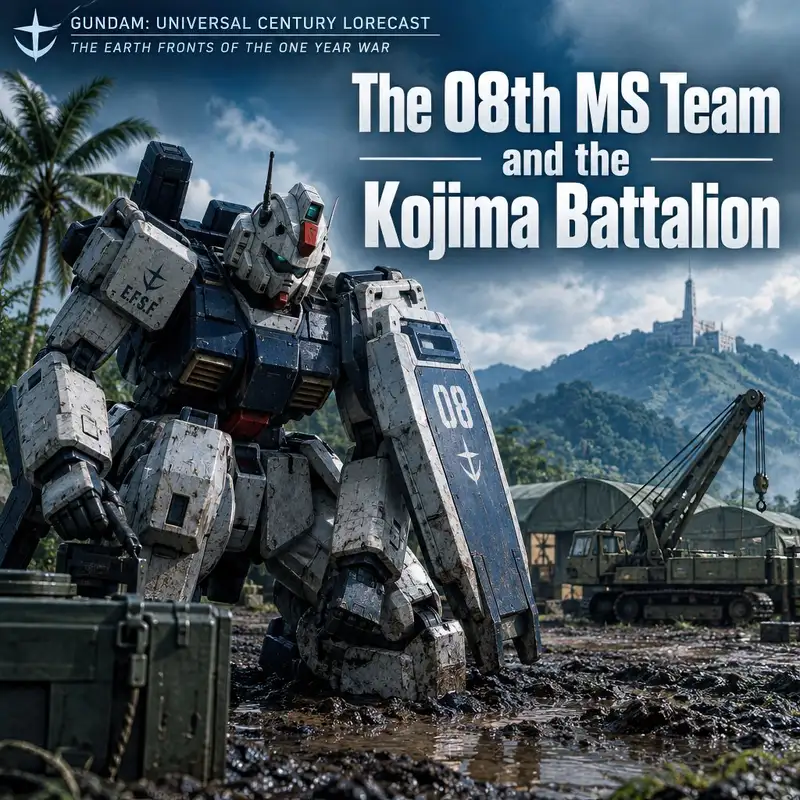
The 08th MS Team and the Kojima Battalion
In the ruins below Ginias Sahalin’s mountain base, the 08th Mobile Suit Team does not survive because three Ground Type Gundams are individually unbeatable. Their pilots are moving through broken streets, obstructed sight lines, and the debris of a battlefield that gives every defender a chance to hide. What keeps the team from walking blind into that trap is the hover truck operating behind them. Michel Ninorich and Eledore Massis provide navigation, communications, and sensor information. They help turn scattered sightings into usable contact reports and give the mobile suits a picture of terrain their cockpit cameras cannot reliably provide. Nearby, other Federation elements are fighting their own part of the battle. Guntanks supply heavy firepower. Aircraft and infantry add pressure. Mechanics, medics, and base personnel sustain the force before and after combat. The famous image is of Gundams advancing through smoke. The military reality is a small combined-arms system trying to function under pressure.
That distinction is the key to understanding the 08th Team and its parent formation, the Kojima Battalion. The team is remembered for Shiro Amada, Aina Sahalin, the Apsalus project, and a sequence of unusually personal battles in Southeast Asia. But the OVA’s ground war is not really a story about exceptional machines operating in isolation. It is about a Federation formation trying to make limited numbers of advanced mobile suits useful in a difficult theater. The battalion has to conduct reconnaissance, defend its own facilities, gather intelligence, work around damaged equipment, coordinate with local people, and eventually join a larger assault against a defended mountain complex. The Ground Types matter. So do their pilots. Yet neither would be effective for long without the people who fuel, repair, guide, recover, treat, and supply them.
The Kojima Battalion is a Federation mechanized formation operating in the Far East during Universal Century seventy-nine. The available screen record does not provide a clean table of organization, an exact troop strength, or a reliable total for every vehicle and mobile suit under its command. It does show enough to establish its character. This is not a polished parade-ground formation built around a single decisive armored thrust. It is a field command spread across a vast and unsettled area, where jungle, rivers, villages, desert ground, damaged towns, and mountain approaches all impose different demands. It contains mobile-suit teams, support vehicles, maintenance personnel, medical capability, local headquarters functions, and later, attachments for larger offensive operations. Its commander, Lieutenant Colonel Kojima, is more than a name on an organizational chart. He is the local authority responsible for turning incomplete orders and imperfect resources into something his soldiers can actually carry out.
Into that formation comes Second Lieutenant Shiro Amada, newly graduated from officer school and assigned to command the 08th Mobile Suit Team. He arrives with formal authority, but formal authority is not the same thing as practical command. Shiro is young, earnest, and technically qualified enough to hold the post. What he lacks is the accumulated experience of men and women who have already learned how quickly a clean plan can be ruined by mud, fatigue, a broken transmission, a frightened civilian, or an enemy that was not where the intelligence report said it would be. His command is not a training exercise. The 08th Team is already an operational element in an active war zone. Its members are expected to patrol, fight, survive, and return their machines in condition to fight again.
Karen Joshua provides the team with its most important internal counterweight. She is the experienced pilot who understands the practical demands of the theater and the human limits of the people operating in it. Karen is not simply Shiro’s skeptical subordinate. She is a necessary source of field judgment. Her resistance to his impulsive decisions often reflects a professional concern for the team’s survival, its mission, and the people who will have to recover them if something goes wrong. Terry Sanders Junior brings a different form of experience. He is a veteran marked by the deaths of previous comrades, carrying the burden of survival into every new mission. His caution is not cowardice. It is the memory of what bad information, poor luck, and combat panic can do to a mobile-suit unit. Michel and Eledore, operating the hover truck, are equally central even though they do not sit in Gundam cockpits. They are the team’s navigators, communicators, observers, and support specialists.
The first challenge for Shiro is therefore not defeating Zeon in some abstract sense. It is learning how to make this group work together. A lieutenant can issue orders because the organization grants him that power. But soldiers must decide whether those orders reflect sound judgment when the radio is weak, the terrain is unfamiliar, and the person giving them has never seen this particular kind of danger before. Shiro’s strength is his willingness to act and his refusal to regard his subordinates as interchangeable pieces of equipment. His weakness is that he can confuse moral conviction with adequate planning. In a less dangerous environment, that might be an ordinary problem of professional maturation. In the Kojima Battalion, it can mean exposing a support vehicle, losing a pilot, compromising local relationships, or placing a small team beyond recovery range.
The machines assigned to the 08th Team are also best understood as part of this larger effort at adaptation. The RX seventy-nine G Gundam Ground Type is not simply the famous RX seventy-eight two Gundam moved onto Earth and repainted for jungle service. It is a limited ground-oriented system, assembled from resources associated with the Federation’s RX seventy-eight program and adapted for practical field employment. It has the armor, mobility, weapons flexibility, and general-purpose capability to give a small unit substantial combat power against Zeon mobile suits and fixed positions. Its equipment can be changed for different missions. In a theater where one day may involve jungle patrol and the next a fight across open ground or through urban ruins, that flexibility has real value.
Southeast Asia is a particularly unforgiving place to attempt that conversion. Jungle warfare compresses visibility and fragments formations. Trees, ridgelines, ravines, weather, and dense vegetation can conceal movement until the last moment. A mobile suit’s height may provide observation in one circumstance and make it an obvious target in another. Heavy machines can cross obstacles that would stop a truck, but they can also be channeled into predictable routes or separated from the support vehicles that give them awareness. Maps are never enough. Roads shift in importance. Bridges become chokepoints. Villages become sources of food, intelligence, suspicion, and political danger. A unit that treats the local population as scenery soon discovers that the terrain itself has a memory and a network of human observers.
The battalion’s contact with Kiki Rosita and the local guerrillas demonstrates this reality. Their knowledge is not a substitute for formal military intelligence. Guerrillas may have limited communications, local loyalties, incomplete information, and reasons to distrust both large armies operating around them. But they understand routes, villages, hiding places, and the immediate consequences of military movement in ways that a Federation map officer cannot reproduce from a distant headquarters. The Federation, in turn, has equipment, firepower, and organizational resources that local fighters do not possess. Neither side holds the complete picture. Their relationship is useful precisely because each can fill gaps in the other’s knowledge.
That relationship is also politically delicate. Villages caught between Zeon forces, Federation patrols, and irregular fighters do not experience the war as a clean contest between symbols. They experience it through patrols near their homes, food shortages, displaced families, damaged infrastructure, and the constant danger that one side will accuse them of aiding the other. For Kojima Battalion, local cooperation is not merely a convenient plot device. It is a military necessity and a test of conduct. A formation that needs civilian information must give civilians some reason to believe that cooperation will not invite indiscriminate retaliation or abandonment. Shiro’s instinct to see people before categories has value in this environment. His problem is that humane instinct must still be connected to disciplined procedures if it is to protect anyone reliably.
The hover truck is where those procedures become visible. Michel and Eledore’s vehicle is the hidden half of the 08th Team. It moves through terrain the mobile suits cannot always read easily, carries communications and detection equipment, assists with navigation, and helps provide the sensor picture that allows the pilots to act with purpose rather than instinct alone. In a story full of mobile suits, it is tempting to treat the truck as background equipment. That would miss the point. Its crew provides the link between scattered observation and concentrated firepower. The mobile suits can act quickly once they know where to go. The truck helps establish where the enemy is, where friendly forces are, and which route remains usable.
The support crew is also exposed to the same hazards as the pilots. Eledore’s wounding during the team’s unauthorized effort to investigate the Apsalus presence near a village is a reminder that reconnaissance and recovery are not safe work performed somewhere behind the lines. Support personnel share operational risk, and their loss changes the unit’s capability. A wounded operator is not only a human casualty, though that comes first. He is also a gap in the team’s communications, navigation, and institutional memory. Someone else must cover his responsibilities. Medical personnel must treat him. The vehicle must remain functional. The team must decide whether to continue, withdraw, or alter the mission. This is what combat power looks like when it is viewed as a system rather than a collection of machines.
The incident also exposes the tension within Shiro’s command style. His willingness to pursue a lead can produce valuable intelligence. It can also bypass the discipline that protects a small unit from its own enthusiasm. In a larger formation, unauthorized action can compromise a broader plan, trigger friendly-fire risk, or force commanders to send forces into danger to recover people who should not have been there. The issue is not whether initiative is good or bad. Minovsky-era operations often require subordinates to make decisions without waiting for perfect instructions. The issue is whether initiative is tied to commander’s intent, adequate reconnaissance, and a realistic understanding of what the support system can absorb. Shiro has to learn that courage does not cancel responsibility for the people following him.
The Apsalus project enters the battalion’s war through this process of partial discovery. At first, the Federation does not possess a complete dossier explaining exactly what the weapon is, what it can do, how many versions exist, or what Ginias Sahalin intends to accomplish with it. The 08th Team encounters capability before it understands purpose. The Apsalus appears as an experimental mobile armor undergoing field testing, with Aina Sahalin at its controls. Its unusual performance makes clear that the Federation has found something more dangerous than an ordinary local mobile-suit detachment. But the first encounter does not instantly turn rumor into certainty. It provides evidence, questions, and a reason to investigate further.
Aina’s role makes that problem more complicated without making it incomprehensible. She is a Zeon test pilot tied to her brother Ginias’s project. Her encounters with Shiro reveal that the opposing sides are not populated by faceless machines. They also reveal the strain placed on individuals inside secret weapons programs and collapsing military positions. Yet her presence should not make the Apsalus merely a romantic symbol. The project has a military purpose. It requires a hidden base, technical labor, protection, testing space, supply, and personnel who can operate under secrecy. Ginias’s ambitions, Aina’s position, and the local Zeon defense effort are connected, but they are not identical. A research program can have its own priorities, distinct from the immediate needs of the troops assigned to hold the ground around it.
As the search continues, the theater shifts from jungle conditions into desert approaches and more exposed terrain. This does not make the campaign easier. It changes the problem. Open ground can improve long-range observation, but it also increases vulnerability to fire and makes supply routes more visible. Heat, dust, distance, and sparse cover challenge both men and machines. For the 08th Team, the search for the Zeon test range becomes an exercise in turning physical evidence into usable intelligence. The marks left by a powerful beam weapon, the pattern of damage, and the indications of repeated testing all help establish that the Apsalus is not an isolated oddity. Something organized is being developed and supported in the region.
This is the point at which the 08th Team begins to move beyond its earlier role in local security and anti-mobile-suit operations. It remains a small tactical element, but its missions now contribute to a larger pursuit. The Federation needs to locate the source of the threat, determine its likely employment, and disrupt it before the project becomes more dangerous. That is not a simple matter of sending a Gundam toward a target. It requires routes, reconnaissance, interpretation, and decisions about where to concentrate forces. The battalion’s value lies in its ability to connect the tactical level to the operational level. A patrol report becomes a staff concern. A damaged village becomes evidence. A strange machine becomes a possible strategic threat.
Shiro’s aggressive style is useful in this transition because he is willing to press contact and act on incomplete information. But it remains dangerous for the same reason. Every independent move can reveal something about the enemy. It can also reveal something about the Federation’s own methods, weaken relations with local communities, or consume resources needed for a later operation. Military organizations need officers who can act when the situation changes. They also need officers who understand that an action’s value is not measured only by whether it produces a dramatic encounter. The question is whether it advances the larger mission without breaking the force that must carry that mission forward. The 08th Team gradually becomes more effective as its members learn this together, often through painful experience.
The Federation victory at Odessa changes the strategic map around them, but it does not instantly solve the war in Southeast Asia. Zeon forces retreating from Europe and other pressured areas create new movement toward Ginias’s mountain base. Personnel, wounded troops, refugees, and military resources begin converging on a region that now has even greater importance as a place of concealment, evacuation, and last-ditch technical ambition. From a distant strategic map, Odessa can look like a decisive turn in the Federation’s return to the offensive. On the ground, its consequences arrive as more people, more pressure, and a harder problem concentrated in difficult terrain.
The Zeon defenders are not a single undifferentiated enemy. Ginias Sahalin is focused on the completion and use of Apsalus. His project has become so consuming that ordinary military judgment begins to bend around it. Aina remains bound to the test program and to the personal demands placed on her. Norris Packard is primarily a defender, a professional soldier tasked with buying time and protecting those who need to leave. Yuri Kellerne’s concerns include evacuation, wounded personnel, and the survival of people trapped by the collapsing situation. These aims overlap, but they do not always align. The base is a weapons site, but it is also a refuge, a medical burden, a defensive position, and a crowded point of retreat.
That human density matters. The people around the base include soldiers, technicians, wounded personnel, refugees, and civilians whose relationship to the Zeon war effort is not reducible to a single ideological category. The Federation has a legitimate military reason to stop an experimental weapon being developed under hostile control. But the method of doing so cannot be judged only by whether the target disappears from a map. A mountain installation is not an empty bunker. It contains lives, infrastructure, and the accumulated consequences of a war that has already uprooted communities across Earth and space. Kojima understands this because he is close enough to the campaign to see what higher headquarters can turn into abstractions.
The threat becomes more urgent when Federation planners model what an operational Apsalus might do. A simulation depicts the mobile armor penetrating from space into the atmosphere and striking Jaburo, the Federation’s central command complex on Earth. The image is alarming because Jaburo is not just another target. It is a major political and military center, a symbol of Federation authority, and a hub whose loss could create confusion far beyond the physical damage. But the simulation must be understood for what it is. It is a threat-assessment device. It demonstrates a possible employment of the weapon. It does not show an event that has already occurred, and it does not prove that every element of the projected attack is certain.
Kojima’s conflict with Ryer is not a simple clash between a compassionate officer and a villainous superior. It is a dispute over command responsibility. Ryer is focused on the possibility that delay will allow Apsalus to become an intolerable danger. Kojima is responsible for the troops, support personnel, and civilians who will absorb the consequences of whatever method is chosen. A commander at the local level cannot responsibly regard casualties as a line on a planning board when he knows the names, injuries, and limits of the people being ordered forward. He also recognizes that methods matter. A force that wins by treating its own personnel and the population around it as disposable may destroy more than the immediate target. It may destroy the trust and discipline that make military success sustainable.
The assault on the mountain base brings these questions into sharp focus. It is not a three-Gundam raid. The Federation attack employs the 08th Team within a larger effort that includes Guntank elements, Jet Core Boosters, infantry, base personnel, and the support structure needed to move and coordinate a force through difficult ground. Each element has a different role. The mobile suits provide maneuverable direct fire and can contest Zeon mobile suits. Guntanks offer heavy weapons support. Aircraft can strike, reconnoiter, and move rapidly across the battlefield. Infantry can occupy ground, search areas, and operate in spaces too dangerous or constrained for large machines. Support crews keep the entire effort from becoming a brief and unsustainable burst of firepower.
The ruined-city fighting during this operation is the clearest expression of the battalion’s hard-won combined-arms method. Urban ruins limit sight lines, conceal enemy movement, create chokepoints, and make raw firepower hazardous to friendly forces and survivors. A mobile suit can dominate an open approach, then become dangerously blind when it enters a narrow street or damaged structure. The hover truck’s sensor and communications role becomes indispensable. Michel and Eledore do not merely watch the battle from safety. They help guide the team through a landscape in which every turn may contain an enemy position, a survivor, or an obstacle that can trap a machine. The Gundams can fight effectively because someone else is helping them understand where the fight is.
Norris Packard’s defense in the Gouf Custom is one of the most memorable actions of the campaign, but it should be understood as a delaying operation rather than proof that one ace alone controls the battle. Norris uses a specialized machine, experience, terrain, and aggressive tactical judgment to hold back a superior attacking force long enough to support evacuation and withdrawal. That is a meaningful military achievement. It buys time, and time is often the most valuable resource in a collapsing position. But his action exists within a larger defensive effort involving retreating personnel, crowded routes, the unfinished Apsalus program, and commanders trying to decide who and what can still be saved. The Gouf Custom is not standard Zeon equipment, and Norris is not an average pilot. His performance shows what an exceptional defender can do under favorable local conditions. It does not erase the operational situation closing in around him.
The Federation, meanwhile, confronts its own failure of command judgment. Ryer’s proposed use of catastrophic reactor failure to destroy the mountain base represents a line that Kojima cannot accept. The proposal is not best described as a formally authorized nuclear strike. It is a plan to use the destructive consequences of a mobile-suit reactor catastrophe as a means of annihilating the target. The difference in terminology does not make the idea less grave. Such a method threatens everyone within range, including Federation personnel, wounded people, evacuees, and civilians caught near the base. It treats the force as a delivery system for destruction rather than a community of soldiers for whom command retains responsibility.
Kojima’s resistance is therefore not mere sentimentality. It is a professional judgment about what military authority is for. Commanders are expected to accept risk. They are not entitled to manufacture unnecessary catastrophe simply because the target is important and the people exposed are lower in the hierarchy. The distinction matters especially in the Universal Century, where institutions repeatedly claim that emergency permits them to sacrifice the politically weak, the geographically distant, or the militarily subordinate. Kojima Battalion has been held together by trust between pilots and support crews, between officers and subordinates, and between the formation and the local people whose knowledge it needs. A plan that casually expends those relationships may achieve destruction while undermining the very force that made the operation possible.
The completed Apsalus Three is the culmination of everything the battalion has learned and everything the Zeon project has distorted. By the time of the final confrontation, the Federation understands far more than it did during the first encounter. It has gathered evidence, tracked the program, assessed the possible danger to Jaburo, and concentrated forces against the mountain base. The 08th Team has gained field experience, learned the value of its support network, and become more capable of operating together. Yet the final fight is not merely a technical contest between one mobile armor and several Federation machines. It is also the collapse of the command relationships around Ginias’s project. The weapon has become so central to its creator that normal obligations to personnel, family, and military purpose begin to disintegrate.
Shiro and Aina matter here because their relationship exposes that disintegration. They each see the other as a person across a war that has trained them to think in categories of enemy and ally. That recognition does not magically end the battle or remove their responsibilities. It does reveal the human cost of allowing a secret weapons project to consume every other consideration. Aina is not simply an enemy pilot to be eliminated, and Shiro is not simply a Federation officer who can ignore what he knows about her. Their divided loyalties create stress within an already confused command environment. The important point is not that personal feeling overcomes war. It is that war’s institutions repeatedly demand that individuals suppress judgment precisely when judgment is most needed.
In the wider war, the destruction of Apsalus removes a potential threat to Jaburo. That is significant. It does not decide the One Year War by itself. The wider conflict is shaped by fleets, industrial capacity, campaigns across Earth and space, political authority, and the ability of each side to replace losses. A single experimental weapon can alter planning and create urgency. It cannot substitute for a durable war-making system. Ginias’s project demonstrates this limitation from the Zeon side. It achieves frightening capability, but it is dependent on secrecy, specialized personnel, a vulnerable base, and an increasingly unstable chain of command. It is technically impressive and strategically fragile.
Ryer’s conduct reveals the opposing danger within the same institution. A military that measures success only by the destruction of a target can lose sight of the people, legitimacy, and discipline required to sustain victory. The Universal Century is full of leaders who believe that emergency grants them permission to spend lives as though they were ammunition. Sometimes they call it necessity. Sometimes security. Sometimes efficiency. Kojima Battalion’s experience suggests a harsher truth. Soldiers, mechanics, medics, scouts, and civilians are not obstacles to military effectiveness. They are the human structure that makes effectiveness possible.
The civilian outcome remains unresolved, as it often does after a battlefield victory. Villages remain exposed to the effects of occupation and counteroffensive. Refugees and wounded people do not disappear because a base has fallen. Those evacuated from one threatened area enter another uncertain future. The local guerrillas who supplied information must continue living with the consequences of collaboration, resistance, and shifting military control. The Federation can claim a necessary victory over a dangerous weapons project. It cannot claim that the campaign’s human cost has been neatly settled by that victory.
The 08th Mobile Suit Team therefore reveals something more important than the arrival of Gundams on the ground. It shows the Federation struggling to build a practical combined-arms system from limited experimental machines, inexperienced officers, hardened veterans, support crews, local allies, damaged equipment, and a command structure under strain. The team succeeds when those elements are connected and when its members recognize their dependence on one another. Its greatest danger comes when higher authority treats the same people as expendable means rather than the force that made victory possible.