Texas Colony, M’Quve, and the Last Battles Before Solomon
Columbus supply ships came alongside White Base before the assault on Solomon. Fuel, ammunition, spare parts, food, and the ordinary burdens of keeping a warship and its mobile suits in action moved through the fleet. Inside Solomon, Zeon technicians and crews were bringing the components of Big Zam into readiness. The contrast matters. Both sides understood that the next battle would not be decided by courage alone. The Federation was preparing to sustain an offensive across a major space fortress. Zeon was preparing an emergency weapon inside a position that was becoming increasingly isolated. There is also a chronological point worth settling at the start. In the original television series, the fighting at Texas Colony comes after the Battle of Solomon, not before it. The compilation films reorder that material, but the television record places Texas in the retreat that follows Solomon’s fall. That is more than a bookkeeping detail. Solomon belongs to the last great phase of organized fortress and fleet warfare. Texas belongs to what came afterward, when Zeon’s surviving forces were moving toward A Baoa Qu and the war was narrowing into ambushes, rivalries, family secrets, and encounters that conventional command could neither predict nor fully control. The same late-war crisis connects both places. But they reveal different levels of collapse. Solomon shows a defensive system being overwhelmed. Texas shows what its officers and exceptional pilots did once that system could no longer give them a coherent purpose.
Solomon was not merely a large target on the route to Side Three. It was a fortress, a base, a logistical node, and a barrier between the Federation’s advancing fleets and Zeon’s political center. A fortress in space could mount defenses, shelter ships, repair machines, concentrate supplies, and provide a place from which mobile suits could sortie. It could also impose hesitation on an attacker. Every assault force approaching it had to account for defensive guns, mobile-suit attacks, mines, patrols, local knowledge, and the possibility that the defenders had prepared an unpleasant surprise. But fixed strength was not the same thing as strategic security. Solomon still needed communications, mobile reserves, supply movement, functioning docks, evacuation routes, and a command structure capable of deciding what to defend and when to withdraw. Once those connections began to fail, even a heavily armed fortress became a position that could be surrounded, exhausted, and bypassed only at terrible cost. Dozle Zabi commanded the defense under those conditions. His task was not simply to defeat the Gundam or destroy White Base. He had to hold a major operational position long enough for Zeon’s wider defense to survive the Federation advance. That meant balancing resistance with evacuation, local counterattack with preservation of forces, and political expectation with military reality. The television series does not provide a clean staff map of every formation at Solomon, and it does not need to. What it establishes clearly is that the fortress was under pressure from an enemy able to bring ships, mobile suits, specialized weapons, and continued supply support into one coordinated offensive.
The Federation attack was effective because it was a system, not because it possessed one remarkable ship or one exceptional pilot. White Base was important, and its crew was repeatedly placed at the center of the action. But it operated as part of Admiral Tianem’s much larger assault force. The Federation brought fleet pressure against Solomon, sent mobile suits forward to penetrate and disrupt defenses, and employed the Solar System weapon as part of its effort to break the fortress open. These were not interchangeable tools. The fleet could deliver force and carry supplies. Mobile suits could operate at close range, exploit openings, and fight through the confused environment created by Minovsky particles. The Solar System weapon could concentrate destructive power against a fixed defensive problem. Taken together, they forced Zeon to defend in more than one way at once. The logistics shown around the operation are especially important. Columbus-class supply ships are not glamorous, but they are evidence that the Federation had learned how to maintain tempo. A mobile suit that has exhausted ammunition, suffered damage, or run down its propellant does not remain a strategic asset because its pilot is talented. A ship cannot keep launching sorties without maintenance crews, replacement parts, and replenishment. The Federation’s growing advantage was not perfect command or universal competence. It had suffered surprise, invasion, and enormous losses earlier in the war. By this stage, however, it could bring resources to bear in a way Zeon increasingly could not match.
Minovsky conditions still shaped the battle. Long-range detection and communication were degraded, formations had to operate with incomplete information, and local initiative mattered more than it would in a clean electronic battlespace. That was one reason mobile suits had become so valuable. They could maneuver, identify targets at close range, and make decisions when a distant headquarters could not see the fight clearly. But Minovsky particles did not make command vanish. Orders still had to be issued. Ships still had to maneuver toward objectives. Resupply still had to arrive. The Federation’s advantage at Solomon was that it could accept confusion at the point of contact while maintaining enough operational direction behind it. White Base and the Gundam were sharp instruments inside that larger structure. They were not the structure itself. This distinction becomes essential when judging Zeon’s response. Zeon could still field dangerous machines and skilled pilots. It could still create local crises. It could still compel Federation crews to take risks and absorb losses. What it could no longer do reliably was convert those local successes into a restored operational position. By the time the assault closed in, the question was no longer whether Solomon had defenses. The question was whether its defenses could alter the campaign before the Federation’s weight of force made the fortress untenable.
Big Zam was Zeon’s most dramatic answer to that problem. Its arrival was not evidence that Zeon had developed a mature new force structure ready for broad deployment. In the television series, it is an extraordinary experimental mobile armor committed in an emergency. Its purpose was plain enough. Big Zam brought immense firepower, heavy protection, and an I-field capable of complicating Federation beam attacks. In the crowded, violent approach to Solomon, that combination created a severe local threat. Federation mobile suits and ships that had pushed close to the fortress suddenly faced a machine built to dominate precisely that sort of engagement. It was not a dueling machine in the usual sense. It was an assault and defensive weapon intended to blunt an attack through concentrated violence. For a brief period, it did exactly that. The problem was scale. Big Zam could destroy attackers. It could delay them. It could force them to improvise. It could not reopen supply routes, restore lost mobile reserves, or repair the damaged relationship between the fortress and Zeon’s wider strategic situation.
Dozle’s decision to sortie personally in Big Zam must be understood in that context. It was an act of military necessity, because the defense had reached the point at which the commander could no longer preserve the position from a protected headquarters. It was also an act of political symbolism. The Zabi system had long relied on authority expressed through spectacle, rank, lineage, and personal will. In a crisis, that culture encouraged senior leaders to become visible emblems of resistance. There is courage in such a decision, but courage and sound institutional practice are not the same thing. A command system is in trouble when its senior commander must personally become the last reserve. Dozle’s presence in Big Zam gave the defense a focal point. It did not give it a plan for survival after the fortress was lost. The distinction is harsh, but it is central to the battle. Zeon’s late-war problem was not a shortage of men willing to fight. It was the shrinking space in which fighting could still serve a coherent strategic purpose.
The destruction of Big Zam demonstrates the difference between a tactical crisis and a strategic reversal. Sleggar Law’s attack in the G-Armor was a desperate effort to break through an emergency defensive system that had already inflicted serious damage. His death should not be treated as a decorative act of heroism. It was the cost paid by a crew and a pilot confronting a weapon that had forced the Federation to absorb risk at close range. Sleggar’s action helped create the opening in which Amuro could complete the attack. Amuro’s destruction of Big Zam removed the immediate obstacle. It mattered. Without that result, Federation forces would have faced a far more difficult final assault on Solomon. But it did not make the Gundam the sole explanation for the battle. The Federation had already assembled the fleet, maintained the offensive, brought the Solar System weapon to bear, and pushed Zeon’s defense into a position where Big Zam had to be committed.
Tactically, Big Zam’s destruction ended a local killing ground. At the mission level, it allowed the Federation assault to continue. Operationally, it helped make Solomon’s fall unavoidable. Strategically, it deprived Zeon of a major defensive position and accelerated the pressure on the remaining line at A Baoa Qu. Those are related outcomes, but they are not identical. The television series is careful to show both the machine’s frightening effectiveness and its inability to solve the larger problem. That is the proper way to understand experimental weapons in the Universal Century. A prototype can be brilliant in the circumstance for which it was built. It can still fail to change the war because wars are decided by more than a single combat system. They are decided by routes, replacement, command, industrial capacity, political purpose, and the ability to keep fighting after the first emergency measure has been spent. Big Zam was not ineffective. Its limits were more serious than ineffectiveness. It arrived at a point when its success could only delay defeat.
Dozle ordered evacuation as Solomon’s defense came apart. That order recognized a reality that the fortress could no longer conceal. A position may be lost, but forces and personnel can sometimes be saved for another battle. Evacuation in space is not simple. Ships need routes, protection, fuel, docking capacity, and some measure of order amid panic and damage. The defenders had to withdraw under pressure while the Federation continued its advance. Some Zeon forces escaped. Their survival mattered, because the war was not over. Yet the retreat did not preserve Solomon as an operational shield. It preserved fragments of a force that had lost the ground, or rather the orbital position, from which it had been intended to fight. The news reaching Zeon’s leadership was therefore not simply that a battle had gone badly. It was that the final defensive line had moved closer to Side Three. A Baoa Qu became more important because Solomon had failed. That is an ominous sort of strategic clarity. It narrows the map, but it does not solve the problem.
M’Quve escaped in this retreating environment. His survival should not be mistaken for a smooth transition from one command to another. Earlier in the war, he had held a significant position in Zeon’s Earth operations and had been associated with the political and military struggle around Odessa. By the time of Solomon’s aftermath, the war had moved beyond the world in which a senior officer could derive influence from a regional command and its resources. His practical authority was narrower. His position was more dependent on access to superiors, personal reputation, and whatever forces he could still direct. Zeon retained armed units and capable officers, but its operational depth was shrinking. The ability to survive a retreat was not the same as the ability to organize a recovery. That distinction leads directly to Texas Colony. The Texas fighting is not a second Solomon. It is what happens when the large formations have dispersed, when commanders are working with incomplete information, and when personal aims begin to crowd out the strategic tasks that a collapsing state can no longer organize effectively.
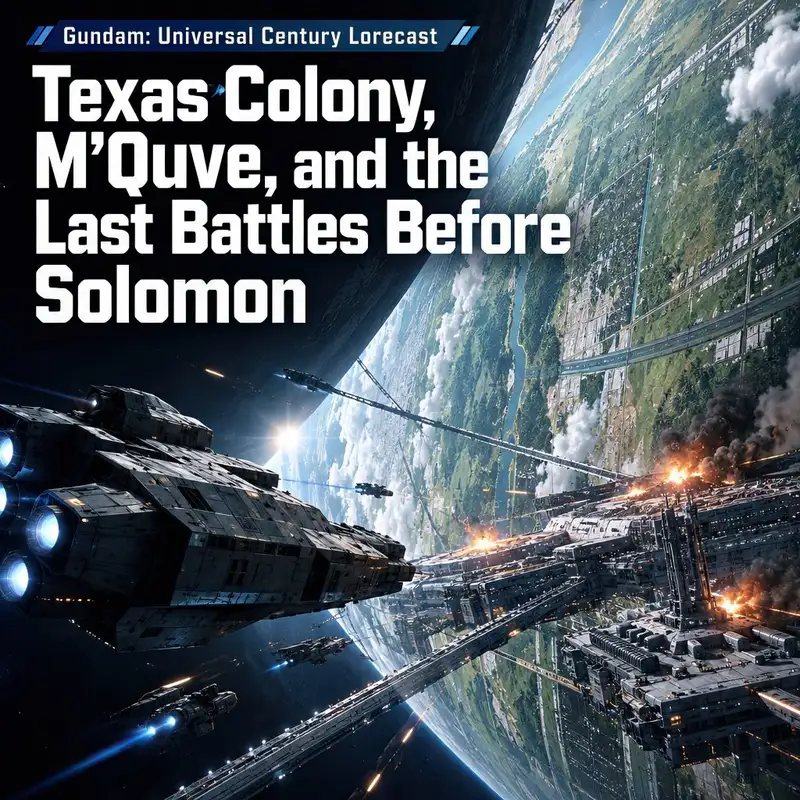
Texas Colony in the television series is a damaged and abandoned place. It is not the populated Texas of another adaptation, and it should not be imagined as a normal colony going about ordinary civilian life while mobile suits fight outside its windows. The absence of a visible civilian population does not make the location insignificant. A colony is still habitation, infrastructure, industrial investment, transport space, and a political community even after war has emptied or ruined it. Its wrecked condition is evidence of how thoroughly the conflict had converted civilian-built environments into military terrain. Debris, broken structures, enclosed passages, disrupted lines of sight, and uncertain approaches made Texas unsuitable for orderly fleet combat. A formation could not simply maneuver through it as if it were open space. Ships had limited room to operate. Mobile suits could disappear behind wreckage, enter confined structures, or approach from angles that sensors and lookouts could not easily cover. Under Minovsky conditions, those physical complications mattered even more.
Texas favored ambush, pursuit, and deception. It fragmented command because commanders could not maintain a clean picture of every unit’s position. It favored a pilot or small team that knew the terrain and had prepared traps. It also made rescue difficult. A damaged mobile suit could become isolated behind debris or inside colony structures. A ship attempting to recover it had to weigh the risk of moving into a confined and potentially mined environment. The colony was therefore useful to M’Quve not because it offered a defensible base for a renewed Zeon campaign, but because it offered an opportunity for a local act. That is another sign of the changed war. Solomon had been a fortress designed to hold space for a state. Texas was a ruin in which individuals could try to reclaim status, settle scores, or seize a brief advantage. The former was strategy. The latter was increasingly what Zeon had left.
M’Quve’s problem was personal, but it was not merely private. He understood that Char Aznable’s importance was rising, especially through Kycilia Zabi’s growing interest in Newtype capability. Char had already established himself as a formidable pilot and an unusually independent operator. Lalah Sune’s potential gave him a further connection to a field of military significance that senior Zeon figures only partly understood. M’Quve did not simply want the Gundam destroyed because it was an enemy weapon. He wanted to defeat it in Char’s presence. Such a success could restore prestige, prove relevance, and demonstrate that M’Quve remained a figure who could command attention at the highest level. It was a familiar response inside authoritarian and factional systems. When formal authority weakens, officers may compete for visible victories that can be converted into political capital.
That does not make M’Quve a figure of pure comedy. His vanity is real, as is his opportunism. But his final actions also reveal an institution in which personal reputation, access to elite equipment, and rivalry among senior figures were becoming substitutes for coherent recovery planning. The immediate military question after Solomon should have been how to preserve forces, secure routes, coordinate surviving commands, and prepare the defense of A Baoa Qu. M’Quve instead saw an opening to make the Gundam his prize. In another context, eliminating an enemy prototype and its pilot might have had genuine operational value. The Gundam had proven dangerous throughout the war. At Texas, however, the planned ambush was shaped as much by court politics and rivalry as by a wider campaign requirement. M’Quve was fighting for influence inside a shrinking command system. The fact that he had a remarkable machine at hand did not change the weakness of his position. It only gave him a more dramatic way to express it.
The Y M S fifteen Gyan was M’Quve’s personal prototype. It was not a standard Zeon mobile suit, not proof of a fleetwide close-combat doctrine, and not evidence that Zeon had solved the larger problem of replacing losses with an integrated mass-production system. Its weapons suited the kind of fight M’Quve intended. The beam saber gave it a powerful close-range option. Needle missiles and hide bombs supported concealment, surprise, and the use of prepared terrain. In open space, a machine’s performance might be judged by mobility, weapons, pilot skill, and support from nearby units. In Texas, the Gyan’s value was tied to terrain. M’Quve could hide, create obstacles, force the Gundam into confined approaches, and turn debris into part of his weapons system. The encounter was not a clean trial of one machine against another. It was an ambush in a ruined colony, conducted by an officer who had prepared the ground and intended to use every advantage it offered.
That is why the duel matters historically. It shows how elite equipment can magnify a plan without making the plan strategically sound. M’Quve had surprise, an appropriate environment, and a machine designed to exploit both. Yet Amuro adapted. By this stage of the war, he was becoming increasingly difficult for opponents to anticipate. His skill was not simply faster reflexes or a larger collection of victories. The series presents a pilot whose perception of danger, position, and intention is changing in ways that other combatants can sense but cannot explain with confidence. M’Quve’s trap depended on the assumption that the Gundam could be channeled, surprised, and finished before its pilot understood the pattern. That assumption failed. Once the ambush lost its control over the engagement, the Gyan’s specialized advantages no longer guaranteed the outcome.
Even if M’Quve had succeeded, the result would have had limited strategic value. Destroying the Gundam would have been a real tactical achievement and a blow to White Base. It would not have rebuilt Solomon, reopened Zeon’s defensive depth, or resolved the conflict among Zeon’s senior leaders. M’Quve’s final concern for the vase he intended for Kycilia is revealing in this light. It is not merely an odd detail attached to a dying man. It points toward the world of patronage, cultivation, status, and personal favor that still occupied his attention as the state around him was fighting for survival. The vase represents a relationship with power, not an operational plan. M’Quve dies with the Gyan, and his death does not turn the war. What it does is expose the mismatch between the scale of Zeon’s crisis and the scale of the ambitions guiding one of its remaining senior figures.
The Texas engagement also brings Char, Lalah, and Amuro into a new kind of battlefield relationship. Before Solomon, Amuro encountered Lalah without immediately understanding who she was or what role she would come to play. Char had brought her into his orbit and was preparing her for combat under conditions shaped by Kycilia’s interest in Newtype potential. Lalah had already begun to recognize something unusual in Amuro’s fighting. Char recognized it as well, though he interpreted it through his own experience, ambitions, and partial understanding. M’Quve looked at the Gundam and saw a target whose destruction could improve his standing. Char looked at Amuro and saw a rival, a threat, and perhaps evidence that the war was producing people whose abilities did not fit conventional military categories.
Lalah’s connection with Amuro should not be reduced to a settled scientific claim. The series shows an emerging awareness, a contact between individuals whose perception appears to exceed ordinary battlefield observation. It is not presented as simple mind reading, and it does not make either of them omniscient. What it does affect is combat. A pilot who can sense danger, intention, or presence before ordinary sensors and visual observation provide a clear picture has an advantage in the fragmented conditions of late-war mobile-suit fighting. Yet that advantage is difficult for an institution to command. Kycilia’s interest in Newtypes points toward a new military priority. Zeon wants to identify, cultivate, and use unusual human capability. But the people involved are not standardized weapons. They have loyalties, fears, memories, and relationships that no research program can cleanly control. Char’s concern for Lalah is personal as well as military. Amuro’s response to her is not a staff calculation. The most consequential new factor in the battle is therefore also the least institutionalized.
That creates a contrast with Solomon. At Solomon, the Federation’s success rested on the ability to coordinate large systems despite uncertainty. At Texas, the most important local developments arise from perception and personal connection that neither side can fully organize. This does not mean conventional warfare has become irrelevant. White Base still needs to recover its mobile suits. Zeon ships and commanders still need to avoid unnecessary losses. The movement toward A Baoa Qu still depends on fleets, bases, and remaining supply. But the war’s final phase is becoming more volatile because exceptional individuals can now influence local combat in ways commanders do not yet understand. M’Quve tries to solve that uncertainty with a trap and a prototype. Char tries to interpret it through Lalah. Amuro experiences it directly, without possessing a theory that can explain it. Each response is incomplete. Texas is dangerous not only because it is physically ruined, but because its participants are moving through a political and military environment in which the old categories are failing faster than new ones can be built.
After M’Quve’s death, the Gundam becomes temporarily isolated in the colony. Char attacks in his Gelgoog, and the confrontation again demonstrates how difficult it is to exercise clean command in Texas. Damage, terrain, incomplete information, and the pressure of pursuit all interfere with decisive action. Char encounters operational trouble and uses a deceptive explosion to withdraw. This is not a grand maneuver by a unified Zeon force. It is a skilled pilot extracting himself from a confused local situation. White Base, nearby Federation elements, Char’s forces, and other Zeon survivors are operating in the same damaged environment without a single side possessing complete control. The colony turns every movement into an intelligence problem. Is a signal genuine? Is a retreat a trap? Is a machine disabled or merely concealed? Can a separated pilot be recovered before the enemy reaches them? These are the practical questions of fragmented warfare.
Sayla’s encounter with Char belongs in that same setting, even though it is not a mobile-suit duel. Their confrontation is a family event, but it is also an intelligence and political event. Char reveals himself as Casval Rem Deikun, and Sayla as Artesia, the children of Zeon Zum Deikun. In the television series, that knowledge clarifies why Char’s relationship with the Zabi family cannot be understood as ordinary military loyalty. His war against them is political, but it is also driven by personal grievance and a claim upon the legacy of their father. That does not make Char’s path inevitable, nor does it make it universally binding on those who share his history. Sayla rejects his course. She recognizes the depth of the grievance, but she does not accept revenge as a sufficient political program.
Her refusal matters because the Universal Century repeatedly tempts its characters to treat inherited injury as a mandate. Shared family history does not dictate one political choice. Colonial injustice does not dictate one form of resistance. The murder of a father does not automatically justify the institutions or methods built in the name of vengeance. Sayla’s response does not erase the crimes and betrayals surrounding Zeon’s rise. It does show that personal legitimacy and political legitimacy are not the same thing. For Bright Noa and White Base, knowledge of Char’s identity also creates a command-security problem. Sensitive information about an enemy officer, a crew member’s family, and internal Zeon politics has to be managed while the ship remains in combat. Personal revelation does not suspend military responsibility. It complicates it. By the time the forces leave Texas behind, Zeon is closer to its final defensive battle, but less able to treat that battle as a unified national defense rather than a convergence of conflicting personal, political, and institutional agendas.
Solomon and Texas therefore reveal two connected stages in the last phase of the One Year War. Solomon shows that conventional operational realities still decide campaigns. Fortresses need supply. Fleets need endurance. Mobile suits need support. Commanders need reserves and evacuation routes. A defensive position cannot survive on prestige or firepower alone when the enemy can sustain pressure across the whole system. The Federation did not take Solomon because the Gundam was invincible. It took Solomon because it could assemble fleet strength, maintain tempo, employ specialized weapons, absorb losses, and keep attacking after Zeon’s emergency measures had been committed. Big Zam was a formidable weapon, and Dozle’s resistance imposed a real cost. But neither could repair Zeon’s strategic isolation.
Texas shows the aftermath of that failure. There, the war no longer appears as a clean contest between organized defensive lines. It becomes a conflict of scattered forces, damaged infrastructure, prototypes, rival commanders, concealed identities, and extraordinary perception. M’Quve’s death is not a turning point comparable to Solomon’s fall. It is evidence of what Zeon’s collapse had done to its remaining leadership. A senior officer with a personal prototype and a prepared ambush could still create danger. He could not create a recovery strategy. Char could still pursue his own political and personal objectives. Lalah and Amuro could experience a new form of contact that altered the character of individual combat. None of that restored the coherent military and political structure Zeon needed to defend itself.
The approach to A Baoa Qu would bring those unresolved failures together under even greater pressure. Zeon still possessed capable individuals, dangerous machines, and men and women willing to fight. But its fortress network had narrowed, its command relationships were fractured, and its war aims had become entangled with succession, revenge, ideology, and survival. Solomon was lost because the defensive system around it had been overtaken at the operational level. Texas revealed what remained afterward: talent, courage, prototypes, secrets, and perception, but no longer the unified structure required to turn those assets into a durable defense.