Sweetwater and Char Aznable’s Revival of Neo Zeon
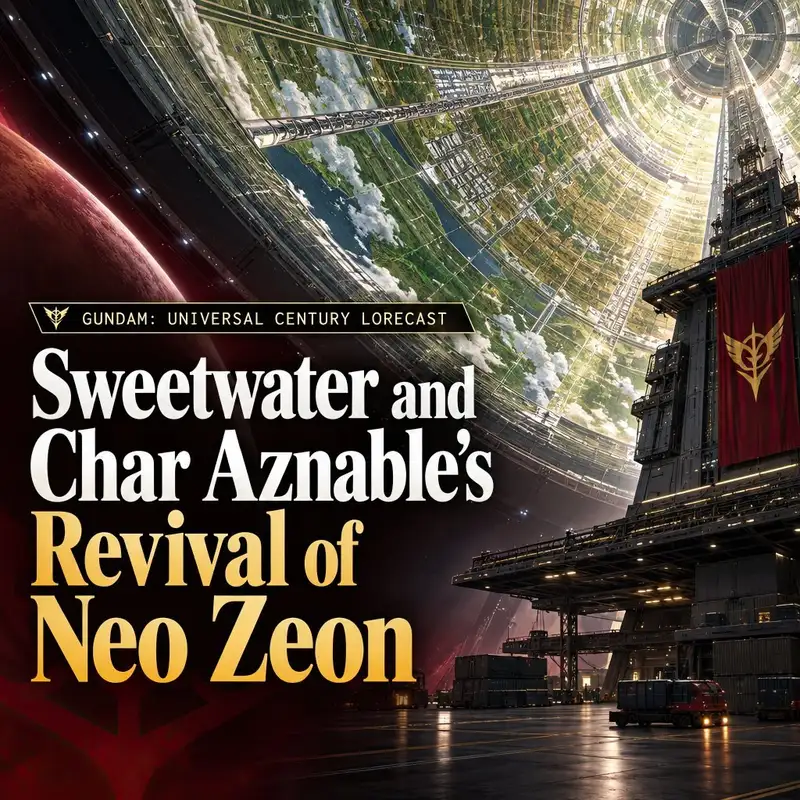
Sweetwater was built to hold people the Earth Sphere had failed to place anywhere else. In the film’s account, it is an improvised refugee colony, assembled by joining open and closed colony structures after earlier wars displaced large numbers of people. Its mismatched construction is more than scenery. It tells the listener that this is not a settled community planned around long-term work, representation, schools, transport, and civic life. It is an emergency solution that became permanent enough for people to be expected to live inside it. By Universal Century ninety-three, refugees from the Earth Sphere’s repeated wars are still being managed as a problem of space and housing rather than treated as citizens with a durable political future.
That condition gives Sweetwater its importance. A colony can be a home, a transport hub, an industrial installation, a military objective, and a political community at the same time. Sweetwater is all of those things, but its political meaning comes first. It is visible evidence that the Federation has survived several wars without resolving the displacement, resentment, and unequal authority those wars created. The colony’s residents are not simply an audience waiting for Char Aznable to deliver a speech. They are people living in an environment shaped by hurried construction, uncertain status, and the memory of previous disasters. Their grievances do not need to be invented. They are built into the place where they live.
The exact construction date, population, legal charter, and administrative status of Sweetwater are not securely established by the film. That uncertainty matters. It prevents us from turning the colony into a neatly documented case study with a census, a budget, and a constitutional history that the available record does not provide. But the film is clear on the larger point. Sweetwater exists because the postwar Earth Sphere has produced refugees faster than it has produced a political settlement for them. It is a community created by war, then left to carry the consequences of war long after the shooting was supposed to have stopped.
Char Aznable understands what that means. He does not arrive at Sweetwater with a grievance nobody has heard before. The language of colonial exclusion, Earth-centered privilege, and spacenoid autonomy already has a long history. Zeon Zum Deikun had argued that people living in space required political independence from an Earth government that treated the colonies as subordinate territory. The Zabi family then seized that language, turned it into the ideology of the Principality of Zeon, and used it to justify dictatorship, aggressive war, occupation, and mass killing. The One Year War did not settle the political problem that Deikun’s argument had identified. It settled that war by destroying one authoritarian state.
The decades that followed gave people in space little reason to trust that the Federation had learned the right lesson. The Titans emerged from the Federation’s own security apparatus and made anti-colonial repression part of official policy. The Anti-Earth Union Group resisted them, but the Gryps Conflict did not create a clean constitutional renewal. Then Haman Karn’s Neo Zeon brought another war, another struggle over authority in space, and another wave of destruction. By the time Char returns as the leader of a new Neo Zeon movement, the Earth Sphere has accumulated not one grievance but generations of them. The refugee colony at Sweetwater becomes a compressed image of that history.
That does not make Char’s account of history neutral. He presents the Federation as an Earth-bound ruling order that preserves comfort and privilege on the planet while people in the colonies absorb war, displacement, and political neglect. There is truth in the accusation. Federation institutions repeatedly fail to create equal political standing for the people who live beyond Earth. But Char’s rhetoric also simplifies. It gathers Deikun’s autonomy movement, the Zabi dictatorship, the Titans, Haman’s Neo Zeon, and the refugee crisis into one continuous indictment of Earth’s authority. That is useful politics. It gives very different events one target. It also allows Char to present himself as the heir to every spacenoid disappointment while avoiding responsibility for the darker traditions attached to the Zeon name.
Char’s return also carries symbolic weight that few other leaders could reproduce. He had disappeared after the Gryps Conflict, leaving behind the identity of Quattro Bajeena and reappearing in Universal Century ninety-three as Char Aznable, openly leading Neo Zeon. The name had military associations, political associations, and emotional associations across the Earth Sphere. To supporters, Char could appear as a survivor of Zeon’s broken promise, a veteran of resistance to the Titans, and a man willing to confront the Federation when others had accepted compromise. To opponents, he was a proven revolutionary operator with an unusual ability to turn personal prestige into military action.
But prestige alone does not create a revived Neo Zeon. Char’s personal image could attract attention. It could not move warships, sustain mobile suits, manage intelligence, or negotiate with Federation officials. The film shows that the organization around him has real military capability. It possesses a fleet, trained officers, mobile-suit forces, communications, reconnaissance, and a command structure capable of conducting coordinated operations. It fields Geara Dogas as regular combat machines, Jagd Dogas for Newtype-oriented operations, the Alpha Azieru, and Char’s own Sazabi. Those systems imply access to manufacturing, repair, skilled technicians, spare parts, weapons, propellant, and training. They do not prove that Neo Zeon can equal the Federation’s total industrial base. They prove something more limited and more important. Char has enough organized force to make his political claims dangerous.
Sweetwater helps make that force politically usable. A military movement based in an asteroid fortress or hidden fleet can be dismissed as a remnant, a pirate force, or a temporary security problem. A movement that claims to protect a refugee population has a more complicated position. It can describe its military activity as defense. It can frame territorial demands as humanitarian relief. It can present negotiations as diplomacy rather than extortion. It can make Federation leaders worry not only about warships and mobile suits, but about public opinion, colonial anger, and the possibility that a refusal to negotiate will look like another betrayal of people in space.
That is the political utility of a damaged civilian community. It is also the ethical corruption at the center of Char’s project. Sweetwater gives him a credible moral argument against the Federation, because the colony demonstrates that something has gone badly wrong in the Earth Sphere’s postwar order. Yet he uses that community not primarily to demand reconstruction, representation, legal protections, or a durable resettlement program. He uses it as the foundation for a military revival. The residents become the constituency from which Neo Zeon draws legitimacy, recruits, symbolic authority, and negotiating leverage. Their suffering becomes evidence in Char’s case against Earth, but it also becomes material for a new campaign.
The film does not establish that every resident supports Char. It does not show Sweetwater holding a free election that grants him authority. It does not establish that dissent is absent, or that every refugee accepts Neo Zeon’s definition of liberation. That distinction is essential. A neglected population can be politically useful to a revolutionary leader without being politically unanimous. Char does not need universal consent to use Sweetwater. He needs the colony’s existence, its visibility, and the plausibility of his claim to act in its name.
His public program is built around that claim. Earth, in Char’s telling, has become a refuge for elites unwilling to abandon the planet, while people in space are expected to bear the costs of demographic pressure, war, and environmental decay. The argument has a strategic dimension. Earth remains the center of Federation authority, even when much of humanity lives elsewhere. It has a moral dimension as well. Char suggests that the people of Earth have insulated themselves from the conditions imposed on colonial populations. Sweetwater becomes a living exhibit for that accusation. It shows how the Federation can maintain an imperial center while treating its displaced populations as a logistical burden.
Yet Char’s actual objective is far more radical than his public language initially suggests. He does not merely want Sweetwater improved. He does not seek a negotiated redistribution of political power between Earth and the colonies. He intends to force humanity away from Earth by making continued life there intolerable. The planned Axis drop is meant to cause environmental catastrophe on a planetary scale, creating what the film describes as a nuclear winter and compelling the population of Earth to emigrate into space. This is not refugee policy. It is mass coercion presented as historical necessity.
The gap between the public argument and the actual plan is not an incidental hypocrisy. It is the mechanism of Char’s revival. Sweetwater supplies the public rationale. The refugee colony allows him to say that space needs more living room, more resources, and more political recognition. The military organization allows him to make those demands credible. Then the threat to Earth allows him to turn a political dispute into a crisis that the Federation cannot safely ignore. Char’s program operates across all three levels. He needs a population that demonstrates grievance, a force that can act, and an enemy leadership vulnerable to coercion.
Neo Zeon’s internal structure reflects this blend of politics, military force, and Newtype-era experimentation. Nanai Miguel is one of the senior figures around Char, involved in both his political and military environment. She is not simply a subordinate officer reading orders from a console. Her position suggests that Char’s movement depends on people who can manage the overlap between leadership, research, personnel, and strategic planning. The exact boundaries of her authority are not fully defined in the film, and it would be a mistake to invent a bureaucratic chart that the story does not provide. Still, Neo Zeon clearly has more depth than a single charismatic commander and a few loyal pilots.
Gyunei Guss reveals another part of the organization. He is a Cyber Newtype officer and one of Char’s personal guards, a capable pilot shaped by a military system willing to use artificial enhancement for combat advantage. His presence shows that Neo Zeon retains access to advanced Newtype-related technology and the institutions needed to employ it. It does not establish the entire history of those programs, or prove that Char personally controls every laboratory and researcher involved. What it does show is that the revived movement has inherited the Universal Century’s habit of turning exceptional human perception into a weapon system.
Rezin Schnyder represents a different professional culture within Neo Zeon. She is an experienced combat pilot, skeptical of Gyunei and of the assumptions surrounding younger, enhanced personnel. That tension is not enough to map a formal internal factional struggle, but it is evidence that Char’s forces are not politically or professionally uniform. A revived army is made of veterans, ideological loyalists, technicians, ambitious officers, conscripts, specialists, and people who simply need a place in a military structure. Neo Zeon can project a unified image under Char’s leadership while still containing disagreements about competence, status, risk, and the role of Newtype technology.
The machines of Char’s Neo Zeon make the same point. The Sazabi is an elite command machine designed around Char’s requirements. The Jagd Dogas support specialized psycommu combat. The Geara Doga serves as a more conventional line mobile suit. The Alpha Azieru is a major investment in Newtype weaponry and remote attack capability. None of these machines should be treated as a complete inventory of Neo Zeon’s forces, and the film does not provide reliable production totals. But together they show that this is not a movement surviving on museum pieces and scavenged equipment. It has access to industrial systems capable of sustaining advanced combat machines, at least in limited numbers.
Still, Char cannot expect to defeat the Earth Federation in a long conventional war of attrition. The Federation has greater territory, larger population resources, broader industrial capacity, and a far larger military establishment. Its weakness is not a lack of total resources. Its weakness is the recurring inability to convert those resources into coherent political judgment before a crisis becomes acute. Bureaucratic fragmentation, complacency, political expediency, and the belief that a threat can be bought off all create openings for a smaller but more focused opponent.
Char understands that he does not need to occupy Earth in the conventional sense. He does not need to destroy every Federation fleet, capture every base, or defeat every Earth Federation Forces unit in battle. He needs to threaten the center of the Federation’s political order so severely that its leaders will make concessions, lose credibility, or become trapped inside a crisis they no longer control. This is strategic coercion. A force that cannot win a conventional war may still shape the decisions of a stronger power if it can create an unacceptable danger to civilians, infrastructure, and political authority.
That is why Fifth Luna matters. The operation is not simply a dramatic asteroid attack, and it should not be reduced to a list of mobile-suit engagements. Neo Zeon’s ability to seize and redirect a major asteroid demonstrates coordination across navigation, propulsion, fleet security, command control, and timing. Moving such an object is not the work of a lone ace pilot. It requires an organized military system and a willingness to turn astronomical infrastructure into a weapon. Fifth Luna becomes proof that Char’s revived Neo Zeon can threaten Earth itself.
The strategic effect is larger than the immediate damage. Once Neo Zeon demonstrates that it can direct an asteroid toward Earth, Federation leaders must treat it as more than an isolated colonial movement. The attack changes the political atmosphere around every later negotiation. It tells the Federation that Char possesses both intent and capability. It also tells spacenoids that the new Neo Zeon is not merely speaking about the failures of the Earth Sphere. It can act on a scale that forces Earth to respond.
But Fifth Luna does not solve Char’s political problem. A strike can create fear. Fear can create bargaining leverage. Neither automatically produces legitimate authority, popular consent, or a stable settlement. If anything, strategic terror exposes the contradiction within Char’s claim to represent the people failed by Earth. The more he threatens planetary civilians, the more his movement depends on coercion rather than persuasion. His military demonstration makes the Federation take him seriously. It does not make his program just.
The next step is negotiation. Char meets secretly with the Federation minister Adenauer Paraya. The arrangement concerns Axis, the large asteroid fortress that Neo Zeon seeks to acquire. The deal involves gold, promises of disarmament, and a public commitment that Neo Zeon will send its fleet toward Luna Two. On the surface, the agreement offers the Federation a way to reduce the immediate danger. Neo Zeon receives Axis, while appearing to move toward demobilization. It is the kind of transaction that can appeal to civilian leaders who want a crisis contained quickly, quietly, and without a wider war.
Neo Zeon’s stated reason for acquiring Axis is particularly important. Char presents the asteroid as a way to expand Sweetwater’s living space. In the context of a refugee colony, the demand sounds plausible. Sweetwater is overcrowded, improvised, and visibly inadequate. Additional habitat capacity can be framed as a humanitarian requirement. That framing turns a military asset into an apparent social necessity. It allows Char to ask for a strategically significant object while speaking the language of refugee relief.
Adenauer’s willingness to entertain the arrangement reveals a Federation political failure, but not necessarily a single grand conspiracy. The problem is more ordinary and more dangerous. Federation leaders see a crisis and try to convert it into a manageable bargain. They treat Char’s demands as negotiable assets. They treat the Neo Zeon fleet as something that can be redirected toward disarmament. They assume that territorial concession and financial payment can remove the danger. It is the logic of emergency management applied to an adversary whose long-term aim is not limited to the terms on the table.
That is where civil-military friction becomes decisive. Bright Noa and Londo Bell are responsible for confronting the active threat, but they do not control the entire Federation decision process. Londo Bell is not the Earth Federation Forces as a whole. It is a smaller active force, tasked with responding to dangers that the wider system has often failed to address. Bright’s command can identify operational risk. It can deploy ships and mobile suits. It can warn political leaders. But it cannot automatically overrule a minister who believes he has found a diplomatic solution.
The same problem affects Amuro Ray. Amuro’s importance in this episode is not simply that he pilots the Nu Gundam or that he is Char’s old rival. He recognizes that Char’s political language and his military planning cannot be separated. Char is not using force to support a limited negotiation. He is using negotiation to prepare a larger act of force. Amuro understands that his opponent’s ideology is operational. It determines what targets Char considers legitimate, what risks he accepts, and what scale of destruction he is prepared to impose.
Recognition, however, is not the same thing as authority. Londo Bell may suspect the deception, but suspicion has to move through a political system that has already invested in the idea that Axis can be handled by agreement. This is one of the recurring burdens of military command in the Universal Century. Officers at the point of danger may see a threat more clearly than civilian leaders, but that does not mean they possess the legal authority to act independently. Civilian control of the military is not itself the problem. The problem is a civilian leadership that treats military intelligence as an inconvenience to a political transaction.
Char’s deception is therefore both military and political. The fleet’s supposed movement toward Luna Two for disarmament is not simply a false statement. It is a carefully constructed operational narrative. Dummy ships and manipulated dispositions help conceal the real distribution of Neo Zeon forces. The Federation is encouraged to see the visible fleet movement as evidence that the agreement is working. In a Minovsky-era environment, where long-range detection and communication can be constrained, visual confirmation, prearranged expectations, and incomplete intelligence become especially important. Char exploits those conditions.
The deception works because it rests on assumptions the Federation is ready to make. One assumption is that Neo Zeon remains a manageable remnant force, dangerous but ultimately containable through concessions. Another is that Axis is an asset whose political meaning can be separated from its military potential. A third is that Sweetwater’s refugee crisis can be addressed as a narrow housing problem, without confronting the deeper legitimacy crisis that made Char’s appeal possible. The Federation tries to isolate each part of the problem. Char has designed them to work together.
Sweetwater gives the Axis transfer a humanitarian cover. Fifth Luna gives the negotiation urgency. The false disarmament movement gives it reassurance. The Neo Zeon fleet gives the plan physical force. Char’s personal reputation gives the entire operation political coherence. This is why his revival cannot be explained as nostalgia for Zeon, or as a personal feud carried over from the One Year War. Char is acting as a political entrepreneur in the most dangerous sense. He identifies a real institutional failure, constructs an organization around it, and turns that organization toward a program of mass coercion.
The colony’s residents remain caught at the center of this process. They benefit from Char’s attention in one limited sense. He makes Sweetwater visible. He forces the Federation to confront a settlement it had allowed to stand as evidence of unresolved displacement. But visibility is not the same thing as liberation. A leader can speak for neglected people while still using them. Sweetwater’s hardship allows Char to present himself as the defender of spacenoids. Its civilian character makes his demands harder for the Federation to dismiss. Its existence helps him claim that the future belongs in space. Yet the people living there do not control the strategic program built in their name.
Char eventually states the logic of that program openly. He argues that humanity must leave Earth, and that the planet’s population must be forced to do so because Earth’s political order will never voluntarily surrender its privileges. This is the point at which the language of reform gives way to the reality of planned catastrophe. The Axis drop is not a demonstration intended to win better terms for Sweetwater. It is not a limited military strike against Federation command facilities. It is a deliberate attempt to alter Earth’s environment so profoundly that continued human life on the planet becomes politically and physically untenable.
The plan carries an environmental argument, but it is not environmental policy in any humane sense. Char sees Earth’s continued habitation as the foundation of a stagnant and unjust order. He wants to break that order by making the planet unlivable enough to compel migration. The people of Earth are not treated as citizens who must be persuaded, represented, or protected. They are treated as an obstacle to historical progress. The fact that many of them may have no more control over Federation policy than Sweetwater’s refugees have over Neo Zeon strategy does not change the plan. Coercion on a planetary scale becomes acceptable because Char has decided that the political end justifies it.
This is Sweetwater’s final betrayal. The colony proves that refugees need housing, security, political status, and a future beyond emergency settlement. Char answers by using their condition to justify creating refugees on a planetary scale. The people of Sweetwater are made into symbols of those abandoned by Earth, but Char’s solution is not to end abandonment. It is to universalize displacement. He speaks as though the choice is between a privileged Earth and an emancipated space. His operation instead threatens to produce a devastated Earth and a space population still governed through militarized fear.
The final Axis operation fails. The details of the extraordinary psycho-frame event that follows belong to another question, and they do not explain why Char was able to build this crisis in the first place. The crucial historical point is simpler. Neo Zeon succeeds in demonstrating strategic reach, in obtaining Axis through deception, and in bringing Earth close to catastrophe. It does not succeed in remaking the Earth Sphere’s political geography through that catastrophe. Char’s operational plan is stopped, and his movement is defeated.
Tactically, Char’s Neo Zeon performs effectively enough to prove that it is a real military force. It can coordinate fleets, employ advanced mobile suits, conduct deception, manipulate strategic terrain, and exploit gaps in Federation readiness. The operation against Fifth Luna demonstrates a capacity for high-risk coercive action. The Axis transfer demonstrates political and intelligence competence, at least until Londo Bell and its allies can respond. None of this should be dismissed because the final objective fails. Tactical and operational competence can coexist with strategic disaster.
Operationally, Sweetwater helps Neo Zeon create the conditions for a planetary attack. The colony supplies the political cover for territorial demands. Char’s public role supplies the authority to negotiate. Fifth Luna creates fear. The treaty over Axis opens access to the weapon he actually needs. The deception surrounding disarmament delays a full response. This chain of events shows how a movement with limited resources can impose a crisis on a stronger state. It does not need to match the Federation everywhere. It needs to concentrate its capabilities around a political center of gravity the Federation cannot ignore.
Politically, Char exposes a genuine weakness in the Federation. Sweetwater should not have existed as a permanent symbol of unfinished resettlement. The Federation’s willingness to manage the crisis through secret bargains rather than public political reform demonstrates how far its institutions have drifted from the people affected by their decisions. Adenauer’s negotiation does not mean every Federation official supports Char’s aims. It means that the Federation’s leadership can mistake short-term crisis management for strategy, and can leave officers like Bright Noa responsible for the consequences when the bargain fails.
Institutionally, the episode reveals another pattern. The Federation possesses resources, fleets, industrial capacity, and legal authority, but those assets are distributed across organizations with different incentives and incomplete information. Londo Bell can see the danger, but it operates under constraints. Civilian leaders can negotiate, but they may lack the operational judgment to recognize how their concessions will be used. Char exploits the gap between political authority and military warning. He does not defeat the Federation’s institutions outright. He makes them work against one another.
Industrially, Neo Zeon’s revival is impressive but limited. The movement can support high-performance machines and specialized Newtype weapons. It can field capable officers and maintain a fleet. That is enough for a concentrated strategic campaign. It does not demonstrate that Neo Zeon could sustain a prolonged conventional war against the Federation’s full industrial and manpower base. Char’s choice of asteroid coercion reflects that limitation. He does not seek victory through replacement capacity, territorial occupation, or attritional battle. He seeks a decisive political shock before the Federation’s greater resources can be brought to bear coherently.
For civilians, the outcome is more bitter. Sweetwater gains visibility, but not a durable settlement. Its residents become central to the political drama because their hardship gives Char’s movement credibility. Yet they are not granted control over what that credibility is used for. They are represented by a leader who turns their displacement into an argument for planetary-scale displacement. The Federation, meanwhile, is forced to recognize the colony’s importance only after it has become tied to a military threat. That is a failure of politics before it is a failure of security.
Sweetwater was the foundation of Char Aznable’s revived Neo Zeon because it gave him what a fleet alone could not provide. It gave him evidence of Federation failure, a constituency shaped by real grievance, a platform for political communication, and a civilian community whose needs could be translated into strategic leverage. But it also reveals the fatal corruption of Char’s revival. He could identify the wounds of the Earth Sphere’s postwar order. He could not heal them, because he treated those wounds as raw material for coercion. His answer to exclusion was not a more just political order. It was destruction on a planetary scale.