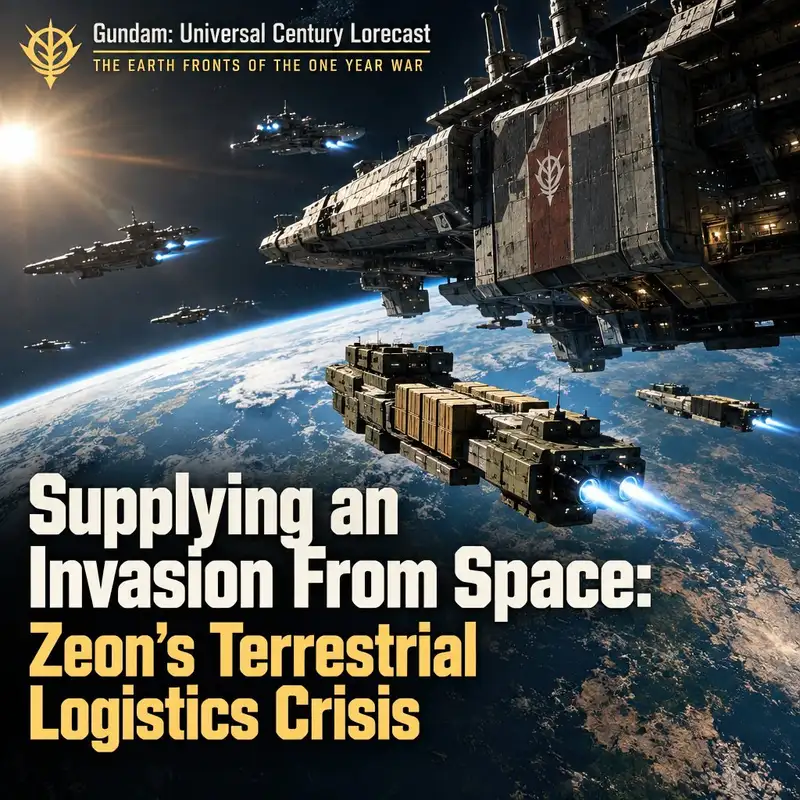
Supplying an Invasion From Space: Zeon’s Terrestrial Logistics Crisis
A mobile suit can survive a battle and still be useless by nightfall. Its armor may be intact. Its pilot may be alive. Its weapons may even have driven the enemy away. But if nobody can deliver replacement parts, ammunition, propellant, technical labor, medical care for the crew, and a protected place to work, that machine is no longer combat power. It is a large, expensive object waiting for the enemy to find it. That was the practical problem concealed behind Zeon’s early conquest of Earth in Universal Century seventy-nine. The Principality of Zeon landed forces, seized wide areas, and used mobile suits to shock a Federation that had not prepared for this kind of war. The image is familiar: Zakus advancing through dust, Gaw carriers crossing the sky, Federation positions collapsing under a weapon system they could not yet match. But landing a mobile suit is not the same as sustaining an army. Zeon’s campaign became difficult not after its early success ended, but because that success created obligations faster than its military system could meet them.
Zeon had not come to Earth merely to win a series of dramatic engagements. The terrestrial offensive sought strategic territory, bases, transport routes, industrial resources, and political leverage against the Earth Federation. A space-based state could strike Earth, but it could not compel a durable Federation surrender simply by proving that it could land troops. It needed places from which to operate. It needed access to material wealth and infrastructure. It needed to threaten the Federation’s political center, disrupt its ability to mobilize, and convince military and civilian leaders that continued resistance was hopeless. Those aims made sense. Earth remained the largest population center in the Earth Sphere, the deepest industrial reservoir, and the political heart of the Federation system. Yet the campaign contained a contradiction from the beginning. The more territory Zeon gained, the more territory it had to secure, administer, supply, and defend. Control on a military map did not mean continuous occupation of every road, city, mine, or settlement. It did not mean that civilians accepted Zeon rule. It did not mean that a captured airfield could immediately become a reliable supply hub. And it certainly did not mean that a region had become useful merely because a Zeon flag had been raised over it.
The phrase invasion from space can create the wrong image if taken too literally. Zeon did not need every bolt, ration, and shell used on Earth to fall directly from Side Three. A terrestrial army could capture Federation facilities, seize local stocks, use existing transport infrastructure, exploit local labor, and extract resources from occupied territory. In fact, it had to do those things if it hoped to remain on Earth for long. The problem was not that Zeon possessed no means of terrestrial sustainment. The problem was that it began as a space-centered military power attempting to transform a rapid landing campaign into a planetary system of supply and control. That transformation required time, secure infrastructure, technical expertise, command coordination, and political compliance. It also required the Federation to remain too disorganized to interfere. Zeon could descend personnel and equipment through the gravity well. It could establish local air and ground mobility. But every landed formation began consuming supplies the moment it arrived. Machinery wore down. Weapons required ammunition. Pilots and crews required food, sleep, and medical support. Vehicles needed repair. Mobile suits needed specialists, diagnostic equipment, spare assemblies, and recovery capability after combat damage. The landing was only the opening transaction. Sustainment was the bill that followed.
Earth’s gravity made the difference between insertion and endurance especially important. In space, a fleet could move along planned routes between established bases and colonies, even under the severe limitations imposed by Minovsky particle interference. On Earth, movement was constrained by terrain and infrastructure. A route that looked direct on a strategic map might cross mountains, forests, urban areas, rivers, hostile territory, or damaged transportation networks. Atmospheric operations required their own aircraft, maintenance crews, fuel arrangements, navigation, weather awareness, and landing zones. The forces that had descended from space could not simply remain supplied by orbital headquarters as though Earth were a convenient depot beneath them. Equipment had to be moved from landing areas to field formations. Damaged machines had to be recovered from the battlefield and sent somewhere that could repair them. Replacement pilots and technicians had to be assigned where they were needed, rather than where they happened to arrive. That is a mundane description of war, but it is the sort of mundane work that decides whether a military advantage survives its first campaign season.
Zeon’s mobile suits provided the most visible advantage in this system, but they also created its most demanding support requirement. The MS-06J Zaku Two, the ground-oriented version of Zeon’s standard Zaku, became a key instrument of the invasion. It was adapted for gravity and terrestrial operations, where its mobility, armor, weapons, and ability to cross difficult terrain gave Zeon a powerful edge against Federation formations not yet organized to fight mobile suits effectively. A Zaku could bring concentrated firepower to a point that might be inaccessible or dangerous for conventional armored vehicles. It could maneuver through broken ground, use buildings and terrain for cover, and impose a shock effect on troops confronting a new class of combat machine. In the early months of the terrestrial war, that mattered enormously. The Federation had not simply been outgunned. It had been surprised by a new tactical problem.
But a ground-adapted mobile suit was not a self-sustaining weapon. A machine designed for terrestrial conditions still needed ammunition, replacement components, maintenance personnel, recovery vehicles or other means of extraction, and protected facilities in which repairs could be carried out. Its pilot needed training appropriate to gravity, terrain, weather, local navigation, and coordination with infantry, aircraft, artillery, and transport. Damage that might be manageable in a well-equipped depot could become decisive in an isolated forward area. A disabled mobile suit could block a route, expose its crew, or become a source of useful intelligence for the enemy. Even routine service mattered. A force with mobile suits but without technical support was not simply less efficient. It was a force gradually turning its best machines into non-operational losses.
This is why the idea that mobile suits made conventional logistics obsolete never survives contact with the actual war. Mobile suits changed how forces could fight. They did not change the need to get parts and ammunition to the fight. They did not make mechanics unnecessary. They did not eliminate the need for food, medicine, transport, staff officers, engineers, or secure rear areas. In some respects, they increased the burden. A conventional infantry unit could disperse, live off local supplies to a limited degree, and continue operating with weapons that were comparatively simple to maintain. A mobile-suit formation could disperse tactically, but its machines tied it to an industrial support network. That network did not need to be elegant. It could be improvised, captured, regional, or temporary. But it had to exist. The greater Zeon’s reliance on mobile suits for its tactical edge, the more seriously it had to treat the infrastructure that kept them moving.
Zeon possessed important tools for local mobility. The Gaw attack carrier is a clear example. It could transport a mobile-suit company and carry additional aerial and support assets, including Dopps, Lugguns, and Komusai craft. In operational terms, that gave Zeon a means to shift combat power within a theater. A Gaw could move mobile suits faster than they could march across hostile terrain. It could support an attack, reinforce a threatened sector, evacuate personnel, or help establish an advanced position. It also represented an effort to integrate air movement, mobile-suit employment, and command functions on Earth. This was not a minor capability. In a war where distance and terrain could divide formations, the ability to reposition a company of mobile suits had real tactical and operational value.
Still, local air mobility was not the same as unlimited strategic lift. A carrier able to move a formation from one sector to another still needed somewhere safe to land, refuel, rearm, and receive maintenance. It could not carry an entire occupation economy in its hull. It could not repair every damaged mobile suit, replace every lost pilot, guard every mine, or keep every road open. Aircraft and carriers also become high-value assets precisely because they connect separated forces. An enemy that disrupts those connections can weaken a field army without defeating every mobile suit in direct combat. This was a recurring reality of the One Year War. A force could possess formidable machines and still be constrained by what it could transport, what it could protect, and what it could replace.
The image of a Gaw passing over a battlefield can therefore conceal a larger chain of requirements. Someone had to provide the crew. Someone had to inspect the engines and maintain the weapons. Someone had to supply the munitions and parts for the mobile suits carried inside. Someone had to coordinate arrival with the ground commander who needed reinforcement. Someone had to know whether the landing area remained secure. Someone had to decide whether the aircraft was better used moving combat power forward, recovering wounded personnel, carrying supplies, or withdrawing a damaged unit before it was cut off. In an expanding campaign, those decisions multiply. The carrier that appears at the right moment is dramatic. The transport allocation meeting that determines whether it can appear at all is less dramatic, but it is often more important.
Zeon’s terrestrial war also required a network of bases, captured installations, temporary depots, workshops, airfields, and command posts. The exact global layout of that network is not securely documented in the original television record, and there is no reason to invent a clean map where the sources do not provide one. But the military necessity is plain. Mobile suits, aircraft, land battleships, infantry formations, and occupation detachments could not all operate directly from a single point of entry. They needed staging areas. They needed fuel and ammunition stocks. They needed personnel replacements and medical facilities. They needed places where intelligence could be collected, orders distributed, prisoners held, and damaged equipment examined. As Zeon moved into more regions, its system had to become more dispersed. Dispersion could make a force flexible, but it also made it vulnerable. Each node required guards. Each route required protection. Each local commander required some degree of autonomy, because a remote headquarters could not manage every immediate problem through a disrupted communications environment.
That was the central logistical mechanism of Zeon’s crisis. Territory multiplied the burden. A captured route was useful only if it remained open. A mine was useful only if it could be worked, protected, and connected to processing and transportation. A city was useful only if its population could be controlled without consuming more troops than the city was worth. An airfield was useful only if it could support sorties rather than becoming a liability that demanded constant defense. A forward garrison might protect a bridge, a rail junction, a warehouse, or an industrial facility. Yet every garrison also removed personnel and equipment from the mobile reserve needed to respond to threats elsewhere. The more a force spreads out to prove control, the less concentrated it may be when a major enemy formation appears.
The civilian dimension made the problem still harder. Occupation is not simply an extended form of maneuver warfare. It requires some relationship with the population living under the occupier’s authority. That relationship can be built on cooperation, coercion, propaganda, employment, fear, or a mixture of all five. None of those methods is free. Civilians need food, water, power, transport, medical care, and a degree of predictability if daily life is to continue. Local workers may be needed to operate rail lines, warehouses, mines, factories, and repair facilities. But workers can resist, flee, sabotage equipment, withhold information, or cooperate only under compulsion. Zeon’s military success could not erase the political reality that it had arrived as an invading power. Its claim to represent spacenoid independence did not automatically persuade people on Earth to accept its authority, particularly when the Principality’s war had already demonstrated a willingness to employ mass violence on a catastrophic scale.
Odessa illustrates why resources became central to Zeon’s effort to turn conquest into a sustainable position. In the television-era account, Odessa is associated with Zeon mining operations under M’Quve’s command. It was not merely a place where two armies happened to meet. It represented an attempt to secure extraction infrastructure on Earth itself. For a space-originating expeditionary force, that mattered. Resources obtained on Earth could potentially reduce the burden of bringing every requirement from off-world or from distant theaters. Mining capacity could support industrial activity, transport, construction, repair, and the larger military economy needed to sustain forces in the field. The Federation understood this well enough to make Odessa the target of a major counteroffensive.
Yet raw material is not combat power by itself. Ore must be extracted. It must be processed. Equipment must be maintained. Workers must be organized or compelled. Transportation must move usable material to workshops, factories, depots, and units that need it. Those routes must be protected. A mine under military control can still produce little if its labor force is unavailable, its machinery is damaged, its connections are disrupted, or its output cannot be converted into replacement parts and operational equipment. Odessa was valuable because it was part of a system. It was also vulnerable for the same reason. Once it became a major regional anchor for Zeon, its loss threatened more than a patch of territory. It threatened the infrastructure that made a broader occupation possible.
M’Quve’s role should be understood in that light. He was associated with the Odessa mining area and the resource side of Zeon’s terrestrial war, but he was not a single man holding every thread of Zeon logistics in his hand. No commander could have done that across a planet. The larger problem was institutional. Zeon’s Earth Attack Force had to coordinate regional commands, mobile formations, extraction sites, transport assets, defensive positions, and political objectives. Those demands could pull in different directions. A commander responsible for a valuable resource area would naturally prioritize its defense. A regional commander facing a Federation threat would demand reinforcements. A political leader might value a symbolic victory or the survival of a prominent officer. A field unit might need parts immediately, while a distant headquarters might be thinking in terms of future operations. None of those priorities was irrational in isolation. Together, they could create a military system that spent more effort resolving internal competition than concentrating force against the enemy.
The North American theater offers another view of this problem through Garma Zabi’s command. Garma was a major Zeon figure on Earth, with both military authority and political significance as a member of the ruling family. But his position should not be mistaken for command over every Zeon operation on the planet. His theater had its own demands, personalities, objectives, and vulnerabilities. The fact that prominent commanders operated in different regions did not automatically make Zeon incompetent. Large campaigns require regional commands. The difficulty was making those commands serve one coherent strategic purpose. A force can have talented local officers, effective mobile-suit units, and strong regional positions while still lacking the transport, intelligence, communications, or political coordination needed to convert those assets into a durable campaign.
This mattered because Zeon’s strategic position depended on speed. The Federation had been shocked by the opening war and by Zeon’s mobile-suit advantage. Its forces on Earth were initially disorganized, outmatched in key engagements, and forced to improvise. But Zeon could not count on that condition lasting indefinitely. The Federation possessed greater demographic and industrial depth on Earth, along with access to terrestrial infrastructure that Zeon had to capture, borrow, or build around. Those advantages did not make the Federation immediately effective. Large institutions often respond badly to surprise. Their strength is not elegance. It is recovery. Once the Federation began reorganizing commands, restoring supply systems, adapting doctrine, and fielding its own mobile-suit programs, Zeon’s early qualitative advantage became less decisive.
The development of Federation mobile suits mattered in this process, but it should not be treated as a magical reversal in which one Gundam solved the entire war. The Federation’s technological response narrowed Zeon’s advantage and gave its forces new tactical options. More importantly, mobile-suit development was connected to a larger institutional recovery. A prototype could demonstrate capability. A production system could spread that capability through the force. Training systems could create pilots. Maintenance organizations could keep machines operating. Transport and supply services could move them where commanders needed them. The Gundam was significant as a proof of concept and a battlefield asset, but the Federation’s strategic strength lay in its ability to turn lessons, industrial capacity, and surviving institutions into broader combat power.
White Base provides a useful, if exceptional, case study in that process. It was not an ordinary Federation formation. Its crew, its prototype mobile suits, and its repeated survival under extraordinary pressure make it an unusual example. Still, the vessel’s experience exposes a truth applicable to forces on both sides. White Base could not continue fighting simply because its crew was determined. It required resupply, maintenance, technical support, communications, and replacement stores. Its movement through the terrestrial war was shaped not only by combat but by the search for support and the danger attached to receiving it. The ship’s survival depended on a network that extended beyond its own guns and mobile suits.
Matilda Ajan’s Medea supply unit represents that network in human form. Under General Revil’s orders, Matilda’s mission included supplying and maintaining White Base while carrying communications. That description is revealing. Supply, maintenance, and communications were not separate administrative concerns. They were part of operational command. A warship that cannot receive information, spare parts, ammunition, and technical assistance is not a mobile striking force for long. It becomes isolated, then predictable, then vulnerable. Matilda’s transports brought more than cargo. They connected White Base to the Federation system that was slowly recovering around it.
The loss of Matilda’s unit also demonstrates that logistics was exposed combat power. Supply transports were visible, valuable, and vulnerable targets. An enemy did not need to destroy White Base directly if it could cut the links that sustained White Base. Protecting a resupply effort could require mobile-suit escort, diversion of combat assets, careful timing, and the acceptance of risk. For commanders, this created constant tradeoffs. A mobile suit defending a transport was not attacking the enemy elsewhere. A carrier carrying spare parts might not be carrying reinforcements. A route used for supplies might need protection that could otherwise support an offensive. The glamorous version of warfare imagines that combat forces exist at the front and support happens safely behind them. The One Year War repeatedly disproved that assumption. The rear area was often simply the part of the battlefield where people were unloading ammunition.
By November, the Federation had reached the point where it could mount its major counteroffensive against Odessa. The operation began on November seventh, Universal Century seventy-nine, and concluded with Zeon’s defeat two days later. The battle mattered because Odessa was more than a defended position. It was a resource center, a regional command area, and an anchor for Zeon’s terrestrial war effort. The Federation was not merely seeking a tactical victory over enemy mobile suits. It was attacking the system that allowed Zeon to sustain forces across a major part of Earth. Taking Odessa would deny Zeon a valuable base, disrupt its resource position, and demonstrate that the Federation had regained the ability to organize large-scale operations on the ground.
M’Quve’s Dabde-class land battleships show the kind of solution Zeon had attempted to build for this environment. These enormous ground vessels could function as mobile command centers and heavy fire-support platforms. They gave Zeon the ability to direct forces and bring substantial weapons into a terrestrial battle without relying on a fixed headquarters that might be vulnerable or poorly positioned. In a communications-limited environment, that mobility had genuine value. A Dabde could move with an operation, support local command, and help concentrate firepower. But it could not solve the deeper problem of sustainment. A mobile command center still needed fuel, maintenance, communications, escorts, ammunition, intelligence, and routes through which subordinate units could be supplied. It could manage a system only to the extent that the system existed.
Odessa became the operational verdict on Zeon’s earlier expansion. On the battlefield, Zeon lost a major battle, and important formations were destroyed or forced to withdraw. At campaign scale, it lost a principal terrestrial anchor and a resource center that had supported its broader position. At the strategic scale, the Federation regained the initiative on Earth. The war was no longer defined only by Zeon’s ability to choose where to strike and force the Federation into reaction. Politically, the defeat weakened the image of Zeon’s terrestrial victory as inevitable. A state that presents itself as advancing irresistibly suffers when one of its major ground positions collapses under a coordinated counteroffensive.
The civilian stakes should not disappear beneath the armor and smoke. Odessa was economically important territory, not an empty testing ground for land battleships and mobile suits. Mining areas, transport links, local settlements, labor forces, and infrastructure all mattered because people lived and worked within them. A battle for resources is also a battle over the people who extract, process, transport, and depend upon those resources. When armies fight over industrial regions, civilians become vulnerable to displacement, coercion, disrupted food and medical systems, destruction of infrastructure, and the sudden collapse of whatever order had existed before the battle. The military value of Odessa was real. So was the human cost of making it a battlefield.
Zeon’s failure on Earth was therefore not simply a matter of running short of supplies in some narrow administrative sense. It was not one missed convoy, one incompetent commander, or one superior Federation machine. It was the cumulative result of trying to sustain an expanding invasion with a military system that had won its initial advantages through speed, surprise, and technical superiority. Those advantages worked best when Zeon could concentrate force, choose the point of attack, and keep the Federation off balance. They worked less well when Zeon had to hold territory, protect resource sites, maintain dispersed machines, administer occupied populations, coordinate regional commands, and replace losses across a growing number of fronts.
The central contradiction was that every success increased the demand for the very system Zeon had not yet fully built. Capture a route, and it must be guarded. Capture a mine, and it must be operated. Deploy another mobile-suit unit, and it must be maintained. Establish another garrison, and it requires food, medicine, ammunition, technical support, and reliable communication. Shift forces with Gaw carriers, and those carriers require their own support structure. Build a mobile command center, and it still needs a command network capable of moving information and supplies through a contested environment. Zeon’s territorial gains were not imaginary. Its early mobile-suit superiority was not a myth. But neither achievement was self-sustaining.
The Federation, for all its failures, survived long enough to make those burdens decisive. It recovered command capacity. It mobilized industry. It used its deeper terrestrial base. It adapted to mobile-suit warfare. It turned the war from a shock campaign into a contest of endurance, and endurance favored the side that did not have to build an occupation and a supply system at the same time. Odessa did not end the One Year War, but it demonstrated that Zeon’s terrestrial position could be broken where its military, industrial, and logistical requirements converged.
Zeon’s terrestrial logistics crisis was not an administrative failure separate from the invasion. It was the invasion’s central contradiction. Zeon could land forces, win local battles, and seize resource zones, but it could not reliably transform a rapid spaceborne offensive into a self-sustaining planetary occupation before the Federation recovered. Its mobile suits made conquest possible. They could not make conquest governable, repairable, replaceable, or strategically decisive.