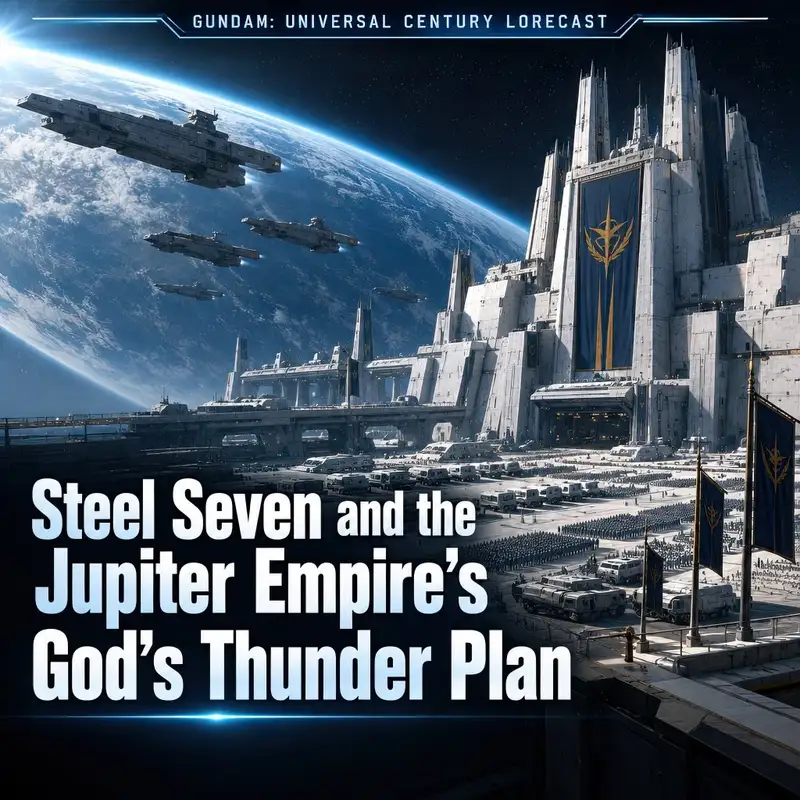
Steel Seven and the Jupiter Empire’s God’s Thunder Plan [Manga]
Earth had roughly two weeks of warning. Not two weeks to mobilize an expeditionary fleet, establish a supply line, negotiate access to lunar facilities, confirm every intelligence report, and prepare a campaign against Jupiter. Two weeks to stop a weapon already being prepared to fire. The restored Jupiter Empire’s God’s Thunder Plan centered on Sinvatz, a colony-laser system meant to strike Earth across interplanetary distance. Its purpose was not to win a conventional battle. It was to make conventional battle irrelevant by threatening destruction on a scale that could break governments, kill civilians in enormous numbers, and turn Earth itself into a hostage.
The distinction matters. Earth was not an abstract strategic target on a map. It was home to population centers, transport networks, political institutions, industrial facilities, and people with no practical role in the conflict between the Crossbone Vanguard and the Jupiter Empire. A long-range attack of this kind promised terror as much as military effect. The Jupiter Empire did not need to occupy Earth in order to shape its politics. It intended to demonstrate that resistance could be punished from beyond the reach of ordinary defense.
The warning came through Europa Dogatie. She had escaped the Jupiter Empire and reached the Earth Sphere while pursued by forces that understood her value. Europa was the widow of Crux Dogatie, a central figure in the earlier Jupiter War, and the adoptive mother of Bernadette. More urgently, she possessed knowledge of the regime that had reassembled in Jupiter’s orbit under new leadership. The Empire was now directed by the twin Callistos, Light and Shadow, and their plan was approaching execution.
For Tobia Arronax and the Crossbone Vanguard, the immediate question was brutally narrow. They did not need to conquer Jupiter. They did not need to liberate its entire population, destroy every military installation, or rebuild the political order that had produced the threat. They needed to prevent Sinvatz from firing. Everything else was secondary. That is why the operation that followed was possible at all. Its objective was limited, but its time limit was merciless.
That gap between what had to be achieved and what could realistically be fielded defined Steel Seven from the beginning. It was not a heroic solution to an ordinary military problem. It was an emergency answer to a problem that ordinary military methods could not reach in time. The mission required a means of travel rare enough that it could not support a conventional force structure, and dangerous enough that using it would create new risks even as it solved the old one.
The key lay with the Strategic Naval Research Institute, the SNRI. Its Second Lunar Development Laboratory had been working on the F99 Record Breaker, an advanced mobile suit associated with a downsized Minovsky Drive. The Minovsky Drive mattered because it offered an extraordinary form of strategic mobility. It could make a rapid Jupiter transfer conceivable where ordinary propulsion and normal operational planning would leave the attackers too late.
The technology available to Steel Seven was tied to earlier development work involving the prototype known as Speed King, and to a system the SNRI knew as Icarus. The precise lineage is less important than the operational reality. The Crossbone force did not possess a mature fleet of drive-equipped warships. It had access to scarce, difficult, and irreplaceable capability. The mission would depend on making that capability work once, under conditions where failure could not be corrected with a second attempt.
This is the point where the industrial meaning of the crisis becomes clear. The Minovsky Drive could make the mission possible, but it could not be scaled. The destruction of the program meant that the defenders had no prospect of converting their breakthrough into a broad strategic response before Sinvatz fired. There would be no drive-equipped squadron arriving behind the first wave. No mass-produced successor would reinforce the survivors. Steel Seven would fight with the technical inheritance of a damaged research program, not with the strength of a mobilized industrial base.
Minoru Suzuki entered the crisis from precisely that world of training, experimentation, and operational realism. He was an SNRI mobile-suit instructor, but his importance was not bureaucratic rank. It was practical judgment. He understood that Tobia’s first instinct, however courageous, was not enough. A fast trip to Jupiter did not create a plan for penetrating a defended strategic installation, separating enemy defenders, maintaining command under pressure, and reaching the target before the clock expired.
The attack on the SNRI therefore produced a grim but necessary transformation. What had been a desperate raid became a designed special operation. The force would still be improvised. It would still depend on machines assembled under emergency conditions. But it would not proceed as a collection of talented pilots hoping that speed and determination could compensate for everything else. Minoru’s contribution was to impose structure on desperation.
He proposed a seven-person force. The number was not chosen because seven was mystical, elegant, or conveniently dramatic. It reflected a tactical design. The mission required assault capability, close protection, long-range support, coordination, and the ability to keep functioning after contact with the enemy disrupted the original plan. Minoru compressed a combined-arms logic into the limited space of a mobile-suit strike team.
Each assault element needed more than a pilot willing to attack. An attacker without support could be isolated. A support unit without protection could be eliminated before it shaped the engagement. A commander without communications, situational awareness, or trusted subordinates would have little more than a title. The force had to create temporary local advantages against a much larger enemy defense. It needed to divert defenders, hold open routes, shield vulnerable machines, and maintain enough cohesion to strike Sinvatz rather than be pulled into a series of disconnected duels.
Under Minovsky conditions, that kind of planning was even more important. The Universal Century had long learned that particle interference could complicate long-range detection and communications. It did not make all sensors useless or turn every battle into blind chaos, but it reduced the reliability of centralized control. Commanders could not assume that they would see the entire engagement in real time. Subordinates had to understand intent before contact. They had to know what mattered when the plan began to fail.
Steel Seven was built around that requirement. It was not a conventional unit with reserves, replacement crews, supply ships, and a layered command staff. It was a clandestine strike force operating at the far limit of its reach. There would be no meaningful reinforcement once it entered Jupiter’s defensive space. There would be no safe withdrawal if the drive system failed, if the machines were damaged beyond repair, or if the enemy disrupted the assault before Sinvatz was reached.
Minoru’s estimate of survival reflected those conditions. The expected chance that all seven would return was effectively negligible. That was not theatrical pessimism. It was a planning assumption based on distance, enemy strength, technical scarcity, and the fact that the force had to attack a prepared strategic target with no second echelon behind it. The mission was designed to succeed even if individual members could not survive it. That is a cold logic, but it was the logic imposed by the threat to Earth.
Tobia remained the operational leader. His role was not to become a solitary champion who could win the entire battle by force of personality or skill. He had to hold together a coalition, define the mission’s purpose, and commit to a plan in which success could not be measured by whether he personally survived. Tobia’s experience with the Crossbone Vanguard gave him a political and military perspective that differed from a regular state commander’s. He understood clandestine action, improvised alliances, and the danger of allowing one regime’s crimes to define an entire population.
Minoru provided the tactical architecture. He transformed the mission from a rush toward Jupiter into a structure of roles and mutual dependencies. In many military operations, the person with formal authority and the person with practical control are not identical. Tobia commanded the operation in its political and operational sense. Minoru made it militarily workable. That division was a strength because neither man tried to do the other’s job alone.
Europa Dogatie was indispensable for a different reason. She was the intelligence asset around which the entire warning had formed. She understood the threat, the Empire’s leadership, and the stakes of the God’s Thunder Plan. Yet intelligence sources are rarely simple assets. Europa’s connection to the Jupiter Empire made her valuable precisely because it made her vulnerable. The enemy knew who she was. Her knowledge could guide the attackers, but her history made her a possible channel through which the Callistos could anticipate, pressure, or manipulate them.
The remaining members of Steel Seven made the force politically unusual as well as tactically useful. Mitchell Dreck Nahr brought the surviving connection to the Record Breaker program. He was not merely another pilot added to increase numbers. His survival represented the portion of the SNRI’s human capital that had escaped the laboratory attack. In a mission built around rare mobility technology, that experience mattered.
Giri Gadeuka Aspis and Barnes Gernsback were former Jupiter Empire personnel, associated with the Death Gale Team. Rosemary Raspberry also came from that world. Their presence meant that Steel Seven was not a clean story of Earth Sphere fighters confronting an alien enemy from Jupiter. Jupiter was not politically uniform, and neither was its military. The strike force included people who had served the Empire, understood its equipment and habits, and had reasons of their own to oppose the regime’s new direction.
That did not make trust automatic. Former enemies do not become reliable partners because a crisis creates convenient dialogue. They become useful partners when their knowledge, incentives, and conduct can be integrated into a shared mission. Steel Seven needed the expertise of people familiar with Jupiter’s methods before it could claim any deeper unity. Its cohesion was functional. The team did not have the luxury of resolving every history, grievance, or doubt before departure.
This is one of the operation’s most important political lessons. The Jupiter Empire’s God’s Thunder Plan was the project of a regime, not of every person who lived or served in Jupiter’s sphere. A government that claims to speak for an entire population can be challenged from within by defectors, survivors, and former soldiers. The presence of Giri, Barnes, and Rosemary did not absolve them of their past service, nor did it make them representatives of all Jupiter residents. It did show that the Empire’s leadership could not rely on total loyalty.
Before departure, Tobia sought the involvement of Kincade Nau, the man once known as Seabook Arno. Kincade did not join the mission. Harrison Madin also remained in the Earth Sphere. The manga does not present these choices as a formal doctrine of personnel management, but they carry an operational meaning. A small force cannot always include every capable person. In a mission expected to consume its participants, preserving experienced personnel outside the strike may be as necessary as concentrating them inside it. The decision to leave someone behind can be an acceptance of limits, not a failure of resolve.
The machines assembled for Steel Seven reflected the same logic. The force included the Crossbone Gundam X1 Full Cloth, the F90 Intercept Type in Jupiter Battle Specification, the F91 in Jupiter Battle Specification, the Begina Gina II in Jupiter Battle Specification, the Bala Tortuga, the Alana Abijo, and the Angel Diona in Jupiter Battle Specification. The list is impressive, but the important point is not the catalogue of names. These machines were not a standardized squadron. They were a temporary operational system.
The X1 Full Cloth gave Tobia an assault platform suited to the demanding work expected of the mission leader. The F90 Intercept Type and the F91 brought different forms of speed, engagement capability, and combat endurance. The Begina Gina II, Bala Tortuga, and Alana Abijo contributed to the force’s ability to protect, support, and survive within an engagement that could not be won by a single attacker. The modifications associated with Jupiter battle specifications were not evidence that a broad service branch had equipped itself for this war. They were evidence of emergency adaptation.
Angel Diona was especially important because Europa used it as a command and coordination platform. In an operation where information was as valuable as firepower, the machine’s role could not be reduced to its weapons. Europa needed to remain connected to the mission while guarded against the Callistos’ ability to intrude upon her mentally. The force therefore equipped Angel Diona with a brainwave-blocking device.
The device was a countermeasure, not a solution to every uncertainty. It represented an attempt to turn an extraordinary and dangerous human connection into a manageable operational risk. The Callistos’ mental link with Europa could not simply be ignored. But neither could it be treated as an all-knowing power that made normal planning irrelevant. The blocker could reduce one-sided intrusion. It could not make Europa omniscient, erase the enemy’s ability to act, or guarantee that the team would not be surprised.
Europa’s presence made the command danger immediate. She knew too much to be ignored. The Empire’s pursuit of her was proof that the Callistos understood the threat she represented. Steel Seven was not simply trying to outfly Jupiter’s defenses. It was entering an intelligence contest in which the attackers had insider knowledge, while the defenders had an intimate awareness of the source of that knowledge. The operation depended on using Europa’s access without allowing it to become an open line back to the enemy.
The Minovsky Drive brought Steel Seven to Jupiter in time. It did not resolve this contest. Speed reduced the warning available to the Empire, but it could not eliminate defenses, erase political loyalties, or prevent the Callistos from acting once the attackers arrived. The force still had to penetrate the area around Sinvatz, preserve its specialized roles, and strike a target whose defenders understood that the survival of their regime depended on keeping it intact.
Sinvatz represented the strategic imagination of the Jupiter Empire. It was designed to bypass the slow, uncertain work of conventional war. A fleet campaign requires supply lines, escorts, scouting, repair, sustained command, and exposure to enemy counterattack. A colony laser offered a different promise. It could project coercion across immense distance and threaten a target that might otherwise be difficult to reach. Its political message was simple: Jupiter could decide Earth’s fate without asking Earth’s permission.
But strategic weapons carry their own dependencies. Sinvatz required preparation, timing, command authority, defense, and a functioning leadership structure. It was not merely a gun pointed at Earth. It was an entire political-military system concentrated around one act of destruction. The weapon had to be protected long enough to fire. Its operators had to receive and carry out orders. Its leaders had to remain capable of directing the wider defense. The very scale that made Sinvatz terrifying also made it difficult to disperse or conceal.
This was its strategic weakness. A dispersed military force can lose ships, bases, or units and continue fighting. A regime that stakes its political future on one decisive superweapon creates a single point of failure. If that weapon is disabled before it achieves its purpose, the regime loses not only a military asset but the credibility of its entire strategy. It has promised its followers certainty. Failure reveals dependence.
Steel Seven was designed to exploit that dependence. The attackers did not need to defeat every Jupiter force in open combat. They needed to survive long enough to disrupt the chain of events leading to Sinvatz’s firing. That required speed, deception, role specialization, and the willingness to accept losses that a normal campaign would regard as unacceptable.
The final assault became a series of simultaneous fights. That was inevitable. A small strike force entering a defended area cannot expect the enemy to line up for a single decisive engagement. Defenders try to divide attackers, isolate vulnerable machines, force them into reactive combat, and delay them until the strategic clock runs out. Steel Seven’s task was to resist that fragmentation while using it when possible against Jupiter’s own defense.
The Callistos deployed their paired Dictus machines as their principal defensive and command instruments. The Dictus units were more than heavy combat machines. They embodied the brothers’ personal control of the battle. Their presence meant that the assault against Sinvatz could not be separated cleanly from the assault against the Empire’s leadership. To reach the weapon, Steel Seven had to contend with the people who had built the entire plan around it.
The force’s small size offered advantages in precision and adaptability. Seven machines could move faster and make decisions more quickly than a conventional fleet. They could exploit confusion, shift roles, and concentrate effort against a narrow target. But small size also imposed severe disadvantages. There was little endurance. Every damaged machine represented a lost capability. Every wounded pilot created a hole that no reserve could fill. The team could not trade losses evenly with a larger defense force. It had to make each action preserve the path toward Sinvatz.
This is where Minoru’s design proved its value. The team was not structured around the assumption that every member would remain untouched. It was structured so that support, protection, and attack could continue even when the original arrangement was disrupted. The assault elements had to adapt in real time. Long-range support became a means of creating openings. Close defense became the difference between an attacker reaching the target or being stopped short. Command became less about issuing perfect orders and more about preserving the mission’s purpose amid confusion.
The engagement also demonstrated the limits of centralized control. Under pressure, communications become uncertain, sensors become incomplete, and each pilot sees only part of the battle. The team could not wait for Tobia or Minoru to solve every local problem. They had to act according to shared intent. The objective was Sinvatz. A fight that did not contribute to stopping the weapon, however dramatic, was a distraction the attackers could not afford.
The cost was severe. Members of Steel Seven were wounded or lost as the assault progressed. The story does not require a neat casualty chart to make that clear. What matters is that the operation consumed the irreplaceable people and machines on which it depended. The team had traveled to Jupiter with no illusion that advanced hardware could protect everyone. Once contact began, the operational reality caught up with the plan.
Yet the mission continued because its members preserved one another’s functions. In a conventional battle, a commander might replace a damaged unit with another from reserve. Steel Seven had no such luxury. Its only replacement system was human decision. One pilot covered another. One machine held a position long enough for another to move. One person’s survival became meaningful because it allowed a critical role to remain in the fight.
Barnes Gernsback’s protection of Giri Gadeuka Aspis is the clearest example. Barnes acted to preserve Giri’s ability to carry out the final attack. That is not simply a story of individual sacrifice, though it is certainly an act of courage. It is an example of mission continuity. Barnes recognized that Giri’s remaining operational function mattered more than his own immediate survival. By protecting Giri, he preserved the team’s capacity to strike where it still needed to strike.
Military history is often tempted to treat such moments as proof that sacrifice itself is noble. It is not. Sacrifice can be wasted by poor planning, bad leadership, or political vanity. Steel Seven’s losses were not made wise merely because the threat was terrible. They were made meaningful only because the mission had a narrow purpose, because no conventional alternative could arrive in time, and because each member’s action remained connected to stopping a planned mass-casualty attack on Earth.
Even then, the cost cannot be ignored. Barnes, Giri, and the others were not expendable pieces in a tactical diagram. They were experienced personnel with histories, loyalties, and skills that could not be reproduced quickly. The SNRI’s destruction had already shown what happens when a small pool of technical talent is lost. The final battle repeated that lesson in human form. Rare technology is difficult to replace. People who know how to use it are often rarer still.
The immediate military result was that Sinvatz did not achieve its intended strategic effect. The Dictus defenses were defeated or rendered ineffective, and the God’s Thunder Plan failed before it could impose the destruction for which it had been built. At the tactical level, Steel Seven broke through a defense system centered on the Callisto brothers and their machines. At the operational level, it stopped the imminent attack on Earth.
The strategic result was larger. Jupiter lost the ability to force its will through one decisive act of long-range terror. That did not mean every political problem between Earth and Jupiter vanished, or that the destruction of a weapon automatically created a stable peace. But the Empire’s chosen strategy had collapsed. It had invested its authority, its military posture, and its political future in Sinvatz. Once the weapon failed and the Callisto leadership was lost, the regime could no longer present itself as the inevitable master of events.
A Jupiter resistance movement called for surrender. That appeal is important because it distinguishes the Empire from Jupiter itself. The people and forces associated with Jupiter were not identical with the regime’s exterminatory policy. The collapse of the Callistos’ command structure created space for opposition that had existed under the shadow of the superweapon. A government held together by terror may appear unified while its instruments are functioning. When those instruments fail, the political fractures beneath them become visible.
The Jupiter Empire therefore collapsed as a coherent war-making authority not simply because it lost a battle, but because it lost the structure that made its war possible. Its leadership had concentrated command in the Callisto brothers. Its strategy had concentrated coercive power in Sinvatz. Its legitimacy had been tied to the claim that it could threaten Earth without consequence. Steel Seven attacked all three concentrations at once.
The humanitarian consequence is equally important. Earth avoided an intended mass-casualty attack. The operation did not solve every injustice in the Earth Sphere, nor did it erase the Federation’s long history of political failure and colonial inequality. But preventing one authoritarian regime from murdering civilians at planetary scale remains a real achievement. Moral complexity does not require pretending that all outcomes are equally ambiguous. The God’s Thunder Plan was designed to make civilians pay for political conflict. Stopping it mattered.
Steel Seven did not prove that seven people can routinely defeat an empire. It proved almost the opposite. The mission worked because the circumstances were unusually narrow and because the attackers exploited vulnerabilities that could not be counted on in ordinary war. They had insider intelligence. They had a rare mobility system. They had a team designed around complementary roles rather than individual prestige. They faced an enemy whose greatest strength, Sinvatz, was also a concentrated point of failure.
The Minovsky Drive made the operation possible, but it did not decide the outcome by itself. The drive created the operational opportunity. It did not provide the intelligence that identified the target, the tactical design that organized the force, the former Jupiter personnel who made the enemy legible, or the political fractures that turned military defeat into regime collapse. Extreme technology opened the door. People, institutions, and decisions determined what passed through it.
The destruction of the Record Breaker program provides the harsher industrial lesson. The defenders possessed an extraordinary capability, but they could not turn it into a durable force before the deadline. The mission had to rely on scarce hardware, modified machines, surviving expertise, and personnel willing to make a one-way commitment. Technological superiority without production depth, maintenance capacity, and trained replacements is not strategic security. It is a temporary advantage, sometimes enough for one crucial operation, but not enough to build a stable order.
The Jupiter Empire made the opposite error. It mistook destructive reach for political strength. Sinvatz could threaten Earth, but it could not create legitimacy in Jupiter. It could compel fear, but it could not guarantee loyalty among soldiers, defectors, resistance members, or civilians. By tying its survival to a weapon and a small leadership circle, the Empire made its own future depend on whether those few points could survive one determined strike.
That is what Steel Seven actually proved. A near-suicidal force did not overpower Jupiter through individual superiority. It found an emergency window created by intelligence, rare mobility, specialized planning, and the enemy’s own overcentralization. The operation saved Earth from a planned act of mass killing, but its deeper lesson is harsher: regimes that try to replace legitimacy with terror may build weapons of extraordinary reach, yet they also make their collapse depend on a single point of defeat.