Space Colonization: Sides, Lagrange Points, and Strategic Geography
A pressure alarm inside a colony does not sound like the beginning of a war. It sounds like a maintenance problem. A seal has failed. A micrometeoroid strike has opened a weakness in the outer structure. A pump is losing pressure. A recycling system is not returning enough water. Somewhere, technicians are closing bulkheads, checking air quality, rerouting power, and deciding whether a damaged section can remain inhabited. The immediate issue may be small. The implications are not. In a terrestrial city, a damaged utility line can be serious without threatening the entire basis of life. In a space colony, air, water, power, food production, gravity, and structural integrity are all parts of one engineered environment. Failure in one system can become pressure on every other system.
That is the first fact to remember about the Universal Century’s space colonies. They were not cities placed in empty space. They were inhabited machines, built at enormous cost, sustained by permanent technical labor, and located within a political system that decided who could travel, trade, build, defend, and govern. Their residents lived in homes, attended school, worked in factories, farms, docks, and offices, argued about politics, and formed local identities. But they also lived inside pressure vessels. The same institutions that managed transportation, maintenance contracts, security, and emergency response possessed leverage over the conditions of civilian survival. That gave space colonization a military meaning long before a mobile suit entered a battlefield. A damaged colony was never just damaged property. It was a humanitarian emergency, an industrial disruption, a political crisis, and potentially a strategic opportunity for anyone willing to exploit it.
Large-scale emigration began in the early Universal Century, with the establishment of the new calendar in Universal Century one. The precise scale of migration is less important here than its political character. Humanity did not simply scatter into space as independent settlers. Colonization required organized construction, financing, transport, law, labor, and administration. Governments, public corporations, industrial contractors, lunar interests, and local authorities all had roles to play. The Earth Federation claimed authority across this expanding sphere. Its civilian government made policy. Its military institutions protected routes, installations, and political order. Construction and administrative bodies dealt with the immediate work of moving people and maintaining habitats. Colonial communities managed daily life under conditions they had not entirely chosen.
This arrangement created the central contradiction of colonial life. Population moved outward, but sovereignty remained concentrated. A person could be born in a cylinder far from Earth, work in a local factory, depend on local farms and maintenance crews, and still find that major political decisions were made elsewhere. Migration might offer employment, housing, or a future unavailable on an overcrowded Earth. It could also mean leaving the center of political power while remaining subject to it. The distance was not merely emotional. It was built into transport schedules, supply chains, communications, security arrangements, and the simple fact that an emergency on a colony required someone, somewhere, to decide whose resources would be diverted to solve it.
The Earth Sphere, then, was not divided neatly between Earth and space. It was a hierarchy of connected places. Earth had gravity, established institutions, and political prestige. The Moon possessed industrial value and strategic importance. The colonies held growing populations, labor, agricultural capacity, workshops, docks, and local markets. Between them ran transport routes that were as important as any highway, sea lane, or rail network in earlier history. Whoever could regulate movement through that system possessed more than military power. They could shape migration, trade, access to materials, emergency relief, and the development of entire communities.
The geography of that system began with the Earth and Moon. Their gravitational relationship created regions that were especially useful for placing large installations and recurring traffic networks. These are the Lagrange points, although that name can make them sound more mysterious than they are. A Lagrange point is not a fixed platform in space, and it is certainly not a place where a ship can stop using propulsion and remain perfectly motionless forever. It is a useful gravitational reference region in a two-body system. The gravity of Earth and the Moon, combined with orbital motion, creates locations where an object can follow a relatively useful path with less effort than it might require elsewhere.
In broad terms, the Earth-Moon system contains five such reference regions. The fourth and fifth points, commonly called L four and L five, are comparatively stable regions. Objects can occupy broad libration paths around them with less continual correction than locations along the direct Earth-Moon line. The first, second, and third points lie in more delicate positions and require managed trajectories. A spacecraft or colony associated with one of those regions would not be resting on an invisible shelf. It would require station-keeping, navigation, and careful management of its orbit, often through paths sometimes described as halo orbits. Stability in space is always relative. It does not remove the need for engines, planning, or skilled crews.
For the Universal Century, the significance of these regions was not that they provided magical shortcuts. Their importance came from concentration. If colonies, depots, docks, transport routes, and industrial facilities accumulated around certain parts of the Earth-Moon system, then those areas became places where population and infrastructure could be found together. That made them economically valuable. It also made them politically sensitive and militarily consequential. A transport route is not merely a line on a map. It is a sequence of departure windows, rendezvous points, fuel and propellant planning, maintenance stops, cargo schedules, traffic control procedures, and destinations that must receive what is being sent. A colony cluster near a major route could become a market, an industrial hub, a naval staging area, or a bottleneck.
The colonies were grouped into regional clusters known as Sides. A Side was not one colony. It was not one cylinder, one town, one ethnic group, or one political opinion. It was a grouping of colonies associated with a particular region of the Earth-Moon system. That distinction matters because listeners often encounter Side names only when a war begins. Side Three, Side Six, Side Seven, and the others can sound like labels on a battlefield map. In practice, each Side represented a regional system of habitats, ports, traffic, industries, administrative structures, and communities. A Side could develop shared interests without becoming politically uniform. It could contain workers, officials, merchants, technicians, soldiers, dissidents, and civilians who disagreed sharply about the future.
The familiar reference framework places Side Two and Side Six near the L four region, while Side One and Side Four are associated with L five. Side Five is associated with the vicinity of L one. Side Three lies near L two, beyond the Moon from Earth’s perspective, and Side Seven is associated with the L three region on the far side of Earth. Later diagrams and reference materials do not always preserve every point of this geography with perfect consistency, so it is wiser to treat the arrangement as an orienting framework rather than a precision navigation chart. The important fact is the pattern. The Sides were distributed around the Earth-Moon system. They were separated by real distances, orbital conditions, and travel requirements. Yet they remained part of one larger political and economic sphere.
A Side’s importance depended on more than its formal location. It depended on what had been built there. Docks matter. Repair yards matter. Agricultural sections matter. Warehouses, factories, hospitals, power systems, schools, and local governments matter. So do traffic lanes, customs rules, military patrols, and communications links. A cluster of colonies could support mutual trade and shared services. It could also share vulnerability. Damage to a major docking facility, disruption of transport, or a failure in a regional power system could affect more than one habitat. The Side was therefore a useful political unit because it connected communities through practical needs. Its residents might not think alike, but they had reasons to care about the same routes, regulations, and institutions.
This regional character also gave the Sides collective political weight. A single colony might petition for repairs, protest a tax, or demand more local control. A Side could develop a broader public identity. It could produce newspapers, political movements, industrial interests, security concerns, and ideas about representation. The farther colonial society developed from the Earth-centered institutions that governed it, the more likely its residents were to ask whether they were citizens with meaningful authority or simply labor and population managed from a distance. That question did not have one answer across the Earth Sphere. But it became harder to ignore as the colonies grew into functioning societies rather than temporary construction camps.
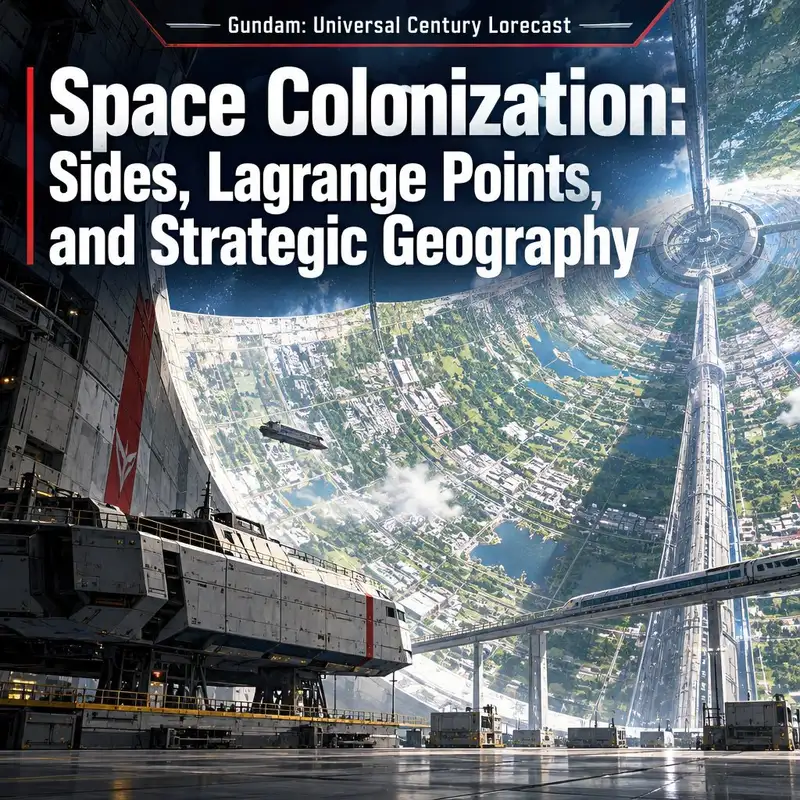
The construction of those societies was itself an industrial achievement. The Universal Century’s colonies draw on the broad tradition of rotating space-habitat concepts associated with Gerard K. O’Neill. The basic principle is straightforward. A large cylinder rotates, and that rotation creates artificial gravity along its inner surface. Residents can walk, work, farm, and build communities in an environment designed to resemble a terrestrial landscape. The interior may contain land sections, residential areas, agricultural zones, transport corridors, and bodies of water. Windows and mirror systems can provide controlled illumination in many designs. Life-support systems recycle air and water. Structural systems maintain pressure. The finished habitat can appear calm and almost pastoral. Its apparent normality is the product of continuous engineering.
That engineering began long before residents arrived. Constructing immense habitats in orbit would be prohibitively difficult if every ton of material had to be lifted from Earth’s surface. The setting therefore connects colonial construction to the Moon and to asteroid resources brought into the wider Earth Sphere. This does not provide a complete economic map of the Universal Century, and the surviving sources do not justify pretending that every mine, factory, or shipping contract is known. But the implication is clear. Space colonization required space-based extraction, transport, fabrication, and skilled labor. Lunar material had to be processed. Asteroid resources had to be moved. Components had to be manufactured, assembled, inspected, and repaired. Ships had to move people and cargo between worlds that were linked politically but separated physically.
The colony was the visible result of that wider industrial system. Behind every agricultural district stood pumps, filters, lighting systems, maintenance crews, machine shops, emergency stores, and replacement parts. Behind every dock stood cargo handling, traffic coordination, tug crews, inspections, and the ability to receive vessels that could not simply pull up to a curb. Behind every large civic space stood structural engineering and the routine work of keeping a rotating pressure habitat safe. The colony was not an escape from industry. It was industry made habitable.
Different colonies could embody different technical choices. Setting materials associated with the Universal Century describe many colonies as open-type cylinders, using windows and mirror arrangements to manage sunlight. Side Three is often described as an important exception, with closed-type colonies relying more heavily on external solar-power systems rather than the same window and mirror arrangement. The exact technical details should not be treated as a universal standard for every colony in every source. What matters historically is that design choices had consequences. They shaped power requirements, maintenance patterns, vulnerability, construction methods, and perhaps even how residents imagined their relationship to the space outside.
Colonization was not a completed project that could be left to run on its own. It involved accidents, equipment failures, structural damage, and the constant possibility that a small technical problem could become a large social crisis. Meteoroid protection, hull repairs, atmosphere recycling, emergency evacuation, medical care, and the replacement of worn systems were not glamorous parts of the Earth Sphere’s expansion. They were the work that made expansion possible. A colony survived because thousands of people performed specialized tasks reliably, often without public notice. This created a form of power that military histories sometimes overlook. The technician who keeps a life-support system operating may have no rank and no weapon, but the survival of a colony depends on that labor as surely as a warship depends on its engines.
The logistics of survival became the politics of dependence. Colonies could grow food. They could manufacture goods. They could host research facilities, docks, and workshops. None of that automatically meant complete self-sufficiency. Agriculture requires equipment, seeds, fertilizers, spare parts, water management, and energy. Industrial production requires raw materials, machine tools, trained workers, transport, and access to markets. Medical systems require supplies and specialist knowledge. Habitat maintenance requires components that may be produced locally, imported from another Side, or supplied through a chain that reaches back to the Moon or Earth. A colony with farms was not necessarily independent. A colony with factories was not necessarily sovereign.
This was not simply a question of economics in the abstract. It affected daily life. Political authority could be experienced through permits, work assignments, customs inspections, security checks, shipping priorities, housing allocation, maintenance budgets, and emergency response. If a transport delay threatened a hospital’s supplies, residents did not need a lecture on constitutional theory to understand that decisions made elsewhere had material consequences. If a local authority lacked the power to address a crisis without approval from Earth-centered institutions, that was not merely an administrative inconvenience. It was evidence of where sovereignty actually resided.
From the perspective of many colonists, dependence could appear as political exclusion. The broad Universal Century setting repeatedly returns to the belief that people sent into space had been treated as disposable, distant, or less fully represented than those who remained near the center of power. That belief cannot be reduced to a single statistic, and not every resident of the Sides shared it in the same way. Some found opportunity in the colonial economy. Some supported the Federation. Some feared that independence movements would bring instability or war. Some simply wanted a functioning job, a safe home, and a future for their families. But grievances did not need to be universal to become politically important. They only needed to be organized, articulated, and connected to the institutions that shaped daily life.
As colonial communities developed, demands for local authority became increasingly difficult to dismiss as temporary complaints. A population that maintains its own habitat, staffs its own industries, and develops its own social institutions will eventually ask why it should be governed primarily as an outpost. Yet the Federation had reasons, including military reasons, to distrust unrestricted autonomy. Colonies were not isolated villages. They lay beside critical transport routes and contained infrastructure that could support industrial and military activity. A local administration capable of managing life support and commerce might also possess docks, workshops, trained technical labor, and access to equipment that could be adapted for defense. The line between civilian capability and military potential was not always clear.
That ambiguity produced a colonial security dilemma. The Federation could regard garrisons, security oversight, and restrictions on independent military power as necessary measures to preserve order across the Earth Sphere. From that viewpoint, allowing every Side to build substantial autonomous armed forces could turn a political dispute into a fragmentation of sovereignty. Colonists could see the same garrisons and restrictions as proof that the Federation did not trust them with their own security. A security force stationed in a colony may protect shipping, deter sabotage, and respond to emergencies. It may also monitor dissent, control access, and remind residents that the final authority lies elsewhere. Both interpretations can exist at the same time.
This tension is especially visible in adaptation-specific accounts such as Mobile Suit Gundam: The Origin, which presents Federation military presence and limited colonial defense capability as part of Side Three’s political environment. That is a useful illustration of the larger problem, but its detailed chronology belongs to that retelling and should not be imposed unchanged on the original animated record. The broader point is secure enough without forcing every source into one seamless file. Colonial autonomy was constrained. Military power was politically charged. The Federation’s concern about secession could reinforce the very resentment that made secessionist politics more attractive.
Colony geography complicated this problem. Civilian traffic moved through docks and ports. Industrial facilities could be compartmentalized across multiple habitats. Cargoes could be legitimate, misdeclared, diverted, or hidden within a vast commercial system. Controlled approaches could aid security, but they could also make surveillance selective. A government could monitor major routes while still struggling to understand local networks, private contractors, and the movement of specialized equipment. Intelligence in the Earth Sphere was not just a matter of intercepting messages. It depended on understanding who controlled a dock, who maintained a factory, who had access to shipping records, and which local officials had reasons to cooperate or conceal.
Side Three became the most consequential example of how geography could become political identity. In the familiar framework of the original Mobile Suit Gundam, Side Three stood as the colony cluster furthest from Earth. It later became the center of the Principality of Zeon, the state that declared independence and launched the One Year War. Its location mattered, but not because distance alone creates rebellion. Distance can create administrative separation. It can make local security concerns feel more immediate than directives from Earth. It can encourage the growth of separate industrial networks and political organizations. It can strengthen the feeling that a community must speak for itself because those at the center do not fully understand its needs.
But geography did not produce Zeonism by itself. The political movement associated with Zeon Zum Deikun involved ideas about Spacenoid identity, human development, and independence from Earth-centered rule. The later Principality of Zeon involved the capture and transformation of that political space by the Zabi regime, with its own authoritarian institutions, military ambitions, propaganda, and coercive methods. These were not identical things. The Republic of Zeon, the later Principality, the Zabi leadership, the armed forces, and the civilian population of Side Three should not be treated as one undifferentiated actor. A colony cluster can generate a distinct political identity without every resident endorsing dictatorship. Real grievances can exist without justifying aggressive war, political murder, conquest, or mass killing.
Side Three’s location contributed to the conditions in which a separate political society could imagine itself as more than a distant administrative district. Its industry, population, and strategic position gave that identity material support. Political movements need more than ideas. They need newspapers, organizations, funding, meeting places, sympathetic officials, workers, technicians, transport access, and sometimes armed forces. A Side with concentrated infrastructure could support all of those things. Once a political movement gained control of such a regional system, it possessed assets that were far more significant than rhetoric. It had people, production, docks, routes, and a position within the wider Earth Sphere.
That did not make Side Three invulnerable or strategically self-sufficient. Distance from Earth could provide room for political development, but it also imposed burdens. Supplies still had to move. Military forces still had to be trained, maintained, and deployed. Industry still depended on materials, labor, and transport. A state can turn geographic separation into a defensive advantage, but it cannot repeal logistics. Zeon’s later military achievements would demonstrate both sides of this equation. Its leaders could exploit the Earth Sphere’s geography and the Federation’s unreadiness. They could not escape the long-term realities of industrial capacity, replacement, and political legitimacy.
Every Side therefore carried a dual character. It was an asset and a hostage. It was a place where people lived, worked, and built a future. It was also a concentration of infrastructure that could support commerce, industry, and military operations. A colony cluster could offer docking facilities, repair capacity, fuel and propellant storage, medical services, communications infrastructure, and access to trained labor. Fleets required such support. Mobile suits, once they became central to warfare, did not appear from empty space and vanish into it after battle. They required launch facilities, hangars, technicians, spare parts, ammunition, propellant, recovery systems, and crews capable of repairing damage under difficult conditions. The colonies and their surrounding ports made that wider system possible.
Yet the presence of civilian infrastructure also constrained military action. A commander might value a colony’s docks or industrial output, but the same colony contained residents who could be endangered by combat, sabotage, debris, fire, decompression, or the loss of power. A fleet could seek protection near a colony, but doing so placed the colony at risk. A military force could use civilian traffic as cover, but that blurred the line between commercial movement and military activity. A government could station forces near a habitat in the name of defense, while residents feared that their home had become a target. Space warfare did not occur in a clean void. It occurred around fragile communities whose survival systems could be disrupted by decisions made far away.
Control of a colony route was not the same as control of a colony population. A fleet can seize a docking area. A garrison can occupy a port. A blockade can restrict trade. None of these actions automatically creates political obedience. People still require food, medical care, work, security, and some reason to believe that the authority now controlling their lives can provide a future. Military maps tend to simplify this. A Side becomes a marker. A colony becomes a base. A port becomes an objective. But the people inside those places do not disappear when the map changes color. They become civilians under pressure, workers under new management, potential collaborators, potential resisters, and witnesses to whether military power can govern as well as destroy.
This is also why the use of colonies as weapons or shields carries such enormous moral weight. A colony is not merely a large object with mass and momentum. It is a society with air, agriculture, schools, families, hospitals, labor systems, and memories. To treat it only as a strategic asset is to erase the people inside it. The One Year War would make that erasure catastrophic. But the vulnerability existed from the beginning. The same engineering that allowed human beings to live in space created conditions in which political neglect, military coercion, or deliberate attack could threaten civilian life at a scale few earlier societies had experienced.
Side Seven at the opening of the One Year War reveals the logic of the entire system. In the original Mobile Suit Gundam, the Federation’s Project V is undergoing testing there when Zeon attacks. The immediate events are familiar because they introduce the Gundam, White Base, and the war’s central cast. But the larger significance lies in the setting. A colony environment had become the site of a sensitive military development program. That does not mean every Side was heavily militarized, nor does it prove that every colony facility had a hidden arsenal beneath it. It does show that civilian colonial geography and military competition had become inseparable. Secrecy, research, transport, and defense could all be embedded within a habitat built for human settlement.
The attack on Side Seven was not merely a raid on prototypes. It demonstrated that a location could become strategically important because of what passed through it, what was being tested there, and what its enemies believed it contained. The colony’s value was not determined by its size or public reputation alone. It was determined by its place within wider networks of intelligence and logistics. A peripheral site could matter if it held a research program. A quiet dock could matter if it received sensitive cargo. A supposedly civilian route could become contested if it connected a military project to the Federation’s industrial base.
The One Year War converted the Earth Sphere’s settlement patterns into military terrain. Colonies became targets, bases, refuge points, supply anchors, political symbols, intelligence environments, and instruments of coercion. Routes became lines of communication and potential ambush corridors. Lunar and asteroid facilities became strategic objectives. Earth itself became both the Federation’s political center and a theater that Zeon could invade, occupy, and exploit. None of this was inevitable simply because people had moved into space. It followed from the failure to resolve the political question created by colonization. Who owned the infrastructure? Who governed the communities inside it? Who had the right to arm, regulate, tax, or separate from the larger Earth Sphere?
The answers offered by the major powers were often inadequate. The Federation’s central authority could preserve unity while failing to provide a convincing sense of equal representation and shared political ownership. Zeon’s independence movement could identify real colonial grievances while being transformed into an authoritarian state that used those grievances to justify domination and war. Ordinary colonists could desire autonomy without supporting militarism. Federation personnel could believe they were maintaining order while enforcing a system that many residents experienced as remote and unequal. The geography did not settle these contradictions. It made them impossible to ignore.
Tactically, colonies constrained combat because every exchange of fire occurred near systems that sustained civilian life. A damaged pressure hull, disrupted power system, or destroyed docking facility could create consequences far beyond the immediate engagement. At the operational level, routes, docks, depots, shipyards, and approach geometry shaped how forces moved and how long they could remain effective. At the strategic level, the Sides distributed population and industry across contested space. No government could ignore them, and no rebellion could succeed without confronting the wider network that connected them to Earth and the Moon.
Politically, colonization created communities that demanded more than maintenance schedules and migration quotas. People who live, labor, raise families, and sustain their own habitats develop a claim to political authority. At the institutional level, centralized control and local insecurity fed one another. The Federation feared that local military capacity could fracture the Earth Sphere. Colonists feared that dependence on Federation institutions left them vulnerable to decisions made without their consent. Each side’s security measure could become the other side’s evidence of bad faith.
And at the civilian level, the stakes were always immediate. A colony resident did not experience politics only through speeches about independence or unity. Politics arrived through the reliability of air and water systems, the availability of work, the movement of food and medicine, the conduct of security forces, and the knowledge that a distant military decision might turn a home into a battlefield. The Earth Sphere’s wars were never fought in empty space. They were fought through the inhabited infrastructure created by colonization, because humanity expanded its territory without fully deciding who possessed political ownership of that expansion.