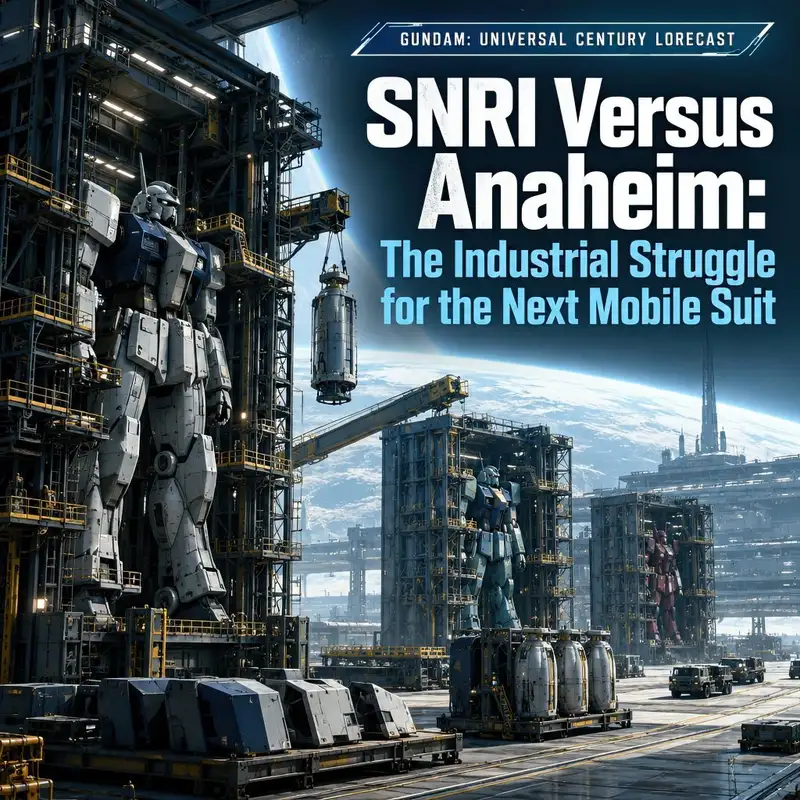
SNRI Versus Anaheim: The Industrial Struggle for the Next Mobile Suit
In Universal Century one hundred twenty-three, Frontier Side was attacked by the Crossbone Vanguard while the Earth Federation’s most advanced compact mobile suit was not standing alert with a trained frontline unit. The F91 was still a prototype. It had to be recovered, prepared, and pressed into combat amid a civilian crisis. In capable hands, it proved that the Formula Project had produced a machine of extraordinary tactical potential. But that success exposed a less flattering fact. The Federation had not turned its most promising design into a mature defense capability. It had no broad formation of F91 pilots, no visible fleetwide maintenance system built around the machine, and no evidence that the surrounding colonies could depend on it as routine protection. The F91 was valuable precisely because it was exceptional. That is useful in an emergency. It is not a substitute for readiness.
This was the contradiction at the center of the late Universal Century mobile-suit industry. The Federation had spent decades relying on Anaheim Electronics for advanced designs, production engineering, repairs, and the complicated industrial work required to turn a prototype into a usable weapon system. Then the Federation’s Strategic Naval Research Institute, usually called SNRI or Sanari, challenged that arrangement. SNRI developed the Formula Project, built the F90 testbed, and eventually produced the F91. It proved that Anaheim was not the only institution capable of defining a new generation of mobile suits. Yet SNRI’s success did not make Anaheim irrelevant. The contest was never simply about who could build the better machine. It was about who would set the technical standard, who would control the production line, and whether the Federation could free itself from dependence on one enormous private contractor.
Anaheim’s importance had never rested on a single famous mobile suit or a single secret laboratory. Its strength was accumulated industrial experience. The corporation had relationships with Federation customers, access to skilled engineers and production workers, established suppliers, repair capacity, and practical knowledge of how to support military equipment after it left the test range. A design office can produce an impressive drawing. A research institute can prove a concept. But a military service needs replacement parts, trained mechanics, quality control, transport arrangements, documentation, and a dependable way to keep machines operating after dust, damage, bureaucratic delay, and ordinary human error begin their work.
That made Anaheim difficult to replace. A government that buys too much from one contractor risks losing bargaining power. It may find that technical knowledge, production capacity, and procurement influence have all gathered in the same private institution. But a government that tries to reduce that dependence faces another problem. It cannot simply announce competition into existence. It must create or support alternative research organizations, protect their funding, establish independent testing systems, and still find someone capable of manufacturing the resulting equipment at scale. The Federation’s late Universal Century effort to challenge Anaheim was therefore an industrial-policy project as much as a military modernization program.
The surviving late Universal Century record does not provide a complete transcript of the Federation’s procurement debates. We do not have a fully documented cabinet meeting in which one minister declares war on Anaheim’s monopoly, nor do we need one to understand the institutional pressure. Official mechanical material associated with the F91 links the Formula Project to a desire to correct Anaheim’s long-standing dominance. The logic is straightforward. If one corporation determines the technical future of the military, the Federation’s armed forces become vulnerable to that corporation’s priorities, bottlenecks, and commercial leverage. The answer was not necessarily nationalization. It was to create another source of advanced design authority.
By the early one hundreds of the Universal Century, the mobile suit had also developed a problem of scale. Machines had become increasingly capable, but capability came with size, complexity, and cost. Larger frames required more hangar volume. More sophisticated systems demanded more specialized maintenance. Heavier equipment complicated transport and recovery. High-performance mobile suits could be impressive in limited numbers while becoming expensive burdens when a military tried to field, repair, and replace them across multiple fleets and colonial garrisons.
The question was not whether a large mobile suit could be powerful. Many could. The question was whether the Federation could maintain useful combat performance without building ever larger and more expensive machines. A force that can afford only a small number of elite platforms is vulnerable to attrition, training shortages, and political delay. A fleet carrier cannot expand its hangar deck merely because procurement has approved a bigger mobile suit. A colony defense force cannot wait for a rare specialist team every time a local crisis develops. A machine that performs brilliantly but demands unique support equipment may be less useful than a slightly less capable design that can be sustained by ordinary units.
SNRI’s answer was miniaturization. Late Universal Century reference material associates the institute with proposals, beginning around Universal Century one hundred two, to reduce the size of Federation mobile suits while preserving or improving their effectiveness. This was not a matter of aesthetics. The smaller Formula architecture was meant to change the relationship among performance, mobility, maintenance, and fleet support. A more compact machine could reduce pressure on hangars and transport systems. It could potentially simplify production and make advanced equipment easier to distribute. It could also create new problems. Shrinking a mobile suit without reducing its combat value requires difficult work in power systems, structure, controls, weapons integration, cooling, and maintenance access.
Miniaturization is often described as though it were automatically efficient. It is not. Compact machinery can be harder to service, less forgiving of damage, and more demanding to manufacture. A smaller frame can save volume while placing tighter tolerances on components and technicians. The benefit depends on whether the entire support system can adapt. If the parts are scarce, the tools specialized, and the mechanics poorly trained, a compact design becomes an elegant way to create a different bottleneck. SNRI’s achievement was not merely making mobile suits smaller. It was proposing that the Federation could reorganize its next generation of mobile-suit capability around a different industrial and operational model.
The Formula Project gave that proposal an institutional home. SNRI was associated with the Federation, but it was not simply a factory complex that could replace Anaheim overnight. Its purpose was research, development, and the establishment of a technical alternative. That distinction matters. A research institute can challenge a contractor’s assumptions, define new requirements, and build prototypes that established firms might not pursue. It can also operate with a degree of political protection when its work serves a government objective. In this case, the objective was both military and bureaucratic. The Federation wanted a more sustainable class of mobile suit, and it wanted the ability to obtain that class without accepting Anaheim as the sole gatekeeper.
This did not make SNRI a pure public-interest institution standing outside politics. Any Federation research body depended on sponsors, budgets, procurement decisions, classification rules, and military customers. It had to convince officials that its designs were worth testing and funding. It had to translate technical promise into requirements that fleets and garrisons could actually use. And it still had to contend with the basic problem of production. The Formula Project could challenge Anaheim’s design authority. It could not, by itself, conjure factories, suppliers, trained labor, and field-service networks on the scale required by a major military.
Anaheim did not wait passively for SNRI to define the future. In November of Universal Century one hundred five, according to the late Universal Century chronology, Anaheim began work on compact mobile suits at Federation request. The resulting RGM seventy-nine Heavygun appeared in the later one hundreds. The Heavygun’s significance lies less in any claim that it was the final answer to Federation modernization than in what its existence demonstrates. Anaheim could respond quickly when its customer identified a new requirement. It already possessed the engineering culture, industrial channels, and customer relationships needed to move a concept toward a deployable machine.
That capability should not be dismissed. Military institutions often need systems that can be built, delivered, repaired, and understood by normal units. A contractor with established production experience can provide that more reliably than an isolated research program, even if the research program has the more advanced prototype. The Heavygun represented Anaheim’s ability to adapt its existing industrial base to the demand for smaller mobile suits. It was not evidence that Anaheim had lost the initiative. At the same time, the Heavygun did not settle the Federation’s requirement for a genuinely next-generation main-force machine. The Federation was still looking for a design that better combined compactness, mobility, combat capability, and long-term growth.
That search reached a decisive stage in Universal Century one hundred eleven. SNRI’s Gundam F90 competed with Anaheim’s MSA zero one two zero. The detailed history of this competition belongs primarily to supplemental Formula Project material, not to the F91 film itself. The film establishes the F91 as an SNRI-developed prototype, but it does not pause to explain every earlier procurement trial that shaped the institute’s position. That source boundary matters. The broad outcome is clear enough. The F90 emerged as the successful Formula Project design, and its selection shifted the prestige of next-generation Federation mobile-suit development toward SNRI.
The two competitors represented different answers to the same problem. Anaheim’s MSA zero one two zero emphasized high instantaneous output and strong resistance to ballistic attack. That was not an irrational approach. A military customer wants survivability, power, and combat margin. A machine that can absorb punishment and generate greater output may offer obvious advantages in a direct engagement. But a main-force mobile suit is not judged only by the moment when two machines exchange fire. It must also be moved, maintained, equipped, trained upon, and sustained by the larger force.
The F90 placed its emphasis elsewhere. It embodied the compact Formula architecture, prioritizing mobility and adaptability within a smaller design. The Federation’s decision suggests that it valued more than raw output or protective strength. It valued a mobile suit that could support a new operational framework. Mobility affects not only combat performance but also how a machine can be assigned, transported, recovered, and configured. A flexible architecture can offer a force commander more options than a narrowly optimized platform, provided the logistics system can support those options.
It would be tempting to describe the competition as a simple victory for speed over armor, or innovation over conservatism. That would miss the point. The MSA zero one two zero was a credible industrial response from a company with long experience in Federation procurement. The F90 was a credible research-driven response to the growing cost and complexity of mobile-suit forces. The Federation’s selection was not a declaration that protection no longer mattered. It was a decision about which tradeoffs would define the next generation. Supplemental records describe the F90 as the winner, but they do not provide a sufficiently secure basis for dramatic claims about exact test scores, named evaluation officers, or a single decisive trial. The historical significance lies in the selection itself.
By choosing the F90, the Federation established that Anaheim would not automatically define the next architecture of its mobile suits. That was a major institutional change. It gave SNRI authority, prestige, and a practical basis for further Formula development. It also sent Anaheim an unmistakable message. The company could remain a major supplier, but it could no longer assume that its preferred design philosophy would become Federation doctrine merely because it possessed the greatest industrial experience.
The F90, however, was not a finished army in miniature. It was a testbed. Its defining feature was a system of hardpoints and detachable mission packs that allowed one core mobile suit to be fitted for different roles. This approach promised a form of modular procurement. Rather than creating entirely separate airframes for every specialist mission, SNRI could examine whether a common platform could accept mission-specific equipment. In principle, that could reduce duplication, simplify development, and let the Federation adapt a shared machine to changing operational needs.
The appeal is easy to understand. A force might use one basic mobile-suit architecture and alter its role through equipment packages rather than through a sprawling family of unrelated machines. That could improve standardization. It could concentrate training around a common cockpit and frame. It could simplify some categories of spare parts. It could also allow engineers to test specialized capabilities without committing immediately to a separate production line for every concept. In an era when mobile suits had become costly and complex, modularity offered a way to recover flexibility without paying for a wholly new vehicle every time doctrine changed.
But modularity creates its own discipline problem. Mission packs must be stored, inspected, transported, and assigned to the right units. Mechanics must know how to install and test them. Pilots must learn what changes when their machine receives a new configuration. Commanders must understand which modules are available and whether they can be moved to the place they are needed before the mission begins. A modular system can become a warehouse full of impressive equipment if no one has planned its distribution. The difference between a flexible mobile suit and a confused supply chain is often a matter of records, schedules, and trained personnel. Bureaucracy is not glamorous, but neither is arriving at a crisis with the wrong equipment package in the hangar.
The F90 therefore represented a new technical direction rather than an immediate replacement for every Federation mobile suit. It allowed SNRI to test the Formula concept across multiple roles. It also gave the Federation evidence that compact design could support a broader family of capabilities. Yet the F90’s very status as a test platform revealed the distance between successful experimentation and general adoption. A prototype can answer technical questions. It cannot automatically establish a fleetwide training syllabus, a depot system, or a procurement plan that survives budget pressure and political indifference.
Anaheim’s response came quickly. In Universal Century one hundred twelve, it began the Silhouette Formula Project. Official F91-related material identifies this as Anaheim’s answer to the Formula Project. The name itself carried the point. Anaheim was not content to remain outside the emerging compact-mobile-suit standard. It intended to develop machines that could match, reinterpret, or compete with SNRI’s work. This was commercial self-defense, but it was also an argument about technical ownership. If the Formula approach became the Federation’s future, Anaheim needed a place within that future.
Some supplemental accounts associated with the Silhouette Formula history describe Anaheim as having obtained SNRI technical information improperly. That claim should be handled carefully. It belongs to the detailed late Universal Century supplemental record, not to a universally settled account demonstrated across every animated source. What can be said with confidence is that Anaheim mounted a counter-project in response to SNRI’s lead. Whether the company’s access to Formula principles came through ordinary procurement channels, competitive study, personnel movement, intelligence collection, or misconduct varies in emphasis across the supporting material. The important historical fact is that industrial competition in the Federation did not remain politely contained inside separate laboratories.
That should not be surprising. Defense industries learn from one another. Governments issue requirements. Contractors observe which prototypes receive funding. Engineers move between programs. Subcontractors see components. Military customers compare systems. The line between legitimate competitive analysis and improper acquisition of technical data can become difficult to establish, especially in a classified environment. But it would be irresponsible to turn that ambiguity into a melodramatic tale of omniscient corporate espionage. Anaheim did not need supernatural insight to recognize that the Federation was shifting toward compact Formula designs. The F90’s selection had already made that direction impossible to ignore.
The Silhouette Formula Project demonstrated that losing one competition did not remove Anaheim from the strategic picture. A private contractor with large industrial resources can absorb a setback, redirect research, and seek new customers or new production roles. That resilience is part of what made Anaheim powerful. It could develop its own designs, manufacture systems devised elsewhere, redesign prototypes for practical production, and retain relevance through the ordinary but essential work of keeping military equipment available. SNRI had won recognition as a source of innovation. Anaheim was working to ensure that innovation would not become a monopoly in the opposite direction.
The clearest evidence that SNRI did not simply replace Anaheim is the F71 G-Cannon. The G-Cannon originated as an SNRI design, but Anaheim redesigned and manufactured it under contract. That relationship explains more about the real industrial contest than any dramatic claim of victory or defeat. SNRI could produce the technical concept and set the direction. Anaheim could take that concept into the difficult world of production engineering. Those are related skills, but they are not identical.
Production engineering is where elegant military designs meet hard limits. A machine may work in a prototype workshop because a small group of specialists can hand-fit components, inspect every assembly, and solve problems one unit at a time. A manufacturer must ask different questions. Can the components be made repeatedly? Are the materials available? Can workers be trained? Can tolerances be maintained across multiple facilities? Can damaged systems be repaired by field units? Can replacement parts be stocked without creating an administrative disaster? Can the machine be built at a cost and rate acceptable to the customer? Those questions determine whether a mobile suit becomes a weapon system rather than a demonstration.
Anaheim’s role in the G-Cannon program gave it continuing leverage. It remained valuable not merely because it had political connections, but because it possessed industrial competence that the Federation still needed. The Federation could use SNRI to prevent Anaheim from being the only source of technical imagination. It could not easily use SNRI to eliminate the need for large-scale manufacturing expertise. In fact, the G-Cannon arrangement may have been exactly the compromise the Federation wanted. SNRI could define a government-backed design direction, while Anaheim could be employed as a contractor rather than accepted as the unquestioned author of the future.
That compromise had advantages. It gave the Federation more options. It could compare proposals, set requirements with greater independence, and avoid allowing one corporation to dictate the entire development path. It also preserved access to Anaheim’s factories, workforce, supply chains, and accumulated knowledge. Yet compromise can create its own vulnerabilities. If the government depends on one contractor to make a rival institution’s designs practical, then independence remains partial. The Federation may have separated design authority from production authority, but it had not necessarily created a fully independent public industrial base.
The F91 represented the most ambitious expression of the Formula Project’s technical direction. Official model-manual material places its completion in Universal Century one hundred sixteen, with later operational testing in one hundred twenty-one and one hundred twenty-two. Those dates matter because they show that the F91 was not a machine that appeared suddenly in response to the Frontier Side attack. It was the product of years of design and testing. It also was not a mass-production mobile suit waiting in every Federation hangar. Its development continued through a period in which the Federation’s political and security institutions were becoming increasingly complacent.
The F91 demonstrated what SNRI’s approach could achieve at the high end of performance. It was compact, advanced, and capable of extraordinary combat effectiveness. But a prototype’s success creates a dangerous illusion. It can persuade observers that the technical problem has been solved when the institutional problem has only begun. A mobile suit may pass tests and still require years of work before it can be issued broadly. Pilots need conversion training. Mechanics need manuals, tools, and spare assemblies. carriers need procedures for launch, recovery, inspection, and repair. Supply commands need to know what to stock and where. Budget authorities need to fund production. Commanders need doctrine that explains how the new machine should be used alongside older units.
The more advanced the prototype, the more difficult that transition can become. High-performance systems may depend on specialized components, sensitive manufacturing processes, or a small pool of trained personnel. A research institute can accept some of those burdens in a trial program. A fleet commander cannot accept them indefinitely across dozens of scattered formations. The Federation needed to decide not merely whether the F91 was impressive, but whether it could be built, supported, and integrated in enough numbers to matter beyond a single emergency. By Universal Century one hundred twenty-three, the evidence suggests that this conversion from technological success to general readiness had not been completed.
That does not mean the Formula Project failed. It means that technical excellence and military readiness are different categories. The F90 demonstrated a promising design philosophy. The G-Cannon demonstrated a possible relationship between public-sector design and private-sector production. The F91 demonstrated the performance ceiling that compact Formula technology could reach. But each stage also showed the institutional work still required. The Federation had created an alternative to Anaheim’s design dominance. It had not yet created a seamless system that could move an SNRI breakthrough from laboratory, to factory, to training command, to fleet service, to the defense of ordinary civilians.
The Crossbone Vanguard assault on Frontier Side made that gap impossible to ignore. The Vanguard’s political project and military campaign belong to their own history, rooted in Buch Concern, Cosmo Babylonia, and the crisis of Federation authority. They were not simply another participant in the SNRI-Anaheim contest. Their importance here is that they exposed the Federation’s weak readiness. Frontier Side was not attacked by an abstract procurement report. It was attacked by organized military force, and civilians were caught inside the failure of a political system that had not aligned its advanced technology with credible local defense.
In that crisis, the F91 mattered. Its performance validated the technical promise of the Formula Project. The machine could engage contemporary threats with capabilities beyond those of many ordinary Federation systems. Its compact architecture was not a theoretical exercise. Under combat conditions, it showed that SNRI’s research had produced something real. But the circumstances of its use matter as much as its performance. The F91 was recovered and modified in an emergency. It was not the visible center of a mature Federation force built around common doctrine, trained squadrons, and established support arrangements.
At the tactical level, the F91’s employment was a vindication. A capable machine, operated effectively, could alter the immediate balance of a fight. At the operational level, it was an indictment. A single prototype cannot substitute for a distributed defense system. It cannot cover every colony, escort every evacuation, or make up for a command structure caught unprepared by a determined attack. At the strategic level, the crisis showed that the Federation’s technical modernization had outpaced its political and security reform. The government could produce advanced research programs while remaining unable to guarantee that its citizens would be protected by a ready and coherent military response.
The civilian dimension is especially important. Frontier Side’s residents did not experience the F91 as a procurement victory. They experienced invasion, displacement, confusion, and danger inside inhabited colonies. For them, the difference between an excellent prototype and a properly fielded defense force was not academic. A colony is not a testing ground. It is a home, a pressure vessel, an economy, and a political community. When military modernization remains incomplete, civilians become the people who pay for the gap between what a government can display and what it can reliably provide.
So did SNRI defeat Anaheim Electronics? In one important sense, yes. SNRI broke Anaheim’s claim to be the inevitable author of the Federation’s next mobile-suit generation. The F90 selection gave the Formula Project institutional legitimacy. The F91 proved that SNRI could produce advanced designs at the frontier of Federation technology. The Formula approach changed the terms of the debate. Compactness, modularity, and a more sustainable relationship between performance and fleet support became central questions that Anaheim could not ignore.
But SNRI did not defeat Anaheim in the broader industrial sense. The G-Cannon showed why. A research institute could originate a design, while Anaheim could redesign it for manufacture and build it under contract. That was not a trivial supporting role. It was the work that turned technical concepts into equipment that soldiers and crews could actually receive. Anaheim retained skilled labor, industrial infrastructure, supply relationships, and the practical experience needed to sustain machines beyond their first demonstration. Its Silhouette Formula response also showed that it could adapt when the Federation shifted technical direction.
The Federation, then, achieved competition rather than independence. It gained a second center of design authority, which gave it more leverage and reduced the danger of leaving all innovation to one private corporation. Yet it remained dependent on the industrial ecosystem it had hoped to balance. That was not necessarily a failure. Governments often need private industry, especially in technically demanding fields. The failure came when the Federation treated a promising research breakthrough as though it could substitute for the slower work of production planning, force integration, training, maintenance, and local security.
The F91’s emergency success at Frontier Side therefore carries two meanings at once. It vindicated SNRI’s Formula Project by showing that compact mobile-suit design could produce exceptional combat power. It also exposed the Federation’s inability to convert that achievement into broad readiness before a crisis arrived. Anaheim had lost its exclusive hold over the future, but it remained too important to discard. SNRI had won the right to define the next architecture, but not the capacity to make that architecture a complete military system. The Federation discovered that a better prototype could change a battle, while only coherent institutions could protect a society.