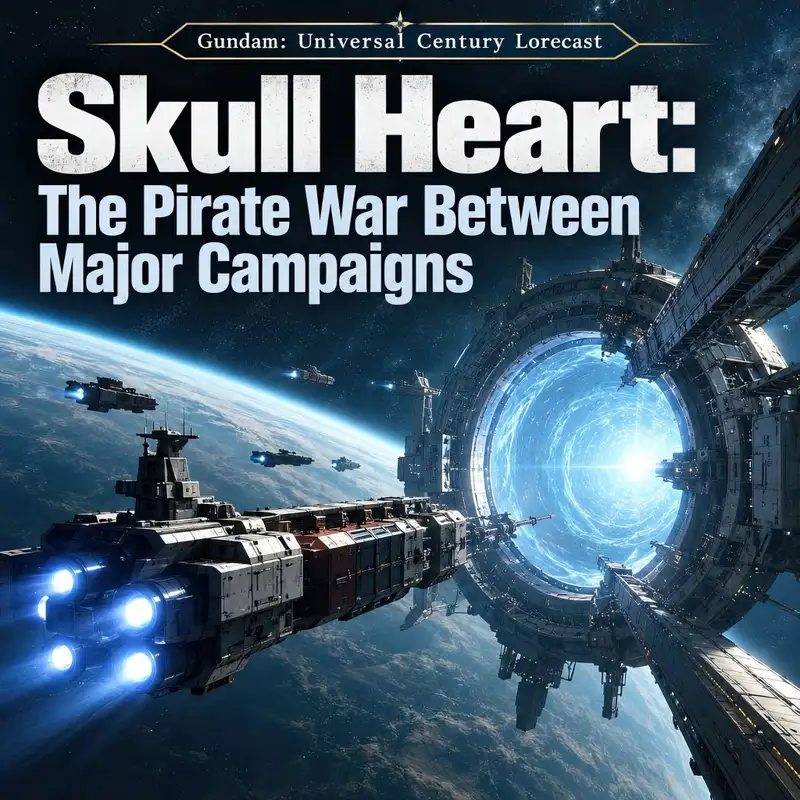
Skull Heart: The Pirate War Between Major Campaigns [Manga]
Neverland was not a fortress, a capital, or a prize that could alter the balance of the Earth Sphere. It was a small asteroid settlement, marginal enough that larger powers could treat it as scenery. That was precisely what made it dangerous. In Universal Century one hundred thirty-three, the Crossbone Vanguard was pursuing Jupiter forces toward Earth in the unsettled aftermath of the Jupiter War. The pursuers were tired, their information incomplete, and the enemy had chosen the ground, or rather the rock, on which contact would occur. Around Neverland, the pirate force found itself caught in an ambush near a civilian community with very little protection beyond its own knowledge of how to survive there.
That opening tells us what Mobile Suit Crossbone Gundam: Skull Heart is really concerned with. This is not the record of one uninterrupted pirate campaign, with a front line moving steadily from one strategic objective to another. It is a collection of incidents spread across years, linked by veterans, unfinished wars, dangerous technology, and the places where formal authority has become thin. The Crossbone Vanguard is called a pirate force, but it does not arrive at Neverland to seize territory or collect tribute. It arrives in the space between wars, where armed men still have ships, civilians still have homes, and no large government has made their safety a priority.
That is where Blacklow Transport becomes important. Publicly, it is a civilian transport company. Privately, it gives former Crossbone personnel a way to travel, carry cargo, gain access to routes, and investigate trouble without announcing the return of a pirate fleet. A transport concern is not an accidental disguise. Commerce crosses borders that warships cannot always cross openly. It needs information about ports, schedules, hazards, customers, and local conditions. It also requires crews who can repair equipment, load supplies, recover damaged craft, and keep vessels moving. In the late Universal Century, a transport network can be a lifeline, an intelligence system, and a cover story at the same time.
Tobia Aronnax embodies that arrangement. To the public, he works through Blacklow Transport. In practice, he remains connected to the Crossbone force and its covert missions. His value is not simply that he can pilot the Skull Heart effectively. Tobia is useful because he can work across categories that regular military organizations prefer to keep separate. He is a veteran, a transport employee, an investigator, an irregular combatant, and, when circumstances demand it, a man willing to make decisions before a distant headquarters can authorize them. That flexibility is an advantage. It is also a burden. Every decision made outside normal authority creates questions about evidence, responsibility, and legitimacy.
Tobia’s principal machine, the Crossbone Gundam X1 Kai Kai known as the Skull Heart, is part of that inherited military capital. It is a specialized and modified Crossbone Gundam, not a standard machine available to every member of the organization. Its compact late-era design, mobility, and close-range flexibility suit the sort of dangerous missions that a small force is likely to accept. The ABC mantle gives it a defensive option against beam weapons in high-risk fighting. That matters when an irregular unit cannot afford to trade losses evenly with a larger opponent.
That limitation is visible at Neverland. Even a capable mobile suit cannot prevent an ambush if the enemy has chosen the time and place. The Crossbone force had pursued Jupiter attackers into a region where the normal lines between battlefield and settlement had broken down. Neverland’s value was not in grand strategy. It was a small community living within a difficult environment, dependent on its own systems, its own routines, and the limited resources that could be extracted from the asteroid. To an outside force, it could look disposable. To its inhabitants, it was the entire world.
Tobia is shot down during the incident and encounters Twinkle Stella Ravelado, the young inhabitant whose life has been shaped by Neverland’s isolation. Her presence changes the meaning of the operation. The settlement is not merely cover for an enemy ambush or a convenient supply point. It has people, memory, and a future that cannot be measured by the remaining value of its rock and machinery. The Jupiter forces intend to use Neverland and then discard it once it has yielded what they want. That is a familiar pattern in the Universal Century. Peripheral communities become useful as bases, mines, hostages, labor pools, or shields. Their survival becomes someone else’s calculation.
Asteroid settlements are especially vulnerable to that kind of thinking. They are isolated, dependent on limited infrastructure, and often have constrained routes for escape or resupply. A small failure in life support, power, docking facilities, or local transport can become a crisis quickly. In such a place, geography is not abstract. The residents understand routes through the settlement, the condition of equipment, the locations that can shelter people, and the systems that cannot be damaged without putting everyone at risk. That knowledge is a form of power. It does not turn civilians into a professional military unit, but it makes them indispensable to any real defense.
The people of Neverland matter because they know what outside commanders do not. They know which spaces are habitable, which systems are fragile, and what can be sacrificed without destroying the settlement altogether. In a conventional campaign, a commander may think in terms of objectives, routes, reserves, and firepower. In an isolated asteroid community, those categories are inseparable from air, water, power, and the ability to get home after the fighting stops. A mobile suit duel can look decisive from the outside. For the people living nearby, the decisive fact may be whether the dock remains intact or whether a damaged generator can still support the settlement.
Kincaid Nau’s intervention helps turn the encounter into a successful defense. His experience gives the Crossbone force a veteran presence that Tobia alone cannot provide. Yet the outcome remains deliberately limited. Neverland is saved from immediate destruction, but it is not transformed into a secure and prosperous community protected by a permanent fleet. The pirate force can interrupt violence. It cannot create a durable security order around every isolated settlement in space. That distinction is one of the anthology’s most persistent arguments.
Twinkle’s choice to remain behind and educate herself before entering the wider world is important for the same reason. The story does not end with a heroic pilot carrying a helpless civilian away from danger and solving her future by force of personality. She retains agency. Rescue matters, but rescue is not ownership. For a community on the margins, survival also means gaining the ability to understand the wider political world that has repeatedly treated it as expendable. The Crossbone Vanguard can help preserve that possibility. It cannot live the life that follows on behalf of the people it saves.
For that reason, remnant warfare often centers on things that a conventional campaign history might treat as secondary. Cargo matters. Records matter. A transport route matters. The contents of a sealed container may matter more than the destruction of the ship carrying it. In Universal Century one hundred thirty-five, “The Pirates’ Treasure” turns on precisely that kind of conflict. A transport vessel connected to corruption among senior Federation officials is seized by Jupiter remnants. The immediate fight involves mobile suits and competing armed forces, but the real struggle is over custody, concealment, and political leverage.
The Earth Federation forces involved are led by Captain Harrison Madin. Harrison’s objective is to recover sensitive official property and preserve control over it. The Jupiter remnants have their own reasons to seize the material, whether to hide information, gain leverage, or exploit the disorder around it. The Crossbone Vanguard enters with a third objective. Its members understand that the cargo may contain evidence tied to misconduct within the Federation’s upper levels. The contest is not a simple clash between lawful authority and pirates. It is a three-sided engagement in which every participant wants the containers, but not for the same reason.
That makes the tactical problem unusually difficult. In an ordinary battle, destroying the enemy’s transport may be an acceptable result. Here, destruction could erase the evidence that makes the mission worthwhile. Recovering the cargo intact might preserve public property, but it might also allow compromised officials to bury the material again. Allowing the remnants to escape could place sensitive information in the hands of people willing to use it for coercion or revenge. The Crossbone force must fight without treating firepower as a solution to every problem. The cargo is political ammunition. Once it is destroyed, hidden, or selectively released, the balance of legitimacy changes.
The story’s importance lies in that uncertainty. It does not require every container’s exact contents to be catalogued in order to show what is at stake. Corruption thrives on compartmentalization. A document, a shipment record, or a sealed package can connect decisions that institutions prefer to keep separate. It can reveal that public authority has been used for private advantage. It can also become a weapon in the hands of people who care less about accountability than leverage. Evidence is powerful, but evidence does not explain itself. Whoever controls it can shape the story told about it.
The Crossbone Vanguard’s interest in the cargo reflects its political position. A regular government might be able to investigate corruption through formal channels, at least in principle. An irregular force has fewer legal tools, but it can sometimes pursue information that official institutions are reluctant to acknowledge. That is one reason piracy has value in Skull Heart. It can operate beyond the boundaries of respectable procedure. Yet that same freedom creates a hazard. Pirates who seize evidence can expose a crime, but they can also decide for themselves what should be exposed, to whom, and under what conditions. The absence of formal authority does not automatically produce justice.
Harrison Madin provides an essential contrast. He is not presented as proof that the Earth Federation is clean, and he is not a secret pirate ally in uniform. He is a professional officer trying to perform a lawful duty within an institution whose higher levels may be compromised. His concern for recovering official property and containing the incident is understandable. So is the suspicion that official custody might protect the institution before it protects the public. Harrison represents the problem of institutional decency. Competent people can limit damage, preserve order, and act honorably within their responsibilities. They cannot necessarily cure secrecy and corruption created above them.
His practical cooperation with Blacklow Transport is therefore situational. It reflects the fact that a regular officer sometimes needs information, mobility, or local capability that an irregular network can provide. It does not mean that the Federation has formally embraced the Crossbone Vanguard or authorized it as a standing auxiliary force. Such cooperation is useful precisely because it remains ambiguous. Each side can claim that it was responding to an immediate threat, not establishing a permanent alliance. The arrangement works in a crisis. It is a poor foundation for accountable government.
That ambiguity is part of the pirates’ operating environment. They can be tolerated when they solve a problem that official forces cannot solve cleanly. They can become liabilities the moment their existence embarrasses the people in power. A state wants order, but it also wants control over who is allowed to use force and who is allowed to reveal damaging information. The Crossbone Vanguard has neither the strength nor the legitimacy to challenge that principle openly. It survives by being useful enough to keep alive and small enough to remain deniable.
Where official institutions are limited by what they can admit, irregular actors depend on what they can learn. “The Final Soldier,” set in Universal Century one hundred thirty-six, turns that problem toward historical memory and military technology. Gray Stoke, a veteran with deep connections to Jupiter transportation and the outer-system world, approaches Blacklow Transport with a rescue request. The language surrounding the mission initially invokes Amuro Ray, a name with immense symbolic weight in the history of the One Year War. The suggestion is designed to seize attention. It implies that something associated with a legendary pilot may still exist and may need to be recovered.
But the operation is not a rescue mission for Amuro Ray himself. The story does not establish that Amuro’s personality, soul, or consciousness has been preserved in a machine. The target is a bio-computer, or bio-brain system, built around combat data associated with an Amuro-linked Core Fighter or learning-computer record. That distinction matters. The Jupiter remnant program has not brought a dead hero back to life. It has taken historical combat performance and tried to turn it into an engineering resource.
The machine produced by that effort is the Amakusa. It is a dangerous expression of a familiar military desire: the wish to preserve an exceptional fighter’s performance, remove the unpredictability of the human being, and reproduce the result whenever needed. Every military institution wants to learn from its best personnel. It studies reports, recordings, training methods, tactical decisions, and equipment use. The Amakusa pushes that logic into something more troubling. Instead of learning from a pilot, it attempts to turn the pilot’s accumulated combat patterns into the controlling core of a weapon.
At first, the Amakusa appears to justify that ambition. Its reaction speed and tactical behavior overwhelm the Crossbone force. The danger is not merely that it is fast. It behaves according to a combat profile shaped by data from one of the most famous pilots in the Universal Century. Against an opponent expecting a conventional machine, that can create a severe shock. A pilot cannot simply assume that the enemy will react according to ordinary training or ordinary human hesitation. The program has created a machine that makes historical reputation into an immediate tactical threat.
Yet the operation also shows the limits of turning a person into data. Combat records can preserve patterns. They can preserve responses to certain threats, certain movement habits, certain expectations about enemy behavior. They cannot automatically preserve judgment in a new environment. They do not carry moral responsibility. They do not understand the political meaning of a mission. They do not possess the relationships, memories, doubts, or capacity for adaptation that shape a human decision under pressure. The more a military system treats a famous pilot as a source of reusable performance, the more it risks mistaking the visible result for the whole person.
The Amakusa’s weakness emerges from its own testing configuration and its hostile-recognition problem. Within the facility, the system’s assumptions become a liability. Tobia does not defeat it by proving that the Skull Heart is simply stronger, nor by matching a legend with a larger legend. He exploits confusion in the environment and recognizes that the machine’s behavior is constrained by the categories its creators have given it. A combat intelligence can be quick and still misunderstand what it sees. In war, that can be fatal.
This is a tactical victory, but it is not proof that the Jupiter remnant program was strategically viable. A dangerous prototype may defeat ordinary opponents under controlled conditions and still fail as a scalable weapons system. It needs reliable data, secure facilities, compatible hardware, trained support crews, and a doctrine for deploying it without creating new risks. It must also be able to distinguish friend from foe under conditions that are rarely as neat as a test environment. A weapon that cannot be trusted inside its own facility is not a foundation for stable military power.
The ethical failure is as significant as the technical one. The attempt to extract combat value from a historic figure turns a person into an asset whose worth lies in lethal performance. It avoids the question of who should be accountable for the decisions made by the resulting machine. If a bio-brain kills civilians, misidentifies an ally, or carries out an obsolete tactical pattern, responsibility becomes easy to blur. The engineer can point to the data. The commander can point to the system. The institution can point to the emergency. The absent human being, whose record made the weapon possible, cannot answer for any of it.
Skull Heart does not ask the listener to settle a metaphysical question about whether information can preserve a person. It asks a harder institutional question. What happens when an organization treats historical memory as a mineable resource? The answer is not that memory becomes useless. Veterans’ experience, training records, and past operations matter deeply. But memory without context can become dangerous. A legendary pilot becomes a template. A template becomes a weapon. A weapon becomes an excuse for people in the present to evade their own responsibility.
The anthology reaches that same concern from a more comic direction in the story of Umon Samon. “A Fool Comes Riding on a Ball” returns to Universal Century seventy-nine, during the Battle of Solomon. Umon, much younger then, pilots a heavily modified Ball fitted with a large Gundam-like face. The absurd appearance is not merely visual comedy. In a Minovsky-era battle, identification is uncertain, communications are degraded, and pilots often make rapid judgments from incomplete visual information. A machine that looks wrong can create hesitation. Hesitation can create an opening.
Umon’s story is tied to the claim that he shot down six Rick Doms. Skull Heart does not present that number as a sterile, independently verified combat statistic. The tale is built from confusion, deception, improvisation, luck, and the sort of retrospective embellishment that grows around veterans. A Ball was not equal to a Gundam merely because it wore a crude Gundam face. It remained a far more vulnerable machine, operating in conditions where surprise and enemy misidentification could briefly matter more than raw performance. The point is not that Umon secretly possessed a superweapon. The point is that war legends often compress complicated circumstances into a simple tale of individual prowess.
Such stories are attractive because they are easy to carry forward. Six Rick Doms destroyed by a strange Ball is memorable. A careful explanation of Minovsky interference, battlefield recognition, formation disruption, pilot stress, and chance is less likely to become a legend. Yet the legend depends on those conditions. The story preserves the hero and loses the system that made his survival possible. That is how military memory often works. It remembers the remarkable act and forgets the mechanics, crews, confusion, and luck surrounding it.
Umon’s tale also reminds us that the old wars do not remain in the past simply because newer conflicts replace them. They survive in veterans, reputations, design habits, rumors, and the expectations people bring into later fights. The Amakusa is one attempt to weaponize a famous combat record directly. Umon’s Ball is a reminder that even a humorous battlefield story can become part of the cultural equipment of a later generation. The past supplies both technology and mythology. Neither is harmless when stripped from context.
“Monkey Satellite” makes the point even more bluntly. The story begins with accidents near Side Two linked to mobile suits operated by monkeys. It is an intentionally ridiculous premise, and Skull Heart allows the comedy to remain comedy. But the danger is real. Harrison’s Federation command and Blacklow Transport become involved in investigating a problem tied to an old Zeon-era experiment. The central fact is not that animal-piloted mobile suits were ever a major military doctrine. The manga gives no reason to treat them that way. Their importance is thematic and local.
The experiment is the kind of residue that only appears ridiculous because it has outlived the institution that made it. Somewhere in an earlier military system, someone had funding, personnel, secrecy, and a rationale for turning animals into components of a mobile-suit project. The project may have been abandoned, hidden, or forgotten by the people who authorized it. Its material consequences were not forgotten. Equipment remains. Knowledge remains. Unsafe practices remain. Eventually, civilians around Side Two are the ones exposed to the risk.
That is the serious core beneath the joke. Military institutions are often better at beginning programs than ending them responsibly. A project can be canceled on paper while its hardware sits in storage, its data remains classified, and its personnel carry knowledge elsewhere. Official histories prefer clean endings. A program is approved, tested, discontinued, and filed away. Skull Heart suggests a messier reality. Sometimes the abandoned project comes back as an accident, a black-market asset, an isolated threat, or an embarrassment that no one wants to claim.
The humor works because the danger is too foolish for official history to admit comfortably. No institution wants to explain that civilians are at risk because an old secret program involving monkeys and mobile suits was never properly resolved. Yet the absurdity does not make the threat unreal. It exposes the gap between bureaucratic language and human consequences. People living near Side Two do not care whether the paperwork calls the program obsolete. They care whether something armed and unstable is still moving through their space.
Across these stories, the Crossbone Vanguard repeatedly appears where that gap has opened. At Neverland, an isolated settlement is treated as expendable by armed outsiders. In “The Pirates’ Treasure,” sensitive cargo becomes the center of a struggle among secrecy, accountability, and political leverage. In “The Final Soldier,” historical combat data becomes the basis for a weapon that its creators cannot fully control. In Umon’s story, war becomes legend. In “Monkey Satellite,” a ridiculous old experiment becomes a present danger. These are not separate curiosities. They are different forms of the same postwar condition.
The major campaigns may be over, but their debris remains active. Some debris is physical: mobile suits, research facilities, transport routes, stockpiles, and damaged settlements. Some is institutional: classified files, compromised officials, incomplete investigations, and professional habits formed in wartime. Some is cultural: legends about heroes, myths about machines, and the temptation to treat the past as a source of simple answers. A pirate force is well suited to moving through that environment because it is small, mobile, and willing to operate outside respectable categories.
At the tactical level, the Crossbone Vanguard can be effective. It can raid a facility, intervene at a settlement, investigate a transport, recover dangerous material, and defeat a localized threat. Its veteran pilots and specialized equipment give it a capability that ordinary civilian organizations do not possess. At the operational level, Blacklow Transport provides mobility, access, and cover. Commercial routes become more than economic infrastructure. They become channels through which information, people, supplies, and intervention can move without announcing a military deployment.
At the strategic level, however, the pirates remain limited. They cannot govern the Earth Sphere. They cannot replace the Federation’s administrative structure, repair its political legitimacy, or guarantee that every remnant facility will be found before it harms someone. They cannot erase the economic and political conditions that leave frontier settlements vulnerable. The Skull Heart can reach places a regular force cannot reach quickly. It cannot create shipyards, courts, schools, accountable intelligence services, or a durable system of representation by itself.
Politically, their independence is both their strength and their weakness. They can expose a buried crime when official channels are compromised. They can cooperate with an officer like Harrison when circumstances make cooperation necessary. But they cannot claim that every action taken outside the law is automatically just. Their secrecy protects them from enemies and from political retaliation. It also denies the public a clear way to supervise what they do. An irregular force can be more responsive than a government in a crisis. It can also become dependent on the judgment of a few individuals, which is a fragile basis for power.
For civilians, the value of the Crossbone Vanguard is often more immediate and more modest. It can prevent a settlement from being discarded. It can stop an unsafe remnant weapon from becoming someone else’s disaster. It can preserve evidence before it disappears. It can create enough space for a person like Twinkle to have a future beyond isolation and exploitation. These are not small achievements. In the Universal Century, where distant institutions repeatedly treat colonies and frontier communities as strategic objects, saving a few people from becoming expendable is a meaningful political act.
But Skull Heart refuses the comforting fantasy that better pirates can repair a broken civilization. Tobia’s machine matters not because it allows him to dominate every battlefield, but because it gives a small force the ability to intervene where state power is absent, compromised, or too politically constrained to act. The Crossbone Vanguard can rescue, investigate, expose, and fight. It can preserve lives and interrupt the afterlife of old wars. It cannot create the accountable political order that would make such interventions less necessary.