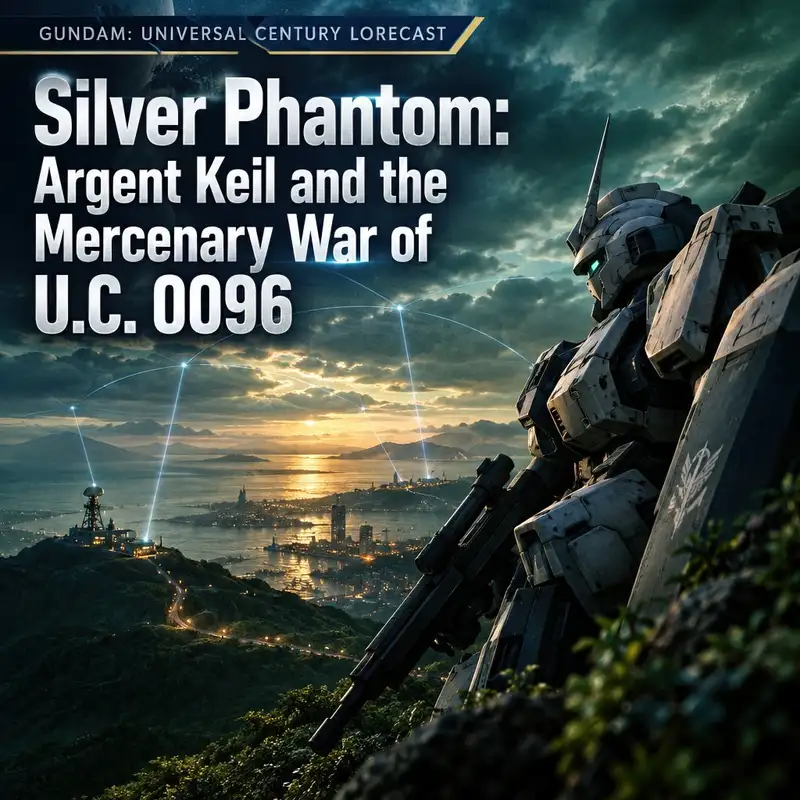
Silver Phantom: Argent Keil and the Mercenary War of U.C. 0096 [VR Film]
A contract is supposed to clarify responsibility. One side pays. The other side performs. In Universal Century ninety-six, Argent Keil accepts a contract to kill Azami Meggineh, a former Earth Federation official accused of maintaining contact with Zeon remnants. The arrangement is already politically toxic. The Federation cannot expose Azami’s relationship with those remnants without exposing its own embarrassment, its own failures of vetting, and perhaps its own private channels. So it turns to an unofficial mercenary organization. Then, before Argent Keil can carry out the mission, Federation Jegans attack the mercenaries’ fleet. At that point, the first question is no longer whether Azami is the target. It is whether the customer has decided to erase the contractor.
That reversal is the heart of Mobile Suit Gundam: Silver Phantom. Its conflict is not officially named a mercenary war, but the description fits. It is a small, deniable campaign fought in the spaces between formal governments, remnant forces, corporate supply networks, and people whose military careers have outlived the wars that formed them. Argent Keil does not represent an independent state. It does not command an Earth Sphere fleet or claim to govern a colony. It survives by accepting work that regular institutions want done without public ownership. That gives the organization freedom of movement, at least on paper. It also makes Argent Keil vulnerable to every actor with more money, more secrecy, or a stronger claim to legitimacy.
The opening attack by the Jegans matters because it exposes the structure beneath the contract. Deniable violence creates deniable responsibility. A Federation official can commission an assassination without putting a public order on the record. Another Federation formation can attack the assassins without admitting why. The available record does not prove that the entire Earth Federation government is following one unified conspiracy. That would be too neat, and the Universal Century rarely rewards neat explanations. What it shows is more plausible and more dangerous: divided authority, compartmentalized information, and armed personnel operating under orders that the people being shot at cannot authenticate in time.
Under Minovsky-era conditions, that uncertainty is not merely philosophical. Identification, communications, and command control are already difficult when forces are honest about who they are. A sudden attack by machines carrying the insignia of the organization that hired you creates a counterintelligence crisis in the middle of an operational emergency. Was the attack a mistake? Was it a purge? Was Azami protected by a separate channel inside the Federation? Was Argent Keil used to draw out a hidden asset? The mercenaries cannot pause the battle until they have satisfactory answers. They have to launch, maneuver, preserve their fleet, and decide which information is worth trusting while the enemy is already firing.
That is when Argent Keil reveals its hidden silver Gundam, the DZ-001 Delta Zayin. The machine is launched as a survival asset, not as a ceremonial declaration. Its appearance tells us that Argent Keil has more depth than a collection of freelance pilots in customized colors. It possesses concealed equipment, technical personnel capable of maintaining unusual hardware, and access to channels that can move a highly sensitive machine beyond ordinary military oversight. Yet the Delta Zayin also reveals the limits of the unit’s independence. A mercenary group does not manufacture a Gundam-class prototype from raw materials in a garage at the edge of the Earth Sphere. It needs industrial access, parts, engineers, documents, transport, and people willing to look away.
Silver Phantom takes place three years after Char’s Rebellion, in the same broad period as the Laplace Incident. The great wars of the earlier Universal Century have ended, but the machinery of war has not disappeared. Zeon remnants still exist. Former Federation personnel still carry old loyalties, resentments, and secrets. Weapons designed for wars that were supposed to be over remain in storage, in private hands, or attached to programs whose official purpose has become difficult to identify. The Earth Federation remains the largest political and military institution in the Earth Sphere, but its size does not guarantee transparency or control. In fact, large institutions often become especially good at creating spaces where no one can be held fully responsible.
Argent Keil operates in one of those spaces. It is not ideologically neutral in the sense of being untouched by politics. No armed organization can be. Its contracts decide who lives, who dies, and whose problems are allowed to remain hidden. But Argent Keil is not presented as a Federation unit, a Sleeves formation, or a conventional remnant army. Its practical objective is contract fulfillment and organizational survival. That distinction matters. A state may claim public authority, however imperfectly. A remnant movement may claim political legitimacy, however selectively. A mercenary group has to keep its people alive, its machines functioning, and its clients willing to pay. Those needs can create a hard-eyed professionalism. They can also create dependence disguised as autonomy.
The civilian danger in such a system is broader than any one battlefield. When governments use unofficial force to avoid scrutiny, they weaken the line between public security and private violence. A political problem becomes an assassination package. An intelligence failure becomes somebody else’s risk. A former official with inconvenient connections becomes an embarrassment to be removed rather than a case to be investigated. The people most affected may never know which office made the decision, which military formation received the order, or which corporation enabled the operation. That uncertainty is useful to those in power. It is much less useful to the people living under the political order that permits it.
Argent Keil’s survival also depends on mundane military realities. The group has a fleet, or at least enough ships and support infrastructure to launch and recover mobile suits, maintain them, move personnel, and withdraw when a position becomes untenable. The film does not establish a complete order of battle, and there is no reason to invent one. What matters is that a mobile suit sortie is never just a pilot climbing into a cockpit. Machines need technicians, replacement parts, propellant, ammunition, hangar space, medical care, navigation, and a ship or base that can still receive them after combat. A unit that loses mobility can lose its independence before it loses its last machine.
Argent Keil’s silver-painted equipment serves as an organizational marker, but paint is the least important part of the story. The practical significance lies in modernization and lifecycle extension. Official profiles describe the organization’s GM and Zaku-derived machines as updated to remain credible in Universal Century ninety-six, with performance compared in broad terms to more contemporary Federation and Neo Zeon equipment. That does not establish exact parity with a Jegan or Geara Doga in every environment. It does establish a familiar military fact. Older platforms can remain useful when skilled maintainers, compatible components, and careful modification keep them in service. The limitation is that every irregular upgrade can also deepen dependence on scarce parts and specialized labor.
A regular military can standardize equipment imperfectly, but at scale. It can assign replacement machines, maintain depots, and absorb losses across a larger system. Argent Keil appears to sustain itself through a narrower network. Its machines are inherited, modified, and privately maintained. That may give the unit flexibility. It may also mean that damage to a rare component is more serious than the destruction of an ordinary machine. Mercenary independence is therefore not a condition of being free from logistics. It is the condition of having more fragile logistics, fewer official guarantees, and less margin for political betrayal.
That material reality shapes Mabel Lena’s command decisions. Mabel is a veteran pilot, an operator within Argent Keil, and Babia Lena’s adoptive mother. Those roles pull in different directions. A commander must preserve the organization. A pilot must understand the immediate tactical danger. A parent, adoptive or otherwise, sees the person inside the cockpit. Silver Phantom does not reduce Mabel to any one of these identities. Her problem is precisely that all three exist at once. When the fleet is under attack, she cannot simply protect everyone by withdrawing. Retreat may preserve ships in the short term, but it does not resolve the threat posed by Azami, the compromised mission, or the forces now hunting Argent Keil.
Mabel’s answer is an operational compromise. She works to preserve Argent Keil’s ability to relocate while sending Babia and the protagonist toward the decisive confrontation. That is not a clean choice between mission and people. It is an acknowledgment that the mission has already become part of the organization’s survival. If Azami has turned the contract into a trap, then simply abandoning the target may leave Argent Keil exposed to the same network that arranged the ambush. The group has to regain initiative, learn who set the conditions, and prevent itself from being hunted piecemeal. In military terms, Mabel is trying to keep a tactical crisis from becoming organizational collapse.
The protagonist complicates that decision because Silver Phantom does not present them as a conventional fixed hero. Official material identifies the protagonist as a former Federation servicemember who was saved by Babia during combat and later joined Argent Keil. The protagonist is not introduced as a legendary ace. In fact, the pressure of being assigned a Gundam is part of the role. This is someone asked to carry equipment whose symbolism, sensitivity, and hidden history exceed their own confidence. The assignment is not a reward for established greatness. It is a demand made by circumstances.
The virtual-reality format changes how that demand is experienced. In a traditional animated story, the audience observes a named pilot with a fixed face, voice, history, and sequence of decisions. Silver Phantom places the viewer inside an intentionally open role. The protagonist can be voiced in more than one way, and the character is not given a single fixed gender, personal identity, or complete inner biography that the audience must accept as final. That does not make the protagonist empty. It makes the perspective unstable in a deliberate way. The viewer is asked to inhabit a combatant who knows only part of the situation and who must act before the political structure around them becomes fully visible.
That perspective also imposes limits. The participant does not begin with omniscient knowledge of Federation covert channels, Azami’s intentions, the Sleeves’ internal calculations, or the Delta Zayin’s full history. They learn under pressure, through fragments of evidence, interpersonal trust, and immediate danger. This is a more honest military perspective than many heroic war stories allow. People in combat rarely receive a complete briefing after the fact. They act with incomplete maps, conflicting reports, damaged communications, and the knowledge that delay can kill someone. The virtual-reality format makes that uncertainty personal. It does not turn the player into the master of history. It turns the player into another person caught inside it.
The Delta Zayin is central to that experience, but it should not be mistaken for a miracle machine. Officially, it is a modified Delta Plus supplied through Anaheim Electronics. Its construction is deliberately irregular. Its exterior incorporates nonstandard components. Its head derives from another prototype line. Its armor data is associated with a machine whose development had been frozen. It carries a specialized shield unlike ordinary field equipment. The result is not a clean production model with a stable supply chain. It is a covert hybrid assembled from overlapping programs, compartmentalized knowledge, and hardware that conventional procurement channels either could not or would not acknowledge.
That makes the Delta Zayin a valuable weapon system, but not necessarily a reproducible one. A prototype can demonstrate engineering possibilities without proving that an organization can build, train for, maintain, and deploy that capability in quantity. The machine’s unusual design may offer tactical advantages. It may also require specialized maintenance, uncommon spare parts, and technicians who understand systems not found on an ordinary fleet roster. A force that depends on a singular machine gains an edge only as long as it can keep that machine operational. The history of the Universal Century is full of prototypes that were brilliant in a hangar, frightening in a duel, and strategically limited because they could not be made ordinary.
Anaheim Electronics is important here, but not because it secretly controls every war in the Earth Sphere. The available record supports a narrower and more revealing conclusion. Anaheim can supply sensitive technology through arrangements that preserve deniability. It can connect marginal organizations with hardware that larger institutions prefer not to have publicly associated with them. That kind of corporate access is politically powerful because it allows military capability to move through channels that are neither fully private nor fully accountable. The company does not need to command every participant to shape the conflict. It only needs to make certain options possible for people who would otherwise lack them.
The Delta Zayin was originally prepared for Fixzi Fix, a former Argent Keil pilot. That detail turns the machine from a collection of unusual parts into an inheritance. Its concealed history is also a concealed human history. Fixzi was twenty-one in Universal Century ninety-three, during the period surrounding Char’s Rebellion. Later accounts connected with the film describe him as a Cyber Newtype and associate him with the Murasame Newtype laboratory. That association should be treated as part of Silver Phantom’s own record, rather than casually merged into every earlier account of Murasame research. The important point is not to create a perfect institutional genealogy. It is to recognize the pattern.
The Universal Century repeatedly takes unusual human perception and translates it into military potential. A person becomes a research subject. A research subject becomes a pilot candidate. A pilot candidate becomes an interface for a machine too complex, too unstable, or too politically valuable to entrust to ordinary doctrine. The individual may be treated as gifted, dangerous, broken, irreplaceable, or disposable, sometimes all at once. Cyber Newtype programs are not simply technical projects. They are institutions of coercion, expectation, and control. They ask whether a human being can be manufactured into a weapon, then hide the damage when the answer is anything less than convenient.
Babia Lena carries part of that legacy. Her Jagd Weise is derived from the Jagd Doga line, but its original psycommu equipment has been removed. That is more significant than a comparison of weapons or output figures. The removal marks a boundary around what Argent Keil can support, what it trusts, and what it is willing to place in Babia’s hands. Psycommu systems promise expanded engagement geometry and direct response to a pilot’s perception. They also impose unusual demands on the person operating them. They can turn the pilot’s emotional and sensory condition into a battlefield variable. Removing such equipment may reduce capability in one sense while reducing risk in another.
Babia’s connection to Fixzi gives the crisis an emotional force that cannot be separated from its military meaning. She is not merely watching a new pilot occupy a machine intended for someone else. She is confronting the possibility that the past has not remained in the past, that Fixzi’s suffering, ability, or presence may still be embedded in the Delta Zayin and in the people around it. The film depicts or reports visions and communications connected to Fixzi. It does not provide a settled scientific explanation for them. Are they psycho-frame effects? Newtype resonance? Memory, trauma, projection, or something more difficult to classify? The honest answer is that the work leaves room for interpretation.
Commanders, researchers, and corporations will often see an unexplained phenomenon and ask how to exploit it before they ask what it has done to the person experiencing it. The protagonist’s emerging abilities may help them survive. In the Universal Century, extraordinary perception is rarely allowed to remain private for long. Once it produces a tactical effect, someone wants to measure it, recruit it, train it, command it, or weaponize it.
The interactive record moves the confrontation to the ruins of A Baoa Qu. That location matters even without retelling the entire One Year War. A Baoa Qu is not simply a dramatic backdrop for a final battle. It is a remnant of earlier state violence, a place where old military infrastructure, old wreckage, and old political memory remain available to new actors. Fortresses do not disappear from history just because a war ends. Their ruins can provide concealment, salvage, routes through debris, symbolic power, and a ready-made stage for people who want to invoke the legitimacy or trauma of a previous conflict.
In Universal Century ninety-six, fighting among the remains of A Baoa Qu suggests that the Earth Sphere has not truly demobilized from its past. The physical landscape still contains the material residue of campaigns fought decades earlier. The political landscape contains their survivors, myths, weapons, and grudges. A clandestine operation can use such terrain because secrecy thrives where records are broken, jurisdiction is unclear, and old military spaces have outlived the governments that built them. The ruin is not only a battlefield. It is where old wars make new secrecy possible.
There, Azami Meggineh’s role becomes clearer. The available interactive account presents the assassination contract as a trap designed to draw Argent Keil in. Azami is a former Federation official who later finds shelter among the Sleeves, the Neo Zeon remnant faction active in this part of the story. Her position is not simply that of a defector protected by one side against another. She uses three overlapping forms of protection. Federation secrecy makes it difficult to expose her cleanly. Remnant shelter gives her access to armed support outside regular Federation control. Personal loyalty gives her people who will fight for her even when the larger political purpose becomes uncertain.
This does not mean that Azami speaks for the Sleeves as a whole. The Sleeves are not interchangeable with every Zeon remnant, every earlier Neo Zeon movement, or the entire political history of Zeon. Azami’s personal scheme should not be inflated into a strategic program for all remnant forces. Her importance lies in how effectively she exploits fragmented authority. The Federation wants her removed without public exposure. Argent Keil wants to complete the contract and survive. The Sleeves provide concealment and military cover. Azami turns the conflicting interests of those actors into a trap, using the very deniability that was supposed to make the operation safe.
Joff Idiy is the practical instrument of that trap. Formerly Azami’s bodyguard, he serves with the three-mobile-suit RGTS team and pilots a customized red Zssa. It would be easy to treat him as nothing more than the final opponent for a Gundam pilot. That misses his military and political role. Joff represents personal loyalty made operational. He is a capable pilot attached to a small remnant formation, but his commitment is not necessarily to an abstract remnant ideology or a grand campaign plan. It is to Azami. In a fragmented conflict, that kind of loyalty can be more reliable and more dangerous than formal command relationships.
The Zssa is also a useful reminder that the late Universal Century battlefield is not divided cleanly between modern Federation machines and obsolete Zeon relics. Older designs can be modified, retained, and employed in specialized roles. What matters is not whether one machine is newer on a technical chart. It is whether the pilot understands the mission, whether the unit can sustain the machine, whether the terrain favors its employment, and whether the opponent knows what to expect. Joff’s threat comes from training, preparation, loyalty, and the fact that Argent Keil has been drawn into an engagement whose terms were shaped by someone else.
The original assassination package has therefore failed as intelligence. Argent Keil may have been hired to eliminate Azami, but the mission did not provide a reliable understanding of who protected her, what forces would respond, or which Federation elements might interfere. Outsourced covert action often produces this problem. The sponsor limits what the contractor knows in order to preserve secrecy. That same compartmentalization prevents the contractor from recognizing manipulation until it is too late. In conventional operations, inadequate intelligence can cost a unit its objective. In deniable operations, it can cost the unit its existence, because the sponsor may decide that the contractor knows too much once the mission is over.
As the confrontation intensifies, the protagonist’s connection to Fixzi and the Delta Zayin’s specialized shield becomes more important. The shield contains psycho-frame technology associated with the machine originally intended for Fixzi. The film’s record depicts extraordinary perception and apparent communication under combat pressure. What can be observed is that the protagonist experiences something beyond ordinary training and that this experience affects the immediate battle. What characters infer is more uncertain. Some may see Fixzi’s presence. Others may see an awakened Newtype ability. A military institution would likely see an opportunity and a problem: a pilot whose performance has suddenly become difficult to predict, classify, or control.
The tactical effect is real within the story. The protagonist gains the ability to survive an engagement that had been shaped against Argent Keil from the beginning, and ultimately to overcome Joff and Azami’s immediate threat. But tactical success should not be confused with scientific understanding. There is no basis for claiming that the Delta Zayin can reproduce the effect on demand, that psycho-frame has a uniform effect on every compatible pilot, or that Fixzi’s apparent connection can be reduced to a reliable engineering procedure. The Universal Century repeatedly demonstrates that extraordinary events become tempting subjects for weapon development precisely because they resist ordinary replication.
The protagonist’s awakening is also dangerous because it changes their institutional value. Before the battle, they are an inexperienced mercenary assigned a difficult machine. Afterward, they may appear to be someone with Newtype potential, psycho-frame compatibility, or access to a phenomenon connected to a prior experimental pilot. That can make them more capable. It can also make them less free. A person who performs exceptionally under impossible conditions is likely to attract attention from commanders, researchers, corporations, and political actors who believe the result belongs to them. The same system that treats people as expendable can become intensely interested in them once they prove useful.
The climax occurs alongside the firing sequence of Gryps Two, the colony laser whose use belongs to the much larger crisis unfolding elsewhere in Universal Century ninety-six. Its presence establishes scale. Argent Keil’s battle is immediate, personal, and lethal. Gryps Two represents strategic violence on an entirely different level, involving forces and political stakes far beyond this small mercenary organization. Argent Keil does not control that weapon. The Delta Zayin does not determine its employment. The contract war does not become the decisive event of the broader Laplace Incident simply because it unfolds at the same time.
That separation is important. The Earth Sphere is large enough for private struggles to occur inside public emergencies. A mercenary unit can fight for survival while governments and major factions maneuver around a strategic weapon. A former official can turn personal protection into a military trap while larger political settlements rise or fail elsewhere. The intimacy of Argent Keil’s struggle does not make it irrelevant. It reveals what large crises look like from below, among the people who are ordered into danger without being told the full purpose of the operation.
Silver Phantom’s final structure gives that perspective its most distinctive form. The protagonist reaches a point where the viewer must choose. The interactive narrative offers broad branching outcomes. In one, the protagonist sacrifices themselves to save Babia. In another, the protagonist attacks Babia and survives. In a third, the protagonist abandons the fight. These are not three events that occurred simultaneously in one fixed historical record. They are branches made possible by the film’s interactive design. No single outcome should be casually declared the one definitive ending unless the work itself establishes that later.
What remains constant across those branches is more important than selecting a preferred result. The protagonist is finally given a personal decision after the institutions around them have spent the entire conflict narrowing the range of possible choices. The Federation’s covert channels made the assassination necessary. The attack by Federation Jegans made the contractor disposable. Anaheim’s hidden procurement made the Delta Zayin possible while keeping its history obscured. Earlier military experimentation shaped Fixzi’s fate and cast a shadow over the protagonist’s awakening. Azami’s trap turned personal loyalty and remnant shelter into a weapon. By the time the final choice arrives, nearly every condition has been inherited from decisions made by other people.
That is the difference between agency and freedom. The protagonist has agency because the final decision matters. It affects Babia, it affects the protagonist’s survival, and it affects the emotional meaning of the mission. But the choice is not made in a free and open political space. It is made under trauma, uncertainty, military pressure, and the accumulated damage of institutions that have treated human beings as tools. The player is not asked to solve the Earth Sphere’s political crisis. The player is asked to decide what one person does when the systems that should have protected meaningful choice have already failed.
This is where the virtual-reality format becomes more than a novelty. A conventional film can show a pilot making a painful decision. Silver Phantom asks the viewer to occupy the role of the person making it. That does not erase the limits of the medium or transform player action into a universally fixed historical fact. It does make responsibility feel different. The audience cannot remain entirely outside the chain of command, watching a named protagonist absorb the moral burden. The final branches make the viewer confront the fact that every available option has a cost because the conflict was built on secrecy long before the final battle began.
Argent Keil’s contract war therefore reveals the limits of mercenary independence in Universal Century ninety-six. The organization may reject formal allegiance to the Earth Federation or to Zeon remnants, but it cannot escape the political systems that fund it, arm it, target it, and exploit it. Its silver machines, hidden Gundam, and experienced pilots give it a measure of tactical autonomy. They do not give it sovereignty. Its survival depends on the same military-industrial networks and covert arrangements that make it vulnerable to betrayal.
The Delta Zayin and the protagonist’s awakening offer extraordinary possibilities in combat, but neither repairs the institutions surrounding them. They cannot make a covert assassination accountable. They cannot turn remnant shelter into political legitimacy. They cannot undo the damage done to people like Fixzi, or guarantee that another emerging Newtype will be treated as a person before being treated as a capability. In Silver Phantom, the final choice matters not because it resolves the Earth Sphere’s crisis, but because it exposes the human cost of a political order that leaves decisive moral choices to the people it has already used as disposable instruments.