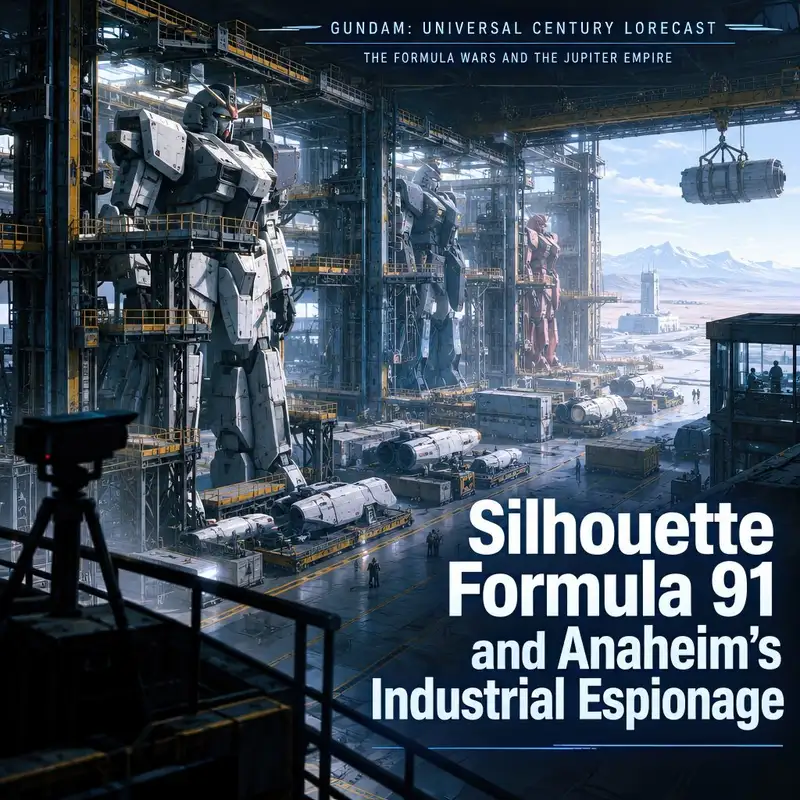
Silhouette Formula 91 and Anaheim’s Industrial Espionage [Manga]
The Bladewood was built to test mobile suits, not to survive a hunt. In the Zebra Zone, a remote corridor between Side Three and the Moon, that distinction became painfully important. The ship carried experimental machines, engineers, test pilots, incomplete maintenance stocks, and data that several institutions would have preferred to control. After an encounter with unknown mobile suits, the Bladewood was damaged and forced to seek repairs. Its most advanced machine, the RXF-91 Silhouette Gundam, had already revealed one of the great weaknesses of prototype warfare. It could perform at an extraordinary level, but it could not be sustained like an ordinary service machine. Spare parts were scarce. Repairs demanded specialists. Its crew was a test team, not a line combat unit with reserves, escorts, and a secure logistics chain.
The immediate danger was not simply that hostile machines had appeared in an isolated sector. The Bladewood had stumbled into evidence of a military organization that was not yet prepared to disclose itself. At the same time, the ship embodied another secret, one involving Anaheim Electronics, the Earth Federation’s Strategic Naval Research Institute, and a struggle over who would build the next generation of mobile suits. In the Zebra Zone, those secrets collided. A corporate development program became an intelligence problem. An intelligence problem became a military operation. And that operation placed a refugee community in the line of fire.
The story of Silhouette Formula 91 is often reduced to a simple claim: Anaheim tried to copy the F91. That is too neat, and it misses the more revealing issue. The manga presents Anaheim’s Silhouette Formula Project as an effort to recover ground in a changing procurement environment. The company had long been one of the Earth Sphere’s central military-industrial powers, but the Federation was no longer comfortable relying so heavily on one contractor. The Strategic Naval Research Institute, usually called S.N.R.I., represented a competing path. It was connected to the Federation’s own institutional effort to develop smaller, more efficient, high-performance mobile suits.
Anaheim’s Silhouette Formula Project emerged from that environment. It was an effort in acquisition, adaptation, and rapid development. The company had industrial depth, but it did not possess perfect knowledge. Its work remained divided among secret projects, prototype teams, and personnel with incomplete access to the larger picture. That matters because Anaheim is sometimes imagined as an all-knowing corporate state hiding behind a logo. The manga gives a more constrained image. Anaheim has reach and influence, certainly. It also has technical gaps, internal secrecy, limited hardware, and dependence on military protection that can vanish when political conditions change.
The Bladewood was where this procurement theory met engineering reality. It was a test ship, but that description should not make it sound like a simple transport carrying machines from one range to another. The ship provided hangar space, maintenance facilities, recovery capability, communications, technical analysis, and command support. It was the mobile infrastructure required to turn a prototype into useful information. Without the Bladewood, the Silhouette Gundam was not a strategic asset. It was an expensive machine with no secure place to launch, recover, repair, or evaluate.
Its personnel reflected the blurred boundary between corporate development and state security. Captain Aitor Horst commanded the ship. Albert Elsener served as chief engineer. Iris Orlando worked as an engineer within the project. Tokio Randall was a Federation-linked test pilot, while Kevin Forrest flew as a civilian test pilot. Karl Schwitz, a former Neo Zeon pilot, was also part of the team. This was not a conventional squadron built around common training, shared doctrine, and a predictable chain of command. It was a mixed organization of military personnel, corporate specialists, civilians, and a former enemy pilot brought together by technical necessity.
That mix gave the Bladewood useful experience, but it also created vulnerabilities. A regular combat formation trains for mutual support, replacement, emergency procedures, and sustained operations under hostile conditions. A test team must perform different tasks. It measures systems, records failures, evaluates pilot workload, and decides whether a machine can become something more than an impressive demonstration. It may carry weapons because testing military equipment without weapons would be a strange form of optimism. But it is not organized around the expectation that every sortie could become a battle for survival.
The ship carried three important systems: the RXF-91 Silhouette Gundam, the RGM-111 Hardygun, and the F71B G-Cannon Magna. Their importance lies less in their names than in what they represented. The Hardygun and G-Cannon Magna gave the project comparative platforms. The RXF-91 carried the greatest political and technical burden. It was the visible expression of Anaheim’s attempt to answer S.N.R.I.’s Formula development. If the machine performed well, it could support Anaheim’s argument that the company remained essential to the Federation’s future. If it failed, the company risked falling behind in precisely the field it could least afford to abandon.
The RXF-91 was not a mass-production Federation mobile suit. It was a prototype, and the manga makes its limitations part of the story rather than an inconvenience to be ignored. Prototype status means more than a unique paint scheme and a higher specification. It means uncertain maintenance procedures, limited spare components, incomplete doctrine, and often a small number of people who understand how the machine truly works. A damaged mass-production machine can sometimes be repaired with standardized parts, cannibalized from another unit, or serviced by an established depot. A damaged prototype can become a hangar queen after one component fails.
The Silhouette Gundam’s mobility-control limiters provide another lesson in the difference between performance and fieldability. When those limiters are disabled, the RXF-91 demonstrates much greater capability. But this is not a mystical release of hidden power. It is a technical tradeoff. The controls are being allowed to operate beyond the tolerances considered safe for normal use. The machine becomes more responsive, more difficult to handle, and less suited to the demands of standard training and broad deployment.
The project’s vulnerabilities became visible because the test environment stopped being controlled. During operations in the Zebra Zone, the Bladewood’s personnel encountered mobile suits connected to the Crossbone Vanguard. At first, the situation was uncertain. The encounter involved training ammunition and an unidentified red machine with a Zaku-like appearance. That ambiguity mattered. In an environment shaped by Minovsky interference, dispersed mobile suits, incomplete sensor information, and the difficulty of visual identification, neither side began with a clean picture of the other.
The Bladewood team did not understand that it had encountered a force preparing to play a much larger role in the political crisis gathering around Frontier Side. The Crossbone Vanguard’s Dark Tiger unit, meanwhile, faced a security problem. The test ship had seen evidence that could compromise the Vanguard’s concealed activity before it was ready to act openly. From the narrow perspective of operational security, the conclusion reached by Dark Tiger was brutally straightforward. The witnesses had to be silenced.
That decision had a military logic, but logic at one level can produce disaster at another. A concealed force depends on controlling information. If a civilian or corporate vessel sees too much, the force may consider destruction cleaner than containment. Yet eliminating witnesses transforms an accidental contact into a deliberate incident. It creates survivors with information, wreckage that may be examined, missing personnel who must be explained, and a chain of escalation that draws in other actors. The Dark Tiger unit did not need a complete strategic plan to make the situation worse. It only needed to treat secrecy as an objective greater than restraint.
The attack damaged the Bladewood but failed to destroy it. For the test crew, survival was not the same as success. The ship’s capacity to maintain its mobile suits had been compromised. Its personnel were now operating under the pressure of incomplete intelligence, damaged infrastructure, and the knowledge that the attackers had reasons to pursue them. The Silhouette Gundam could still fight, especially when pushed beyond its normal control limits. But it could not solve the broader problem. A prototype can win time. It cannot manufacture spare parts, restore a damaged support ship, or make hostile institutions stop regarding witnesses as liabilities.
The Bladewood withdrew to a colony described as abandoned. That word deserves scrutiny. Military maps and administrative records often use terms like abandoned, uninhabited, inactive, or restricted with an air of bureaucratic certainty. Such labels can conceal more than they reveal. An installation may no longer appear on a major route. A colony may have lost official recognition. Its government may have collapsed, its population may have scattered, and its infrastructure may be deteriorating. None of that proves that no one lives there.
The colony in the Zebra Zone housed a community descended from Neo Zeon personnel and refugees. Their presence changed the meaning of the Bladewood’s retreat. The ship had not merely found a convenient repair site. It had entered a vulnerable civilian space shaped by war, displacement, and distrust of Federation authority. The people there had reason to be suspicious when a damaged ship connected to Anaheim and the Federation appeared at their home. To them, official institutions had not been abstract agencies or procurement offices. They had been forces capable of deciding who counted as a security threat and who could be left beyond the protection of the law.
Layla Lagiorr embodied that history. Her initial hostility toward the Anaheim personnel was not simple prejudice or a personal obstacle placed in the story to create tension. It reflected the community’s experience. The colony’s inhabitants carried memories of earlier Federation violence, and they had survived in part because they remained outside ordinary political visibility. A damaged test ship brought weapons, engineers, military-linked personnel, and dangerous attention. From Layla’s perspective, the newcomers could not be separated from the system that had made her community insecure.
This is where the espionage story acquires human weight. Industrial secrecy can seem distant from ordinary life. It involves laboratories, patents, test data, classified files, and contracts negotiated in offices. But classified projects move through real places. They require ships, routes, bases, and technicians. When they are exposed, armed organizations often attempt to contain the damage where the exposure occurred. In the Zebra Zone, that meant an already vulnerable community could become collateral in a struggle it did not create.
The arrival of the Ra Cailum-class Ajax appeared at first to offer relief. A Federation warship arrived under Commander Buzz Galemson, officially to assist with repairs and personnel transfer. On paper, that was an entirely plausible mission. The Bladewood was damaged. Its test program involved Federation-linked personnel and valuable military technology. A larger warship had the facilities, command authority, and physical security to evacuate people, move equipment, and stabilize a difficult situation.
That legitimacy was part of the Ajax’s power. A warship does not need to arrive firing weapons to control events. It can define the emergency. It can establish a security perimeter, demand the transfer of personnel, classify information, and decide which witnesses are authorized to speak. In a remote zone, with damaged communications and no nearby civilian authority capable of challenging it, a Federation vessel can make its own interpretation of necessity feel final. Rescue, investigation, custody, evacuation, and detention can begin to resemble one another when the people with weapons control the records.
The manga gradually reveals that Galemson’s mission was not a neutral recovery operation. The Ajax was tied to a plan that threatened both the refugee community and the Bladewood personnel. The ship’s presence turned the colony into a controlled interception site. What had begun as an industrial test project and an accidental encounter with Crossbone Vanguard activity became an operation in which several inconvenient groups could be removed at once. The refugees represented an unwanted remnant population. The Bladewood crew possessed sensitive information. The corporate program itself contained data and personnel that could be controlled, exploited, or erased.
Galemson should not be treated as a representative sample of every Earth Federation officer or every Federation unit. The Earth Federation Forces were too large, too fragmented, and too institutionally varied for that. But his conduct reveals a particular anti-remnant command culture, one shaped by the belief that security threats could be defined broadly and dealt with through exceptional authority. In such an environment, civilians associated by ancestry or history with a former enemy could be treated as active danger. Engineers working on classified technology could be treated as property of the state. Subordinates could be pressured through old chains of command and personal loyalty.
The Ajax operation also demonstrates the danger of compartmentalization. The Anaheim test team did not initially understand the Crossbone Vanguard’s purpose. The Crossbone Vanguard did not possess complete control over what the Federation’s anti-remnant forces intended to do. The refugees understood their own history of persecution but not every classified program converging around them. Even people aboard the Ajax did not necessarily share the same knowledge or motives. Galemson’s advantage came from exploiting those fragments. He could move through the confusion because he held armed authority and because others were still trying to discover what kind of crisis they were in.
The situation became even more dangerous through the Neo Gundam program. The Neo Gundam was not simply another experimental mobile suit appearing to provide a more dramatic final battle. It represented Anaheim’s next effort to turn Formula-related knowledge into a project more firmly under its own technical control. The Silhouette Formula Project had demonstrated the potential of compact, advanced systems. The Neo Gundam effort aimed to build on that work, incorporating experimental technology and combat data into a new platform.
That transition reveals how technology transfer actually works. A company does not acquire a piece of information and immediately gain a mature industrial capability. It must interpret the information, adapt it to its own design practices, test components, solve integration problems, and gather operational data. The RXF-91’s experiences in the Zebra Zone therefore mattered to the Neo Gundam program. Its combat data could reveal how a high-performance compact machine behaved under stress, how pilots responded to control demands, and which systems failed when the ideal conditions of a test program disappeared.
Iris Orlando was taken aboard the Ajax because her expertise had become operationally valuable. She was needed to transfer data from the Silhouette Gundam to Neo Gundam Unit Two and to adjust its controls. That act was presented as technical necessity, but it occurred under coercive conditions. The engineer was no longer simply a member of a corporate development team. She was a person held within the authority of an armed vessel, expected to make a classified machine usable during a crisis she did not control.
Aboard the Ajax, Iris encountered Elizabeth, another Anaheim engineer associated with the Secret Formula Project, the internal effort behind the Neo Gundam. Elizabeth’s presence made the connection between corporate secrecy and military coercion impossible to ignore. Anaheim’s programs had been compartmentalized, but compartmentalization did not protect the people inside them. It made them easier to isolate. Each engineer could know only enough to perform a specialized task. Each could be transferred, detained, questioned, or compelled without being able to judge the full political purpose of the operation.
The Neo Gundam carried exceptional experimental systems, including a Neo Psycommu system in Unit One. That should not be mistaken for proof that Anaheim had achieved a mature and reproducible Newtype weapons program. The presence of advanced equipment says that a research program has reached an experimental stage. It does not establish stable doctrine, broad pilot compatibility, reliable production, or ethical control. Like the RXF-91, the Neo Gundam was a demonstration of possibility entangled with risk. In the hands of a commander willing to treat people as expendable, it became less a symbol of technological progress than an instrument of domination.
This was the deeper problem in the Zebra Zone. Corporate secrecy and state force were not separate spheres. Anaheim wanted data, contracts, and technological relevance. Federation authorities wanted control over classified material and political threats. The Crossbone Vanguard wanted its preparations concealed. The refugee community wanted to remain alive and beyond the reach of another punitive operation. These objectives overlapped without aligning. The result was not a single grand conspiracy directed by one all-powerful institution. It was a collision of interests in which each actor tried to use secrecy for protection, advantage, or survival.
Galemson’s personal relationship with Tokio Randall sharpened the coercive character of the operation. He had been Tokio’s superior officer. That history gave their conflict a military dimension beyond personal hostility. Former commanders can invoke duty, discipline, and shared service even after the legal and moral basis of their orders has deteriorated. For a subordinate, resisting such authority is rarely simple. Military culture trains people to recognize rank and command. When a superior misuses that structure, he can turn loyalty into a weapon.
Layla’s recognition of Galemson gave the conflict another dimension. She identified him as the officer responsible for an earlier massacre of her people. The manga does not use this merely to personalize the final battle. It connects the Ajax’s present mission to a longer pattern of anti-remnant violence. Galemson’s willingness to destroy the colony was not an isolated lapse caused by the immediate security crisis. It emerged from a view of certain populations as permanently suspect, permanently disposable, and outside the protections normally claimed by the Federation.
That view is politically useful to commanders who require simple categories. If every descendant of a former enemy is treated as an active remnant, then civilian status becomes conditional. If every hidden colony is presumed to be a military threat, then destroying a community can be described as clearing a security problem. If engineers with inconvenient knowledge are treated as loose ends rather than citizens or employees with rights, then coercion can be presented as classified necessity. The language of security does not remove responsibility. It can make responsibility harder to trace.
Galemson’s operation pursued several objectives at once. It sought to eliminate witnesses connected to the Crossbone Vanguard encounter. It targeted the refugee population. It aimed to seize or control advanced Anaheim technology. And it served the commander’s own power, allowing him to direct events under the cover of official authority. Those motives do not need to be reduced to one explanation. Institutions often become most dangerous when professional security concerns, political prejudice, bureaucratic secrecy, and personal ambition reinforce one another.
The legal and moral problem was not that no authority existed. Too much authority existed in overlapping, poorly accountable forms. Anaheim had control over proprietary knowledge. S.N.R.I. had institutional claims over Formula-related development. Federation military units possessed security powers. Anti-remnant commands could invoke emergency necessity. The Ajax had physical custody of people and equipment. Yet no one in that arrangement appears to have held a transparent mandate to decide the fate of the refugees, the engineers, or the Bladewood crew. Armed force acted decisively while responsibility remained diffuse.
The escape from the Ajax did not solve those institutional problems, but it prevented Galemson from completing his operation. Tokio, Iris, Kevin, and Layla attempted to break free from a situation in which normal channels of authority had failed them. Their choices were crisis measures. Layla’s use of the Silhouette Gundam is particularly important in that regard. She was not the product of a standard Federation pilot-training pipeline, and her presence in the machine does not demonstrate that the RXF-91 could be handed to any determined civilian in an emergency.
Instead, it demonstrates what happens when a technical system is forced into circumstances beyond its intended doctrine. The Silhouette Gundam was a prototype already difficult to sustain and control. Its capabilities became available to Layla because the situation had collapsed into immediate survival. That may produce a dramatic tactical result, but it is not evidence of a viable force structure. A military cannot build doctrine around desperate exceptions. It cannot assume that every refugee community contains an available pilot, that every prototype will survive damage, or that emergency courage can replace training, maintenance, and command.
Tokio and Iris used Neo Gundam Unit Two, while Galemson operated Neo Gundam Unit One. The final engagement is best understood not as a contest of abstract machine rankings but as a struggle shaped by information, access, and desperation. Galemson possessed the authority of the Ajax and the advantages of a prepared coercive operation. The escaping group possessed technical knowledge, personal motivation, and the ability to improvise across systems that had been developed under different assumptions.
Tokio’s role in immobilizing Galemson’s Neo Gundam Unit One mattered because it created an opening. Layla and Tokio then combined the Silhouette Gundam’s weapons with those of its core fighter to destroy Galemson’s machine. The tactical sequence was decisive. A commander directing a campaign of witness elimination and civilian destruction was defeated. The immediate survivors gained a path out of the Ajax’s control. But the battle did not prove that the Silhouette Gundam was universally superior, or that the Neo Gundam program had been redeemed by one act of resistance.
The prototypes solved a narrow problem. They helped people escape an immediate threat. They did not repair the Bladewood’s shattered mission. They did not establish public accountability for the operation. They did not erase the refugees’ history of persecution, reveal every channel through which Formula information had moved, or dismantle the institutions that had allowed Galemson to act. Tactical victory can be morally necessary and still remain politically incomplete.
What survived the Zebra Zone incident was therefore more complicated than a victorious test program or a defeated villain. At the tactical level, Galemson was stopped and his machine destroyed. At the immediate operational level, Bladewood personnel and refugees escaped destruction. That mattered. In a story built around institutions treating people as expendable, survival is not a minor outcome.
But the Bladewood’s original purpose had been badly disrupted. It was supposed to test Anaheim’s response to a changing mobile-suit market. Instead, it became a damaged witness to corporate espionage, Crossbone Vanguard secrecy, anti-remnant violence, and classified weapons experimentation. The data gathered under those circumstances could still advance Anaheim’s development work, but it came at a cost. Combat information gained during a crisis is useful, yet it is not the same as a controlled test record. It reflects damaged ships, stressed crews, improvised control settings, and political pressure as much as it reflects design quality.
At the intelligence level, the Crossbone Vanguard’s secrecy had been threatened, but the incident did not produce a clean public reckoning. Too many actors had incentives to contain what had happened. The Federation’s internal contradictions remained hidden behind classification. Anaheim’s acquisition of Formula-related knowledge remained politically ambiguous. The refugee community’s vulnerability could still be dismissed by officials who preferred administrative labels to lived reality. A zone marked abandoned remained a place where people could be found, targeted, and forgotten.
At the industrial level, Anaheim had demonstrated that it could adapt Formula-related concepts and push forward with experimental machines such as the Silhouette Gundam and Neo Gundam. Yet it had not escaped dependence. Its technological recovery relied on access to information it did not fully control, engineers who could be seized by armed authorities, and political tolerance that could be withdrawn whenever convenient. The company remained powerful, but power without secure legitimacy and independent access to the state is a precarious form of power.
For the Federation, the procurement dilemma also remained unresolved. It wanted the benefits of competition without allowing its established industrial giant to fail. It wanted advanced technology without accepting transparent responsibility for the channels through which that technology moved. It wanted security against remnant forces without confronting the moral cost of treating whole communities as suspect. Those contradictions did not disappear because one commander was defeated. They were built into the relationship between military requirements, corporate influence, and weak political accountability.
The refugees survived the immediate operation, but their survival did not end their insecurity. They remained people whose history could be used against them, whose home could be called empty by outsiders, and whose lives could be subordinated to classified priorities. That is the civilian lesson of the Zebra Zone. A colony is not empty because a registry says it is. A population does not become a military target because its ancestors served a defeated regime. And a community’s fear of government forces may be based on history rather than misunderstanding.
Silhouette Formula 91 presents industrial espionage as a symptom rather than the original disease. Anaheim’s methods were compromised, but they flourished because the Federation wanted the benefits of competition without accepting the cost of either breaking with Anaheim or openly sustaining it. Once corporate technology, classified military programs, anti-remnant violence, and Crossbone Vanguard secrecy converged, prototypes became tools of coercion and civilians became expendable witnesses. The survivors escaped Galemson’s operation, but the political economy that made such an operation possible remained in place.