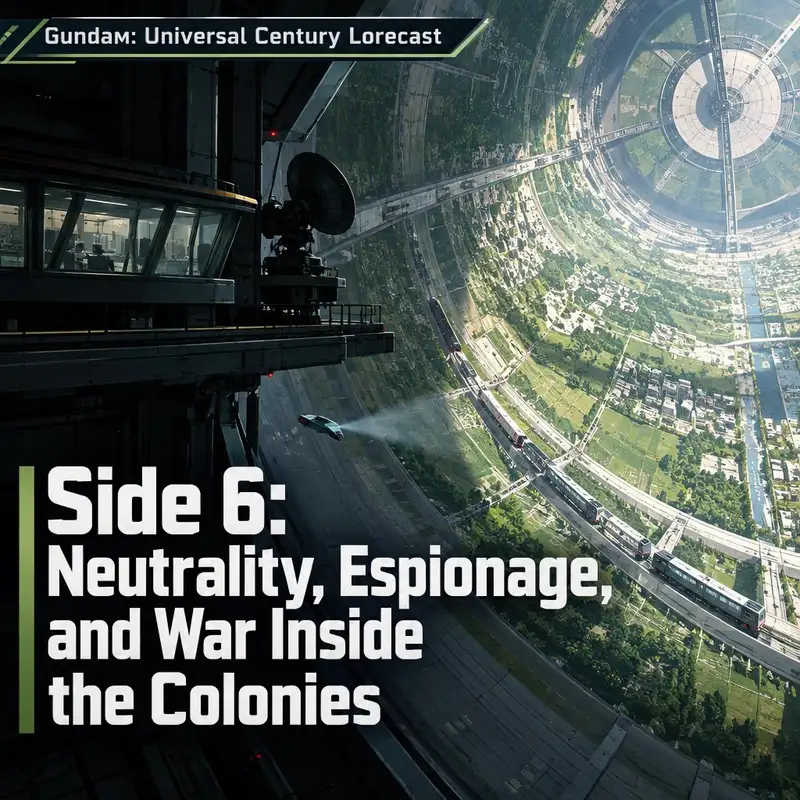
Side 6: Neutrality, Espionage, and War Inside the Colonies
A damaged warship approaches Side 6 looking for something more valuable than a friendly harbor. It needs time. Time for technicians to inspect damage, time to replace parts, time to restore systems that cannot be repaired by courage or a fresh magazine of ammunition. White Base has reached neutral space late in the One Year War, but its refuge is imperfect. The commercial floating dock that can service the ship lies outside the strongest protection of Side 6’s neutral boundary. That small fact creates the operational problem. The ship cannot remain safely in open space. It cannot receive repairs without exposing itself. And the Zeon commander pursuing it does not need to invade the colony to exploit the situation. He only needs to wait until White Base crosses the line where political restraint becomes less certain.
Side 6 was neutral, but neutrality did not mean that war had passed it by. During the One Year War, any colony region with transport access, skilled labor, docking facilities, communications, and civilian commerce possessed military value whether its government wanted that role or not. A neutral colony could not make itself irrelevant simply by declining to join either belligerent. Ships still needed repair. Crews still needed food, medicine, and information. Merchants still saw contracts. Intelligence services still saw access. Military planners still saw a place where an enemy might hide, recover, or move something important under a civilian flag.
The precise constitutional history of Side 6 is not entirely consistent across Universal Century reference traditions. It is often associated with the Riah Republic, and official chronology places its declaration of neutrality early in Universal Century seventy-nine. Other accounts place its autonomous status earlier. The important point is not a legal date. It is that Side 6 claimed a political position separate from direct participation in the war. Its authorities had to preserve that claim while surrounded by powers whose military operations could reach the colony at any time.
That was an extremely difficult position. Neutrality is not a force field. It is a status maintained by diplomacy, commercial usefulness, local administration, and the expectation that violating it will impose costs on someone. Those costs may be legal, political, economic, military, or simply reputational. A belligerent that attacks an openly neutral colony risks alienating civilians, disrupting trade, damaging facilities it may later need, and giving its enemy a powerful propaganda advantage. But a neutral state also has to convince outsiders that its territory will not become a military base in all but name.
Side 6 therefore existed inside the war’s geography without fully belonging to either side’s war effort. That distinction mattered. The Earth Federation and the Principality of Zeon could not casually treat the colony as an occupied base. Neither could assume that open violence inside its protected space would be consequence-free. Yet both could seek commercial access, collect information, cultivate contacts, send personnel through civilian traffic, and watch for opportunities just beyond the border. Neutrality imposed constraints. It also created edges, loopholes, and ambiguities. War tends to collect around such places.
The colony’s value was practical before it was ideological. A shipyard, dock, warehouse, clinic, or transport terminal can be strategically significant without carrying a military insignia. Side 6 offered the kind of infrastructure that makes an inhabited colony function: skilled workers, industrial capacity, food distribution, transit routes, repair services, housing, and communications. Those were civilian systems, but civilian systems are often what keep military forces alive. A damaged warship does not become less damaged because it has entered neutral territory. It still needs tools, parts, labor, and a place to conduct repairs without drifting into combat.
Commercial neutrality could also be profitable. Pergamino, the proprietor associated with the floating dock used by White Base, represents an uncomfortable but realistic feature of wartime neutrality. A neutral businessman could provide services to vessels from either side without formally joining either side’s cause. In theory, that business served commerce. In practice, it served war as well, because commerce and logistics were never cleanly separable in the Earth Sphere. The dock did not need to fire a weapon to become militarily relevant. It only needed to keep a warship operational.
This was not hypocrisy unique to Side 6. It was the condition of any civilian economy attempting to survive amid total war. A colony government could want peace, local autonomy, and continued trade. Its merchants could want income. Its residents could want normal life. None of those desires erased the fact that an enemy ship might also need repairs, shelter, supplies, or information. The alternative, refusing all contact, would have required a degree of isolation that few inhabited colonies could sustain. Neutrality was never the same thing as self-sufficiency.
In the television account of White Base’s passage through Side 6, the ship arrives carrying the accumulated wear of a long campaign. Its crew cannot simply press onward because the strategic situation demands it. Warships are systems. Their weapons, engines, sensors, launch equipment, hull integrity, and embarked mobile suits all depend on maintenance. The same is true of the people aboard. Pilots require rest. Mechanics need parts and workspace. Medical personnel need supplies. Commanders need time to assess what remains usable and what has become a liability.
White Base’s turn toward Pergamino’s floating dock therefore reveals a basic military truth. A ship can survive battle and still be operationally defeated if it cannot recover afterward. The dock offers a solution, but it is not a military facility under Federation protection. It is commercial infrastructure operating near neutral space. That means White Base gains access only by accepting vulnerability. The ship has to move where the dock is. The dock has to remain exposed enough to conduct business. The neutral boundary protects a political space, but maintenance happens in physical space, where a vessel must approach, halt, connect, and remain still long enough for technicians to work.
For Zeon, White Base’s repair requirement is an opportunity. Dozle Zabi wants the ship destroyed. By this stage of the war, White Base has become more than another Federation vessel. It has demonstrated unusual resilience, carried an important mobile suit force, and repeatedly survived encounters that should have eliminated it. From Dozle’s perspective, removing it would have military value and symbolic value. Conscon is sent to do precisely that. His task is not merely to find White Base. It is to destroy it where the political restrictions surrounding Side 6 can be minimized.
Official reference material describes Conscon’s force as including a Chivvay heavy cruiser, two Musai-class light cruisers, and twelve Rick Doms. The exact count is less important than what the force represents. This is not an improvised patrol stumbling across a target. It is a deliberate effort to bring enough mobile suits and supporting ships to overwhelm White Base once it moves outside the protected zone. The Rick Dom was suited to space combat, and their employment reflects Zeon’s continuing effort to use mobile suits as the striking arm of fleet operations under Minovsky conditions.
Conscon’s plan depends on a simple operational calculation. Neutrality protects a location more effectively than it protects movement to and from that location. The moment White Base leaves the most defensible political space to reach the dock, it becomes a target in a more permissive environment. Zeon does not have to announce an assault on Side 6 itself. It can frame the engagement as an attack on a Federation warship outside the colony’s protected boundary. The distinction may feel thin to civilians watching the battle, but to commanders it matters. It changes the diplomatic risk.
The destruction of the floating dock makes that distinction morally and strategically uncomfortable. The dock is not simply scenery between White Base and the enemy. It is the infrastructure that allows neutral commerce to exist. Its loss damages the capacity of Side 6 to offer the services from which it draws both usefulness and independence. It also demonstrates that even when belligerents avoid a formal assault on a neutral colony, the facilities surrounding that colony may still become casualties of military calculation. The edge of neutral space can be as dangerous as a front line.
The White Base engagement was not preserved in exactly the same way by every version of the original story. The compilation films compress the Side 6 material and do not retain the floating-dock sequence in the same form as the television series. For the television account, however, the dock is central because it makes the logistics visible. White Base does not merely pass through a neutral region. It depends on that region’s commercial infrastructure, and that dependency gives Zeon a way to apply pressure without openly occupying the colony.
A second engagement near Side 6 deepens the political meaning of the episode. The colony is not merely a backdrop for warships and mobile suits. Its television station broadcasts the fighting. Residents can watch the war approaching their community through a medium that turns military action into public knowledge. A local audience does not need access to classified plans to understand that neutral space is under strain. It can see ships maneuvering nearby. It can see combat. It can see that the distinction between protected territory and dangerous territory has become fragile.
Public visibility matters because it narrows the room for denial. A government may insist that its neutrality has been respected. A military command may claim that it attacked only legitimate enemy forces outside protected space. Both statements can contain some truth while leaving civilians with a more immediate impression: the war is close enough to threaten their homes, commerce, and future. Broadcasting does not stop an attack. It does not make a neutral authority militarily powerful. But it transforms combat into a political event witnessed by people whose cooperation and confidence are necessary for the colony to function.
That is the first Side 6 lesson. Neutrality can force war to operate indirectly. It can push combat outward, toward approaches, docks, and transit routes. It can make commanders consider appearances and legal boundaries. But it does not remove the military value of a colony. In some ways, it heightens that value. A place where neither side can act openly may become especially attractive for activities that require secrecy, deniability, or civilian cover.
The December events at Ribo Colony, told in Mobile Suit Gundam 0080: War in the Pocket, show the other side of that equation. White Base’s experience concerns war pressing against Side 6 from outside. Ribo Colony shows war already operating within neutral space. There is no need for a fleet to cross a boundary in force when personnel, equipment, and classified work have entered quietly. The battlefield is no longer a dock or an approach route. It is a lived-in colony, with homes, schools, public spaces, and ordinary routines continuing around a military secret.
The Federation’s secret in Ribo Colony is the Gundam NT-1 Alex. Developed through the Federation’s Newtype-related research effort and moved through the Arctic, the Alex is assembled and adjusted at a concealed facility in Side 6. The choice of location is revealing. A neutral colony offers civilian cover and distance from an obvious Federation military base. It may also seem less likely to face an open Zeon assault because such an assault would violate the political understanding surrounding Side 6. For a weapons-development program, that combination of concealment and assumed restraint is valuable.
But the Alex is not a ready answer to the war. It is a prototype. Its promise depends on testing, specialist maintenance, secure handling, trained personnel, and a pilot who can become familiar with a demanding new machine. Christina Mackenzie is assigned to test it, not to lead an established combat unit into a planned campaign. The distinction matters. A prototype can be advanced and still be operationally immature. Its existence does not mean the Federation has solved Newtype integration, produced a standard doctrine, or created a machine that can be fielded across the fleet.
The hidden facility also reveals the limits of secrecy. A prototype must be built somewhere. Parts must arrive. Technicians must work. Test pilots must train. Security personnel must decide whom to admit and whom to exclude. The more complex the program, the more people, equipment, and logistical movement it requires. A neutral colony may conceal some of that activity inside normal commerce, but it cannot make the material reality disappear. Every secret project creates an intelligence signature. The question is whether the enemy can identify it in time and interpret it correctly.
Zeon’s initial attempt to deal with the Alex begins far from Ribo Colony. Cyclops Team attacks a Federation installation in the Arctic, seeking to seize or destroy the new Gundam before it can be moved. That effort fails to resolve the problem. The machine is transported to Side 6, and Zeon now faces an intelligence challenge shaped by neutral territory. The target has disappeared into an inhabited colony beyond the reach of an easy conventional strike. A fleet attack would risk political consequences and civilian catastrophe. The alternative is covert action.
The resulting Rubicon Plan sends Cyclops Team into Ribo Colony. The team is not a conventional mobile suit formation sent to win a battle through firepower alone. Its mission depends on infiltration, disguise, reconnaissance, local access, smuggled equipment, and the ability to identify a secret facility in a civilian environment. Steiner Hardy, Mikhail Kaminsky, Gabriel Ramirez Garcia, Andy Strauss, and Bernard Wiseman enter a space where the line between military activity and ordinary life has been deliberately blurred.
Neutral civilian territory provides excellent cover for espionage because people expect to see strangers. Ports receive cargo. Shops receive customers. Housing districts hold families, workers, travelers, and contractors. A person moving through that environment may be a merchant, a technician, a refugee, a student, or an intelligence operative. The same conditions that make Side 6 commercially alive make counterintelligence difficult. Security forces cannot treat every civilian movement as hostile without undermining the normality that neutrality is meant to preserve.
That creates risk for everyone. The Federation’s secret project places local residents near a military target without their informed consent. Zeon’s infiltration places agents and weapons inside an inhabited colony. The colony’s authorities may know some things, suspect others, or simply lack the capacity to identify every concealed operation. Civilian life becomes part of the operational environment. A child can overhear a conversation. A neighbor can notice unusual traffic. A local facility can become a target because soldiers on both sides have decided that its existence matters more than the safety created by political neutrality.
Alfred Izuruha sees this war from below, and his perspective is valuable precisely because it is incomplete. Al is not an intelligence officer. He does not know the full purpose of the Alex, the chain of command behind Rubicon Plan, or the calculations being made by senior officers far from Ribo Colony. What he sees are fragments. He sees unfamiliar soldiers, rumors, damaged places, and the sudden excitement of events that adults do not fully explain. His viewpoint captures how military secrecy appears to civilians: not as a coherent briefing, but as a series of disruptions that gradually reveal danger.
Cyclops Team’s first attack on the Federation facility is where covert war becomes open combat. The team has found its target, but destroying it is not a clean matter of placing explosives and withdrawing. The Alex is protected. The facility is staffed. The colony environment limits movement and increases the danger of collateral damage. A sabotage mission depends on surprise, but surprise alone does not guarantee success when the target is defended by an advanced mobile suit and when every action risks attracting attention from civilians and local authorities.
The battle demonstrates the vulnerability of a research program caught before it is fully integrated into a military system. The Alex has formidable capabilities, but its use is shaped by emergency. Christina Mackenzie is forced to defend the machine in conditions far removed from a controlled testing environment. The Federation has a prototype, a facility, technicians, and a test pilot. What it does not have is the freedom to employ the machine as if Ribo Colony were an ordinary military base. The very secrecy intended to protect the project constrains its defense.
The Cyclops Team operation also shows the difficulty of special operations conducted on the basis of incomplete intelligence. A commando team may be highly trained and still fail if it misunderstands the target, underestimates defenses, loses mobility, or cannot adapt once the mission becomes a firefight. The team enters Ribo Colony to eliminate a military asset. Instead, its members are drawn into combat inside a civilian community where concealment, extraction, and reinforcement all become harder. The operation is no longer clean, covert, or controllable.
Bernard Wiseman emerges from the immediate mission as the surviving Zeon participant who can still act against the Alex. That does not make him the master of the situation. It makes him a junior operator carrying a fragment of a collapsing plan. Bernard begins as part of a military mission with defined objectives and a team structure. As the operation fails, the distinction between official policy, local initiative, and personal responsibility becomes increasingly important. He learns more about the stakes, but he never gains the ability to control all of them.
The failure of the first operation should have led to reassessment. Instead, it produces escalation. Zeon commander Killing orders a far more extreme response: if the Alex cannot be eliminated, Ribo Colony itself is to be destroyed with a nuclear weapon. This is the moment when Side 6’s neutrality is tested most brutally. The problem is no longer whether a covert team can destroy a prototype. It is whether senior command is willing to kill a colony’s civilian population in order to deny the Federation a weapons-development success.
The threatened attack is not simply another tactical option. It is an effort to turn mass destruction into a solution for an intelligence and operational failure. Zeon has not been able to remove the Alex through the mission initially assigned. Rather than accept that failure, Killing is prepared to destroy the environment containing the target. Such a decision exposes the moral and institutional danger of compartmentalized command. Officers who see only a target may not see the people living around it. Leaders insulated by distance can treat a neutral colony as an obstacle, a hiding place, or a bargaining problem rather than a community.
Vice Admiral von Helsing recognizes the catastrophe embedded in the order. He understands that a nuclear attack on Side 6 would violate the restraints associated with the Antarctic Treaty and would destroy a neutral colony. His opposition matters because it shows that not every officer accepts the logic of escalation. Yet his position also shows the limits of individual dissent within a rigid command system. Recognizing that an order is wrong does not automatically give an officer the authority or ability to stop it. Military institutions distribute responsibility upward and downward, often leaving subordinates trapped between obedience and conscience.
Von Helsing’s eventual opportunity to surrender prevents the threatened nuclear strike from reaching its intended conclusion. That outcome matters, but it should not be mistaken for proof that the system worked. The crisis was not resolved because neutrality provided an impenetrable shield. It was resolved because circumstances changed, because individuals made choices, and because the escalation plan lost the support needed to carry it through. Ribo Colony survived a threatened atrocity, but it survived after the threat had already exposed how little protection legal status offers when senior command decides that restraint has become inconvenient.
Bernard’s final decision has to be understood in that context. His fight against the Alex is not an authorized conventional Zeon offensive launched after a coherent command decision. It is an improvised attempt to prevent the nuclear attack by destroying the machine that has become the pretext for it. Bernard acts because he understands enough to see that the stakes have changed. If the Alex can be eliminated, the argument for destroying the colony may disappear. His action is therefore both military and personal, shaped by the collapse of the plan that brought him to Side 6.
That does not turn Bernard into a solution to the larger institutional failure. One pilot in a damaged mobile suit cannot repair the command system that authorized nuclear coercion. He cannot restore the members of Cyclops Team already lost. He cannot make the Federation’s secret weapons project harmless to the civilians around it. His initiative matters because individual choices can interrupt disaster at the tactical level. But its limits matter just as much. The crisis exists because governments and military commands placed a prototype, a commando team, and ultimately a nuclear threat inside the same civilian space.
Christina Mackenzie is also caught in that collision between institutional plans and immediate survival. She is testing a machine designed for a highly specialized purpose, yet the emergency turns her into a combatant defending the colony around the facility. Her fight with Bernard is not a clean contest between representatives of equal forces. It is the final compression of a much larger failure. Zeon has failed to destroy the Alex through covert action. The Federation has failed to keep its project invisible and insulated from civilian risk. Ribo Colony has failed, through no simple fault of its residents, to remain outside the war that both powers brought into it.
Alfred sees the final consequences through the narrow frame of personal connection. He understands enough to care, but not enough to grasp the full chain from Arctic raid to covert mission to nuclear threat. That is how civilian experience often works in war. People do not receive the complete operational picture. They experience the effects: the damaged street, the missing neighbor, the unfamiliar military vehicle, the adult conversation that stops when they enter the room, the person who leaves and does not return. The historical record can reconstruct the command decisions. The resident lives with their aftermath.
The battle inside Ribo Colony is especially disturbing because familiar civilian terrain becomes military terrain. Streets, wooded spaces, homes, and local infrastructure become places through which mobile suits move and fight. The colony is not destroyed, but that is not the only measure of harm. Combat changes the meaning of ordinary places. It damages confidence in the institutions that claimed to protect them. It teaches residents that a secret facility may exist near their homes and that distant commanders may be willing to use their community as leverage in a war they did not choose.
This is why Side 6 cannot be understood simply as a successful neutral haven or as a place where neutrality was meaningless. Neutrality achieved real things. It gave Side 6 political space that neither major power could ignore casually. It supported civilian autonomy and commercial life. It made open occupation and unrestricted attack more costly. White Base had to maneuver around the boundary. Conscon had to exploit the edge of protected space rather than simply attack through the colony. Zeon used infiltration at Ribo because a conventional strike carried consequences it preferred to avoid.
At the same time, neutrality created an environment that both sides could use. White Base sought repair through neutral commerce. The Federation concealed the Alex project inside Ribo Colony. Zeon inserted an infiltration team through civilian life. Intelligence operations benefited from the traffic, anonymity, and ambiguity that made the colony economically viable. Neither power openly controlled Side 6. Both found ways to gain access, conceal activity, and place military burdens on a population that had not joined the war.
The tactical results were mixed. White Base gained an opportunity to seek repairs, though the destruction of the floating dock showed how precarious that support could be. The Alex survived the immediate Zeon threat, but it was damaged, and it never became the decisive operational weapon its designers may have hoped to field. Cyclops Team reached its target but failed to complete its original mission. Bernard’s final action helped interrupt the logic of nuclear escalation, but it came at immense personal cost and did not undo the damage already caused by the covert campaign.
Operationally, Side 6 showed that neutral space could redirect war rather than exclude it. Belligerents could pressure the boundaries, attack targets outside the most protected zone, use commercial infrastructure, hide classified projects, and substitute sabotage for conventional assault. This was not peace. It was a different kind of battlefield, one in which the decisive questions involved access, concealment, legal risk, and deniability as much as firepower. The colony’s neutrality shaped the form of conflict. It did not end the conflict.
Strategically, Side 6 remained vulnerable because it was useful. A location that provides repair capacity, transport routes, industrial skill, and civilian cover cannot remain invisible to military planners. The more valuable the colony becomes as a sanctuary, the more tempting it becomes as a target or an operating base. Neutrality can survive only while major powers believe that respecting its broad limits serves their interests better than violating them. Once a commander decides that a pursuit, prototype, or political objective outweighs those limits, the neutral boundary becomes something to evade or destroy.
The civilian lesson is the hardest one. The residents of Side 6 did not control White Base’s need for repairs. They did not order the Federation to hide the Alex in Ribo Colony. They did not send Cyclops Team into their streets, and they did not authorize a nuclear strike. Yet they bore the risk created by each decision. Neutrality gave them a measure of protection, but it did not give them control over the military systems operating around and beneath their lives.
Side 6 demonstrates that neutrality in the Universal Century was not a wall around civilian life. It was a negotiated condition maintained by commerce, diplomacy, and the expectation that open violence would cost more than it gained. That arrangement gave the colony room to survive, but it also made Side 6 useful to every force that needed concealment, repair, access, or plausible deniability. When commanders decided that a prototype or a pursuit mattered more than the people living behind the neutral boundary, the boundary did not disappear. It became the line they tried to exploit, evade, or destroy.