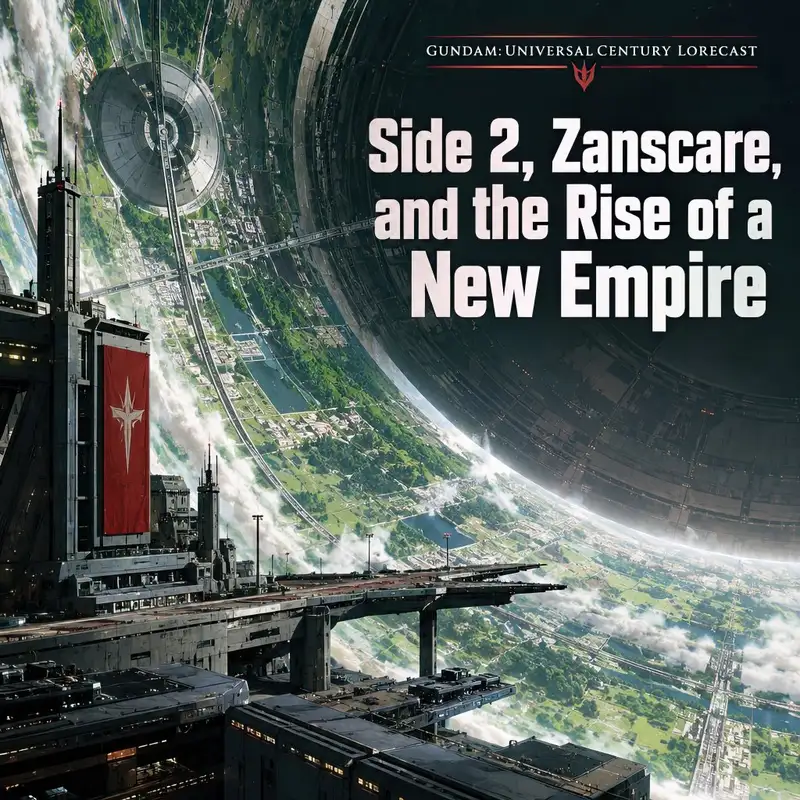
Side 2, Zanscare, and the Rise of a New Empire
In Amelia, the sound of the guillotine was part of political life. It was not simply an instrument of execution, though it was certainly that. It was a public declaration that the old order had ended, that the new rulers could judge the powerful, and that they possessed the machinery to make judgment final. In a late Universal Century marked by distant government, weak institutions, and exhausted populations, that kind of certainty had an audience. The guillotine promised that corrupt elites would no longer escape consequence through status or connections. It also warned every citizen that the state had claimed the right to decide who belonged within the new moral order.
That contradiction was built into the Zanscare Empire from the beginning. Its public language centered on Maria Pure Armonia, a woman associated with healing, compassion, and a critique of male-dominated political power. Yet the regime that elevated her image relied on public terror, surveillance, military occupation, and eventually war far beyond Side Two. Zanscare was not merely an army that happened to possess a religious symbol. It was a political movement that fused moral renewal with coercive state formation. The question is not why its leaders were hypocritical. Most authoritarian systems contain hypocrisy. The more important question is how that combination became persuasive, organized, and militarily formidable enough to challenge the Earth Federation.
Side Two was not an empty patch of space waiting for an empire to appear on a map. It was a community of colonies, ports, industries, families, administrators, workers, and political factions living within the declining political structure of the late Earth Sphere. By Universal Century one hundred fifty-three, the Federation still existed, still fielded armed forces, and still claimed authority over its colonial population. But authority is not the same thing as effective government. The Federation’s capacity to provide security, representation, and confidence had weakened unevenly across the Sphere. Its institutions remained large, but size did not guarantee responsiveness. In many places, central power had become slow, fragmented, and detached from local political conditions.
But a genuine grievance does not dictate a democratic outcome. A society frustrated with corruption and neglect may seek representation, local security, or reform. It may also accept a movement that offers order in exchange for obedience. That was the opening available in Side Two. The appeal of Zanscare did not begin with an invasion fleet. It began with the political weakness of the system that was supposed to prevent such a fleet from becoming necessary, or possible. When established institutions appear unable to punish corruption, protect communities, or give people a meaningful voice, a movement that promises moral clarity can acquire extraordinary power.
Maria Pure Armonia supplied much of that moral clarity. Official accounts present her as a woman who had known poverty and became known for unusual healing abilities. The exact nature of those abilities is not the point here, and the series does not require us to reduce them to a settled scientific category. What mattered politically was her reputation. Maria became associated with care for the vulnerable, spiritual authority, and a vision of society that rejected the violence and arrogance of established male leadership. In a political culture that many residents experienced as remote, hierarchical, and indifferent, that image could be deeply compelling.
Mariaism was not simply a cult of personality imposed on an unwilling population from above. It addressed real exhaustion. It offered a language of renewal to people who had watched governments fail, military institutions decay, and public life become the preserve of entrenched interests. Its maternal imagery mattered because it suggested protection rather than predation. Its criticism of male-dominated power mattered because the existing order had given people ample reason to associate authority with hierarchy, neglect, and violence. Maria’s public persona made it possible to imagine that Side Two could become something other than another Federation dependency ruled from a great distance.
Yet Maria the person, Maria the public symbol, and Mariaism as a political instrument were never identical. A movement can begin with sincere ideals and still be reshaped by those who understand organization, fear, and ambition better than its spiritual leader does. Maria’s image could unite supporters, but it could not independently manage a party, build a security apparatus, supervise an arms industry, command fleets, or suppress rivals. Those tasks required institutions. They required people prepared to turn moral authority into administrative power. And in Zanscare, the man who understood that process best was Fonse Kagatie.
Kagatie was the leader of the Gatie Party, officially the chancellor serving beneath Queen Maria. In formal terms, that arrangement made him her subordinate. In practical terms, he controlled the levers that determine who rules during a crisis: party organization, military force, punishment, planning, and access to information. He led BESPA, Zanscare’s military organization. He was associated with the regime’s guillotine punishments. He directed strategy while Maria provided the political language that made the new order appear humane. It was a division of labor with enormous consequences.
Calling Maria only a puppet misses the point. Her authority was real in the sense that people believed in it, responded to it, and saw it as an alternative to the old order. A figurehead with no public appeal is merely decorative. Maria was more than decorative. Her reputation gave the regime a moral face that Kagatie could not have supplied himself. The problem was that her influence depended upon what she was permitted to know and what she was allowed to decide. As the state expanded, the more violent parts of its policy could be compartmentalized. Military operations could be managed elsewhere. Executions could be described as justice. Occupation could be presented as security. The queen could remain a symbol of compassion while others made war in her name.
Kagatie’s achievement was therefore institutional before it was military. He understood that a political movement needed more than applause and religious enthusiasm. It needed offices, loyal officials, controlled communications, disciplined armed forces, secure transport, weapons procurement, and a method of dealing with opposition. It needed a narrative that could portray punishment as renewal rather than terror. The guillotine served that purpose with brutal efficiency. It dramatized a break with compromised elites, but it also made dissent dangerous. Every public execution announced that the new system would not merely criticize the old one. It would eliminate those it defined as enemies.
This was the darker logic of Zanscare’s state formation. Anti-Federation feeling created a political opening. Mariaism made a new moral order imaginable. Kagatie’s party transformed that imagination into a hierarchy. The hierarchy then used coercion to prevent the movement from being redirected by critics, rivals, or even its own ideals. The result was not a spontaneous revolt of all Side Two residents. Support varied. Fear varied. Many people may have welcomed local autonomy while rejecting imperial war. Others may have had little freedom to express their doubts at all. In a coercive environment, public loyalty is never a simple measure of consent.
Reference chronologies commonly place the proclamation of the Zanscare Empire around Universal Century one hundred forty-nine. That date is useful as a broad marker, but the television series itself enters the story with the empire already established by Universal Century one hundred fifty-three and reveals much of its political background gradually. What matters more than a single proclamation date is the sequence of consolidation. A local movement acquired a party structure. The party gained control over political space. Public punishment and security institutions narrowed the room for opposition. Maria’s authority became the state’s moral foundation. BESPA gave that state armed force. And the title of empire expressed a claim that went beyond local self-government.
An empire is not defined only by a crown, a flag, or a ruler’s title. It is defined by structures of command and subordination. Zanscare claimed the right to organize Side Two under its own political system, but it also developed the capacity to impose its will on neighboring communities and, eventually, on Earth itself. The move from autonomy to empire was not accidental. Once Kagatie’s regime possessed military institutions, political legitimacy, and the means to punish dissent, it faced incentives to expand. Expansion could secure routes, acquire strategic depth, defeat rivals before they interfered, and prove that the new state was more than a fragile colonial rebellion.
That required BESPA. The organization was not merely a collection of mobile-suit pilots in distinctive uniforms. BESPA was the institution that translated Zanscare’s political claims into enforceable power. It could suppress opponents within the empire, protect the capital, contest nearby space, seize territory, and support operations on Earth. Its effectiveness depended on more than charismatic officers or individual machines. A force capable of conducting fleet warfare and invasion needs trained pilots, mechanics, command staffs, ship crews, communications systems, depots, maintenance facilities, transport capacity, and an industrial structure capable of replacing losses.
The Zoloat illustrates the point. It is identified as Zanscare’s first successfully mass-produced space mobile suit, and that description matters more than a list of technical figures. A mass-produced machine represents an institutional accomplishment. It means designers, factories, technicians, training programs, and supply systems have produced something that can be fielded beyond a single prototype squadron. The Zoloat gave BESPA a standard mobile-suit foundation in space, one from which later systems and specialized roles could develop. It did not mean every Zanscare unit had identical equipment or that the empire possessed unlimited numbers. Exact production totals are not securely established. But it demonstrates that Zanscare had crossed the threshold from political movement to serious military power.
Its fleet architecture mattered just as much. The Amalteia class, with mobile-suit catapults and substantial firepower, represented the sort of modern warship required to integrate mobile-suit operations into fleet combat. A mobile suit can be agile and destructive, but it does not create strategic reach by itself. It needs a ship to move it between theaters, launch it into combat, recover damaged machines, carry spare parts, sustain pilots, and provide command support. A battleship or carrier must also defend itself, coordinate formations, manage ammunition and propellant, and keep operating after damage. Zanscare’s ability to field such vessels showed that its military program was not built around isolated duels.
The same is true of its Earth operations. A colonial power invading Earth needed more than space mobile suits. It required atmospheric systems, transports, landing plans, ground maintenance, occupation forces, and a way to connect orbital command with operations under gravity. Zanscare’s military inventory was differentiated because its strategy was differentiated. Some forces were intended for fleet action. Others supported ground combat, atmospheric movement, or local security. This was not an improvised insurgency armed with a few captured machines. It was a state military, though one whose exact size and distribution remain uncertain.
That institutional strength gave Kagatie options. BESPA could defend Zanscare’s political center, but defense alone would not secure the empire’s future. Side Two existed within a contested region of colonies, transport routes, and Federation authority. A new regime that waited passively for intervention would remain vulnerable. It needed initiative. It needed to demonstrate that the Federation could not simply reassert control whenever it chose. And it needed to establish the sort of local military superiority that would make other actors reconsider their own positions before challenging Zanscare.
Mutterma Zegan’s operations were important in that regard. As a senior Zanscare commander and an old associate of Kagatie from their Jupiter-connected past, Mutterma commanded forces that achieved early successes against surrounding colonies and against the Federation fleet in the Side Two region. Those victories should not be exaggerated into proof that Zanscare dominated every approach to Side Two forever. The series does not provide a reliable basis for a precise order of battle or total regional balance sheet. But the operational significance is clear. Zanscare could fight and win fleet actions against established opposition.
Local space control gave the new empire breathing room. It protected its political consolidation from immediate intervention. It secured movement between colonies and military facilities. It disrupted Federation efforts to respond through familiar channels. It also made Zanscare’s claims appear credible to undecided observers. Political authority often depends on an audience believing that the government can survive. A party may promise a new order, but if the first serious fleet arrives and removes its leadership, that promise ends quickly. Mutterma’s successes showed that Zanscare could defend its position and impose costs on those who challenged it.
Still, victory in nearby space did not automatically create political control over every colony. A fleet can clear a route, intimidate a government, or defeat an opposing formation. It cannot manufacture loyalty among civilians. It cannot guarantee that occupation will be cheap or that a population will accept the ideology attached to its conquerors. This was one of the limits already present within Zanscare’s success. Its military power made expansion possible. Its political rhetoric justified expansion. But every new community brought different interests, resentments, and opportunities for resistance.
The move toward Earth made that problem far more severe. By Universal Century one hundred fifty-three, Zanscare had occupied Largaine in Europe and used it as a forward base for its campaign on Earth. Largaine was not merely a battlefield location. It was a bridgehead. For a force based in Side Two, a European city offered a place to land personnel and equipment, establish supply stocks, maintain machines under terrestrial conditions, coordinate local security, and launch further operations. It connected the empire’s orbital resources to an expanding ground war.
A bridgehead on Earth demands a different kind of military competence than a victory in space. Forces must survive reentry and landing. They must move equipment across roads, cities, and damaged infrastructure. They must find fuel or propellant, ammunition, spare parts, food, water, medical care, and sheltered maintenance areas. Space-oriented mobile suits may need specialized support under gravity. Occupation forces must distinguish enemy combatants from civilians, or at least decide whether they care to make that distinction. Local populations may resist, collaborate, flee, or simply try to survive while armed forces turn their communities into military terrain.
Chronicle Asher’s initial assignment at Largaine placed him at this meeting point between imperial politics and military expansion. As Maria’s younger brother and a Zanscare officer, Chronicle had status that no ordinary field commander possessed. He was a capable pilot and military figure, but he was not the architect of the regime. His family connection gave the empire a visible link between the queen’s household and the war being fought in Europe. That link mattered symbolically. It suggested that the royal order was not detached from the military campaign. But the broader policy still belonged to Kagatie and the institutions he controlled.
The occupation of Largaine showed what Zanscare’s imperial project meant in practical terms. A state that began by claiming renewal within Side Two was now projecting armed authority into Europe. Its argument could no longer be limited to colonial dignity or local self-government. It was governing, or attempting to govern, people far from the political community whose frustrations had helped bring it to power. For civilians in occupied territory, the politics of Amelia became immediate. They were expressed through patrols, checkpoints, requisitions, arrests, military installations, and the constant possibility that their city would become a target.
For that reason, colonial military power and terrestrial governance must be kept separate. Zanscare could land forces, seize facilities, and establish bases. None of that meant it could create legitimate rule on Earth. A colony empire might portray itself as an alternative to Federation decay, but occupation reproduces many of the same problems in more immediate form. Who makes the rules? Who controls movement? Who benefits from security? Who bears the cost of military priorities? The answers at Largaine were not determined by Mariaism’s language of compassion. They were determined by BESPA’s needs and Kagatie’s strategy.
Amelia, the Zanscare capital, reveals the other side of that system. It was not simply a sinister command center. It was a living city and the political heart of a state. Residents needed food, medicine, transport, work, and access to basic services. Officials needed to administer civil life even while security forces guarded the regime. The capital’s importance came from its symbolic role as well as its military function. It was where Maria’s image was concentrated, where the empire presented itself as orderly and legitimate, and where the machinery of government could be seen operating.
The League Militaire’s infiltration of Amelia makes that complexity visible. The operation was tied to the need for medical treatment for an ill child, a small but important reminder that civilian survival does not stop because governments are at war. Access to medicine in a militarized capital becomes political. Movement through the city requires contacts, deception, and an understanding of who controls which spaces. The mission demonstrates that the capital was heavily guarded, but not sealed off from the human needs and informal relationships that make every security state more permeable than it appears.
The infiltration also exposed the regime’s military character. The League’s actions in Amelia involved attempts to extract people from the center of Zanscare power, the freeing of Federation prisoners, and the destruction of a nuclear weapons cache. Those events should not be reduced to an action sequence. Their larger significance is that Zanscare’s capital contained both civilian life and concentrated coercive capacity. Prisoners, guarded facilities, and nuclear weapons did not exist on the margins of the state. They were part of what the state had become. The promise of a gentler political order was now defended by institutions prepared for large-scale violence.
At the same time, the League’s ability to penetrate Amelia showed a weakness common to centralized systems. Security can control formal access, but it depends on people obeying routines, sharing reliable information, and believing that fear will prevent cooperation with opponents. A resistance organization with local knowledge, civilian contacts, and willingness to accept risk can exploit gaps between official control and lived reality. No capital is an impregnable fortress when its government must still function through ordinary people. The more a regime relies on secrecy and compartmentalization, the more dangerous it becomes when those compartments are breached.
That breach also mattered for Maria herself. Her public role was indispensable to Zanscare, but the series makes clear that she did not possess full knowledge of the war conducted in her name. She initially sought to direct the new state toward a better order. As Kagatie’s power expanded, however, she was increasingly isolated from the realities of invasion and repression. This was not merely a personal tragedy within a royal family. It was an institutional method. By restricting what the symbolic leader knew, the regime could preserve her moral value while allowing operational decisions to be made by those committed to military expansion.
This does not erase Maria’s responsibility. Her name, her authority, and her ideology helped make Zanscare legitimate. People who trusted her could be drawn into a system that used their trust for purposes they might not have endorsed. Political symbols are not innocent merely because they lack full operational control. But responsibility has levels. Maria was not Kagatie. She did not command BESPA in the way he did, control the state’s coercive machinery in the same way, or set the empire’s military strategy. The moral fracture within Zanscare came from that division. Compassion was placed at the top of the state’s public image, while violence was delegated downward and outward.
The regime’s use of female moral authority was therefore not a rejection of domination. It was a rebranding of domination. Mariaism criticized an old political order shaped by men who treated power as entitlement. Yet Kagatie’s system concentrated power in a familiar pattern: party control, military command, censorship, public punishment, and exclusion from decision-making. The empire could speak of maternal care while sending soldiers into Europe. It could condemn old elites while creating new untouchable officials. It could promise social renewal while making civilians dependent on a security state. Its language changed. Its structure of authority became more severe.
Opposition to Zanscare did not emerge only from loyalty to the Earth Federation. That distinction is essential. The League Militaire formed because people recognized that Federation weakness had created a dangerous vacuum, but they also recognized that Zanscare was filling that vacuum with empire rather than freedom. The League brought together committed civilians and people with military experience who were unwilling to wait for a slow and uncertain Federation response. Its existence demonstrated that the political alternatives of the late Universal Century were not limited to accepting decaying Federation rule or accepting authoritarian colonial nationalism.
Hangelg Evin, one of the League’s founders, represented the importance of organization in resistance as much as Kagatie represented it in state building. The League needed people who could create networks, move personnel, gather intelligence, acquire equipment, and sustain operations in the face of a stronger formal military. Its development of the Victory system was part of that response. The machine mattered not because one advanced mobile suit could solve the war, but because it reflected an attempt to build a usable military capability outside the failed rhythms of Federation procurement and Zanscare control.
The League Militaire’s existence is central to understanding Side Two. The crisis was not a simple Earth-versus-space conflict. Side Two contained people with grievances against the Federation, people attracted to Maria’s promise of renewal, people who served the Zanscare state, people who benefited from it, people intimidated by it, and people who resisted its expansion. Earth itself contained Federation institutions, local communities, collaborators, prisoners, occupiers, and resistance networks. The lines of conflict ran through societies as well as between them. Zanscare’s propaganda required a cleaner story. History did not provide one.
Its military successes were real. BESPA could fight local opponents, conduct fleet operations, field mass-produced mobile suits, integrate them with capital ships, and establish a bridgehead on Earth. At the tactical level, that made Zanscare dangerous. At the operational level, Side Two possessed enough industry, organization, and command structure to sustain more than a symbolic revolt. Amelia served as a political center. BESPA supplied armed power. Senior commanders such as Mutterma could act across the regional space environment. Officers such as Chronicle carried the empire’s authority into ground campaigns. These were the components of a state capable of war.
At the strategic level, Zanscare benefited from initiative. The Federation’s decline did not guarantee Zanscare victory, but it gave the empire time to consolidate before a coherent response could form. In a fragmented political environment, speed matters. A movement that controls the capital, organizes armed forces, secures nearby approaches, and presents a compelling public ideology can become difficult to dislodge before its opponents agree on what it is. Is it a local autonomy movement? A religious revival? A military threat? A legitimate government? By the time those questions are settled, the movement may already possess fleets and occupied territory.
But Zanscare’s strength contained the seeds of weakness. Its authority was concentrated around Kagatie’s control of party, military, and information. Its moral legitimacy depended heavily on Maria’s public image. Its military capacity relied on centralized institutions and elite commands. That made the empire formidable, but also brittle. A system that suppresses open disagreement can act quickly, yet it loses the corrective information that disagreement provides. A leader shielded from the consequences of policy may remain politically useful, but the gap between symbol and reality grows. An empire that expands through coercion gains territory while accumulating populations with reasons to resist.
Its industrial and military base also had limits. Side Two could produce serious weapons and sustain modern fleets, but the evidence does not support treating Zanscare as an unlimited industrial power. Advanced systems, specialized ships, trained crews, and capable officers are expensive to replace. Every operation on Earth lengthened supply lines and increased the burden on maintenance, transport, and command. Every occupied city required troops who could no longer be used elsewhere. Every political opponent who was silenced rather than persuaded remained a potential source of instability. Military power can seize initiative. It cannot eliminate the cost of holding what has been seized.
For civilians, the promise of order became inseparable from fear. In Side Two, public punishment taught people what political disagreement might cost. In Amelia, security restrictions and militarization shaped ordinary life, including access to medical care and movement through the city. In occupied Europe, the empire’s strategic ambitions arrived as a foreign military presence. The people living under Zanscare did not experience its rise as an abstract argument about constitutional authority. They experienced it through uniforms, patrols, guarded facilities, propaganda, shortages, danger, and the knowledge that a state claiming compassion also possessed the guillotine.
For that reason, Zanscare cannot be understood as simply another version of Zeon or as a generic late Universal Century villain. It emerged from its own conditions. It used its own ideological language. Mariaism gave it a distinctive claim to moral authority, rooted in social renewal and rejection of exhausted patriarchal power. Kagatie gave that claim the machinery of a party-state. BESPA gave it fleets, mobile suits, transport, and the ability to turn political ambition into military action. The combination was historically potent because each part compensated for what the others lacked.
Mariaism without organization might have remained a movement of moral protest. Kagatie without Maria might have been another ambitious strongman with limited popular appeal. BESPA without a political base would have been a military force in search of a state. Together, they created an empire. Yet the empire never resolved the underlying problem that had made its rise possible. Side Two’s people wanted dignity, security, and meaningful political power. Zanscare answered that demand by centralizing authority, ritualizing violence, and exporting war. It replaced a distant and failing order with a closer, more disciplined, and more dangerous one.
Side Two therefore became one of the clearest late Universal Century examples of a recurring political failure. When an old system cannot credibly provide representation, security, or justice, people do not automatically receive freedom. They may instead receive a movement that speaks the language of liberation while building institutions of domination. Zanscare rose because Federation decline created the political space, Maria supplied the language of renewal, Kagatie organized coercion behind that language, and BESPA made the new order militarily credible. Its rise proved that the collapse of legitimacy can create a new empire long before it creates a freer society.