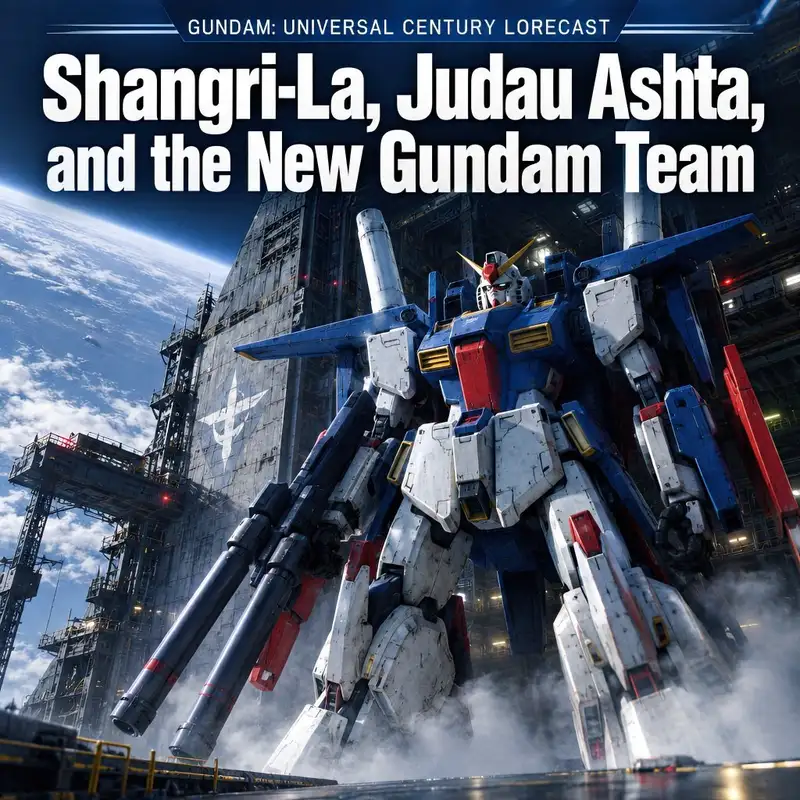
Shangri-La, Judau Ashta, and the New Gundam Team
The Argama arrived at Shangri-La carrying some of the most valuable surviving military hardware in the Earth Sphere, and almost no reliable way to use it. The Anti-Earth Union Group had helped break the Titans in the Gryps Conflict. On paper, that made the Argama part of the winning side. In practice, victory had left the ship battered, its veteran network scattered, and its combat strength dangerously thin. Its most capable mobile suit, the Zeta Gundam, was still aboard. So were the Gundam Mark Two and the Hyaku Shiki. But machines do not operate themselves, and the pilot most associated with the Zeta, Kamille Bidan, was incapacitated. The Argama needed repairs, supplies, replacement personnel, and a safe route away from its enemies. Instead, at Shangri-La, it found a fourteen-year-old junk dealer trying to steal the Zeta Gundam and sell it. That is the starting contradiction of the new Gundam Team. It was not formed by a confident military organization selecting the best graduates from a training pipeline. It emerged because a damaged warship had rare equipment, a hostile force closing in, and too few adults left who could fly the machines.
The larger political situation made that shortage especially dangerous. The Titans had been defeated, but the Anti-Earth Union Group, usually called the AEUG, had not emerged from the conflict as a stable government or as the unquestioned core of a rebuilt Federation military. It was a coalition created to resist a security apparatus that had become a threat to the people it claimed to protect. Coalitions are often very good at opposing a common enemy. They are less reliable at converting battlefield success into lasting institutions. The AEUG had ships, pilots, sympathetic officers, and connections to industrial support. It did not have a secure rear area, a unified political center, or a deep reserve of trained replacements. That weakness created an opening for Neo Zeon, which entered the postwar vacuum while both the AEUG and the regular Federation forces were exhausted by the struggle against the Titans. The Argama’s repair stop was therefore more than a pause in a journey. It was a test of whether one damaged carrier could preserve enough combat power to remain relevant in a new war.
Shangri-La was not a military base built for that purpose. It was a colony, an inhabited section of Side One, with workers, families, shops, transit routes, docks, and all the vulnerable infrastructure necessary to keep a civilian population alive in space. It was also a place shaped by the military economy of the Universal Century. War leaves debris behind. It leaves damaged equipment, abandoned parts, informal markets, repair skills learned outside official schools, and people who understand that discarded military material can be turned into food, rent, medicine, or a chance to leave a place with no obvious future. Shangri-La’s salvage culture did not mean its residents were soldiers waiting to be recruited. It meant that military technology had become part of civilian life.
For teenagers growing up in that environment, a mobile suit was not only a weapon. It was also a machine with components that could be stripped, repaired, traded, or sold. That familiarity could create real technical competence. It could also create a dangerous illusion that military equipment was simply another form of property. The Argama represented opportunity before it represented a cause. Its arrival brought outsiders with expensive machines and urgent needs into a colony where many young people had learned to survive by finding value in other people’s losses. The practical knowledge of Shangri-La’s youths would become essential to the Argama. But it came from poverty and militarization, not from a healthy system of civic education or military preparation.
Judau Ashta stands at the center of this story because he embodies that contradiction more clearly than anyone else. He is fourteen years old, a junk dealer, and the older brother of Leina Ashta. His first relationship to the Zeta Gundam is not ideological. He does not board it because he has pledged himself to the AEUG, because he has studied its political goals, or because he has decided that Neo Zeon is a threat to the Earth Sphere. He sees an extraordinarily valuable machine and recognizes that it might solve immediate economic problems. That is opportunism, certainly. It is also the opportunism of a young person living in a colony where military wreckage has become part of the local economy.
Judau is not alone. Beecha Oleg, the oldest of the group, is fifteen. Mondo Agake, Elle Vianno, and Iino Abbav are fourteen. They are friends, rivals, accomplices, and, at times, liabilities to one another. They do not arrive as a disciplined squad with a chain of command and a common doctrine. Beecha is ambitious and often opportunistic. Mondo has mechanical usefulness but not much military maturity. Elle is direct, forceful, and less willing than the others to excuse foolishness simply because it is entertaining in the moment. Iino is quieter, more useful in support and auxiliary roles than in the front line. Their shared identity is initially social, not military. They know the colony, they know salvage, and they know how to improvise. None of that automatically makes them fit for combat.
This matters because later reputations can make the beginning look more orderly than it was. The new Gundam Team was not waiting in Shangri-La like a reserve unit hidden in civilian clothes. It was a loose group of adolescents confronting a chance to profit from a damaged warship. Their different motivations were not a flaw in the writing of their story. They were the operational problem Bright Noa had to manage. A military organization can assign people to a ship. It cannot instantly create trust, discipline, judgment, or loyalty. The Argama would need all of those things, and it would have to build them while under pressure.
Kamille Bidan’s condition made the crisis impossible to ignore. His incapacity was not simply a convenient way to move the Zeta Gundam from one protagonist to another. It was a human disaster and a military loss. Kamille had been one of the AEUG’s most capable pilots during the Gryps Conflict. His presence aboard the Argama was a reminder of the cost of that victory, but he could not provide the combat power the ship needed. The machine remained. The pilot did not. This is one of the clearest examples in the Universal Century of the difference between possessing equipment and possessing usable capability.
A high-performance mobile suit requires more than a pilot who can physically fit in the cockpit. It needs someone who understands its controls, can manage the stress of combat, can interpret incomplete information, can work with the ship’s crew, and can survive long enough to become better at all of those tasks. The Argama had mechanics who could maintain its machines, bridge officers who could direct the ship, and Captain Bright Noa’s experience. What it lacked was a dependable pool of trained mobile-suit personnel. The old Argama generation had been reduced by combat, injury, exhaustion, and competing obligations. Fa Yuiry, who had carried responsibility through the previous war, was increasingly pulled toward Kamille’s care rather than the continuation of front-line operations. Her eventual departure would make the transition even more visible. The Argama was not simply gaining young recruits. It was losing much of the human foundation that had once made it a veteran warship.
Judau’s first encounter with Kamille also signals something unusual in him. He responds to Kamille’s condition with an empathic sensitivity that the series associates with Newtype potential. But that sensitivity should not be treated as a complete explanation for what follows. It does not give Judau an instant military education. It does not make him morally wiser than everyone around him. It does not eliminate fear, anger, immaturity, or the difficulty of operating an advanced machine under fire. What it does suggest is that Judau can perceive something in Kamille’s suffering that others cannot easily reach. In the immediate context of the Argama, that matters because it reveals that the boy trying to steal the Zeta is not merely a scavenger with quick hands. He has unusual potential. Potential, however, is not a substitute for a training system.
Bright might have preferred to keep Judau and his friends away from the ship’s most sensitive equipment until they could be assessed, trained, and assigned properly. But commanders rarely receive ideal conditions. Neo Zeon’s Endra arrived at Shangri-La under the command of Mashymre Cello. Mashymre’s immediate mission was to capture the Argama and bring that prize to Haman Karn. His personal ambition mattered. He wanted recognition and status under Neo Zeon’s leadership. Yet his pursuit of the Argama also belonged to a wider strategic opportunity. Neo Zeon did not need to defeat every surviving AEUG element at once. It could exploit the fact that the forces which had just overthrown the Titans were overextended, divided, and short of stable support.
The Endra turned Shangri-La from a repair stop into a contested operation. The Argama could not simply depart at will. It needed repairs completed, access secured, its machines prepared, and a route out of the colony’s immediate environment. Neo Zeon pressure disrupted all of that. In a colony, combat carries risks that extend far beyond the opposing pilots. Hatches, docks, traffic routes, pressurized structures, and civilian areas are not empty terrain. A fight near a colony opening can threaten evacuation, movement, repair work, and the structural security of an entire community. The physical geography of Shangri-La also limited what either side could know with confidence. In a Minovsky environment, long-range sensing and centralized command are degraded, but not erased. Local visibility, quick recognition, prearranged signals, and immediate initiative become more important. That favored people who knew the colony’s spaces, but it also increased the danger that a confused situation would spin beyond anyone’s control.
Mashymre had a warship, mobile suits, and a formal mission. The Argama had damaged systems, incomplete repairs, and a shrinking cadre of professionals. Yet Neo Zeon’s nominal advantage did not automatically become control. Mashymre’s force had limited familiarity with Shangri-La, incomplete information about the Argama’s condition, and a commander whose desire for a dramatic victory could become a weakness. The Argama’s defenders, meanwhile, had the advantages of proximity, improvisation, and a civilian environment that neither side could treat as a simple firing range. The colony did not remove the danger. It made every decision more constrained.
Under those conditions, Judau’s attempted theft became emergency combat employment. He enters the Zeta Gundam because the situation has moved beyond resale value. Leina’s safety matters. His friends matter. The colony itself is under threat. The machine becomes a means of protecting people he knows rather than an object to be converted into money. That shift is important, but it should not be romanticized into an instant transformation from civilian to soldier. Judau is still a fourteen-year-old with no conventional military preparation. He acts because the immediate danger leaves him little room to stand apart.
His first combat use of the Zeta Gundam demonstrates several things at once. It shows boldness, quick adaptation, and an unusual ability to function under pressure. It also shows why the Argama cannot simply dismiss him after the crisis passes. A ship desperate for pilots is unlikely to ignore a civilian who has just demonstrated that he can operate one of its most valuable machines in battle. But early success is not proof of a completed training pipeline. The Zeta Gundam remains a sophisticated system. Judau’s actions are supported by the ship’s crew, by mechanics who keep the machine functioning, by the Argama’s own movement and defenses, and by the particular terrain of the colony operation. He is not an independent strategic weapon.
The most revealing feature of those early engagements is not that Judau wins every exchange through raw talent. It is that he survives and adapts in a situation where conventional command arrangements have already broken down. His knowledge of Shangri-La gives him a practical understanding of the environment. His attachment to Leina gives him a clear immediate purpose. His Newtype sensitivity may help him respond to danger in ways that ordinary training cannot fully account for. But none of these qualities erase the risks of inexperience. A pilot can have extraordinary instincts and still make decisions that endanger a ship, a colony, or a fellow crew member. Bright’s task was to use what Judau could do without pretending that a talented child had become a finished military professional.
The pressure did not end with one sortie. Mashymre continued to threaten the Argama. Other local actors complicated the situation, including opportunists and surviving figures from the previous conflict who had their own reasons to exploit the confusion around Shangri-La. The important point is not to treat every encounter as a decisive battle in the First Neo Zeon War. They were not. Their importance was cumulative. The Argama’s young civilians were forced into repeated contact with military danger before they had developed cohesion, routine, or confidence in one another. Each sortie became a crude form of on-the-job training. Each unauthorized action exposed the cost of relying on people who had never been taught how a military organization is supposed to function.
This is where the early group begins to divide into roles. Judau becomes the Argama’s principal improvised combat asset. Elle proves increasingly valuable because she can challenge him and the others rather than simply follow their momentum. Her willingness to confront poor judgment is not a minor personality trait. It is one of the few internal checks available in a group with little discipline. Mondo’s mechanical familiarity gives him practical usefulness, especially in a ship where every repair and every available hand matters. But technical competence is not the same as tactical judgment. Beecha is capable, energetic, and influential among the youths, but he remains unreliable because he continues to view the Argama partly as an opportunity rather than a community to which he owes obligation. Iino contributes most effectively through support, bridge work, and auxiliary tasks, rather than as an equal front-line ace.
The colony’s young recruits also reveal a broader civilian cost. Their access to mobile suits does not make them adults. Their ability to navigate maintenance spaces or recognize valuable parts does not make them ready for lethal force. War had already entered their lives through scarcity, salvage, damaged infrastructure, and the absence of stable prospects. The Argama’s arrival gave that existing militarization a new direction. Instead of living beside the remains of conflict, they were drawn into the machinery of conflict itself. The series can be energetic and comic in these early episodes, but the underlying condition is severe. Children and teenagers become militarily useful because the institutions around them have failed to provide safer forms of responsibility.
Roux Louka’s arrival offers the Argama a partial return to something closer to professional capacity. At seventeen, Roux is still very young by any ordinary standard, but within the Argama’s immediate circumstances she brings experience, purpose, and a clearer connection to the AEUG’s surviving support structure. She arrives through the La Vie en Rose, the supply ship linked to the industrial and logistical network sustaining the Argama. Roux is not simply another personality added to the crew. She is evidence that the ship has not been entirely cut off from its larger organization. There are still people moving supplies, coordinating matériel, and attempting to preserve combat capability after the collapse of the old front line.
Her presence matters because she provides a bridge between the Shangri-La group and the military practices they have not learned. A trained pilot does more than fly a machine well. She understands briefing, coordination, responsibility to a ship, and the difference between personal bravado and a mission. Roux cannot replace Kamille. She cannot rebuild the AEUG’s lost cadre by herself. She cannot instantly correct Beecha and Mondo’s opportunism or make Judau less impulsive. But she gives the Argama an operator who can absorb some of the burden and eventually take responsibility for the Zeta Gundam when Judau moves to the newer ZZ system.
The La Vie en Rose also demonstrates a fact often overlooked when discussing famous mobile suits. The Argama’s combat power depends on industrial and logistical connections. Anaheim Electronics and associated supply channels can provide matériel, components, repair support, and specialized systems. That does not mean Anaheim controls every decision made by the AEUG, or that the corporation operates as an invisible government directing the war. It means that a politically marginal warship cannot sustain advanced mobile suits through courage alone. Someone has to build the parts, transport them, integrate them into damaged machines, and provide people who understand how to keep them functioning. The romance of a Gundam tends to focus on the pilot. The survival of a combat unit usually depends on docks, cargo holds, technicians, and paperwork that no one celebrates until it fails.
The Argama eventually escapes Shangri-La, but leaving the colony does not solve its personnel problem. If anything, space makes the problem more visible. Inside a colony, local knowledge and proximity can help compensate for weak organization. In open operations, the ship needs its people to understand where they belong, what they are responsible for, and why they should remain loyal when better offers appear. Beecha and Mondo’s attempt to betray the Argama to the Endra exposes how incomplete that transition is. Their actions should not be mistaken for a sophisticated Neo Zeon infiltration operation. They are not committed agents of Haman Karn. Their behavior grows from resentment, opportunism, immaturity, and a lack of belonging aboard the ship.
For Bright, this is a command failure imposed partly by circumstance. He has no time for a proper induction process, no secure rear base in which to retrain the group, and no large staff dedicated to converting civilians into soldiers. But necessity does not remove the consequences of weak cohesion. The attempted betrayal endangers the Argama, undermines trust, and confirms that its new fighting strength rests on an unstable social foundation. The ship survives not because the problem was unreal, but because its members gradually learn through danger that their actions have consequences beyond themselves.
Judau’s response to the unequal situation also reveals a different kind of competence. He cannot defeat a larger force by simply overpowering it. The Argama lacks the margin for that. Instead, he relies on improvisation, deception, and the ability to exploit what Mashymre’s force does not know. In Minovsky-era combat, where information is fragmented and command systems cannot always see the whole fight, a clever decoy or a sudden maneuver can create opportunities that raw firepower cannot. Judau’s success in this environment reflects initiative and instinct. It also reflects the fact that Mashymre cannot convert his formal advantage into perfect awareness. Neither commander possesses a clean picture of the battlefield. The difference is that Judau is willing to use uncertainty as a weapon.
Still, it would be a mistake to confuse improvisation with a sustainable doctrine. A force cannot build its long-term security around the hope that every inexperienced pilot will make the right decision at the right moment. Deception works because the enemy is uncertain, not because uncertainty is harmless. The Argama’s survival remains precarious. It has gained useful people, but it has not created a replacement system. It has escaped one crisis, but it remains a single carrier operating in a wider political vacuum.
That vacuum is where the ZZ Gundam enters the story. The MSZ-010 ZZ Gundam arrives through the La Vie en Rose connection as components requiring assembly and integration. It is the product of the AEUG’s broader Zeta Project, a high-performance system built around concentrated capability. Its design includes a Core Block arrangement, with the Core Fighter, Core Top, and Core Base forming parts of the complete machine. It can also operate in its G-Fortress configuration. Those features are often treated as spectacle, but their historical meaning lies in flexibility and burden. A machine delivered in components can be moved, assembled, and integrated under difficult circumstances. A transformable configuration can offer different options for movement and deployment. Yet every added capability also increases complexity.
Judau’s transfer into the ZZ Gundam reflects both his growing importance and the Argama’s desperation. He has demonstrated enough ability that the ship is willing to place its newest and most demanding machine in his hands. Roux’s relationship to the Zeta Gundam, meanwhile, helps restore a more workable division of labor. The Argama is no longer dependent on one boy improvising in one inherited machine. It begins to form a small concentration of capable platforms with pilots assigned according to emerging strengths. But this is still an adaptation made under pressure. The ship is reorganizing around whoever is available, not executing a long-planned force modernization program.
The ZZ’s arrival also makes the support structure visible. High-performance prototypes are often remembered as if they appear fully formed in a pilot’s hands. In practice, they arrive through industrial networks, technical labor, cargo movement, and a chain of people who must make the system usable. The La Vie en Rose represents that chain. It is not glamorous, but it is indispensable. Without resupply and assembly support, the Argama’s surviving machines would remain increasingly difficult to sustain. Without pilots, the new machine would be no more useful than the Zeta had been when Kamille could no longer fly it. The story of the ZZ Gundam is therefore inseparable from the story of manpower. Hardware only becomes combat power when people can operate and maintain it.
The informal Gundam Team emerges from this concentration of machines. At its core are the ZZ Gundam, the Zeta Gundam, the Gundam Mark Two, and the Hyaku Shiki. That collection gives the Argama an impressive set of high-value mobile suits. It also gives its young crew a name around which to build an identity. Beecha calls it the Gundam Team because it sounds impressive. That point is more revealing than it may first appear. The name is not a formal AEUG designation. It does not indicate a standardized battalion, a certified squadron, or an institution with established doctrine. It is a practical nickname, part morale device and part adolescent attempt to give meaning to a group thrown together in crisis.
The Gundam Team’s tactical value is real. A carrier able to deploy the ZZ, Zeta, Mark Two, and Hyaku Shiki possesses striking power that few isolated formations can dismiss. These machines can respond quickly to threats, protect the ship, and impose costs on an enemy attempting to force a simple capture or destruction. They are especially useful to a force that cannot rely on large numbers. In that sense, the Argama converts a narrow base of surviving resources into renewed combat capability. The ship remains in the fight because it can concentrate quality where it lacks quantity.
But concentration is also fragility. The Argama carries much of its remaining power in a handful of rare machines and a small group of young, unevenly trained operators. Lose a pilot, damage a specialized component, or disrupt the ship’s supply access, and the apparent strength of the formation can shrink quickly. The same machines that give the Argama tactical prestige also make it dependent on skilled maintenance and careful command. A normal military organization would seek depth, redundancy, training pipelines, and replacement capacity. The Argama has none of those in comfortable supply. It has courage, talent, scarce matériel, and a captain trying to turn emergency measures into something survivable.
Judau and his friends became effective because they had qualities the Argama could use. They were adaptable. They knew how to work around damaged systems and uncertain conditions. They understood Shangri-La’s social and physical environment. Judau possessed exceptional courage and unusual sensitivity. Elle could challenge bad decisions. Mondo and Iino could contribute technical and support labor. Beecha, despite his unreliability, had initiative and influence. Roux brought a measure of trained military competence that helped turn a collection of survivors into something more coherent. None of this was meaningless. Their growth gave the Argama renewed ability to fight and escape.
The institutional outcome is harsher. The team’s existence demonstrates that the AEUG had inherited victory without inheriting the capacity to govern its consequences. It could defeat the Titans’ repression, but it could not immediately produce a secure system of command, logistics, recruitment, and political legitimacy. Neo Zeon’s opportunity grew from that gap. The movement did not need to prove that every surviving AEUG pilot was weak. It needed only to show that the anti-Titans forces could not reliably convert battlefield success into lasting protection for the Earth Sphere.
Shangri-La also reveals the civilian side of that failure. The colony’s youths are not drawn into war because they possess some natural destiny to become pilots. They are drawn in because war has already shaped their economy, their expectations, and their available choices. The debris of earlier conflicts becomes their livelihood. The arrival of another armed ship turns that livelihood into a path toward combat. The adults around them need their skills, their courage, and eventually their willingness to risk death. The series gives Judau real agency, and his decisions matter. But agency should not obscure the conditions that make those decisions necessary.
The new Gundam Team was born from a contradiction at the heart of Universal Century warfare. The Argama possessed extraordinary machines, corporate resupply, and veterans who understood the stakes. Yet it lacked the trained people, secure logistics, and stable institutions needed to use its victory responsibly. Judau Ashta and the youths of Shangri-La became effective because they were brave, adaptable, and unusually capable. They also became necessary because the Earth Sphere had once again allowed adult political failures to become children’s military burdens.