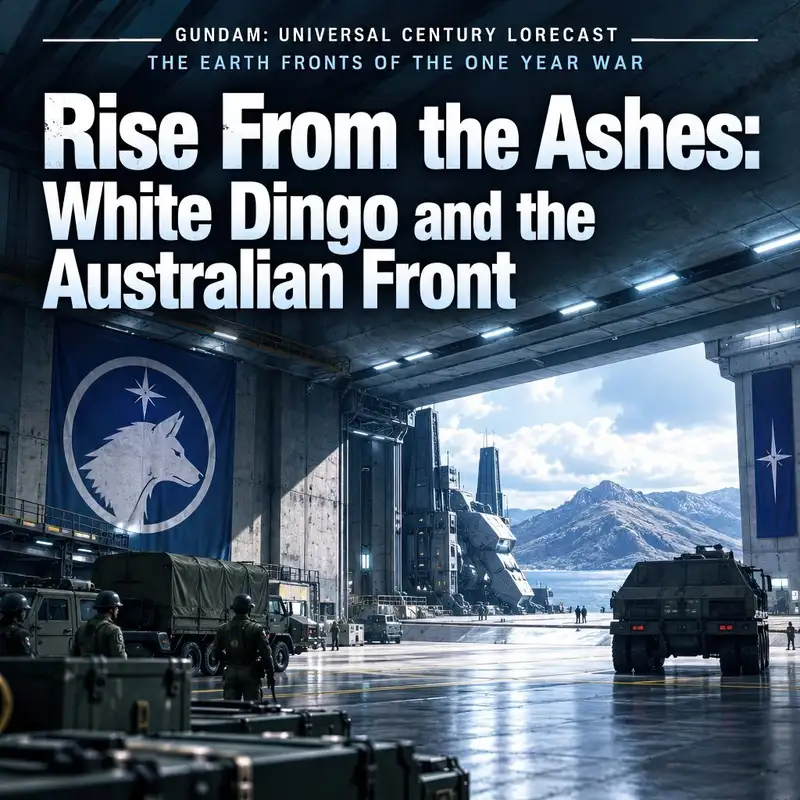
Rise From the Ashes: White Dingo and the Australian Front [Game]
Australia’s war did not begin with a contest for a desert road or a clash between mobile suits. It began with a colony falling out of the sky. Operation British was intended to strike Jaburo, the Earth Federation’s great underground headquarters in South America. Instead, the colony broke apart during its descent. Sydney and much of the surrounding Australian region paid the price. The impact did more than destroy terrain and infrastructure. It shattered administration, transport, communications, and public confidence across a continent already distant from the Federation’s political center. Into that vacuum came Zeon occupation forces, looking for resources, strategic depth, and a place from which to sustain their wider war.
For the people caught there, the distinction between intended target and actual target would have offered little comfort. A colony was not a bomb in the ordinary military sense. It was a habitat, an industrial structure, and a community turned into a weapon of mass destruction. Its impact transformed Australia’s physical and political landscape before Zeon’s occupation had fully begun. Roads, rail lines, ports, settlements, and military facilities became damaged, contested, or unreliable. Civilian life became dependent on whoever could move food, medicine, equipment, and security through a broken continent. The destruction created opportunities for Zeon, but it also created obligations that any occupying force would struggle to meet.
That is the setting of Mobile Suit Gundam Side Story 0079: Rise from the Ashes. Its Australian campaign is not the story of a single superweapon changing the One Year War. It is the story of a damaged theater trying to function again. By late Universal Century seventy-nine, the Federation’s problem was not simply to locate Zeon mobile suits and destroy them. It had to restore enough command, transport, intelligence, maintenance, and confidence to mount a counteroffensive across immense distances. White Dingo, a small Federation mobile-suit team, became useful because it was organized to do more than fight. It could search, identify, coordinate, protect, and strike at the systems that allowed enemy forces to remain mobile.
The broader balance of the war had begun to shift after Operation Odessa. Zeon’s early victories had been built on surprise, mobile-suit superiority, and the Federation’s failure to anticipate how quickly a colonial rebellion could become an interplanetary war. But a war of that scale could not be won by early shock alone. Zeon had to hold territory, support garrisons, move replacements, protect supply routes, and retain access to the resources that had made its expansion possible. In Australia, those demands were magnified by geography. A continent is too large to control simply by winning a few battles or planting a flag over a damaged city.
The game frames the Federation’s Australian Front as a recovering command pursuing mutually supporting objectives around Darwin, Alice Springs, and Adelaide. That does not mean the game provides a complete map of the entire campaign, or a definitive account of every force on the continent. It does establish the operational logic. The Federation was trying to regain connected points of movement, supply, and authority. Alice Springs mattered because central routes mattered. Adelaide mattered because coastal infrastructure and access mattered. The northern approaches mattered because a counteroffensive needs more than a destination. It needs a network that can bring people, fuel, ammunition, spare parts, and orders forward while bringing casualties and damaged equipment back.
White Dingo served within that larger effort. It was not an independent army and not a secret organization operating beyond normal command. The team belonged to the Earth Federation Forces under the Australian Front. Its value lay in being small enough to react quickly and integrated enough to perform several functions at once. The unit consisted of three mobile-suit pilots and a support-vehicle operator. The player controls its commander, Master Pierce Rayer, while the campaign’s structure makes clear that White Dingo is meant to fight as a formation rather than as a collection of solitary aces.
Rayer’s Australian birth gives the campaign a human connection to the theater, but it is not the explanation for his effectiveness. The game presents him as a capable commander, especially in the practical task of directing a small number of mobile suits under uncertain conditions. That is a different skill from simply winning a duel. A small-unit commander has to decide where to search, what to engage, when to protect a vulnerable vehicle, and when to avoid being drawn away from the actual objective. In a theater where transport routes and local intelligence are scarce, those decisions can matter more than a pilot’s ability to score another visible kill.
The other members of White Dingo reinforce that structure. Leon Riefey is associated with close combat, a role useful when mobile suits must operate at short range around terrain, installations, and friendly forces. Some later reference material uses a different transliteration of his name and adds details about intelligence work and nuclear security, but those additions should not be allowed to overwhelm the original game’s record. In the campaign itself, Leon is part of the team’s mobile striking power. Maximilian Berger brings an emphasis on artillery and precision fire. His background, including his earlier service in a military band before mobile-suit aptitude redirected his career, is a reminder of the Federation’s wartime manpower problem. Modern war consumes specialists faster than peacetime institutions can produce them.
Then there is Anita Julianne, the operator of White Dingo’s combat-support vehicle. In another kind of story, that vehicle might be treated as scenery, something parked behind the mobile suits while the important characters go forward. Rise from the Ashes does not support that reading. Anita’s role is reconnaissance, communications, and target acquisition. She is the information node that allows the rest of the team to operate with some understanding of what lies ahead. White Dingo’s center of gravity is not the heaviest weapon in its inventory. It is the ability to see first, decide quickly, and act before an enemy can turn uncertainty into an ambush.
That emphasis appears in the game’s command structure. White Dingo’s mobile suits can be directed to move, search, attack, or guard at different ranges. Those mechanics are not a literal record of every historical order given during the Australian campaign. A player’s exact positioning, weapon selection, and success or failure belong to interactive simulation, not fixed history. But the mechanics reveal the game’s military imagination. The unit is not designed around three pilots charging independently toward the nearest target. It is designed around reconnaissance, local command, and task organization.
This is why White Dingo’s first operations matter. At Rainbow Valley, the team attacks Zeon mobile suits and fixed gun positions. That is a straightforward combat task, but its purpose is larger than the destruction of several enemy machines. Fixed guns and local mobile-suit patrols protect movement corridors. They delay reconnaissance, threaten transport, and impose risk on every unit trying to use the same ground. Removing them opens a route, but only temporarily. A counteroffensive is not a clean line moving across a map. It is a series of local openings that must be exploited before the enemy can close them again.
The next mission near Alice Springs makes the point more clearly. White Dingo targets a Zeon supply train while also conducting a special reconnaissance task for its support vehicle. The train is important not because railways are inherently dramatic, but because a mobile suit without fuel, ammunition, parts, and technicians is an expensive obstacle. Zeon’s forces may have retained capable local units, but those units depended on a distribution system that could carry material across Australian distances. A supply train could move weapons, maintenance items, personnel, and perhaps components too difficult to transport by lighter vehicles. Destroying it attacks combat power before that combat power reaches the battlefield.
At Alice Springs, White Dingo also begins its repeated encounters with Visch Donahue, a Zeon commander known as the Lightning of the Wilderness. The title marks him as a formidable local opponent, and the campaign treats him accordingly. He is an experienced pilot, able to use the terrain and his mobile suit aggressively. But Visch should not be mistaken for a complete explanation of Zeon’s Australian defense. He is not evidence that every Zeon unit retained the same quality late in the war, nor is he presented as a Newtype or as a superhuman figure beyond the normal limits of military analysis. He represents the dangerous core that can remain after a larger force begins to lose cohesion.
At Simpson’s Gap, the target shifts from ground movement to air mobility. White Dingo intercepts a Gaw heavy transport aircraft. A Gaw is not merely another target silhouette. Heavy transports are the connective tissue of dispersed operations. They can carry troops, supplies, equipment, or senior personnel across terrain that makes overland movement slow and vulnerable. In a damaged continent, transport aviation becomes even more valuable because roads and railways may be blocked, destroyed, or insecure. Intercepting a Gaw therefore means contesting Zeon’s ability to concentrate force quickly.
The mission also exposes a practical problem for mobile suits. Even a mobile suit that can cross difficult terrain still operates within a larger system. It must know where the transport is going, reach the intercept point, identify the target, and defeat any escorts or defensive measures before the aircraft escapes. The machine’s mobility is useful, but mobility without reconnaissance becomes wandering. Its weapons are useful, but weapons without a target become dead weight. White Dingo succeeds because the Australian Front can give it a mission and because the team can convert that mission into local action.
Carrieton reverses the perspective. The Federation is no longer only attacking enemy supply. It is protecting its own resupply vehicle against Zaku Cannons and Goufs. The difference is essential. A recovering army cannot live on offensive raids alone. It has to move its own materiel through territory where the enemy still has guns, mobile suits, and the ability to choose an ambush site. The convoy at Carrieton is not a secondary concern behind the glamorous part of the battle. It is the reason the battle occurs. If the vehicle is lost, the Federation loses more than cargo. It loses tempo.
The Federation’s logistical situation was also fragile. It is easy to describe a late-war Federation counteroffensive as though its industrial superiority automatically appeared at every forward position. It did not. Industrial capacity matters only after it is converted into usable equipment, loaded onto transport, delivered through contested territory, maintained by trained personnel, and issued to units that can employ it. A replacement part in a distant depot does not repair a damaged mobile suit in the field. A shell in a warehouse does not defend a convoy. White Dingo’s operations repeatedly show a Federation returning to the continent one convoy, route, and defended position at a time.
Adelaide broadens the campaign again. White Dingo conducts reconnaissance, engages enemy forces, and attacks a Zeon submarine while confronting amphibious mobile suits. The city and its surrounding approaches matter because coastal infrastructure is strategic infrastructure. Ports, warehouses, fuel facilities, communications links, and maritime routes connect a continental war to the larger Earth Sphere. A force that can use the coast can move supplies by sea, evacuate personnel, insert raiding parties, or threaten routes that inland formations assume are secure.
The presence of a submarine and amphibious mobile suits indicates that Zeon still possessed localized reach. Even when an army is increasingly isolated at the operational level, it may retain tools for sudden movement and surprise. Amphibious machines are useful because they can cross the boundary between water and land that divides ordinary ground units. A submarine can conceal its approach, threaten shipping, and support operations near harbors or coastal facilities. Neither system makes Zeon dominant in Australia. But both complicate Federation planning, because they force commanders to consider routes and approaches beyond the obvious roads.
By the time White Dingo reaches Broken Hill and Torrington, the campaign is increasingly concerned with holding ground as well as finding the enemy. At Broken Hill, the team faces Zakus, a Dom, and a hover tank. These are not interchangeable pieces of Zeon equipment. The Zaku remains a flexible general-purpose mobile suit. The Dom is associated with high-speed ground movement, especially over open terrain. A hover tank offers a lower-profile, fast-moving weapons platform that can exploit broad approaches and support mobile-suit operations. Together, they suggest a defense organized around maneuver, not merely static resistance.
That kind of force can be dangerous in Australia’s open spaces. Fast hover movement allows a unit to shift between likely attack routes, threaten flanks, and exploit the long distances between fixed positions. But mobility has a cost. Hover systems, mobile suits, weapons, and crews all require support. They need fuel or propellant, maintenance, spare parts, ammunition, and orders that arrive in time to matter. A Dom can move rapidly over open ground, but it cannot repair itself. A hover tank can reposition, but it cannot create an intact supply network out of a collapsing one. The more isolated a force becomes, the more every mechanical failure and disrupted route matters.
Torrington makes the defensive problem explicit. White Dingo supports a friendly ground unit while defending a position against several Doms and a Zaku. This is not a hunt. The Federation has something it cannot abandon. Fixed positions force commanders to think about approach routes, fields of fire, reserves, and the risk that mobile suits will be drawn away from the point they were assigned to protect. A team may be able to destroy enemy machines in open combat, yet still fail its mission if the enemy reaches a convoy, a command post, a fuel dump, or a vulnerable ground formation.
Later reference material associates Leon with intelligence assignments and with nuclear security at Torrington. That background may help explain why the location carries added significance in expanded accounts, but the original Dreamcast campaign does not provide enough detail to turn the episode into a hidden nuclear-weapons story. What the game clearly presents is a defense mission in which White Dingo must support friendly forces against a mobile Zeon attack. That is sufficient to show the campaign’s central pattern. The Federation’s return depended on protecting the people and equipment that made continued operations possible.
The changing equipment available to White Dingo reinforces this pattern. The team begins with familiar Federation machines such as the RGM-seventy-nine GM and the RGC-eighty GM Cannon. These are not symbols of individual invincibility. They are mission tools. The GM is a general-purpose mobile suit, useful because it can be fielded as part of a wider force. The GM Cannon adds a stronger fire-support role, allowing the team to engage at range and support movement or defense with heavier weapons. Their importance lies in flexibility and integration, not in a claim that either machine wins every engagement.
Later, White Dingo receives the RX-seventy-seven D Guncannon Mass Production Type. The name itself matters. Mass production does not mean ordinary or weak. It means that a system has crossed, or at least approached, the threshold at which an industrial military can provide it in numbers, train crews for it, maintain it, and incorporate it into units. The Guncannon type gives the team a more substantial ranged-fire capability. That changes what White Dingo can do against defended positions and heavier threats. It does not remove the need for ammunition, target information, or careful positioning.
For the final operation, the team employs the RGM-seventy-nine S P GM Sniper Two. It would be a mistake to treat that machine as standard late-war Federation equipment across Australia. In the game, it is a specialized final-mission asset. Its appearance signals a narrower operational need: precision engagement during an attack on critical infrastructure. A sniper-oriented machine is useful when commanders need accurate fire against specific targets, when the enemy is defending a confined approach, or when indiscriminate destruction would be counterproductive. It is not simply a stronger GM by another name.
White Dingo’s advance on Hughenden Fortress brings the campaign’s operational logic into sharp focus. A fortress is not important merely because it has walls, guns, and defenders. In a dispersed theater, a fortified installation can also be a command post, repair center, storage site, communications node, and staging base. It may hold fuel, ammunition, spare parts, maps, transport schedules, and the personnel who make local operations coherent. Taking or disabling such a site attacks the system behind the garrison.
The assault includes the destruction of a large hovercraft. Again, the machine is significant because of what it can move and support. A large hovercraft can transport personnel, equipment, and supplies across terrain where damaged roads or uneven ground make conventional vehicle movement difficult. It may also serve as a mobile command or fire-support platform. Removing it narrows Zeon’s options for shifting resources between threatened sectors. The loss is operational, not merely visual. It makes the remaining defenders less able to compensate for broken rail lines, threatened roads, and declining air access.
Some later reference material connects the Hughenden operations to Astaroth, described as a Zeon biological or environmental weapon intended to cause uncontrolled plant growth and ecological damage. The available English material from the original game does not provide a full technical or strategic account of that threat. Its chain of custody, intended deployment, and ultimate disposition are better developed in later summaries than in the campaign’s own presentation. It is therefore possible to recognize Astaroth as source-sensitive game-story material without pretending that the Dreamcast record establishes a complete biological-warfare campaign. The fortification’s importance is already clear without building the analysis on uncertain details.
Hughenden’s real value lies in its relationship to movement. Once a force loses open routes, it begins to rely more heavily on protected nodes. Fortresses become places to concentrate what remains. They can protect a withdrawal, cover an evacuation, or preserve matériel that might otherwise be abandoned. This is why the final target, the Hughenden HLV base, matters so much. The issue is no longer simply whether Zeon can defend one more position in Australia. It is whether Zeon can remove forces, reinforce them, or preserve their military value beyond a theater that is becoming untenable.
HLVs, or heavy-lift launch vehicles, are strategic infrastructure. They connect the Earth’s surface to orbit. In a late-war campaign, that means they may enable evacuation, redeployment, reinforcement, or the removal of valuable personnel and equipment. A launch vehicle is not a mobile suit, but its destruction can have consequences that extend far beyond a local firefight. Denying an HLV base can trap assets on the ground. It can prevent a commander from shifting forces to another front. It can turn a managed withdrawal into a desperate last stand.
White Dingo’s mission at the base is therefore an attack on Zeon’s remaining options. The team must destroy the launch vehicles while facing Visch Donahue in a Gelgoog and another mobile hover tank. The Gelgoog represents a serious escalation in local combat capability. It is a high-performance Zeon mobile suit, and in the hands of an experienced pilot it poses a genuine threat. But the point of the battle is not that White Dingo has found one final, more powerful opponent. The point is that Visch is defending infrastructure whose loss will reduce Zeon’s ability to recover from defeat in Australia.
His resistance is significant precisely because it is local. A commander such as Visch can make the final phase of a campaign difficult, costly, and uncertain. He can protect an evacuation route or buy time for a launch. Yet he cannot reverse the wider problem if the supply trains are gone, the transports are intercepted, the coastal access is threatened, the fortress is reduced, and the launch site itself is under attack. Tactical skill can preserve a moment. It cannot create an operational network after that network has been dismantled.
The surviving game documentation dates the Hughenden missions to January first and January second, Universal Century eighty. Those dates sit awkwardly beside the conventional chronology of the One Year War’s conclusion. The responsible approach is not to force the campaign into a day-by-day master timeline that the available sources do not securely support. The dates are part of the game’s documentation and help identify the sequence of the closing operations. They do not require us to rewrite the entire war’s endpoint, invent a hidden extension of the conflict, or assume that every later reference has reconciled the discrepancy.
In the immediate fight, White Dingo wins engagements against mobile suits, fixed guns, transports, hovercraft, and fortified positions. Those victories matter. They keep Federation forces moving and deny Zeon the freedom to use particular routes or assets. But tactical victories alone do not explain the campaign. The team’s operations have value because they accumulate into operational pressure. A disrupted train, a destroyed Gaw, a protected resupply vehicle, a compromised submarine, a lost hovercraft, and ruined launch vehicles all reduce Zeon’s ability to move, sustain, concentrate, and extract its forces.
That is the difference between a battlefield success and an operational recovery. Battlefield success asks whether the unit completed the immediate task. Operational recovery asks whether the campaign can now continue. White Dingo’s missions repeatedly protect the conditions of continuation. A convoy gets through. A defense holds. A transport is stopped. A base loses its ability to connect the ground war to orbit. The result is not a clean or total liberation of Australia. The game does not establish that White Dingo liberated the whole continent, destroyed every Zeon formation, or independently changed the outcome of the One Year War.
In the wider war, the team contributes to a wider Federation return rather than replacing it. Strategy involves political control, industrial capacity, force generation, and the ability to sustain authority after the fighting ends. White Dingo can help deny Zeon its Australian network. It cannot, by itself, rebuild cities, restore transport, resettle displaced civilians, repair environmental damage, or answer the political grievances that made the Earth Sphere vulnerable to war in the first place. Capturing a location on a map is not the same as governing the people who live there.
The campaign also reveals the importance of intelligence as a combat multiplier. Anita’s reconnaissance role is not subordinate to the mobile suits. It is what helps make their combat power usable. The ability to search, confirm, direct, and guard turns a small number of machines into a coherent team. In Minovsky-era warfare, that kind of local information can be decisive because centralized command is constrained by distance, interference, and uncertainty. White Dingo is more effective than three isolated pilots because it can make decisions as a formation.
Its equipment progression tells the same story. The GM, GM Cannon, Guncannon Mass Production Type, and GM Sniper Two matter because they support different tasks. General-purpose combat, fire support, heavier ranged engagement, and precision attack all have a place in the same campaign. But none of those machines become strategically meaningful on their own. Their significance depends on maintenance crews, ammunition supply, transport, trained pilots, command direction, and the ability to place each system where it has a useful mission. The machine is never the whole story. It is a tool inside a larger recovery effort.
There is a human cost behind that recovery. Australia’s people had already endured the consequences of Operation British before White Dingo entered the campaign. Occupation added new dependencies, fears, and compromises. A returning Federation force might be welcomed in one place, distrusted in another, or judged by whether it could actually restore food, security, transport, and basic administration. The destruction of Zeon’s military infrastructure could create the conditions for liberation, but it could not automatically restore trust in institutions that had failed to protect the continent from disaster.
Rise from the Ashes is valuable because its interactive structure places mobile suits back inside the wider machinery of war. The game gives the player command authority, but it does not make every player decision fixed history. Its stable campaign framework shows a team conducting reconnaissance, escorting supply, intercepting transport, defending ground forces, and attacking strategic infrastructure. White Dingo’s importance is not that it remade the One Year War through a single heroic act. It is that it shows how a damaged army begins to fight effectively again: by reconnecting information, command, transport, maintenance, fire support, and disciplined purpose.
White Dingo rose from the ashes of a devastated continent not as an invincible formation, but as a functional one. Its victories weakened Zeon because they attacked the systems that made mobile-suit warfare possible. Yet the campaign’s final truth is harder and more important. Military recovery can retake routes, bases, and launch fields. It cannot by itself repair the homes, trust, and political order destroyed long before the counteroffensive began.