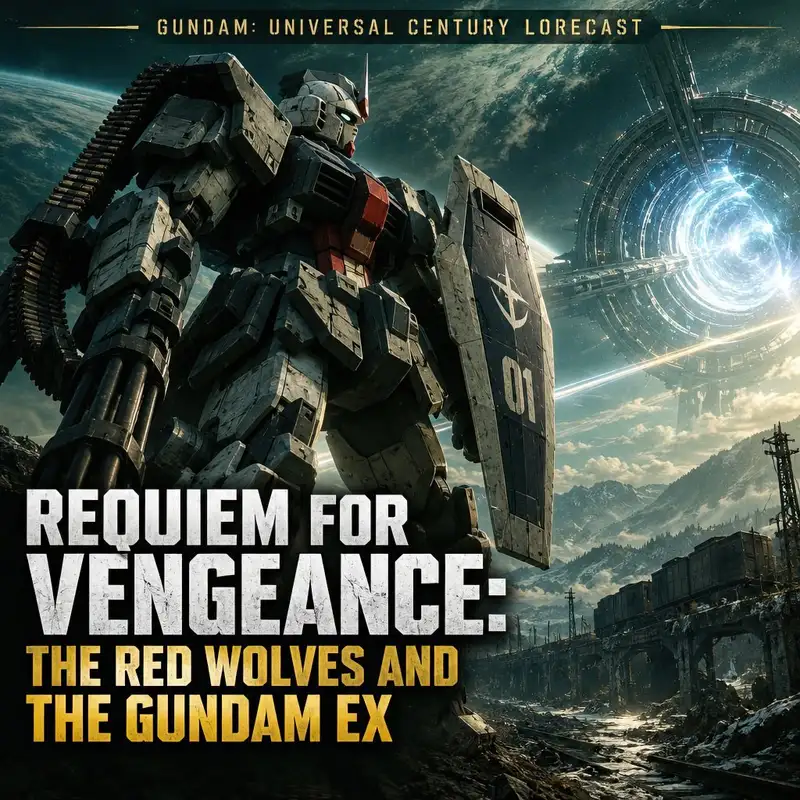
Requiem for Vengeance: The Red Wolves and the Gundam EX
The base had been retaken. That was supposed to mean something. In a ground war, a recovered installation meant shelter, ammunition, maintenance space, maps, radio equipment, medical stores, and a place from which a battered formation could begin to act like a formation again. For Captain Iria Solari and the Red Wolf Squadron, the recapture of a Zeon-held base in Eastern Europe had been hard, costly, and recognizable. It was the kind of operation mobile suits had been built to dominate: armored vehicles, infantry, defensive positions, damaged terrain, and a local counterattack led by experienced Zaku pilots.
Then night settled over the forest, and the Gundam EX arrived.
The machine did not merely win an encounter. It broke an assumption. Zeon had entered the One Year War with mobile suits as its decisive advantage. Its commanders had learned to expect that conventional Federation forces would struggle to answer a Zaku team that could move across broken ground, bring heavy weapons to bear, and adapt faster than tanks or infantry formations. The Red Wolves had every reason to believe that recovering the base would restore at least a temporary measure of control. Instead, the darkness concealed an enemy machine with mobility, firepower, and confidence that the survivors could neither identify nor predict.
That uncertainty mattered as much as the machine’s weapons. Solari’s people did not know what they were facing, where it had come from, how long it could remain in the field, whether it had support nearby, or why it seemed able to strike after the battle should have been finished. The Gundam EX became frightening because it turned a position that had just been secured into a trap. It announced that the European front was no longer a place where Zeon could count on holding the initiative simply because it possessed mobile suits.
The Red Wolves were not anonymous pilots placed in Zakus to be removed by a more famous machine. They were a small, functioning military team, and their destruction carried more weight because they had experience that could not be quickly replaced. Solari commanded the squadron within Zeon’s Seventh Composite Mobile Brigade. Her responsibility was not merely to fight well. She had to judge terrain, coordinate with attached forces, preserve her pilots, make decisions under incomplete information, and keep the squadron useful after contact with the enemy had turned every plan into a compromise.
Her deputy, First Lieutenant Reid Ghelfi, known as Chubs, was the unit’s seasoned veteran and recognized ace. His value was not only skill at the controls. An experienced pilot carries habits formed by survival. He knows when a route is too exposed, when an enemy position is too quiet, when a machine is damaged beyond what optimism can repair, and when a commander’s order cannot be fulfilled exactly as written. First Lieutenant Kneeland LeSean brought ability and aggression, but also the volatility of a younger officer fighting inside a collapsing situation. Second Lieutenant Kale Zavaleta served as the squadron’s marksman, a role that requires patience, observation, and the ability to turn terrain into an advantage.
Together, they gave Solari a team with distinct strengths. That mattered in a battlefield where mobile suits were not simply dueling platforms. A squadron needed pilots who could screen a retreat, cover infantry, identify movement through forest lines, protect vehicles, and make rapid decisions when communications failed. Trust between pilots also mattered. In combat, a formation works because each member has some expectation of what the others will do. When that trust is built through repeated missions, it becomes a form of combat power.
But a squadron is not an army in miniature. Its machines require parts, ammunition, propellant, recovery equipment, technicians, routes, and places to repair. Its pilots need medical care, rest, intelligence, command direction, and replacement personnel when casualties begin to accumulate. It depends on infantry to secure ground it cannot continuously occupy, armored vehicles to support it, and transport to move the supplies that make another sortie possible. A Zaku may be the most visible part of a formation, but the machine is only the sharp end of a much larger system.
That system was coming apart around the Red Wolves. Solari’s skill could preserve people for a time. It could not manufacture a secure rear area, rebuild a destroyed command network, or replace a theater-wide loss of initiative. The value of the squadron was real. So was the limit of what any small group of veterans could accomplish when the institution behind them was beginning to fail.
Europe made that problem especially visible. The front depicted in Requiem for Vengeance is not an empty battlefield arranged for armored duels. It is a damaged inhabited landscape of forests, roads, rivers, bases, wrecked vehicles, rear-area installations, and withdrawal routes. Wooded terrain can conceal movement, but it can also trap formations in narrow corridors. Roads make transport possible, but they also become predictable targets. A river can slow an advance, anchor a defense, or turn a retreat into a bottleneck. A destroyed base does not disappear from the campaign. It becomes wreckage, salvage, cover, a medical problem, and evidence that whatever command structure once existed there has been disrupted.
For the Red Wolves, the immediate issue was more practical. The kind of war Zeon had once been prepared to fight was disappearing. The Gundam EX represented a Federation answer tailored to the changing conditions of the ground campaign.
The Gundam EX was a state-of-the-art Federation mobile suit, but calling it simply a more powerful machine than a Zaku misses the historical point. Its official profile emphasizes ground maneuverability and operating time. Those qualities made it suitable for deep penetration, reconnaissance in force, and disruption behind enemy lines. In other words, it was not merely a mobile suit intended to win a direct engagement. It was a machine designed to move through a contested ground theater, locate weaknesses, survive long enough to exploit them, and force the enemy to react.
Operating time is not glamorous, but it is often decisive. A machine that can remain useful in the field for longer can continue scouting after an ambush, pursue a retreating force, threaten supply routes, and appear at a second location after its enemy assumes the danger has passed. Endurance changes the rhythm of combat. It gives a commander more choices and imposes more uncertainty on the opposing side. A force that must withdraw, repair, or refuel after every hard contact cannot easily maintain pressure against an enemy that can stay active.
Ground maneuverability matters for the same reason. In forests, ruins, roads, and river crossings, speed alone is not the issue. A mobile suit must be able to change direction, use cover, cross uneven terrain, and enter places where armored columns become vulnerable. The Gundam EX’s ability to operate in that environment allowed it to choose the terms of contact more often than the Red Wolves could. It could emerge from terrain that should have provided security, engage at close enough range to exploit surprise, and withdraw or reposition before Zeon could form a clear picture of the situation.
Its weapons were dangerous, but weapons are only as useful as the opportunity to employ them. The Gundam EX was frightening because it possessed the mobility and endurance to create those opportunities. Darkness and broken terrain reduced the value of long-range certainty. Forest cover obscured approach routes. Damaged communications made warnings late or incomplete. A formation that had just fought for a base was tired, scattered, and likely focused on immediate recovery. Under those conditions, a highly capable enemy machine did not need to be invulnerable. It only needed to strike before its opponent could understand the fight.
The Red Wolves could not answer that demonstration with confidence because they lacked the information needed to understand it. Their first encounters with the Gundam EX did not produce a clean intelligence report. They produced shock, damaged machines, casualties, survivors, and fragments of memory. That is a very different thing.
In the aftermath of the first clash, Solari’s problem was not simple fear. It was the difficulty of commanding when the battlefield had become unintelligible. The survivors knew they had faced an unfamiliar Federation mobile suit. They knew it had struck with a level of effectiveness that exceeded what they expected. They did not know its full capabilities, its mission, its support network, or whether another attack was imminent. A commander cannot plan effectively when the enemy’s identity, location, and pattern of employment remain unclear.
Misidentification is especially dangerous in such an environment. A pilot may see an unfamiliar silhouette, a weapon effect, or an enemy movement pattern without having time to determine what it means. A damaged observer may report what seemed most important in the moment. Another survivor may remember the same event differently. By the time the fragments reach a commander, the machine may already have moved elsewhere. The audience can see more than Solari’s people can. The soldiers inside the story cannot rely on that privilege.
The Gundam EX also gained a psychological advantage without needing to conduct psychological warfare as a formal mission. A machine that appears during a night battle, destroys a formation, and then seems to return whenever survivors establish a temporary refuge becomes larger in memory than its actual number. The Red Wolves are not facing an army of Gundams. But from the perspective of isolated personnel, one persistent threat can feel omnipresent. Each new appearance confirms the fear that there is no safe rear area, no secure repair site, and no predictable boundary between front and rear.
For Solari, the answer was not to surrender to fear. It was to keep moving, gather survivors, and find enough support to put damaged people and damaged machines back into action. That effort brings the story from the forest and ruined bases into a more revealing part of war: the salvage operation.
The destroyed brigade headquarters and the recycling center show what the Zeon war effort in Europe has become. These are not grand factories or secure arsenals. They are places where personnel try to recover useful material from the wreckage of an army under pressure. At the recycling center, Solari reconnects with Captain Alfee Zydos, known as Gearhead, a mechanic whose work is as important to the survival of the group as any pilot’s skill. Major Rolph Ronet commands the facility, but his authority is local and administrative. He can organize what remains under his control. He is not a theater commander with the ability to restore the wider front.
The rebuilt Zaku IIs reflect that reality. Their repairs and modifications are acts of field expediency. Mixed parts, added armor, tracks, and layered protection are meant to keep machines moving and give their crews some chance against beam weapons. Such improvisation is not foolish. It is exactly what competent mechanics and crews do when the alternative is abandoning the equipment and the people who depend on it. A damaged mobile suit with a practical modification may still provide convoy protection, cover an infantry withdrawal, or hold an enemy at a crossing long enough for wounded personnel to escape.
But repair is not replacement. Salvage can return a machine to service for another mission. It cannot recreate standardized supply chains, produce reliable spare parts at scale, restore a destroyed maintenance network, or replace pilots and technicians who have been killed or scattered. Field armor may improve a machine’s chance of surviving a hit. It does not turn a rebuilding workshop into a factory. Tracks can improve mobility in damaged terrain. They do not erase the accumulated wear of battle, or the fact that the machine may now require even more attention from already exhausted mechanics.
The attached personnel around Solari make that clear. Ander Heaton and his Magella Attack bring armored support, even if the vehicle cannot substitute for a mobile suit in every situation. Hayley Arhun represents the armored infantry who must occupy ground, secure facilities, escort movements, and survive near machines vastly larger than themselves. Mechanics work under pressure to restore damaged equipment. Transport crews move people and supplies through threatened terrain. None of them are background decoration. They are the human and material structure that allows a mobile-suit squadron to function at all.
The presence of medical personnel is equally important. Dr. Ony Kasuga of the United Maintenance and Relief Corporation provides care without distinguishing between sides. That neutrality does not make the medical mission simple or safe. A collapsing front turns hospitals, repair sites, and evacuation points into vulnerable locations. Wounded people still need transport. Medical supplies still need delivery. A neutral doctor still needs access to the injured, and access depends on roads, security, fuel, and the willingness of armed personnel to recognize that some work must remain outside ordinary military rivalry.
When Gundam EX and a GM strike the recycling center, the meaning of the Gundam changes. Until then, it might have been understood as a singular and terrifying anomaly. The appearance of the GM suggests something more dangerous: the Federation is developing not only one exceptional machine, but a mobile-suit force capable of operating in the same campaign. The GM does not need to equal the Gundam EX in every quality to matter strategically. Its importance lies in reproducibility.
The Federation’s GM is a mass-production mobile suit shaped by the experience gained through Gundam development. That relationship is crucial. A prototype can test a concept, prove that a weapon system works, reveal defects, and teach engineers and commanders what must change. A mass-production machine translates some portion of that learning into a form that can be built, maintained, trained on, and deployed in numbers. It may be less capable than the prototype in an individual engagement. It may have compromises in performance, equipment, or survivability. But if it can be issued to regular units and supported across a theater, its strategic value can exceed that of the unique machine that helped inspire it.
For the Red Wolves, the GM’s presence means that the Gundam EX is no longer simply a nightmare with an unknown origin. It is an indicator of a broader Federation recovery. The enemy is learning how to field mobile suits, integrate them with infantry and armored forces, and bring them forward as part of an offensive. The Federation is beginning to convert industrial depth and combat experience into operational capability.
At that point, Zeon’s local command does something rational. It tries to learn. Major General Yuri Kellerne, commander of Zeon’s European forces, orders Solari toward a new mission: capture a Federation GM for study.
The order is an admission of uncertainty, but it is not an irrational one. Capturing an enemy machine can provide information that visual reports cannot. Engineers may inspect armor construction, weapon fittings, internal layout, maintenance access, cockpit arrangement, and the practical evidence of how a system was built for production. Technicians may identify components that reveal design priorities. Pilots may learn how the machine moves, where its limitations lie, and what tactics might work against it. Even incomplete knowledge can improve training and countermeasures.
It is also a sign of crisis. Solari’s people are being asked to conduct infiltration, capture, extraction, and exploitation while already damaged and under pressure. These are not tasks performed in ideal conditions. To seize an enemy mobile suit, a force must locate it, approach without being destroyed, neutralize or displace its crew, secure the machine, and move it through contested territory. The captured equipment must then reach people capable of studying it. Every stage requires time, routes, manpower, and security.
The Red Wolves have little of any of those things. They are carrying the accumulated burden of previous battles. Their machines have been rebuilt from salvage. Their support network has been attacked. Their rear areas are no longer reliably behind the front. The GM-capture mission is technically sensible, but it asks a deteriorating formation to perform a demanding special operation because the larger system has failed to provide answers earlier.
The infiltration attempt brings Solari into direct contact with the human being inside the machine that has haunted her unit. The Gundam EX pilot remains unidentified. The series does not establish his name, origin, exact age, or a definitive Newtype classification. It presents him as apparently young, and it gives his perception an unusual quality. Those details matter, but they should not be inflated into facts the story does not confirm.
What Solari encounters is not a named legend, not a complete intelligence file, and not a simple technical problem. She encounters a person who appears to be young enough to make the war’s machinery suddenly visible in another way. The Gundam EX has been terrifying because of what it can do on the battlefield. It moves through terrain, strikes isolated formations, and threatens the routes on which Zeon survivors depend. But its effectiveness is carried by a pilot. The machine is not an independent force of history. Someone has been trained, assigned, armed, and sent into combat inside it.
The Gundam pilot’s apparent youth also changes how Solari’s fear should be understood. The fear was never simply fear of a machine. It was fear of a machine that seemed to arrive from nowhere, that could not be classified, and that repeatedly converted temporary safety into danger. But the encounter reveals the cost of treating enemy capability as an abstraction. Behind the armor is a person carrying the same immediate burdens of survival, confusion, and violence that have shaped Solari’s own unit.
Solari’s recognition does not halt the offensive. Personal understanding cannot by itself undo command orders, repair destroyed infrastructure, or end a retreat already in motion. The war continues to demand movement, protection, and sacrifice. By the time of the final convoy operation, the Red Wolves are no longer trying to retake and hold ground. Their mission has changed. They are protecting withdrawal.
That change in mission is a measure of the campaign’s real condition. An advance seeks to seize objectives. A defensive operation seeks to deny the enemy access or preserve terrain. A withdrawal seeks to save what can still be saved. It may preserve personnel, equipment, records, medical supplies, and the core of a unit that can fight again somewhere else. It may also become a desperate effort to prevent a retreat from turning into a rout.
The Federation counteroffensive is driving Zeon forces toward Odessa and its spaceport. The story does not require a detailed map to show what that means for people on the ground. Withdrawal routes become lifelines. Roads carry damaged vehicles, wounded soldiers, technicians, supplies, and personnel whose value cannot be measured only in weapons. A convoy is not merely a line of transports. It is the connective tissue of an army trying to remain an army while it moves under threat.
Dr. Kasuga’s presence gives the convoy a humanitarian dimension that military language can obscure. Medical neutrality does not make the wounded less vulnerable. It does not create fuel, protected roads, or evacuation capacity. It does not guarantee that combatants will be able to distinguish a medical mission from the military traffic surrounding it. The doctor’s work reminds us that a retreat is not only a question of preserving combat power. It is also a question of who is left exposed when combat power fails.
Gundam EX threatens the convoy in exactly this way. It is not simply another opponent for Solari to confront. It threatens the movement that connects the remaining Zeon personnel to survival, evacuation, and any possibility of reorganization. A machine capable of penetrating behind lines can cut at the infrastructure of retreat. It can force escorts to turn back, split a column, and make every delay more costly.
The Red Wolves can still achieve local effects. They can hold a position, delay pursuit, protect a segment of the convoy, or save individuals who would otherwise be lost. Such actions are not meaningless. For the people who survive because someone stood and fought, the distinction between delay and victory may be very small. But at the operational level, local resistance cannot reverse the direction of the Federation offensive. Solari’s people are fighting to buy time, not to restore Zeon’s strategic position in Europe.
In immediate combat terms, Gundam EX repeatedly proves able to disrupt Zeon units under conditions that favor maneuver, surprise, and local knowledge of the ground. It is an exceptional combat machine, and its pilot employs it effectively. But its significance is larger than its individual record. The Federation is demonstrating an ability to integrate mobile suits with GMs, armor, infantry, transport, and sustained pressure. It is not simply winning one dramatic duel. It is pressing a retreating enemy across a theater.
For the wider operation, that is what makes the Gundam EX decisive against the Red Wolves. It can attack formations that have already been weakened by the larger campaign. It can exploit disrupted command networks and vulnerable rear areas. It can return after the enemy thought the immediate danger had passed. It can threaten the repair sites and convoy routes on which survival depends. Its strength is magnified because Zeon’s local system is becoming less able to absorb another shock.
For the war as a whole, the shift is not the story of one Gundam winning Europe. No single machine can carry that burden. The larger change is the Federation’s conversion of industrial capacity, combat experience, and organizational recovery into fielded military power. The GM matters because it shows that lessons from advanced development are becoming reproducible. Federation forces are beginning to place mobile suits in regular formations rather than treating them as a monopoly held by their enemy.
Zeon recognizes the danger, and Kellerne’s GM-capture mission shows that it is trying to adapt. That effort should not be dismissed. Military organizations must learn from enemy equipment and enemy methods. But adaptation is not recovery. Capturing one GM cannot restore secure logistics. It cannot replace lost pilots. It cannot repair every damaged Zaku, reopen every destroyed headquarters, or turn improvised armor into a stable procurement system. Intelligence can reduce uncertainty. It cannot create time that the campaign has already taken away.
The difference between salvage and production is especially important. Alfee Zydos can turn wreckage into another mission. That is a remarkable form of competence. The Federation’s emerging advantage, however, lies in its ability to build and field machines through a system that can endure beyond one workshop, one mechanic, or one exhausted group of survivors. A rebuilt Zaku may fight bravely. A GM may be less exceptional than Gundam EX. Yet a military that can replace losses, train crews, move supplies, and keep pressing forward will eventually impose problems that even the best local unit cannot solve.
Solari’s expanding responsibilities reveal the human side of institutional collapse. She begins as a squadron commander. As the campaign worsens, she becomes responsible for survivors, damaged equipment, evacuation, and choices that extend well beyond normal mobile-suit command. That is what happens when formal structures fray. The people still functioning inherit duties because someone must make decisions. Their competence may preserve lives, but it also exposes how much of the system has already disappeared.
The civilian and humanitarian costs are part of the same story. Rear areas become battlefields. Repair sites become targets. Medical personnel operate amid retreat. Workers, mechanics, wounded soldiers, and transport crews become caught in a contest they did not design and cannot control. The war is not reduced to two machines in a forest. It is a chain of institutions failing people, one damaged route and one abandoned facility at a time.
Requiem for Vengeance is a requiem because it mourns more than named pilots or destroyed mobile suits. It mourns the passing of an early-war illusion. Zeon’s mobile-suit advantage had been real. Its experienced pilots had been dangerous. Its Zaku formations could still fight with skill and determination. But by the time the Red Wolves meet Gundam EX, that advantage is no longer exclusive, and excellence at the point of contact is no longer enough.
Gundam EX frightens the Red Wolves because it is an exceptional machine operating at the forward edge of a recovering Federation military system. Its mobility, endurance, weapons, and pilot skill make it lethal. Its repeated appearance makes it psychologically overwhelming. But its deepest significance lies in what follows behind it: GMs, armor, infantry, transport, intelligence, and an offensive that can continue after one battle ends.
The Red Wolves have courage, experience, and the ability to improvise. Their rebuilt Zakus can still protect people and impose costs on the enemy. Their resistance matters tactically. Yet courage cannot manufacture replacement pilots. Salvage cannot recreate a secure rear area. A captured enemy machine cannot instantly restore intelligence superiority. One small unit cannot regain strategic initiative for an army being driven backward across a continent.
What remains is the tragedy beneath the armor. Solari can recognize the humanity inside the Gundam cockpit, even as the war keeps demanding that she fight it. The unnamed pilot can become an instrument of Federation recovery without being reduced to a machine himself. Around them, armies continue to consume young people, veterans, mechanics, medics, and entire communities in a conflict whose institutions have long since lost the ability to control its human cost.