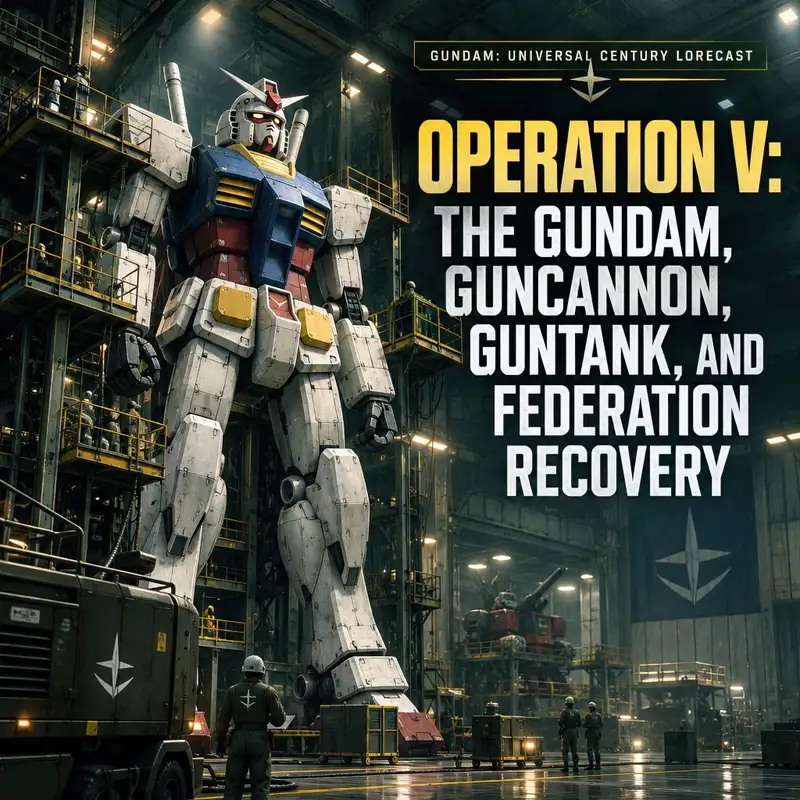
Operation V: The Gundam, Guncannon, Guntank, and Federation Recovery
The emergency at Side 7 began before the Earth Federation had decided who would fly its new machines in combat. White Base had arrived to collect a group of prototypes from what should have been a protected testing site. The intended sequence was straightforward enough. Engineers would complete trials, trained personnel would receive the machines, and a new mobile-suit force would enter the war under controlled conditions. Instead, Zeon reconnaissance reached the colony, fighting broke out inside an inhabited cylinder, and the Federation’s carefully staged program became an evacuation under fire.
In that confusion, Amuro Ray, a civilian teenager with technical knowledge and access to the Gundam’s operating material, climbed into a machine meant for someone else. White Base prepared to escape with damaged equipment, shaken survivors, and a crew structure already coming apart. Civilians faced the danger of weapons fire and structural damage within their own colony. The Federation’s new combat system entered the war not as a polished formation, but as an improvised emergency measure.
That is the central paradox of Operation V. By any ordinary standard, the Side 7 attack exposed serious Federation weaknesses. Security failed. Intelligence failed. The planned manning system collapsed. A secret test site became a battlefield. Yet the project survived long enough to demonstrate something that mattered far beyond Side 7. Zeon’s mobile-suit advantage was not permanent. It could be challenged. The Federation could build machines capable of fighting Zakus on something closer to equal terms, and perhaps on better terms in some roles.
But a useful prototype is not the same thing as a recovered military position. The Federation did not reverse the One Year War because one Gundam defeated a few enemy machines. It began recovering because Operation V preserved a linked set of capabilities: combat machines with different intended roles, a ship built to carry and sustain them, technical knowledge tested under fire, and a surviving group that would become an unwilling field laboratory for mobile-suit warfare. The Gundam was the clearest symbol of that recovery. It was never the whole of it.
Operation V was the beginning of that response. The television record presents it as a Federation program centered on advanced mobile-suit development and the White Base, the ship intended to carry those machines. Later material adds detail to the wider history of Federation development, but the essential point is already visible at Side 7. The project was not conceived around one heroic dueling machine. It was an attempt to create a mobile-suit combat element with specialized parts.
The Gundam, the RX seventy-eight two, represented the close-combat element. Its role was not merely to look impressive on a test stand. It combined mobility, armor protection, manipulators, sensors, and unusually powerful beam armament in a platform intended to fight at short range. That combination mattered because close-range combat had become more common under Minovsky interference. A machine that could survive enemy fire long enough to close, identify a target, and bring a beam weapon to bear offered the Federation a direct response to Zeon’s established mobile-suit threat.
The Guncannon represented a different idea. It was intended for mid-range combat and fire support. That meant it was not simply a lesser Gundam or a more heavily armed companion. It pointed toward a force in which machines could perform differentiated roles. One unit might press close to the enemy. Another might support it from farther back, engage enemy mobile suits at range, or provide fire against fixed positions. The Guntank extended that logic further. Its long-range-support role reflected artillery thinking: the value of a machine able to deliver heavy fire without needing to occupy the same close-in space as the assault element.
White Base was essential to that learning process. The ship was built under Operation V to transport and support the developing mobile suits. That description can sound routine until one considers what it required. A mobile suit is not strategically useful merely because it can move under its own power. It needs a hangar, launch systems, recovery procedures, technicians, tools, parts, ammunition, propellant, medical care, navigation, communications, and a command structure that can decide when to risk it. A damaged mobile suit outside a colony or far from a base is not simply a tactical inconvenience. It can become a stranded pilot, a lost machine, and an intelligence prize for the enemy.
The White Base was therefore more than a vessel carrying the Gundam from one battle to the next. It was a carrier, a workshop, a command platform, a transport, an evacuation ship, and a fragile mobile base. Its value lay in its ability to turn separate machines into a deployable combat element. Without a ship like White Base, the Gundam, Guncannon, and Guntank would have remained isolated prototypes tied to a fixed facility. With the ship, they could become a moving test force. That capability would matter even more after the Side 7 disaster, because the fixed facility was no longer secure.
Operation V’s technical ambition was substantial. Its security arrangements were less convincing. The Federation had concentrated valuable equipment, technical personnel, and a purpose-built support ship at Side 7. That made sense from the perspective of testing and handover. It also created an obvious intelligence target. Zeon did not need to know every detail of the program to recognize that unusual Federation activity at a colony might reveal a major change in the balance of war.
Char Aznable’s force arrived on a reconnaissance mission. Its purpose was to investigate, identify, and assess. Zeon needed to know whether the Federation had developed a serious mobile-suit program, where that program was located, and how close it was to operational deployment. Intelligence of that kind could influence planning far beyond a single colony. If the Federation was merely experimenting, Zeon might retain time to exploit its existing lead. If the Federation had a usable mobile-suit force, Zeon commanders would need to reconsider assumptions that had shaped the war’s opening months.
The Federation’s problem was not simply that Zeon found Side 7. Secret programs can be discovered despite careful precautions. The deeper problem was that the project did not appear to have a resilient response once compromise occurred. There was no smooth transition from protected testing to emergency operational deployment. The site could not remain a safe laboratory once enemy mobile suits entered the colony. The intended pilots were not ready to take the machines into battle. The security system could not keep civilians, engineers, military personnel, and attackers separated once combat began.
This was a failure of compartmentalization and contingency planning. It did not mean that every Federation official was careless or that the whole military was incapable. It meant that a program designed to close a dangerous technological gap had not yet solved the institutional problems surrounding it. The Federation had developed advanced machines before it had fully developed the organization needed to protect and employ them. That is a recurring danger in military innovation. A state can invest heavily in equipment while underestimating the security, training, and command systems that make the equipment useful.
Zeon’s reconnaissance might still have remained limited. Char’s mission required observation and assessment. A reconnaissance force that remains disciplined can gather information, report it, and preserve the option of later action. But the operation did not remain disciplined. Gene attacked prematurely. In the television account, that decision transformed a probing mission into open combat.
The consequences were larger than Gene’s individual act. In military operations, subordinates can create strategic effects when they act in an environment already full of uncertainty. Minovsky conditions increased the value of local initiative, but initiative is not automatically good judgment. A pilot or junior commander may see an opportunity that headquarters cannot see. He may also mistake a partial view for the whole situation, act before the mission is understood, and force every other participant into a crisis.
Gene’s attack gave Zeon immediate contact with the Federation machines. It also sacrificed much of the restraint that had made reconnaissance useful. Zeon gained evidence that something important existed at Side 7, but it now faced an enemy reacting under conditions of alarm rather than allowing the Federation to remain unaware of its discovery. The Federation, meanwhile, lost control of the testing environment. Its prototypes, civilians, and ship were now caught in a battle for which the site was not designed.
The damage was not limited to machinery. An attack inside a colony changes every tactical decision. The walls, corridors, docks, and industrial spaces around the combatants are part of a habitat. Weapons fire can damage homes, transit routes, life-support systems, and evacuation paths. A mobile suit’s size and power become liabilities as well as advantages. Even when the immediate target is an enemy machine, the surrounding civilian environment cannot be treated as empty terrain.
The most consequential result of the attack was that Operation V had to prove itself before it was ready. The Federation did not choose to conduct a combat trial at Side 7. It was forced into one. The difference matters because the famous image of Amuro entering the Gundam can obscure the institutional collapse around him. He did not take the controls as the product of a finished training pipeline. He entered the cockpit because the planned system had failed and there was no better option available in that moment.
Amuro had technical familiarity and access to the Gundam’s manuals and operating information. That gave him a foundation most civilians would not possess. But technical literacy is not the same as combat training. Reading a system manual can tell an operator what a control does. It cannot provide the accumulated judgment of a pilot who has learned to identify threats, maneuver under stress, communicate with a ship, preserve ammunition, avoid friendly fire, and make decisions while frightened.
The Gundam itself helped make survival possible. It was built as a close-combat mobile suit with protection and armament beyond what Zeon’s Zaku units expected from a Federation machine. Its beam weapon was particularly important. The Federation had placed destructive power comparable to a battleship weapon into a mobile platform. That did not make the Gundam invulnerable, and it did not mean every beam shot could be used without consequence inside a colony. But it gave the machine a capacity to destroy enemy mobile suits that immediately altered the local balance of combat.
Its armor also mattered. A combat machine that survives the first enemy hit has a chance to learn, adapt, and return fire. In the opening engagement, the Gundam’s resilience gave Amuro something an ordinary, lightly protected vehicle might not have provided: time. Time to understand the controls. Time to recognize that the enemy’s weapons were not producing the expected effect. Time to move from defensive confusion toward deliberate action.
That is one reason the first battle was so significant. It was not only a display of superior firepower. It was a proof of concept for a survivable mobile-suit design. The Gundam showed that a Federation machine could enter the same close-range environment where Zeon had built its advantage and remain alive long enough to fight effectively. It integrated protection, maneuver, weapons, and pilot control into a credible answer to the Zaku threat.
Still, possibility matters in war. Before Operation V, Zeon had been able to exploit the sense that mobile-suit warfare belonged to Zeon alone. The Gundam’s emergency deployment broke that assumption. Zeon now had direct evidence that the Federation possessed a machine capable of defeating Zakus. The intelligence value ran in both directions. Zeon learned that its monopoly was ending. The Federation learned, at terrible cost, that its prototype could perform in actual combat.
The Gundam became the visible face of that lesson because it fought first and survived dramatically. Yet Operation V’s broader logic is clearer in the Guncannon and Guntank. These machines reveal that Federation planners were thinking in terms of roles, not just icons. The Guncannon’s mid-range combat role suggested a mobile fire-support platform able to contribute without duplicating the Gundam’s close-combat mission. Its weapons and configuration pointed toward the need to engage targets at distance while retaining the mobility of a mobile suit.
The Guntank represented a different compromise. It was a long-range-support machine, an artillery concept moving toward mobile-suit warfare without abandoning the logic of heavy fire support. Its value lay in the recognition that close combat was not the only answer to Minovsky-era operations. A force still needed to suppress enemy positions, support advances, engage from beyond immediate visual contact when conditions allowed, and deliver heavier fire against targets that did not require a Gundam at arm’s length.
Together, the three machines suggested a future force in which mobile suits would not all perform the same mission. That was an important intellectual step. Zeon’s early success had demonstrated the utility of mobile suits. Operation V began asking how mobile suits might be organized within a broader combat system. The answer was not complete at Side 7, and the television record does not establish a polished Federation doctrine waiting just offscreen. But the prototypes showed an effort to divide battlefield tasks among machines rather than expecting one design to solve every tactical problem.
White Base made that process operationally possible. Its survival mattered because the ship carried not only machines but the means to keep them alive as military assets. A mobile-suit carrier must do more than launch dramatic sorties. It must recover damaged machines before they are lost. It must inspect systems after combat. It must replace ammunition and propellant. It must manage spare parts, maintain life support, treat injured personnel, navigate through threatened space, and preserve enough command coherence for pilots to understand their mission.
The Side 7 battle shattered much of the regular personnel structure White Base was expected to have. The ship lost trained people at the moment it needed them most. The surviving organization became improvised, with inexperienced personnel and local survivors taking on responsibilities that normally would have been filled by established military specialists. Bright Noa, Fraw Bow, Hayato Kobayashi, Kai Shiden, and others became important not because they formed a neatly prepared crew, but because they illustrate how quickly a war can force civilians and junior personnel into roles for which they were not fully prepared.
That improvised crew was a strength and a weakness. It gave White Base people who could keep the ship moving, care for survivors, and operate systems under pressure. It also meant the vessel began its combat career with uneven experience, fractured command relationships, and uncertain discipline. A warship cannot be reduced to its hull or armament. It is a social organization under stress. When trained personnel are lost, the ship may retain engines and weapons while losing the routines that make those systems dependable.
White Base’s situation also showed the logistical fragility of advanced prototypes. The Gundam could survive enemy fire, but survival in one engagement did not guarantee long-term readiness. A high-performance machine requires technical knowledge, spare components, maintenance time, and skilled labor. The same was true for the Guncannon and Guntank. If the ship could not repair them, rearm them, or keep its own hangar functioning, their combat value would decline quickly. A prototype is often most impressive at the moment it leaves the factory. Its true military value appears later, when it must remain in service far from the conditions under which it was designed.
The escape from Side 7 therefore preserved more than hardware. It preserved an operating relationship among ship, machines, mechanics, pilots, and survivors. It created a traveling field test force, though no one involved would have described that as a comfortable assignment. White Base would carry the practical consequences of Operation V into the war. Every sortie, repair, command dispute, supply shortage, and battle would reveal something about what the Federation’s new mobile-suit system could do and what it still lacked.
That survival should not obscure the cost borne by Side 7 itself. The colony was an inhabited home, not a convenient military map. The Federation had placed a secret testing facility within a civilian environment. Zeon’s incursion and the subsequent battle turned residents into people trapped between military objectives. Structural damage, panic, displacement, deaths, and the danger of pressure loss were not incidental background details. They were the human price of a program whose protection had failed.
Combat inside a colony is especially unforgiving because infrastructure is life support. Damage to a wall, a docking area, a transit corridor, or an industrial zone can become a threat to people far beyond the immediate point of impact. Evacuation is difficult when routes are blocked and information is incomplete. Civilian fear is rational when combatants carry weapons designed to destroy armored machines. Even restraint can be insufficient. A firefight does not need to target civilians directly to endanger them.
For the Federation, this created a political problem as well as a military one. Operation V demonstrated that the state could build an answer to Zeon’s mobile suits. It also demonstrated that the Federation had not adequately protected the people living around that answer. A government recovering from military surprise may be tempted to treat civilian risk as the unavoidable cost of urgent innovation. But the people of Side 7 had not volunteered to become a proving ground for a secret weapons program under enemy attack.
The Zeon reconnaissance element also bears responsibility for bringing combat into the colony. Yet it would be too easy for the Federation to present Side 7 only as an enemy crime and ignore its own institutional choices. The disaster emerged from an interaction of Zeon aggression, subordinate indiscipline, Federation secrecy, inadequate site security, and the simple fact that both sides were willing to place military objectives inside a fragile civilian habitat. The colony paid because larger institutions had failed to keep a test program from becoming a battle.
What, then, did Side 7 actually achieve for Operation V? In immediate combat terms, the surviving Federation machines defeated or drove off the immediate threat sufficiently for White Base to escape. That mattered. A destroyed prototype teaches less than a surviving one, and a captured prototype can teach the enemy a great deal. The Gundam’s performance showed that the Federation possessed a credible close-combat answer to the Zaku. The other surviving assets showed that the project had depth beyond its most famous machine.
At the mission level, White Base retained key Operation V equipment and personnel. The intended transfer from test site to operational unit had been ruined, but the essential assets did not all fall into Zeon hands or perish with the colony facility. The Federation had preserved a damaged capability. That is not glamorous language, but militaries often recover through the preservation of damaged capabilities. A force that survives its first failure can study that failure and rebuild. A force that loses everything must begin again under even worse conditions.
For the wider operation, the Federation gained a field element capable of generating real combat experience. Test ranges and simulations are useful, but they cannot fully replicate confused command conditions, enemy adaptation, damage, fear, civilian constraints, and the friction of moving through hostile space. White Base’s continued operations would reveal how the machines performed outside a controlled environment. That evidence could inform later decisions about design, maintenance, training, and employment.
The intelligence outcome was more mixed. Zeon learned that the Federation program was real. It had seen enough to understand that a serious new machine existed. That knowledge reduced the Federation’s secrecy advantage and gave Zeon time to consider countermeasures. But Zeon also learned that its established mobile suits were not immune to challenge. The encounter was not simply a warning to the Federation. It was a warning to Zeon that its early lead could erode.
Logistically, the surviving force was in a precarious position. White Base began its journey with inexperienced personnel, disrupted procedures, damaged assets, and uncertain sustainment. The ship had escaped, but escape was not resupply. The prototypes had survived, but survival was not standardization. The Federation could not yet treat its new machines as ordinary tools of war. They remained unusually valuable, unusually vulnerable, and dependent on a small group of people learning under combat pressure.
For civilians, the outcome was worse. Side 7 had become a battlefield and a site of loss. The military significance of the Gundam’s first sortie should never erase that fact. A technological breakthrough can occur in the middle of a humanitarian failure. The existence of a successful prototype does not compensate the people whose homes, families, and sense of safety were destroyed in the process.
The larger significance of Operation V lies in what happened after proof of concept. A state cannot win a prolonged industrial war by relying on a few exceptional machines and a handful of exceptional operators. It must translate lessons into systems that can be reproduced. That means manufacturing methods, supply chains, standardized components, training programs, maintenance doctrine, staff procedures, replacement pipelines, and fleet integration. It means deciding which features of a prototype are essential and which are too expensive, too complex, or too difficult to support at scale.
Here, the Federation’s broader advantages could begin to matter. Zeon had entered the war with a mobile-suit lead and had used it effectively. But a technological lead is not permanent merely because it is dramatic. Once the Federation possessed a workable model of what a capable mobile-suit system required, its larger industrial and demographic resources gave it a chance to mobilize. That did not make recovery automatic. Large institutions often waste resources through bureaucratic delay, rival programs, poor coordination, and uneven training. Industrial capacity is potential, not performance.
Operation V helped convert potential into a more usable form. The Gundam demonstrated survivability, mobility, and beam weapon capability. The Guncannon and Guntank demonstrated the value of differentiated roles. White Base demonstrated the carrier and support architecture required to employ mobile suits away from a fixed base. The Side 7 crisis demonstrated how badly a program could fail if security, crew resilience, and civilian protection were neglected. Together, those lessons were more valuable than any single machine specification.
The Federation’s later ability to field mobile-suit forces depended on simplifying and scaling what it had learned. A mass-production machine does not need to equal every capability of an advanced prototype to be strategically important. It needs to be good enough for its mission, available in useful numbers, repairable by ordinary units, and supported by a training and supply system that can survive losses. The machine that a force can build, maintain, and replace may matter more than the machine that is individually superior but impossible to distribute widely.
That is why the Gundam’s importance should be understood carefully. It was not merely a powerful weapon. It was a demonstration that a Federation mobile suit could meet Zeon’s machines in combat and survive. It carried technical and symbolic value. It showed Federation personnel that Zeon’s advantage was contestable. It showed Zeon that the war’s technological balance was changing. But it could not, by itself, create the factories, crews, doctrine, and command systems needed to turn that demonstration into recovery.
The same caution applies to Amuro. His emergency performance made the Gundam’s potential visible, but it did not solve the Federation’s pilot problem. Exceptional individuals can reveal what a weapon system can achieve at its limit. They can also mislead institutions into believing that the limit is normal performance. A responsible military learns from an ace without designing its entire force around the expectation that every replacement will be an ace. Operation V mattered because its lessons could eventually be absorbed beyond one pilot and one ship.
Technical recovery was also not political recovery. Side 7 exposed weaknesses that a better mobile suit could not repair by itself. The Federation had failed to protect a sensitive program adequately. It had placed civilians at risk. Its emergency command arrangements depended heavily on young survivors and improvised decisions. It could respond to Zeon’s military challenge with technology, but technology could not erase the institutional failures that made the crisis so dangerous.
That tension runs through the Universal Century. Governments repeatedly use urgent technical programs to compensate for political and organizational weakness. Sometimes the technology works. Sometimes it even saves a campaign. But a successful machine can create the illusion that the underlying problem has been solved. A new weapon may restore military confidence while leaving secrecy, inequality, poor governance, and civilian vulnerability untouched.
Operation V began Federation recovery because it preserved a viable answer to Zeon’s mobile-suit advantage at the moment that answer was nearly destroyed. The Side 7 attack did not prove that the Federation had built a flawless program. It proved that a damaged program could still survive long enough to teach. The Gundam provided the most visible proof, but the deeper lesson belonged to the entire system: the Guncannon, the Guntank, White Base, the engineers, the mechanics, the improvised crew, and the industrial effort waiting behind them.
The Federation’s recovery began not when it produced one superior machine, but when it learned that mobile-suit warfare could only be contested by building a force able to field, sustain, replace, and command many machines under conditions far less forgiving than a test range.