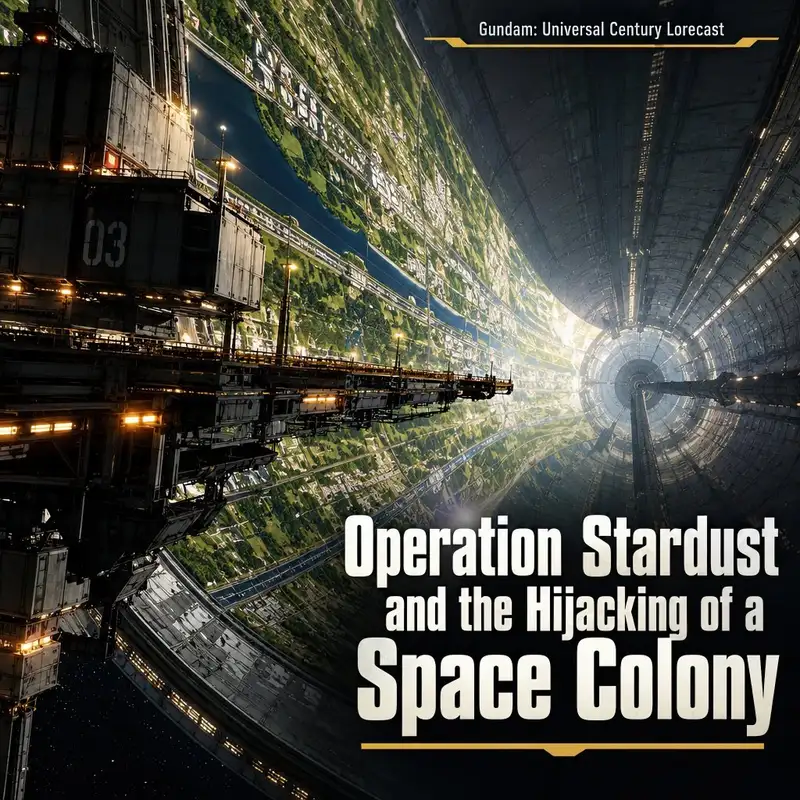
Operation Stardust and the Hijacking of a Space Colony
At Konpei Island, the former Zeon fortress of Solomon, the Earth Federation gathered warships for a naval review meant to show that the One Year War was over and that order had returned to the Earth Sphere. It was a ceremony of recovery, confidence, and military display. Then Anavel Gato arrived in a stolen Gundam carrying a nuclear weapon. The blast tore through the assembled fleet, killing crews and destroying ships that had been positioned for a demonstration rather than a battle. The destruction was immense. The OVA describes a major part of the review force as lost, commonly summarized as roughly two-thirds of the assembled fleet. But the attack’s most important effect was not the wreckage at Konpei Island. It was the time, confusion, and fear created elsewhere. While Federation commanders struggled to understand how a remnant force had struck so deeply, a colony was already being seized and redirected toward Earth.
That was Operation Stardust. It was not simply the theft of a Gundam, the destruction of a fleet, or a colony drop considered in isolation. It was a coordinated campaign in which each phase made the next one possible. The stolen mobile suit provided shock. The naval strike created operational paralysis. The seizure of Federation colony traffic supplied an enormous weapon already moving through space. And the impact on Earth was intended to produce not only physical destruction, but political consequences that would outlive the Delaz Fleet itself.
The operation raises an uncomfortable question. How could a relatively small Zeon remnant force achieve a result that the victorious Earth Federation, with its larger population, factories, fleets, and formal authority, could not prevent? The answer is not that the Delaz Fleet was secretly equal to the Federation. It plainly was not. It had neither the industrial depth to fight a new conventional war nor the territorial control to restore Zeon sovereignty by force. Its success came from recognizing that it did not need to defeat the Federation everywhere. It needed to identify one moment when the Federation’s strength was concentrated, distracted, politically vulnerable, and unable to form a coherent picture of the threat.
The opening move came at Torrington Base in Australia, where Gato infiltrated the Federation installation and stole Gundam Prototype Unit Two, commonly called Physalis. The theft was already a serious security failure. The Gundam Development Project was classified, politically sensitive, and tied to Anaheim Electronics. Its machines were not ordinary front-line equipment. They represented a postwar effort to test advanced Federation mobile-suit capabilities under conditions of secrecy.
Physalis mattered because it carried a nuclear weapon. A mobile suit armed with such a device gave a remnant force a way to threaten a concentrated naval formation without owning a comparable battleship force. The machine’s value was not simply its armor, propulsion, or prestige. Its value was that it could penetrate the Federation’s assumptions. A nuclear attack was supposed to be the business of strategic forces, political authority, and tightly controlled arsenals. Gato’s theft placed that destructive power in the hands of an experienced mobile-suit pilot operating for a force the Federation had not taken seriously enough.
The Federation response began as a recovery operation. Kou Uraki, a young test pilot, took Gundam Prototype Unit One and joined the pursuit aboard the assault carrier Albion. The Albion’s mission was urgent, but urgency is not the same as understanding. At first, the Federation had a stolen prototype, an escaped pilot, and evidence of a serious security breach. What it did not yet possess was a complete picture of a campaign designed to unfold across Earth orbit, colonial transport routes, and the Federation’s own military institutions.
This distinction mattered. A pursuit force can chase a fugitive, investigate contacts, and contest local engagements. It cannot by itself replace theater-wide intelligence, coordinated strategic warning, or unified command. The Albion’s crew saw more of the threat than many Federation officials did, but they were still operating through incomplete reports, political restrictions, and the normal friction of war. Their persistence mattered. It did not give them the power to reorganize the Federation’s entire response.
The classified nature of the Gundam Development Project made the problem worse. Compartmentalization exists for reasons. States protect new weapons, restrict access to sensitive information, and separate technical programs from routine commands. But secrecy also creates blind spots. If too few people understand what has been stolen, who built it, what it can do, and why it matters, then warnings move slowly. The Federation had superior resources, but those resources were divided among military branches, political offices, industrial contractors, research teams, and commands that did not automatically share the same operational picture.
Gato’s escape through the Australian and African phases of the campaign revealed that the theft was not an isolated act. The Delaz Fleet had routes, contacts, planning, and the ability to support a major operation across multiple theaters. Yet even as that evidence accumulated, the Federation continued to react in pieces. The Albion pursued. Local forces engaged. Officials debated responsibility. Intelligence improved, but not fast enough to catch up with the plan already in motion.
This is one of the central realities of Operation Stardust. The Federation did not fail because it had no information. It failed because information arrived in fragments, passed through institutions with different priorities, and did not become a shared operational understanding before the decisive moment. Large military organizations are often good at mobilizing visible strength. They can be much slower at admitting that a familiar problem has become a different kind of threat.
Gato was essential to that process. He was not merely an ace pilot with an exceptional machine. He was Delaz’s trusted instrument, a symbol of defiance, and the operator chosen to deliver the campaign’s most visible blow. His reputation served a political purpose. It connected Operation Stardust to the memory of the One Year War and gave the remnant force a figure around whom old loyalties could gather. But the operation did not rest on Gato alone. A stolen Gundam could destroy ships. It could not seize, escort, redirect, and deliver an entire colony by itself.
That work required Cima Garahau and the Cima Fleet. Cima’s force gave Operation Stardust much of its practical naval capability. Her ships and personnel could move through the Earth Sphere, intercept targets, protect operations, and contest Federation forces in the space around the colonies. Delaz supplied strategic purpose. Gato supplied the spectacular strike capability. Cima supplied the force necessary to make the colony phase operationally possible.
Cima was not simply a loyal believer in Delaz’s cause. Her relationship with the Delaz Fleet was transactional, shaped by survival, mistrust, and the legacy of the One Year War. She commanded people with their own history of abandonment by Zeon’s leadership. That history mattered because it affected what Cima could reasonably expect from Delaz. He saw sacrifice as a price to be paid for political symbolism. Cima understood that soldiers marked as expendable by one command often remain expendable when the speeches are over.
Her eventual break with Delaz should not be reduced to a simple betrayal planned from the beginning. The campaign placed incompatible interests under increasing pressure. Cima needed security for herself and her force. Delaz demanded commitment to an operation whose final stages would consume ships, crews, and political options. Their alliance worked as long as each partner believed it could gain something from the other. It began to collapse when the cost of Delaz’s ambition became impossible to hide.
The colony seizure was where these military and political realities converged. The Federation was conducting a colony-reclamation operation, transferring colonies from Side One toward Side Three. The OVA presents this traffic as part of the postwar movement and reorganization of damaged colonial infrastructure. That made the colonies more than political symbols. They were moving systems of habitat management, transportation, docking, control, and logistics. They had scheduled routes, support arrangements, and predictable vulnerabilities.
A colony cylinder is not an empty shell in space. It is a home, a life-support system, a transport hub, an industrial and social environment, and a political community. Its movement involves residents, workers, support crews, administrators, and dependent communities whose safety depends on systems functioning as intended. To seize such an object is not simply to capture a large piece of equipment. It is to place a civilian population and an entire built environment under military coercion.
That was precisely why the colony was useful to Delaz. The Federation had already invested the effort required to move it. The habitat was already on a planned route, already part of a logistical system, and already positioned in space where an attacking force could exploit it. Delaz did not need to manufacture an asteroid weapon from nothing or build a strategic bombardment platform at industrial scale. He needed to capture a massive object the Federation itself had placed in transit and alter its destination.
The operation involved more than one colony, which complicated the Federation’s threat assessment. Multiple potential targets created uncertainty about which colony represented the immediate danger and which route required the fastest response. In a crisis, uncertainty is itself a weapon. Every force sent toward the wrong target, every commander waiting for confirmation, and every hour spent debating the enemy’s true intention worked in favor of the attackers.
Island Ease became the colony directed toward Earth. Changing its course was not a casual maneuver. A habitat of that scale cannot be treated like a mobile suit making a rapid turn in combat. Its route had to be altered through control of its systems, timing, escort, and enough force to keep Federation intervention from restoring the original plan. The OVA does not provide a technical manual for every adjustment made during the operation, and there is no need to invent one. The essential point is clear. The attackers had to seize control, impose a new navigational purpose, and hold that control long enough for the colony’s altered trajectory to become a strategic fact.
That required coordination. It required ships capable of intercepting and screening the colony. It required an understanding of Federation traffic patterns. It required timing that would exploit the confusion created by the stolen Gundam. It also required the ability to make the Federation hesitate. A smaller force cannot normally hold an objective against a larger one through raw firepower alone. It must create uncertainty, force the defender to disperse, and turn the defender’s decision cycle into a liability.
The Delaz Fleet did exactly that. The seizure was under way while the Federation was still trying to understand the broader meaning of Gato’s theft. The colony had become a weapon before the Federation’s political and military institutions had accepted that they were facing a strategic campaign. That was the operation’s deepest deception. The stolen Gundam looked like the center of the crisis. In reality, it was the opening instrument of a larger attack.
Then came Konpei Island. The former Solomon was a deeply symbolic location. During the One Year War, it had been one of Zeon’s great fortified positions. Now the Federation was using it as the setting for a naval review, a public display of recovered strength. Ceremonial concentration is always dangerous in wartime. It places valuable units close together, narrows attention toward appearance and coordination, and assumes that the event itself will be protected by the prestige of the state organizing it.
Gato used Physalis to turn that concentration into a target. The nuclear strike destroyed ships and killed crews, but it also damaged the Federation’s ability to respond as a system. The reviewed fleet was not merely a collection of hulls. It represented trained personnel, command relationships, communications, logistics, maintenance capacity, and a visible concentration of military confidence. The loss of a major portion of that force carried tactical, operational, psychological, and political consequences at the same time.
Tactically, the attack annihilated or crippled a large number of ships. Operationally, it disrupted a force that could have contributed to the defense of orbital approaches and the response to the colony threat. Psychologically, it shattered the assumption that the postwar Federation could safely display its strength at the site of an old victory. Politically, it exposed the gap between recovery rhetoric and actual readiness.
The exact order of battle at Konpei Island is not securely established by counting animated vessels on screen, and it should not be treated as though it were a modern archival reconstruction. The important fact is the scale of the shock. The OVA presents the attack as devastating enough to disorganize the Federation at a critical point in the campaign. Not every ship destroyed at Konpei Island would necessarily have intercepted Island Ease. That is not the point. The strike reduced available assets, disrupted command, and forced the Federation to respond to catastrophe while a greater threat was moving toward Earth.
The nuclear attack was therefore both destruction and diversion. It was not merely an act of vengeance against the Federation fleet. Delaz needed the Federation to focus on the obvious disaster. He needed surviving commanders to sort out losses, restore communications, account for forces, and reassess the threat. He needed the Federation’s confidence to crack at the moment when clear, rapid coordination was most necessary. The strike bought time for the colony phase, and time was the one resource the Federation could not easily replace.
Only after the colony’s altered course became undeniable did the full shape of Operation Stardust emerge. The Federation now faced a moving strategic weapon on an Earth-bound trajectory. Its advantage in ships, factories, and formal authority could not be converted instantly into an effective interception. Forces were dispersed. Commanders were dealing with the aftermath of Konpei Island. Intelligence had to be confirmed, routes calculated, weapons assembled, and orders transmitted through a system already under stress.
The Federation’s problem was not blindness. It was delayed coherence. The government possessed powerful weapons and substantial resources, but resources are not the same thing as readiness. A state can own fleets and still struggle to assemble them in the right place. It can have advanced research programs and still fail to connect their warning signs to strategic planning. It can maintain a large bureaucracy and still find that responsibility has become so divided that no one acts decisively until the enemy has already shaped the battlefield.
The emergency answer was Solar System Two. The Federation had used a related mirror weapon during the One Year War, and this new system was assembled to intercept Island Ease before impact. In practical terms, it was a large strategic weapon designed to focus immense destructive energy on a target too massive for ordinary mobile-suit attacks to stop reliably. Its mission was not elegant. It was desperate. The Federation needed to destroy the colony or alter its path before it reached Earth.
But a weapon like Solar System Two is powerful precisely because it is not simple. It requires assembly, alignment, coordination, protection, timing, and a functioning control system. It is not a rifle one soldier can carry into a crisis. It is an organized military instrument with vulnerable points of failure. The more powerful and specialized the system, the more dependent it becomes on the crews, ships, communications, and command arrangements that make it work.
Gundam Prototype Unit Three, Dendrobium, entered the crisis as part of that effort. Its importance here lies not in its impressive array of equipment, but in the role assigned to it. The Federation had a powerful specialized machine available for a crisis that had already been shaped by surprise, institutional confusion, and severe time pressure. Dendrobium could fight. It could protect elements of the interception effort. It could engage enemy forces attempting to disrupt Solar System Two. But it could not repair the fact that the Federation had been forced into a last-minute defensive operation.
Gato, now operating the Neue Ziel, understood the same principle from the opposite side. The strategic weapon was dangerous not because every component was invulnerable, but because its success depended on coordination. Destroy the right control element at the right moment, and the entire interception effort could fail. His attack on the control vessel did not need to destroy every mirror or every Federation ship. It needed to break the system at its critical point.
That was the decisive turning point. Solar System Two fired before it could achieve its full intended effect. The colony survived the interception attempt and continued toward Earth. The Federation had not lacked courage, advanced machines, or the willingness of individual crews to fight. It had lacked the time and intact coordination needed to turn those assets into a reliable defensive outcome. The destruction of the control vessel was tactical. The loss of the Federation’s final dependable chance to stop the colony was operational and strategic.
This is the hard lesson of the interception. Exceptional hardware cannot automatically compensate for late warning. Dendrobium was formidable. Solar System Two was formidable. The Federation still failed because both systems depended on a command structure that had been shaken, dispersed, and forced to improvise under pressure. Weapons do not act alone. They require doctrine, intelligence, logistics, trained crews, communications, and political decisions made before the crisis reaches its final hours.
Island Ease struck North America’s agricultural region rather than Jaburo, the Federation’s principal military headquarters. In narrow military terms, the colony did not hit the command target that would have delivered the most direct blow to Federation authority. But missing Jaburo did not make Operation Stardust harmless, nor did it reduce the attack to a near miss. The impact devastated major agricultural production and inflicted a severe shock on land, infrastructure, and civilian security.
The attack’s strategic logic was aimed at the material basis of life. Food production is not an abstract economic statistic. It is the foundation of urban survival, public confidence, political stability, and the ability of a government to care for its population. Damage to agricultural regions can produce displacement, shortages, disrupted transport, damaged communities, and long-term anxiety far beyond the immediate impact area. The OVA establishes a severe blow to North American food production. It does not provide a reliable basis for calculating an exact global famine, and there is no need to exaggerate the point. The damage was already strategic.
The colony’s residents and infrastructure must remain central to that judgment. Island Ease was not a lifeless projectile before it became a weapon. Its seizure placed people under military control. Its redirection made their home part of an attack they had not chosen. Its impact transformed civilian space into a means of civilian destruction. The fact that the weapon had once been a habitat is not incidental to the crime. It is what makes Operation Stardust one of the clearest examples of military planners converting human infrastructure into a tool of mass coercion.
For the Delaz Fleet, the immediate result was an operational success. The Federation naval review had been shattered. Solar System Two had failed to stop the colony. Island Ease reached Earth. A comparatively small force had imposed losses and political damage far beyond what its conventional strength should have allowed. In the short term, Delaz proved his central claim: Zeon’s defeat had not eliminated the ability of men acting in Zeon’s name to strike the Federation.
Yet Operation Stardust did not restore Zeon. It did not seize territory that the Delaz Fleet could govern. It did not create a stable political order. It did not establish a durable military balance. The campaign consumed the force that carried it out. Delaz, Gato, Cima, and much of the participating remnant organization were lost in the operation’s final stages. The fleet achieved destruction, but it could not convert destruction into sovereignty.
Cima’s fate illustrates the limits of coalition warfare built on coercion and expendability. Her force was indispensable to the operation, but Delaz’s willingness to sacrifice subordinates for symbolic victory made trust impossible. When a leader treats allies as tools to be discarded after they have served their purpose, those allies eventually begin looking for another exit. Cima’s break with Delaz was not a side drama separate from the campaign. It was a consequence of its political design.
Gato’s end carries a different form of failure. He remained committed to the mission even as the possibility of a broader Zeon restoration disappeared around him. His skill, discipline, and determination made him a formidable executor of Delaz’s plan. But tactical commitment is not the same thing as strategic wisdom. A pilot can complete a mission while the political cause attached to that mission collapses. The Delaz Fleet achieved its strike. It could not build anything durable from the ruin it caused.
The Federation, meanwhile, suffered a defeat that was military, political, and moral. It had failed to protect its own naval concentration. It had failed to stop a colony being turned into a weapon. It had exposed serious weaknesses in intelligence, command relationships, and crisis response. Yet the Federation state survived. Its industrial base remained. Its political institutions remained. Its capacity to shape the postwar narrative remained as well.
That is the final irony of Operation Stardust. Delaz sought to prove that Zeon could still shape history. He succeeded, but not in the way he intended. The most durable political institution created by his campaign was not a restored Zeon state. It was the Titans, a Federation security apparatus that would later terrorize colonial populations while claiming to defend the Earth Sphere from the legacy of Zeon.
Operation Stardust proved that a weak remnant could still strike with strategic force when it understood the enemy’s assumptions, logistics, and political vulnerabilities. The Delaz Fleet did not defeat the Federation in a conventional contest. It used a stolen nuclear weapon to create operational paralysis, turned a colony-transfer system into a delivery mechanism for mass destruction, and forced the Federation to reveal that its postwar recovery rested on fragmented command and unresolved colonial politics. Yet the campaign did not restore Zeon or create liberation. It destroyed lives, damaged civilian food production, consumed the remnant force that carried it out, and gave Federation hardliners the emergency they needed to build the Titans.