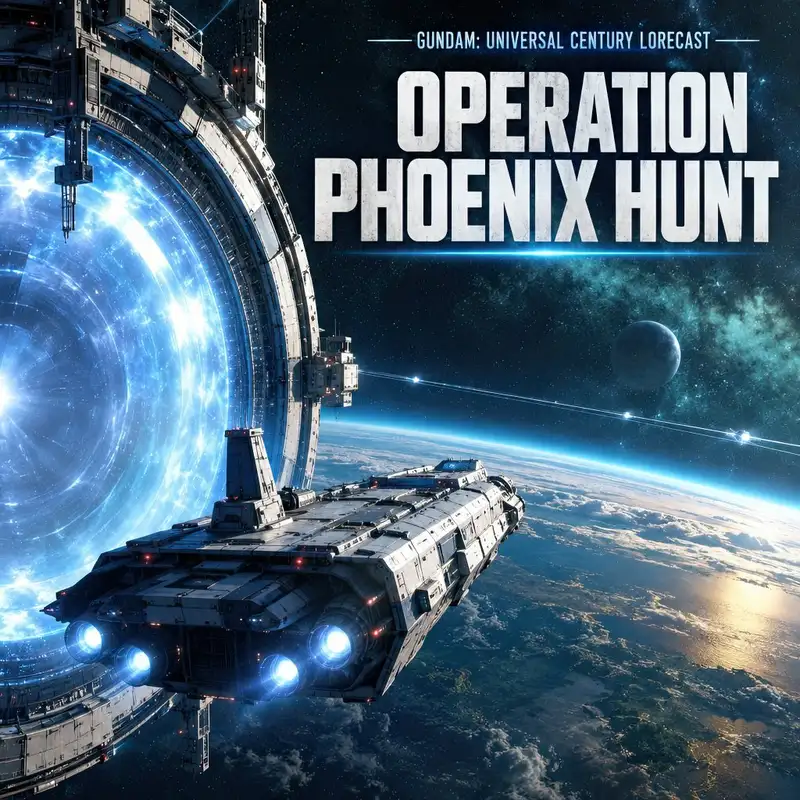
Operation Phoenix Hunt
A recovery mission is supposed to begin with a location, a target profile, and a plan for bringing valuable equipment home. In Universal Century ninety-seven, the Earth Federation had none of those comforts. Its missing asset was the Phenex, the third Unicorn-type mobile suit, lost two years earlier during a test incident with pilot Rita Bernal aboard. Now it had returned to the Earth Sphere. It did not request assistance, respond to ordinary authority, or behave like a damaged machine searching for a base. It appeared, moved with extraordinary speed, and vanished again. The Federation called its classified response Operation Phoenix Hunt. The name suggested a difficult retrieval. The reality was a contest over a weapon whose military value, political meaning, and apparent behavior had all escaped normal control.
The timing made the problem worse. Only a year had passed since the Laplace Incident, when the Unicorn Gundam and Banshee displayed Psycho-Frame phenomena that military and political institutions could observe but not fully explain. The public revelation connected to the original Universal Century Charter had not repaired the Earth Sphere’s political order. Colonial inequality, institutional secrecy, and rivalry over Newtype technology did not disappear because a document had been revealed. Instead, the spectacle of the Unicorn machines created a new concern inside the Federation. Psycho-Frame was no longer merely advanced equipment. It had become evidence that a weapon system might produce effects outside the assumptions of ordinary doctrine, research, and command.
Federation officials used the label Singularity One for the danger represented by the Unicorn-type machines and their extraordinary behavior. The term was useful because it sounded technical without pretending that anyone possessed a complete technical explanation. It described an institutional problem. If a machine could respond to human intention, memory, or emotional crisis in ways that overwhelmed conventional controls, then the question was not simply whether it could be captured. The question was whether any government could possess it safely. Phoenix Hunt began as an effort to recover and suppress that danger. But a recovery mission requires a target that can be found, fixed in place, and controlled. The Phenex offered none of those conditions.
Beneath the operation’s machinery stood three people whose lives had been shaped by an earlier catastrophe. Jona Basta, Michele Luio, and Rita Bernal had survived the destruction caused by the One Year War’s colony-drop disaster in Australia. As children, they were associated with reports of unusual foresight before the impact. Later institutions called them the Miracle Children. The phrase was flattering in the way bureaucracies often flatter people before deciding how they can be used. Their childhood experience brought them to the attention of researchers and officials interested in Newtypes. Trauma, intuition, prediction, and survival became material for programs that wanted measurable results from human suffering.
That history matters, but it should not be turned into a neat supernatural formula. The film does not establish that the three children possessed one identical ability, or that their shared past explains every event involving the Phenex. What it does establish is more troubling. Their extraordinary reputation made them useful to institutions that wanted to understand, exploit, or contain Newtype potential. Rita became the test pilot lost with the Phenex. Jona became a pilot still carrying the burden of that loss. Michele became an executive with access to money, technology, and political influence, but also with a personal fixation on mastering the phenomenon that had consumed their lives.
Michele’s role is especially important because she does not enter Phoenix Hunt as a neutral technical adviser. She brings resources that the Federation needs, including the Narrative Gundam and specialized equipment, but she also seeks control over the power represented by the Phenex. Her ambition is not separate from guilt. Like many people shaped by military research programs, she has learned to express moral injury through the language of acquisition and control. If the phenomenon can be possessed, categorized, and made useful, perhaps it can be made survivable. That is an understandable human impulse. It is also the beginning of a dangerous institutional logic. The Federation had a formal mission, but the people supplying some of its most important tools were pursuing a more personal and private objective.
The official chain of command began with the Earth Federation General Staff. Phoenix Hunt was a classified operation, built around the recapture of the Phenex before it could cause another incident or fall into hostile hands. The Clop-class cruiser Damascus served as its mobile headquarters. That meant more than carrying mobile suits into the area. Damascus provided the launch platform, recovery capability, maintenance spaces, communications center, command post, and medical support required to keep a specialized team operating away from fixed bases. Captain Abarea commanded the ship. Commander Iago Haakana led the mobile-suit force known as the Shezarr Team.
This was a small force for a narrow mission, not a conventional battle group sent to defeat an enemy fleet. That distinction shaped both its strengths and its vulnerabilities. Phoenix Hunt assumed that the Phenex was valuable enough to be captured intact and dangerous enough to require specialists. It did not assume that the mission would become a sustained fight against heavily armed opposition in civilian space. The planning logic was reasonable if the target remained a fast but recoverable mobile suit. It became fragile once the target began behaving in ways the planners could neither predict nor reproduce.
Luio and Company complicated that chain of command from the beginning. Through Michele, the corporation entered the operation with its own ship, the Rosebud, its own technical access, and the Narrative Gundam piloted by Jona. The company was not simply a contractor handing equipment to the military and then waiting for payment. Its contribution created leverage. A private actor that supplies a rare weapon system, specialized support, and a pilot with a personal connection to the target can influence the mission even without holding formal command authority. That is one of the enduring hazards of advanced weapons procurement. Technical access creates practical power, especially when the military itself lacks the expertise to proceed alone.
Anaheim Electronics stood behind much of the advanced hardware involved in the operation, including equipment associated with the Narrative Gundam and the larger Psycho-Frame ecosystem. But Anaheim should not be imagined as an all-seeing hidden government directing events from behind a corporate desk. Its importance came from industrial capability. It could provide designs, components, engineering knowledge, and rapid technical support that governments needed. That did not mean its customers shared a common purpose, or that even Anaheim could guarantee how experimental systems would behave. Phoenix Hunt began with overlapping authority, compartmented knowledge, and different definitions of success. The Federation wanted containment. Michele wanted control. Jona wanted Rita. Those objectives could coexist briefly. They could not remain aligned once the pursuit began.
The Shezarr Team’s equipment shows what the original planners believed they were trying to do. Its six Jestas were organized into three two-machine elements. One group emphasized high-mobility pursuit. Another provided sniper support. A third carried the physical means of capture, including Base Jabbers and capture guns. The doctrine was straightforward. Detect the target, pressure it into a predictable route, limit its escape options, disable it if necessary, restrain it without destroying it, and recover it before the situation widened. Against a conventional rogue mobile suit, that was a sensible division of labor.
The arrangement also reveals the limits of the force. Specialized pursuit and capture equipment is optimized for a controlled interception, not for a battle against an unknown Psycho-Frame response or a hostile mobile armor. The six Jestas were not a sample of ordinary Federation capability. They were a purpose-built team, selected for a highly unusual task. Their performance depended on coordination, timing, situational awareness, and support from Damascus. Even highly mobile mobile suits remained dependent on their ship for sortie planning, fuel or propellant support, repairs, recovery, and the wider operational picture. A squadron can be brave, skilled, and well equipped, yet still be unable to force a target into the conditions its doctrine requires.
Minovsky conditions made those problems sharper. They did not erase every sensor, communication channel, or method of observation. They did make long-range certainty difficult and increased the importance of visual identification, local judgment, prearranged plans, and commanders who understood the limits of their information. A capture operation is especially sensitive to uncertainty. It must know which object is the target, where it is likely to move, whether it is damaged, and how much force can be used without ruining the prize. Phoenix Hunt depended on assumptions about all four. The first interception would test whether the Phenex was still a machine that could be cornered.
The encounter near Side Four unfolded in a debris-filled environment where movement, visibility, and approach geometry already complicated the task. Such a field could provide concealment, interfere with clean pursuit lines, and make every maneuver a calculation of relative motion and collision risk. The Shezarr Team attempted to create a capture envelope around the Phenex. The point was not to win a duel for prestige. It was to herd the target toward the capture element while the other teams limited its freedom of movement. In theory, the Jestas’ different roles complemented one another. In practice, the target’s speed and unpredictability turned their specialized formation into a dispersed pursuit.
Michele’s answer was the Narrative Gundam in its A-Packs configuration. The Narrative had been built around modular equipment packages, and the A-Packs gave it the high-mobility capability and Psycho Capture system intended for this moment. It was an emergency answer to an emergency problem. The equipment did not demonstrate that the Federation or Luio and Company had developed a mature, standardized solution to Psycho-Frame containment. It demonstrated that they could assemble a powerful specialized system quickly when a crisis created political urgency. That is not the same thing as reliability. Rapid procurement can put advanced hardware into the field. It cannot guarantee that doctrine, training, safety, and understanding have caught up.
The trap failed because every part of the original plan depended on the Phenex behaving as an object within a known performance range. The Shezarr Team could pursue it, but could not reliably dictate the engagement. The Narrative’s equipment could reach for it, but could not define what it was reaching for. The Phenex’s movement suggested not only superior mobility but a responsiveness that resisted ordinary prediction. The difference is important. A very fast machine remains a machine if its patterns can be measured, its fuel can be estimated, and its pilot can be pressured into mistakes. The Phenex seemed to occupy a category that its pursuers could observe without mastering.
Jona briefly established contact through a capture line. That contact did not produce a stable technical link, a recovery procedure, or a clear answer to Rita’s fate. Instead, it became psychologically destabilizing. Jona experienced signs that he associated with Rita. The film presents the moment as an extraordinary connection between Jona, the Phenex, and the missing pilot. It does not provide a settled scientific mechanism. Calling it a conventional radio transmission would be inadequate. Declaring it proof of literal possession would be equally inadequate. For the people inside the operation, however, the distinction between observed fact and interpretation did not reduce the effect. Jona’s personal relationship to the target was now impossible to separate from the mission.
Tactically, the Phenex escaped the capture envelope. Operationally, Phoenix Hunt lost its central assumption. The target could not be managed through ordinary restraint, and it could not be treated as a neutral piece of equipment waiting to be recovered. Once that became apparent, every interested actor had a new incentive. If no one could safely contain the Phenex, then no one could allow a rival to acquire it. The hunt ceased to be a controlled Federation recovery mission and became an intelligence contest shaped by secrecy, suspicion, and political fear.
The Federation did not fully understand the Phenex. Michele did not disclose the full extent of her private purpose. Jona was both the operation’s most useful pilot and its most emotionally compromised participant. Those conditions would have been difficult enough inside one organization. They became more dangerous because a parallel operation was already moving through the same battlespace. The Republic of Zeon, publicly a postwar political entity trying to maintain its place in the Earth Sphere, contained factions with very different interests. Foreign Minister Monaghan Bakharov used covert connections to pursue the Phenex through deniable means.
Monaghan’s operation concealed Republic involvement behind the identity of Sleeves remnants. The deception offered political cover. If the mission succeeded, the Republic could gain access to a strategic asset without openly risking its position. If it failed, blame could be directed toward an already discredited remnant network. This was not simply a matter of painting different insignia on mobile suits. It was a method of separating political responsibility from military action. Such methods are attractive to governments because they preserve options. They are dangerous because they also weaken command accountability. The people carrying out the operation know that their patrons want results, but may not know what political limits still apply.
Within that covert effort stood Ellic Hugo and Zoltan Akkanen. Ellic’s task was not merely operational support. She was also assigned to monitor Zoltan, an indication that the Republic’s own handlers did not trust the asset they had deployed. Zoltan was a Cyber Newtype created through the same broad institutional effort that had produced Full Frontal. That connection should not reduce him to a simple imitation or a failed version of someone else. It identifies the kind of program that shaped him: one that treated identity, memory, perception, and human vulnerability as military material. Zoltan’s resentment was personal. The system that made use of it was political.
No participant possessed a complete picture. The Federation had authority but incomplete knowledge. Luio and Company had expertise but a private agenda. Monaghan had deniable tools but limited ability to control them. Ellic monitored Zoltan because the people who created him understood the risk he represented. And the Phenex remained outside every chain of command. This was not a contest between three coherent blocs executing clear plans. It was a collision of fragmentary intelligence, concealed motives, and weapon systems whose users did not fully control. The consequences became unavoidable when the pursuit entered Side Six.
Side Six carried particular political weight. It was inhabited space, economically active and sensitive to the memory of wartime neutrality. A colony is not an empty volume where armed forces can maneuver without consequence. It is life support, housing, transport, education, labor, and a population that must live with the damage after military units leave. The Metis school colony made that reality especially plain. This was not a fortress, a military depot, or a declared battlespace. It was an educational community brought inside the risk envelope because competing institutions refused to abandon their pursuit.
The engagement at Metis marked the failure of controlled operations. The Federation and Republic-linked forces converged around the Phenex, but neither side could fully direct the pace of events. The pursuit had become reactive. Pilots were making decisions under pressure, commanders were responding to incomplete reports, and a target intended for capture was moving through civilian infrastructure. The tactical result was damage and confusion. The larger significance was political. A mission justified as containment had created the very public danger that containment was meant to prevent.
There is a distinction between accepting risk to protect a population and imposing risk because an institution cannot accept the loss of a strategic prize. Phoenix Hunt moved toward the second category. The damage to a school colony was not simply unfortunate collateral from a clean operation. It was evidence that the operation had ceased to possess a credible boundary. The Phenex’s escape, Monaghan’s covert intervention, and the pressure to prevent a rival’s success all made withdrawal seem unacceptable to those involved. Yet the civilian population did not share their priorities. It bore the cost of a struggle over technology, legitimacy, and memory that most residents had no voice in shaping.
Mineva Lao Zabi provided a political counterpoint to Monaghan’s covert network. She understood the danger in reviving the habits and machinery associated with Neo Zeon politics. A Republic that claimed to have moved beyond the old order could not build legitimacy while secret actors used Sleeves cover and experimental weapons to pursue their own power. But recognizing a problem is not the same as controlling every institution acting in a government’s name. Mineva did not possess direct authority over every security or intelligence action conducted through Republic channels. That limitation mattered. States often appear unified from a distance. In crisis, they reveal competing officials, private networks, and chains of command that operate beside formal policy.
Monaghan’s response to the escalating situation was not to disengage. It was to increase force. That decision brought Zoltan and the Sinanju Stein more directly into the operation. The Stein was a remaining Psycho-Frame test unit, a machine with direct relevance to the very technology everyone claimed to fear. Giving it to Zoltan was not a contradiction from Monaghan’s point of view. It was an attempt to use one dangerous instrument to seize another. The same pattern had appeared throughout the operation. Faced with a system that exceeded ordinary control, each institution reached for a more specialized weapon, a more secret program, or a more vulnerable person to restore control by force.
Zoltan’s role must be understood at both the human and institutional levels. He was not merely a pilot with unstable emotions, nor was he only an obedient tool. He had been conditioned by a program that measured his worth against an imposed political image and then used the injuries created by that comparison. His anger gave the operation energy. It also made him difficult to contain. Ellic’s monitoring role acknowledged that fact without solving it. The Republic’s covert network wanted the combat value of a Cyber Newtype while hoping to outsource the human consequences of making one. That is a familiar fantasy in military research. It rarely survives contact with the person who has been made into the weapon.
The deeper failure was not that Zoltan proved impossible to control. The deeper failure was that Monaghan’s operation assumed control could be imposed through custody. Possess the Sinanju Stein, supervise the pilot, conceal the mission, and acquire the Phenex. The structure looked coherent on a planning chart. In reality, it relied on a damaged man, hidden authority, and technology whose effects had already alarmed the Earth Sphere. The Republic’s network repeated the same error made by the Federation and Luio and Company. It treated possession as mastery.
The arrival of the II Neo Zeong changed the scale of the crisis. It was not simply a larger enemy machine entering a mobile-suit battle. Built from components associated with the earlier Neo Zeong, it represented a dramatic escalation in destructive potential and political risk. A capture operation built around specialized Jestas and an experimental Gundam was now confronted by a mobile armor capable of threatening more than the target being pursued. The mission’s center of gravity shifted. The question was no longer who would take custody of the Phenex. The question was whether anyone could prevent a disaster in inhabited space.
The decisive danger emerged around Side Six’s helium-three storage infrastructure. Helium-three is not merely a useful resource in the abstract. In the Earth Sphere, reserves and storage facilities are part of the energy and industrial systems that sustain fleets, colonies, factories, and civilian life. Such infrastructure is embedded within political communities. An attack or uncontrolled catastrophe there threatens more than a military installation. It risks damage to nearby habitats, disruption of essential energy systems, and the creation of debris and secondary dangers across a populated region.
The II Neo Zeong’s extraordinary capabilities should not be treated as normal mobile-armor doctrine. It was a unique escalation produced by exceptional technology, exceptional political recklessness, and a pilot-handler relationship already under severe strain. But its presence clarified what Phoenix Hunt had become. The original mission had been designed to recover a single runaway asset with minimum damage. Now the immediate objective was catastrophe prevention. The Federation could no longer prioritize intact capture. Michele could no longer imagine a clean private acquisition. Monaghan could no longer plausibly claim a deniable political maneuver. The operation had crossed the point where its original tools and assumptions mattered most.
The Narrative Gundam’s shifting equipment configurations reveal that change. Its A-Packs had been built for the initial pursuit, emphasizing mobility and the Psycho Capture system. The later B-Packs and C-Packs reflected an escalating attempt to adapt a modular experimental platform to threats its designers had not planned to face in one operation. This was not seamless technological mastery. It was emergency procurement under fire. The ability to attach different equipment packages can be valuable, especially when a crisis moves faster than a formal development cycle. It can also conceal the absence of a stable doctrine. A machine that can be reconfigured for every mission may be serving as evidence that no one knows what mission is actually coming.
The C-Packs were especially revealing. They assembled a Psycho-Frame arrangement for a crisis in which ordinary firepower and capture systems had become inadequate. That choice had immediate tactical logic. The Phenex and II Neo Zeong had made Psycho-Frame central to the battle, whether the participants wanted it to be or not. But it also exposed the limits of the institutions involved. Anaheim and its associated industrial network could provide advanced components quickly. They could not make the resulting system safe, predictable, or strategically reproducible by delivering it faster. Hardware can be rushed to a hangar. Understanding cannot.
Jona stood at the center of that contradiction. He was not an interchangeable pilot assigned to operate an interchangeable machine. His ability to participate in the Phenex crisis was bound to his Newtype sensitivity, his childhood trauma, and his connection to Rita. Those qualities made him useful. They also made the mission intensely personal. Institutions often mistake such personal investment for reliability. A pilot who wants desperately to reach a lost friend may accept risks that a conventional operator would reject. That can create extraordinary action in a crisis. It is a poor foundation for a weapons program or a command doctrine.
At the helium-three facility, the final engagement was therefore not a contest for possession. It was a struggle to prevent the II Neo Zeong and Zoltan from turning vital civilian-adjacent infrastructure into the center of a strategic disaster. The Phenex, originally the target of the hunt, became part of the only practical resistance to the greater threat. That temporary alignment does not mean the Federation had successfully incorporated it into the chain of command. It means events had made the old distinction between hunter and target irrelevant. In war, a plan can be overtaken so completely that former objectives become obstacles to survival.
The Narrative Gundam was progressively destroyed in the effort to stop the II Neo Zeong. That destruction matters because it strips away the illusion that a specialized platform can solve a political and scientific problem by itself. The Narrative’s equipment had been assembled to reach the Phenex, restrain it, or match escalating threats. In the final engagement, those packages were expended against a crisis that had outgrown the mission’s original design. Jona escaped through the Core Fighter, preserving the pilot even as the larger machine was lost. It was a reminder that recovery of people and recovery of equipment are not identical priorities, even when institutions often treat them as though they were.
Jona ultimately transferred to the Phenex. Together, or through whatever relationship the film presents between Jona, Rita, and the machine, the Phenex defeated the II Neo Zeong and ended the immediate danger. The event must be described carefully. The film depicts a real extraordinary phenomenon. It does not provide a final answer to whether Rita’s consciousness survived in a conventional sense, how Psycho-Frame mediated the experience, or whether the participants’ perceptions can be reduced to engineering. The military facts are clearer than the metaphysical ones. A strategic threat was neutralized. The facility and surrounding habitats were spared the worst immediate outcome. But the machine that achieved that result did not return to the Federation as a normal recovered asset.
The human results were equally severe. Zoltan was consumed by the system that had created and used him. His anger did not excuse the danger he posed, but neither should his destruction be treated as a tidy removal of a villain from the board. He was evidence of what happens when institutions build a person around coercion, comparison, and military utility, then act surprised when that person cannot be managed like equipment. Jona’s final contact with Rita offered a form of closure, but not restoration. It did not return their childhood, erase the One Year War’s disaster, or repair the research programs that transformed survivors into assets.
For that reason, Operation Phoenix Hunt became a three-sided political and military crisis. The Phenex was never only a runaway mobile suit. It was a classified Federation weapon, evidence of the disturbing potential of Psycho-Frame, a symbol of Newtype possibility, a site of unresolved trauma, and a prize that rival institutions believed could grant them leverage. The Federation sought containment. Michele and Luio and Company sought control. Monaghan’s covert network sought political advantage. Zoltan sought recognition and revenge within a system that had denied him any stable identity. Those aims could not coexist, particularly when no participant fully understood the target at the center of the struggle.
The destruction of the II Neo Zeong did not make the operation a success. It stopped an immediate catastrophe, and that mattered greatly to the people living near the threatened infrastructure. But it did not solve the larger problem. The Phenex was not conventionally recovered. Psycho-Frame was not made predictable. The institutions that had funded secret programs, exploited damaged people, and brought their rivalry into civilian space remained in place. The post-Laplace Earth Sphere still had no durable answer to the power it had created.
Operation Phoenix Hunt revealed a familiar Universal Century failure. Governments and corporations confronted a problem born from political violence, human trauma, and scientific ambition, then tried to solve it through classification, custody, and stronger weapons. They mistook possession for control. By the time the immediate danger ended, the Phenex had escaped the categories built around it, and the civilians of Side Six had paid the price for institutions that still believed their most dangerous creations could be managed like property.