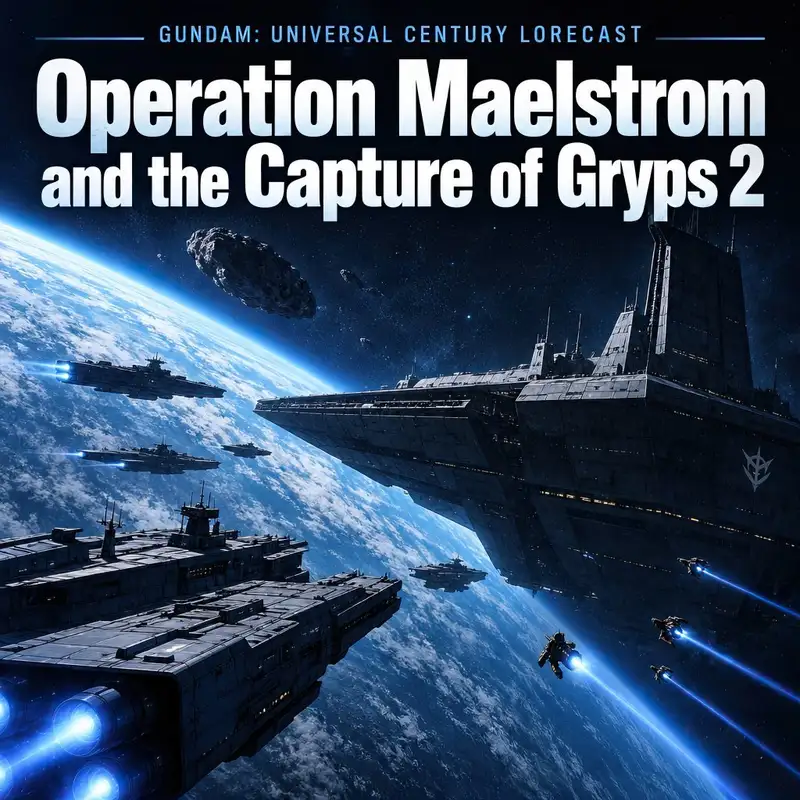
Operation Maelstrom and the Capture of Gryps 2
Granada was not facing an ordinary fleet threat. Axis had seized Gryps 2, a colony laser built from what had once been Green Noa 2, and its movement placed the lunar city under coercive pressure. The Anti-Earth Union Group could not solve that problem simply by retreating, nor could it safely destroy the installation from a distance. Gryps 2 was too large, too dangerous, and too politically important. It was a former colony turned into a strategic weapon, with power systems, control spaces, firing geometry, defensive positions, and whatever civilian infrastructure remained beneath its military conversion. To destroy it risked repeating the very logic the AEUG claimed to oppose. To leave it in Axis hands meant allowing Haman Karn to bargain with the Moon under the shadow of a weapon already associated with attacks on colonies.
That made Operation Maelstrom a contest over control rather than annihilation. The AEUG needed to disable Gryps 2 long enough to penetrate its defenses, seize its operating systems, and use the colony laser’s power to alter Axis’s immediate threat to Granada. Mobile suits mattered, certainly. Kamille Bidan’s Zeta Gundam and Haman Karn’s Qubeley would become the most visible symbols of the battle. But the central military question was broader. Could a materially weaker force surround a fixed strategic installation, disrupt its function, and take possession before the defenders could restore coordination? The answer depended on fleet maneuver, preplanned command intent, local initiative, and the uncomfortable fact that every major power in the Gryps Conflict understood the value of a weapon that could make political argument unnecessary.
The Titans had created that problem. Gryps 2 began as Green Noa 2, a colony in Side Seven, but by the final phase of the Gryps Conflict it had been remade into a colony laser. The conversion was more than an engineering project. It was a political declaration. The Titans had emerged from Federation fears after the Delaz Conflict, then expanded those fears into an apparatus of repression, surveillance, and military privilege. A colony laser fit that worldview perfectly. It concentrated enormous destructive power in an institution already convinced that security required overwhelming force and limited accountability.
By late Universal Century eighty-seven, the Titans had demonstrated what Gryps 2 was for. The weapon was used against Side Two’s Colony Eighteen, and poison gas was used against Colony Twenty-one. Those acts were not ordinary military engagements. They showed a willingness to treat colonies as targets, bargaining chips, and examples. In the Earth Sphere, a colony was not merely a large object floating in space. It was a habitat, an economy, a political community, and a pressure vessel containing civilians who had little say in the strategic designs imposed upon them. The Titans’ use of mass violence was intended to break resistance through fear. Instead, it confirmed to many colonists that the Federation’s security system had become a threat to the people it claimed to protect.
Yet the Titans’ greatest weapon also became their greatest strategic liability. Gryps 2 was too consequential to ignore and too valuable to remain politically neutral. Any force capable of reaching it could threaten the Titans, bargain with them, or seize the weapon for itself. Strategic weapons often create this contradiction. They are built to settle a balance of power, but their existence makes control of the weapon the balance of power. Once Gryps 2 existed, the conflict could no longer be understood only as a contest between the Titans and the AEUG. It became a three-sided struggle in which Axis Zeon could use the colony laser to shape the future of the Earth Sphere without having to win every conventional battle.
Axis understood that opportunity. In January of Universal Century eighty-eight, its forces destroyed the Gate of Zedan, the former A Baoa Qu fortress, and then took Gryps 2. The seizure immediately changed the strategic map. The Titans had lost direct control of their own superweapon, but the AEUG had not gained it either. Haman Karn now held an asset that could threaten opponents, influence negotiations, and preserve Axis’s freedom of action. Her command ship, the Gwadan, and her personal presence gave Axis a clear center of authority. But the political situation around her was not stable.
Axis had previously dealt with the AEUG against the Titans. That arrangement was never a durable alliance. The two sides shared an enemy, not a program for peace. The AEUG wanted to survive Titans repression and preserve a political alternative to Titans rule. Haman wanted leverage, recognition, and the chance to restore Zeon influence on terms set by Axis. These interests could overlap briefly. They could not remain identical once the question became who would hold the Earth Sphere’s most powerful weapon.
The Titans, meanwhile, were in their own crisis. Negotiations between Axis and Titans leadership collapsed. Jamitov Hymem was killed, and Paptimus Scirocco assumed practical control of the Titans’ military direction. The original owners of Gryps 2 remained dangerous, but their command structure was changing at precisely the moment when Axis and the AEUG were deciding whether to cooperate, bargain, or fight. In such conditions, formal authority could change faster than fleets could be redeployed. Scirocco had influence, ambition, and military assets, but he inherited a fractured organization rather than a settled command system.
Haman did not treat Gryps 2 as a trophy. She treated it as leverage. Axis’s position threatened Granada, one of the Moon’s major cities and industrial centers. That threat mattered because lunar industry, shipyards, political leadership, and transport infrastructure were not abstract targets. They were part of the Earth Sphere’s capacity to sustain war and govern afterward. A threat to Granada could pressure the AEUG, the Federation, Anaheim-linked industrial interests, and anyone dependent on the Moon’s strategic position. But Haman’s larger goal was not simply to hold one colony laser at any cost. She needed to preserve Axis as an independent military and political force for the struggles still ahead. That broader priority would matter when the AEUG attacked.
For the AEUG, the operational problem was severe. It had talented crews, experienced commanders, and several advanced mobile suits. It did not have the material depth to absorb a long, straightforward fleet engagement against every remaining major power in the Earth Sphere. The Argama and Radish could conduct mobile-suit operations, coordinate formations, carry supplies, recover damaged machines, and sustain crews under combat conditions. They were not battleships that could simply stand off and trade fire with an installation like Gryps 2 until one side collapsed. Their strength was mobility, concentration at selected points, and the ability to make a small force appear in more places than the defender could comfortably cover.
The AEUG also faced a moral and practical limit. Gryps 2 had been weaponized, but it remained a colony structure. Its conversion did not erase the significance of the habitat beneath the armor, emitters, power conduits, and control rooms. An indiscriminate assault could damage structural systems, life support, or internal spaces in ways the immediate battle would not fully reveal. The television record follows the combatants, as military stories often do, but commanders could not assume that a colony-sized weapon was an empty fortress. Every shot fired at its systems carried risks beyond the destruction of a conventional warship.
More important, destroying Gryps 2 would not necessarily solve the crisis. A wrecked colony laser might deny it to Axis, but it would also deny it to the AEUG. It could create debris, political outrage, and a new strategic vacuum. It would not automatically remove Axis from the theater, nor would it prevent the Titans from exploiting the aftermath. The AEUG required the installation sufficiently intact to take control of its firing function. Only then could it use the weapon to force a change in Axis’s threatening approach toward Granada.
That distinction separates Operation Maelstrom from a raid. A raid seeks damage, delay, or information. Maelstrom required a transition from attack to occupation. The AEUG had to defeat exterior defenders, suppress the colony laser’s immediate ability to fire, open routes into or toward critical control systems, and then hold those systems against counterattack. In military terms, the force had to seize a strategic objective while preserving the objective’s utility. That is much harder than blowing up a target. It demands discipline after the breakthrough, because the attacker must stop shooting at the thing it intends to own.
The name Maelstrom reflected Bright Noa’s solution. The AEUG fleet formed a curved encirclement around Gryps 2, approaching in a pattern described as a whirlpool or vortex. The imagery is dramatic, but the military logic was straightforward. A fixed installation has the advantage of prepared defenses, known internal routes, and the ability to anchor local forces around a protected objective. It also has to defend itself in every direction. Ships and mobile suits can maneuver. A colony laser cannot. If the AEUG could create pressure from multiple approaches, Axis would have to divide its attention, shift interceptors, and make difficult judgments about which contact represented the main assault.
The maneuver also complicated fire control. In a Minovsky-particle environment, commanders could not assume perfect long-range tracking, instant communication, or a single complete tactical picture. The particles did not make sensors and radios useless in every circumstance, but they degraded the kind of centralized control that a large defensive force would prefer. Prearranged plans, visual confirmation, short-range coordination, and officers who understood the commander’s intent became more important. Bright’s task from the Argama was not to personally direct every mobile suit through every exchange. It was to create a plan that could continue functioning when contact became fragmented and individual pilots had to make decisions beyond the bridge’s immediate reach.
A curved attack also offered several possible access routes. Axis defenders could not simply mass at one obvious point and wait for the AEUG to arrive. Mobile suits could probe, suppress, withdraw, and reappear along different portions of the defensive perimeter. The fleet did not need to destroy every Axis unit. It needed to make the defenders uncertain, force them to spend time and fuel repositioning, and create a breach large enough for assault elements to reach the laser’s vulnerable systems.
There was risk in this approach. Encirclement formations can become overextended. Separate groups may lose mutual support. A defender can concentrate against an isolated part of the ring or break through toward the command ships. The Argama and Radish had to remain close enough to direct, supply, and recover their mobile suits, while far enough apart to avoid presenting Axis with one concentrated target. Bright Noa’s experience mattered here. He was not merely commanding a famous ship. He was managing a formation whose success depended on timing, restraint, and the willingness of many crews to perform unglamorous tasks correctly.
The fleet could create opportunity, but it could not by itself capture Gryps 2. A colony laser is controlled through internal systems, electrical infrastructure, receivers, transformers, access points, and personnel who understand how the machinery is operated. The AEUG would need mobile suits to carry the assault close to the objective, protect the ships, defeat local defenders, and interfere with the colony laser’s ability to respond. In that sense, Operation Maelstrom was a combined-arms operation conducted in space. The ships established the operational framework. The mobile suits fought for the corridors within that framework. The installation itself became the terrain.
The AEUG force contained several famous machines, but its effectiveness came from how different units were employed together. The Zeta Gundam was its most capable transformable mobile suit, useful where speed, maneuver, and high-risk intervention were required. Quattro Bajeena’s Hyaku Shiki brought the experience of one of the AEUG’s most important mobile-suit leaders. The Gundam Mark Two, supported by the G-Defenser, gave the force another high-performance element able to operate in demanding combat conditions. Fa Yuiry’s Methuss could provide mobility and support. Rick Dias and Nemo units performed the less celebrated but essential work of screening ships, contesting access routes, suppressing defenders, and making it possible for elite machines to focus on decisive tasks.
That mix mattered because a fleet cannot build its doctrine around one exceptional pilot. The Zeta Gundam could not simultaneously protect the Argama, escort an assault group, disable the laser, defeat Haman Karn, and secure every route toward the controls. Nor could the Hyaku Shiki or the Gundam Mark Two. Advanced prototypes can create local advantage, but local advantage must be supported by ordinary machines, trained pilots, mechanics, launch crews, and commanders who can maintain the larger operation. The AEUG’s strength lay in combining limited numbers of exceptional systems with a broader force that could keep the battle from collapsing around them.
The Argama and Radish were central to that system. Their mobile-suit hangars were not simply dramatic launch bays. They were maintenance spaces, ammunition stores, recovery points, command centers, and medical lifelines. A damaged mobile suit that could return to a carrier might fight again. A pilot who could be recovered might provide intelligence, return to duty, or simply survive. A ship that lost its ability to launch and recover machines ceased to be an effective mobile-suit carrier even if its hull remained intact. The AEUG’s ships therefore had to remain protected while they generated sorties. Every launch cycle involved fuel, weapons, mechanical readiness, pilot fatigue, and the danger that a returning unit might bring battle damage or an enemy pursuer close to the fleet.
For that reason, the more ordinary Nemo and Rick Dias teams were important. They were not background decoration around the Gundams. They provided the mass needed to hold space, escort vulnerable ships, and complicate Axis’s defensive decisions. Their pilots could not all be expected to match Kamille’s reflexes or Quattro’s experience. But a military organization does not survive by asking every pilot to become a legend. It survives by assigning achievable missions, maintaining equipment, and ensuring that the force can absorb losses without losing its purpose.
Axis possessed its own advantages. Its mobile-suit technology was sophisticated, and Haman Karn was not a commander who treated battle as a matter of blind aggression. Her Qubeley was a Newtype-use machine equipped with remote funnels, systems that could attack along angles conventional opponents found difficult to anticipate. In the hands of a capable pilot, that kind of weapon altered local engagement geometry. It could force an enemy to defend in several directions, disrupt formations, and punish predictable movement. But even an advanced mobile suit remains part of a larger force. It requires command decisions, support, awareness of friendly positions, and a strategic purpose that justifies risk.
Axis’s real problem was the size and nature of the objective it held. Gryps 2 was large enough to require a dispersed defensive perimeter. Its defenders had to guard not only the visible exterior but also approaches to the systems that made the laser operational. A mobile defense can maneuver, but it must first know where to maneuver. The AEUG’s encirclement placed Axis under pressure from several directions, and the available television record does not establish exact force ratios or a complete order of battle. It does show that Axis’s response did not prevent the AEUG formation from tightening around the installation.
This does not mean Axis was helpless or incompetent. It means that defensive strength is not merely a matter of possessing advanced machines. The defender must concentrate force at the decisive point before the attacker achieves penetration. That is difficult when the target is a colony-sized installation, communications are degraded, and the attacker has deliberately made its main effort hard to identify. Axis also had a strategic reason not to sacrifice everything in a single defensive stand. Haman’s forces had survived by preserving options. A commander who commits every available unit to hold one position may win the immediate engagement and lose the wider war.
Premature or poorly synchronized defensive fire can make that dilemma worse. If defenders engage too soon, they reveal their positions, expend weapons, and allow the attacker to identify gaps. If they hold fire too long, the attacker closes distance and gains access routes. If units respond independently without a coherent defensive picture, they can be drawn away from the actual point of penetration. The AEUG’s whirlpool formation was designed to exploit exactly that uncertainty. It did not need Axis to make catastrophic mistakes. It only needed Axis to divide attention long enough for the assault to reach the systems that mattered.
A fixed strategic weapon has vulnerabilities that are not visible from the outside. Gryps 2’s destructive power depended on enormous technical infrastructure. In the television episode, the AEUG assault focuses on disrupting elements identified as the microwave receiver panel and transformer, components associated with the colony laser’s electrical operation. The precise engineering language should not be treated as a complete model for every colony laser in Universal Century history. What matters here is the operational principle. A weapon capable of extraordinary destruction still relies on systems that receive power, distribute it, regulate it, and connect the weapon to the commands that authorize firing.
The AEUG did not need to dismantle Gryps 2. It needed to interrupt the chain between command and effect. Disabling the laser’s electrical function prevented Axis from using the installation immediately. That bought time. Time allowed assault units to penetrate farther, allowed the fleet to maintain pressure, and prevented the defenders from converting their possession of the colony laser into a decisive shot. In military operations, temporary paralysis can be more useful than permanent destruction when the attacker intends to seize the objective. A bridge, a port, a communications node, or a power station may be most valuable when it is disabled just long enough to change hands.
The attack on those systems also demonstrates why mobile suits had become so important in Minovsky-era warfare. They were not simply duelists. Their mobility, manipulators, weapons, and ability to operate close to structures made them useful for tasks that conventional ships could not perform safely or precisely. A warship could threaten Gryps 2 from outside. A mobile suit could fight near the vulnerable components, defend an access route, or make a controlled strike against a specific part of the installation. But that flexibility carried danger. Operating close to a colony laser meant fighting amid structures where a missed shot, an explosion, or uncontrolled debris could endanger systems far beyond the immediate target.
The AEUG’s need for restraint was therefore built into the mission. The force could not simply bombard every suspected Axis position. It had to distinguish between defenses that needed suppression and infrastructure that needed preservation. This is one of the less glamorous demands of capturing strategic infrastructure. The attacking force must possess enough tactical aggression to break through, and enough discipline to avoid destroying the prize. The more powerful the installation, the more dangerous its capture becomes. An attacker who takes a weapon intact also inherits responsibility for every danger built into it.
Kamille Bidan’s confrontation with Haman Karn took place within that larger struggle. The Zeta Gundam and the Qubeley were not competing for a title. Haman entered the battle because Axis control of Gryps 2 was under direct threat. Kamille fought because the AEUG assault could not proceed freely while a pilot of Haman’s ability was able to disrupt it. Their engagement was tactically significant, but it was significant because it affected the defense of the installation, not because it offered a clean answer to which machine or pilot was superior.
The Qubeley’s funnels made it dangerous in the confined, shifting geometry around Gryps 2. Remote weapons gave Haman the ability to threaten from more than one direction, forcing Kamille to account for attacks that did not follow the usual line between two mobile suits. The Zeta Gundam’s performance gave Kamille the mobility and responsiveness to survive that pressure and continue fighting. Yet no machine, however capable, removed the larger constraints of the operation. Haman still had to decide how much of Axis’s force to commit. Kamille still had to protect the assault’s purpose rather than pursue a personal victory. The duel was a part of the battle’s command problem.
Their Newtype contact adds another layer, but not a mystical solution. During the engagement, Kamille and Haman perceive one another with an intensity beyond ordinary sensor contact. The encounter demonstrates the possibility of recognition, an awareness of another person’s presence, will, and emotional force. It does not produce trust. It does not settle their political conflict. It does not make either commander morally wiser. Newtype perception in the Universal Century can intensify communication, but it cannot erase ideology, trauma, ambition, or the responsibilities people have chosen to accept.
Haman and Kamille had reasons to recognize the force of the other. Haman was a leader shaped by the survival of Axis and by the political inheritance of Zeon. Kamille was a young pilot fighting against the Titans while confronting the compromises and betrayals surrounding the AEUG. But recognition is not reconciliation. Haman still needed Axis to retain power. Kamille still needed Gryps 2 removed from Axis control. Their contact reveals the tragedy of Newtype potential in this era. People may perceive one another more clearly and still remain trapped inside institutions that reward coercion over understanding.
The battle also exposes a recurring weakness within the AEUG. Its strength depended partly on people willing to act without waiting for permission. The organization had been built in opposition to the Titans, and resistance movements often require initiative, courage, and the ability to improvise under pressure. Those qualities can save lives when formal command systems are slow, compromised, or absent. They can also undermine coordination when individuals decide that personal urgency outweighs the operational plan.
Katz Kobayashi’s participation in the battle illustrates that tension. He entered the fight in the G-Defenser despite the restrictions and command structure that should have governed such a dangerous operation. Fa Yuiry, operating the Methuss, became involved as well. Their presence was not merely a youthful adventure placed beside the main battle. It showed the AEUG’s manpower problem. The organization relied on young, highly motivated personnel whose experience, loyalty, and emotional connections could pull them toward action even when disciplined employment required restraint.
From one perspective, Katz’s initiative increased the number of available hands in a crisis. From another, it complicated launch control, tactical accountability, and rescue planning. A commander cannot easily integrate an unauthorized pilot into a formation that already depends on timing and limited communications. Other crews may have to protect that pilot, adjust routes, or respond to unexpected distress. A damaged unit is not only a personal danger. It can draw escorts away from assigned positions, consume recovery capacity, and create new decisions for a bridge crew already managing a battle around a strategic installation.
That strain extended beyond the cockpit. Mechanics had to prepare machines for combat. Deck crews had to launch and recover them. Medical personnel had to prepare for casualties. Navigators had to keep ships clear of collision, debris, and hostile fire. Communications personnel had to maintain what coordination they could. The public memory of a battle tends to condense around its aces. The actual operation depends on people whose names rarely become myths. Bright’s plan mattered because those people could carry it out under pressure.
By the end of Operation Maelstrom, the AEUG had captured Gryps 2. The immediate tactical result was clear. Axis defenses had been overcome sufficiently for the AEUG to take control of the colony laser. The operational result was more important. The AEUG had not merely survived an Axis threat. It had seized the installation necessary to interrupt that threat and use the laser’s power to alter Axis’s dangerous movement away from Granada.
Maelstrom was therefore a genuine operational success. It combined fleet maneuver, mobile-suit action, technical disruption, and command judgment more effectively than an isolated attack ever could have done. But it did not resolve the conflict that made Gryps 2 valuable. It placed the colony laser in new hands and made the question of its use even more dangerous. The AEUG had taken the weapon from a rival. It had not yet escaped the political world that believed such a weapon could decide who had the right to rule.