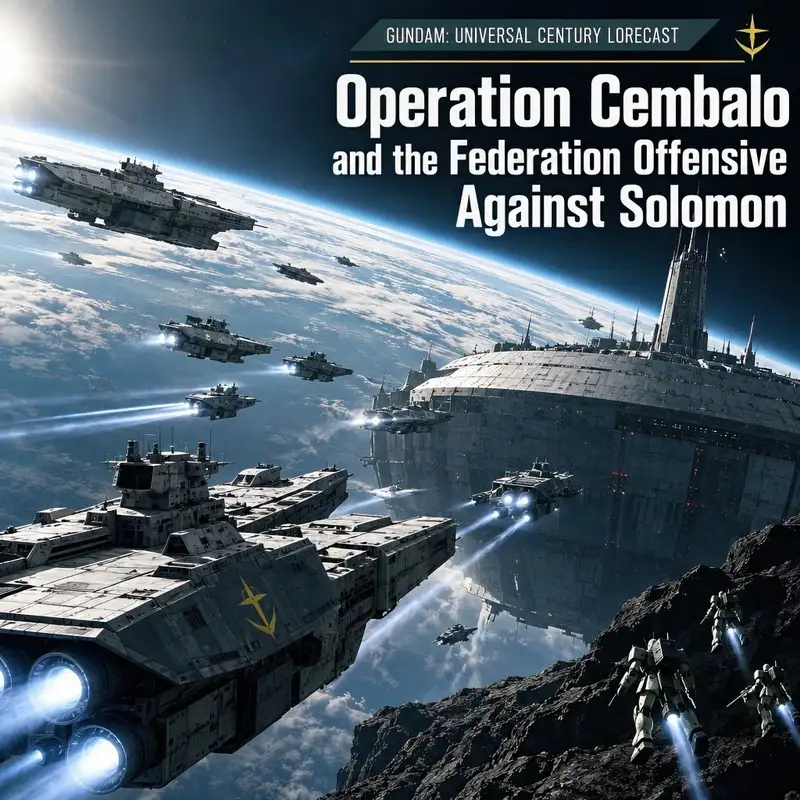
Operation Cembalo and the Federation Offensive Against Solomon
Before the first salvo at Solomon, cargo was already deciding the battle. Columbus-class transports moved among the Federation ships to replenish White Base and the other forces gathering for the assault. Inside the fortress, a Papua-class transport delivered the components of Dozle Zabi’s newest weapon, the prototype mobile armor Big Zam. Neither scene has the glamour of a Gundam charging through a breach or a giant mobile armor firing into a fleet. Both are more revealing. White Base needed fuel, ammunition, spare parts, technicians, and time. Big Zam needed transport space, assembly facilities, specialized labor, and a defended fortress in which to become operational. The most dramatic machines at Solomon were not independent weapons. They were the visible end of supply systems.
Later reference material commonly calls the Federation operation Operation Cembalo. The television record itself presents it more simply as the Solomon offensive. The difference matters mostly for terminology. The military problem remains clear. By late Universal Century seventy-nine, the Earth Federation had recovered enough strength in space to attack one of Zeon’s principal fortified positions. It still had to convert that growing strength into a workable operation. Solomon could not be taken by enthusiasm, or by throwing individual ships at its guns. It had to be isolated, fixed, breached, penetrated, and then occupied before Zeon could restore coherence to the defense.
That is why the battle deserves attention beyond its famous final duel. Solomon fell because the Federation coordinated logistics, fleet maneuver, specialized assault craft, mobile suits, and a cumbersome strategic weapon into one sequence. The Gundam and Big Zam mattered. So did Sleggar Law and Dozle Zabi. But they mattered at a particular point inside a larger campaign design. The fall of Solomon was not proof that one exceptional machine had made fleets obsolete. It was proof that fleets, transports, technicians, mobile suits, and extraordinary weapons had become parts of the same operational system.
Solomon was an asteroid fortress, but that description can make it sound like a rock fitted with guns. In practice, it was a forward military complex. It was a defensive position, a staging base, a command center, a harbor for ships, a protected location for mobile-suit forces, and a barrier between the Federation’s advancing fleets and Zeon’s remaining core defenses. Its value came from more than firepower. A fortress gave Zeon a place to repair, rearm, organize, shelter personnel, and force an attacker to fight on ground, or rather in space, prepared by the defender.
For the Federation, Solomon blocked the route toward the final phase of the war. Zeon had begun the conflict with a remarkable series of strategic shocks. By this stage, however, the balance was changing. The Federation had survived invasion, rebuilt its armed forces, fielded its own mobile suits, and begun to turn its larger industrial and demographic base into military power. That did not mean every Federation unit was equally capable, or that every new GM pilot was an ace. It meant the Federation could now mount large, coordinated operations in space instead of relying on scattered survivors and improvised responses.
Capturing Solomon promised several gains at once. It would remove a major Zeon forward bastion. It would damage Zeon’s ability to defend the approaches to its remaining strongholds. It would give the Federation a forward base of its own. And it would demonstrate that Zeon’s early advantage in mobile-suit warfare no longer guaranteed control of the operational battlefield. A fortress is valuable because it concentrates defensive power. It is vulnerable for the same reason. If the attacker can break the defensive system, the defender may find too many personnel, machines, stores, and command functions trapped in one place.
The Federation could not simply assume that greater resources would solve this problem. A prepared fortress can make an attacker pay heavily for every kilometer of approach. Its guns, mobile suits, patrols, and defensive infrastructure could engage ships before those ships reached positions from which they could threaten the interior. In the Minovsky environment, command and control were also more difficult than a clean map might suggest. Long-range electronic detection and communications were impaired. That did not make every sensor useless or reduce every battle to blind brawling. It did mean commanders had to rely more heavily on prearranged plans, visual observation, local initiative, and units that could continue their mission when headquarters could not see every development.
The challenge was therefore not merely to destroy targets. It was to get close enough, in sufficient strength, to turn Solomon from a secure defensive base into a confused close-range battlefield. Warships could deliver heavy fire, but large ships were poor tools for entering constrained defensive spaces under concentrated attack. Mobile suits could maneuver where ships could not safely go, but they needed carriers, replenishment, command support, and a breach through which to enter. The Federation needed a way to disrupt Solomon’s outer defenses without spending its entire fleet in a direct exchange of fire.
Its answer was a sequence of deception, pressure, and concentrated force. A forward formation would attack aggressively enough to hold Zeon’s attention. Meanwhile, the main Federation effort would prepare a weapon designed not to seize the fortress by itself, but to make seizure possible. The plan did not eliminate risk. It assigned risk. The forward force would bear the danger of drawing enemy fire while the decisive system was made ready. The distinction is important. A force can be sacrificed tactically without the operation being strategically aimless. The question is whether the danger it accepts serves a clear purpose. At Solomon, it did.
Admiral Tianem directed the principal Federation assault. Wakkein commanded the forward force associated with White Base. White Base had become one of the Federation’s most experienced and capable combat ships, with a crew hardened by months of continuous operations and a mobile-suit team that included Amuro Ray in the Gundam. Yet its importance should not obscure its position in the chain of command. At Solomon, White Base was not an independent expeditionary army. It was part of an assigned formation, dependent on the fleet around it and committed to a larger plan.
That dependency was visible even before combat began. The resupply ships were not background decoration. They were the means by which ships and mobile suits entered battle with usable stores and a chance of remaining effective after the first engagement. Ammunition had to be loaded. Damage had to be repaired as far as conditions allowed. Pilots needed briefings, maintenance crews needed parts, and commanders needed enough confidence in their material condition to accept the risks ahead. A famous ship can create the illusion that exceptional crews simply endure forever. In reality, even White Base required a support network.
Wakkein’s forward force had a difficult mission. It was to pressure Solomon, draw defensive attention, and survive long enough for the Federation’s main weapon to be deployed. That made it a fixing force. Its job was not necessarily to win the battle alone. Its job was to keep Zeon commanders focused on an immediate threat while the deeper threat took shape elsewhere. Such missions are often described with the language of sacrifice, and there is truth in that. The personnel closest to the fortress faced the highest danger. But calling the mission sacrificial should not make it sound irrational. The forward attack was the price of creating time.
The Federation also employed Public assault boats equipped to generate a beam-dispersing screen. These were specialized enablers. They were not weapons that could defeat Solomon by themselves, and they were not evidence that defensive fire had suddenly become harmless. Their role was narrower and more practical. By interfering with or reducing the effectiveness of fortress fire, they helped the attacking force survive the approach and created better conditions for the main assault. In a battle against a fixed defense, small specialized systems can have effects out of proportion to their size if they address the right operational problem.
The Public boats also illustrate a larger point about mobile-suit warfare. The One Year War did not replace every older military function with a humanoid combat machine. It increased the value of systems that could cooperate under difficult conditions. Warships brought endurance, firepower, command facilities, and transport capacity. Assault craft performed specialized defensive tasks. Mobile suits conducted close-range combat and entered spaces unsuitable for capital ships. Transports kept the entire effort supplied. The Federation’s growing advantage came not from a single perfect weapon, but from learning to connect these functions at scale.
The centerpiece of that connection was the Solar System. Its name can be misleading if it suggests an ordinary ship-mounted gun or a weapon that could be carried casually from battle to battle. The Solar System was a large reflector array, a collective system intended to concentrate solar energy against a chosen target. It required alignment, positioning, coordination, protection, and preparation. It was powerful precisely because it was not a simple individual machine. It concentrated resources that normally existed across many vessels and made them act as one weapon.
That concentration came with limitations. The Solar System could not rapidly pivot like a mobile suit. It could not independently clear a fortress, escort an evacuation, identify every surviving defender, or occupy captured facilities. While being prepared, it needed time and protection. The Federation had to create the conditions in which it could function. That was why the forward assault mattered. The attacking ships near Solomon were not merely conducting a preliminary exchange of fire. They were helping conceal, protect, and buy time for the system that could change the geometry of the battle.
The Solar System was a breach-making weapon. Its purpose was to strike Solomon’s defensive area hard enough to disrupt the fortress’s ability to keep the Federation at arm’s length. It did not need to erase Solomon from space. It needed to break the defensive zone, damage vital structures, shock the command system, and open a path for the forces that would follow. This is a different military logic from simple annihilation. A commander does not always need to destroy every enemy asset. Sometimes the objective is to make the enemy’s position impossible to hold.
When the Solar System fired, it achieved that effect. Solomon’s defenses were severely damaged. The fortress was not instantly vaporized, and every Zeon unit did not disappear with the strike. But the attack broke the integrity of the outer defense. It created a breach and imposed confusion on a garrison already under pressure. The Federation had engineered a moment in which its fleet and mobile-suit forces could pass from distant attack into penetration.
That transition was decisive. Before the breach, Solomon could use its fixed defenses to shape the battle. After the breach, the defenders faced threats in closer, more complex spaces. A fortress works best when it controls the routes by which an enemy must approach. Once those routes are compromised, defenders must improvise, redeploy, identify threats at short range, and protect internal facilities at the same time. Their command structure can become overloaded very quickly.
The Federation moved to exploit the opening. Ships advanced where they could. Mobile suits, including the newly fielded GMs, joined Balls and other support elements in the effort to penetrate and suppress the defense. White Base’s mobile-suit group was part of this exploitation. The point was not that every Federation machine was equal to the Gundam. It plainly was not. The point was that the Federation now possessed enough mobile-suit capability to use the breach created by its fleet operation.
Mobile suits were especially useful in this phase because they could enter dangerous spaces, engage local defenders, react to obstacles, and protect ships from close attack. Balls, despite their vulnerability, also had a role in a mass assault. They were not glamorous machines, and they were not substitutes for trained mobile-suit pilots. But war is often decided by the systems that can be fielded in quantity and employed for limited tasks. A Ball that helps suppress a defensive position or distract an enemy during a breach can contribute to an operational result even if it will never become the subject of a legend.
The assault was still dangerous. Debris, damaged structures, disrupted communications, and close-range identification all complicated the battle. In a Minovsky environment, a commander could not assume that every subordinate had a complete picture of the fight. Units had to act on intent as much as direct control. That made momentum important. Once the Federation had entered Solomon’s defensive perimeter, it needed to keep pressing before Zeon could restore order, seal approaches, or organize an effective counterattack.
This is where the limits of fixed fortifications became visible. Solomon had been built to resist an enemy outside it. It had defenses, dock facilities, internal spaces, mobile-suit capacity, and command functions. Yet those same functions became liabilities after penetration. Damaged infrastructure could obstruct friendly movement. Evacuation could compete with military traffic. Technical personnel might be needed both to repair defenses and to prepare ships for departure. A fortress under attack is not just a battlefield. It is a collapsing workplace, a transport hub under pressure, and a community suddenly forced to decide who can leave and who must remain.
Dozle Zabi understood the scale of the crisis. As commander of Zeon’s Space Attack Force and the senior defender at Solomon, he faced a situation that could no longer be resolved by holding every position. The Solar System strike had changed the problem from defense to survival. Dozle recognized that the fortress could not be maintained in the same way. He ordered evacuation, including the departure of Zenna Zabi and their infant daughter, Mineva.
That decision is militarily significant because it shows that Dozle had concluded Solomon was no longer a position to be held at all costs. Evacuation is not the same as surrender, and it is not proof that all resistance has ended. It is an acknowledgment that the mission has changed. The defender is now trying to preserve personnel, surviving assets, political continuity, and time. Troops may still fight fiercely, but their purpose is increasingly to cover withdrawal rather than restore the original defensive line.
The evacuation also reminds us that Solomon was inhabited by more than combat pilots. The television narrative naturally follows commanders and mobile-suit crews, but a fortress required mechanics, dockworkers, communications personnel, medical staff, supply clerks, ship crews, families, and other support workers. When a base falls, those people become part of the military problem. They must find transport, receive orders, secure children and dependents, leave behind possessions, and decide whether to flee with the remaining ships or remain amid the fighting. A fortress does not become empty just because a strategic map labels it a target.
Dozle’s answer to the Federation penetration was Big Zam. The machine was an extraordinary emergency asset, but it also revealed Zeon’s strategic predicament. Big Zam had arrived at Solomon in components. It had to be assembled, prepared, and made ready in the very fortress now under attack. This was the other side of the opening image. The Federation had brought a broad support network to sustain an offensive. Zeon had concentrated immense effort into one prototype, hoping it could change the battle at the moment of crisis.
Big Zam was a mobile armor, not simply a larger mobile suit. Its scale, weapons, and defensive systems gave it an outsized battlefield presence. In the fighting around Solomon, it inflicted severe losses on Federation ships and mobile suits. Its appearance was terrifying because it emerged when the attacking force was trying to consolidate success. The Federation had breached the fortress, but the breach still had to become control. A powerful counterattack at that point could damage ships, disrupt formations, slow the penetration, and give Zeon evacuation forces a better chance to escape.
This is the tactical value of a prototype weapon. It can create a local crisis where the enemy least expects it. It can force an attacker to divert attention, consume ammunition, risk experienced personnel, and reconsider the momentum of an operation. Big Zam was not irrelevant because it was only one machine. At the point where it appeared, one machine was enough to threaten the Federation’s assault force.
But tactical terror is not the same as strategic recovery. Big Zam could not rebuild the destroyed defensive network around Solomon. It could not replace the ships, personnel, and facilities already lost or compromised. It could not summon reinforcements that Zeon had failed to concentrate in time. It could not reverse the evacuation order, restore secure command and control, or turn a penetrated fortress back into an intact bastion. Its mission was therefore one of delay and destruction. It could make the Federation pay. It could not by itself make the Federation leave.
This is where the contrast with the Solar System becomes especially sharp. Big Zam concentrated extraordinary capability in a single platform and a single pilot. The Solar System concentrated capability across a large, organized network of ships and reflectors. Big Zam was more mobile and more immediately dramatic. The Solar System was slower, more cumbersome, and dependent on coordination. Yet the Solar System had created the operational opening. Big Zam entered after that opening existed, trying to prevent the Federation from exploiting it fully.
Neither system was self-sufficient. Solar System needed protection and a fleet ready to advance once it fired. Big Zam needed a defended base, assembly capacity, maintenance, and a battle situation in which its local power could have strategic effect. The difference was that the Federation had built a wider operational structure around its weapon. Zeon had been forced to gamble on an exceptional machine amid a collapsing defense.
The fight against Big Zam became the battle’s most remembered episode because it brought the enormous operational crisis down to human scale. Sleggar Law attacked the mobile armor in a final effort to compromise its defenses. His action cost him his life. The sacrifice mattered. It created the opening that allowed Amuro Ray, in the Gundam, to destroy Big Zam.
The sequence should not be simplified into a story in which Amuro alone defeats an invincible enemy. Big Zam was not invulnerable, and the Gundam did not resolve the encounter in isolation. Sleggar’s attack was tactically decisive because it disrupted the defensive protection that had made a direct assault so difficult. Amuro’s follow-up was equally decisive because it removed the machine before it could continue inflicting losses on the Federation force. Each action depended on the other.
Their importance was immediate. With Big Zam destroyed, the Federation no longer faced the same concentrated threat to its ships and advancing mobile-suit forces. The assault could regain momentum. Zeon’s remaining defenders could still resist, and evacuation could still continue, but the last major instrument capable of imposing a local reversal had been eliminated. Tactically, the destruction of Big Zam protected the assault force. Operationally, it helped ensure that the breach at Solomon became a capture rather than a stalled penetration.
Sleggar’s death should not be romanticized as though sacrifice itself were a substitute for strategy. His courage had meaning because it served a defined military need at a critical moment. It did not make the Federation plan costless, and it did not absolve commanders of their responsibility to prepare forces properly. Good operations try to avoid needing such sacrifices. But warfare often reaches moments when plans collide with unforeseen resistance, and an individual act determines whether a larger force can survive. Sleggar’s final attack was one of those moments.
Amuro’s role also needs to be understood in proportion. His ability as a pilot made him uniquely valuable. The Gundam’s performance, his growing skill, and the immediate opening created by Sleggar allowed him to destroy a threat that ordinary Federation units were struggling to contain. That was a real and significant achievement. Yet the Gundam could not have created the Solar System, maintained the forward fleet, supplied the assault, breached the fortress alone, or occupy the base afterward. It was a decisive instrument in a particular engagement, not the whole history of Solomon.
With Big Zam destroyed and the evacuation under way, the Federation completed the seizure of the fortress. Solomon fell and was renamed Konpeitoh under Federation control. The new name marked more than a cartographic change. The Federation had converted a Zeon forward bastion into a base from which it could support the next stage of the war. Its ships now had a position closer to Zeon’s remaining defenses. Its forces had removed a major obstacle from the route ahead. And Zeon had lost not just material, but defensive depth and prestige.
The tactical result was clear enough. Solomon’s defensive system had been broken. The Federation had penetrated the fortress, disrupted the garrison, destroyed Big Zam, and compelled a partial evacuation. But it would be wrong to imagine a perfectly clean victory. Some Zeon personnel and assets escaped. Some defenders continued to fight. The Federation had captured the fortress, not erased every element of Zeon’s war effort. A captured base is useful only if it can be secured, repaired, staffed, supplied, and integrated into the next operation.
Operationally, however, the victory was profound. The Federation had demonstrated that it could take a major space fortress through coordinated offensive action. This was not the improvised defense of an isolated ship or a desperate counterattack on Earth. It was a deliberate fleet operation supported by industrial preparation. The Federation had brought together transport, replenishment, capital ships, assault boats, mobile suits, specialized weapons, and command planning. In doing so, it showed that its recovery had reached the point where it could impose a campaign decision in space.
The intelligence lesson was equally important. Solomon exposed the limits of Zeon’s reliance on strongpoints and exceptional systems. Fortresses remain powerful when they can be reinforced, repaired, and supported by a coherent wider defense. Prototypes remain dangerous when they appear within a stable operational framework. At Solomon, Zeon had neither advantage in sufficient measure. Big Zam proved that Zeon could still produce frightening technology. Its loss proved that a single prototype could not compensate for strategic isolation.
The fall also weakened Zeon politically. A fortress of Solomon’s importance was a symbol of military reach as well as a military installation. Losing it told Zeon personnel, Federation commanders, and the wider Earth Sphere that the war’s momentum had shifted. The Federation had survived the terrible opening months, rebuilt, and returned to space in strength. For the Zabi regime, that was a strategic humiliation. It suggested that the early victories of the One Year War had not created a sustainable military position.
Still, Solomon did not end the war. The Federation intended to use Konpeitoh as a forward base for the final advance, but later events would disrupt any simple onward march. Zeon retained dangerous weapons, remaining strongholds, and the capacity to inflict immense casualties. The battle’s result changed the operational map. It did not remove the political desperation and internal conflict driving the final phase of the war.
That is the deeper meaning of Operation Cembalo. The battle is remembered through its most visible figures: Dozle in Big Zam, Sleggar’s final attack, and Amuro in the Gundam. Those memories are justified. Individual courage and extraordinary machines changed the immediate course of the fighting. But they do not fully explain why Solomon fell.
Solomon fell because the Federation made the fortress fight on terms that favored its growing ability to coordinate resources. Transports sustained the attacking force. The forward assault fixed the defenders in place. Public assault boats helped reduce the danger of the approach. The Solar System created the breach. Fleet and mobile-suit forces exploited it. Sleggar and Amuro removed the final tactical obstacle when Big Zam threatened to turn success back into crisis. Each part mattered because the others existed.
Big Zam showed what an exceptional prototype could do when placed in the hands of a determined commander. Solar System showed what concentrated industrial and organizational power could do when a military had the patience and capacity to prepare it. White Base showed the value of an experienced crew inside a larger formation. The capture of Solomon showed that no single machine, however famous, could replace the system around it.
The Federation had recovered the ability to win one of the war’s largest space battles. What it had not recovered, or perhaps never possessed, was a political order capable of resolving the failures that had made the Earth Sphere vulnerable to war in the first place.