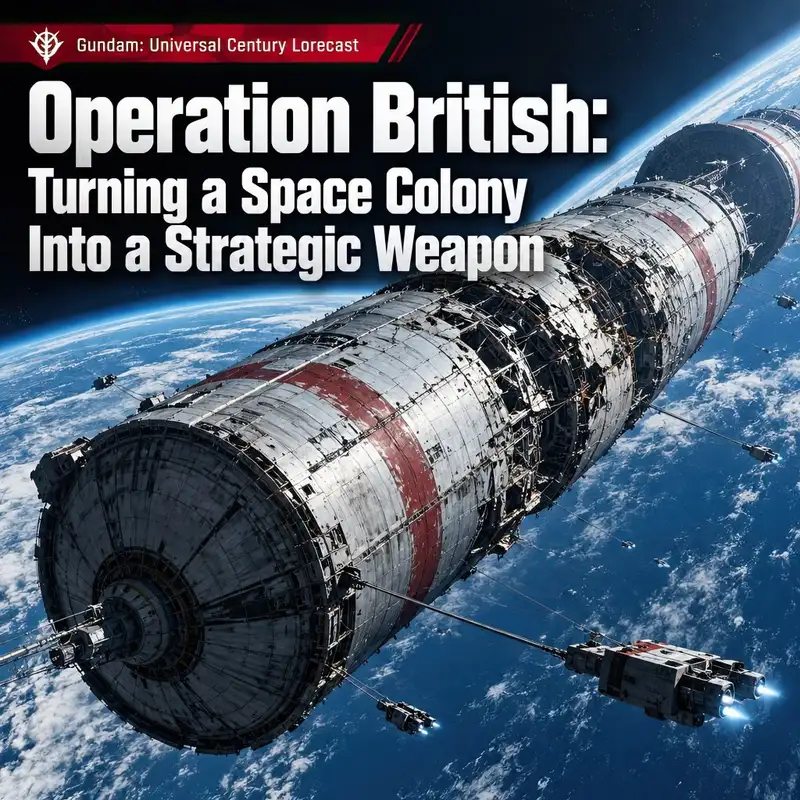
Operation British: Turning a Space Colony Into a Strategic Weapon
A colony is not ammunition. It is a pressurized habitat, a city stretched around a cylinder, an industrial plant, a transport network, a food system, and a political community. It contains people who expect tomorrow to resemble today. Operation British began by denying that expectation. Before Zeon could send a colony toward Earth, it had to seize control of a living world, secure its docks and internal systems, silence its defenders, remove or kill the people inside it, attach the machinery needed to alter its course, and protect that work long enough to send the entire structure toward the planet below.
The intended target was Jaburo, the Earth Federation’s principal military headquarters, buried beneath the Guiana Highlands. The strategic idea was brutally simple. If Zeon could destroy the center from which the Federation directed its military power, the Federation might lose its ability to coordinate resistance before its greater population, territory, and industry could be brought fully into the war. The result was equally simple, although not in the way Zeon intended. The colony drop caused devastation on a civilizational scale. It did not destroy Jaburo. It did not compel surrender. And it helped turn the opening of the One Year War into the long industrial conflict Zeon had hoped to avoid.
That is the central problem of Operation British. Why would Zeon turn a colony into a weapon? Because its leaders understood that they faced an opponent too large to defeat comfortably in a prolonged conventional war. Why did the operation fail despite the destruction it caused? Because destruction, even destruction on this scale, is not the same as strategic decision. A weapon can destroy cities, kill civilians, disrupt transportation, and scar a planet for generations. It can still fail to destroy the command system it was meant to strike. It can still fail to collapse political authority. It can still leave an enemy angry, mobilized, and very much at war.
A colony offered advantages that conventional weapons did not. It had immense mass. It could not be treated like a missile, a warship, or a mobile armor. If directed toward Earth, it would present the Federation with a threat of extraordinary scale. It also promised psychological effect. The Federation would not merely be defending a military base. It would be confronting a weapon made from the infrastructure of human settlement itself. The message was that no distance, no orbit, and no habitat was beyond Zeon’s ability to turn into an instrument of war.
The operation also exploited the limits of the Minovsky environment. Minovsky particles complicated radar, long-range electromagnetic detection, communications, and command coordination. They did not make Zeon invisible, and they did not render the Federation blind. Optical observation, local sensors, scouts, visual identification, prearranged plans, and short-range communication still mattered. But a war fought under Minovsky interference placed a premium on surprise and made it harder for a large organization to build a shared picture quickly. That mattered when the target was not an enemy fleet but a moving colony on a path toward Earth.
Even with compact fusion power and a mature spacefaring civilization, moving a colony was not simple. A reactor provides energy. It does not eliminate the need for propulsion, reaction mass, guidance, structural engineering, labor, timing, and control. A colony at a Lagrange point occupied a stable and useful position within the Earth Sphere’s transport geography. To turn it into a weapon, Zeon had to remove it from that position, alter its course, and guide it toward an atmospheric approach. The operation required engineering on the scale of civil construction under combat conditions.
That was part of its appeal. A colony was difficult to intercept precisely because it was so large, so massive, and so consequential. It was also difficult to employ precisely because it was so large, so massive, and so consequential. A minor error in ordinary weapons employment can mean a missed shot. A failure in the employment of a colony can mean destruction across an entire region, possibly far from the intended target. Operation British was therefore both an expression of immense power and an admission that Zeon was willing to accept immense uncertainty.
Before there was an orbital weapon, there was the seizure of Side Two. The principal animated history establishes the broad fact that Zeon captured a colony from Side Two and used it in the drop. This was not an empty structure waiting to be repurposed. It was part of a colony cluster with residents, internal services, political institutions, docks, communications, security arrangements, and the ordinary vulnerabilities of any closed habitat. A military force entering such a place could not simply fire at will without risking damage to life support, transport systems, pressure integrity, and the infrastructure it intended to use.
Zeon’s immediate military tasks would have been familiar in principle, even if unprecedented in scale. It had to overcome organized defense, secure ports and docking areas, control access to internal systems, protect key facilities, and prevent sabotage. It had to establish authority in an environment where civilians could not simply disperse into open countryside. A colony concentrates people, machinery, utilities, and escape routes inside a limited structure. That makes it economically efficient in peacetime. Under attack, it makes the population vulnerable to whoever controls the airlocks, power systems, transit corridors, and communications network.
Mobile suits were useful in this phase, but they were not the strategic weapon at the center of Operation British. They were tools of seizure, intimidation, security, and combat. They could assault defended positions, patrol docking zones, escort engineers, and suppress resistance. Yet a mobile suit could not make the operation strategically meaningful by itself. The decisive object was the colony. The mobile suits, ships, workers, staff officers, security personnel, and engineers existed in support of converting civilian infrastructure into a planetary weapon.
For the people inside the colony, the military distinction between seizure and weaponization offered little comfort. Once Zeon selected their habitat for the operation, their political agency disappeared from the planners’ calculations. The colony’s inhabitants were no longer citizens, workers, families, or even prisoners whose presence constrained military action. They were an obstacle to be removed. That transformation is essential to understanding Operation British. The colony became a weapon only because its residents were first treated as expendable material.
The later animated retelling Mobile Suit Gundam: The Origin provides the most detailed account of this process, but it must be handled as its own version rather than silently substituted for the original television history. The television series establishes the catastrophe and its enormous consequences. The Origin gives the operation a more specific political and operational form. In that retelling, the Side Two cluster is Hatte, and the colony selected for weaponization is Island Iffish, identified as Hatte’s capital colony.
The Origin also assigns more specific responsibility within Zeon’s senior command. In that account, Gihren Zabi devises Operation British as a strategic attempt to destroy Jaburo and break the Federation before it can mobilize. Dozle Zabi supervises the operation’s execution. These distinctions matter. Strategic authorship, operational supervision, field command, engineering labor, security work, and direct killing are not identical roles. They all exist within the same chain of responsibility, but they involve different forms of authority and different opportunities to question, refuse, conceal, or enable the plan.
The Origin’s account also places Ramba Ral at the opening attack on Hatte. Ral is not presented as a man innocent of war. He is a Zeon officer participating in a military assault. But when confronted with the colony-drop phase, he refuses to carry it out, regarding the act as beyond the limits of what he can accept. He is punished and replaced. That refusal matters because it establishes a simple but important fact. The operation was not an unavoidable consequence of the war. Someone within Zeon’s military system recognized that there was a line between fighting an enemy and converting an entire civilian community into a weapon.
Ral’s refusal does not redeem the institution. It does not prove that the Zeon military broadly opposed the operation. The plan went forward. Other officers accepted responsibility. Other personnel followed orders. Others may have known only their compartment of the mission. A large operation is often designed to divide knowledge as well as labor. One group secures a port. Another manages propulsion equipment. Another controls communications. Another guards a corridor. Another receives a narrow technical order without being told the full political purpose. Compartmentalization can limit information, but it can also make atrocity easier to administer.
The important point is not that every person involved possessed the same knowledge or bore the same responsibility. They did not. The point is that a state can make a crime operationally manageable by breaking it into tasks. A planner can call it strategic necessity. A commander can call it mission execution. An engineer can call it structural modification. A security officer can call it population control. None of those labels changes what the operation does to the people inside the colony.
The Origin makes that reality explicit through its account of GG gas. In that version, Zeon pumps poison gas into Island Iffish, killing the inhabitants before the colony is redirected toward Earth. This is not a detail established in the same way by the original nineteen seventy-nine television series, and it should not be presented as though it appeared fully formed there. But within The Origin’s retelling, it is central. The operation is a two-stage atrocity. First, the people inside the colony are murdered. Then their home is used as a projectile.
The sequence matters because it strips away the language of collateral damage. The colony’s residents are not killed accidentally by a weapon aimed at Jaburo. They are deliberately removed from the weapon before its use. The distinction is morally and historically important. Military planners sometimes describe civilian harm as an unfortunate byproduct of attacking a legitimate target. Operation British, in The Origin’s detailed account, makes the civilian community itself part of the weapon system. The people are killed because their continued existence interferes with the use of their colony.
This was especially grotesque given Zeon’s political claims. The Principality of Zeon presented itself as the defender of Spacenoid dignity against an Earth-centered Federation. There were real grievances behind the broader politics of colonial representation, economic dependence, and Federation neglect. But Operation British showed how thoroughly the Zabi state could subordinate those grievances to authoritarian military power. A government claiming to defend the people of space selected a colony of people in space for extermination and reuse as military hardware.
That contradiction cannot be explained away by saying that the victims belonged to a Federation-aligned colony. Political alignment does not erase civilian status. Nor does it make an entire habitat a legitimate object for extermination. Hatte’s relationship with the Federation, as presented in The Origin, helps explain why it became a target. It does not justify what was done there. A colony’s residents could contain Federation supporters, neutral civilians, local officials, workers, children, dissidents, and people with no meaningful influence over the decisions made above them. A political map is not a death warrant.
Command responsibility in such an operation works at several levels. Senior leaders decide that a colony will be used. Operational commanders allocate forces and ensure that the mission proceeds. Security personnel seize control of the habitat. Technical teams alter its systems. Engineers attach propulsion and protective equipment. Crews escort the structure and protect it from interference. Some participants may understand the whole design. Others may understand only enough to perform a task. The presence of unequal knowledge does not dissolve the responsibility of those who planned and directed the mission. It helps explain how the machinery of mass killing can function without every participant seeing its full shape.
There is also a practical military point here. Zeon could not simply leave a hostile population inside a colony it intended to move. Residents might sabotage propulsion equipment, interfere with guidance systems, transmit information, damage life support, obstruct engineering work, or create pressure for negotiation. The planners solved those operational problems by eliminating the people who created them. That was efficient in the narrowest military sense. It was also a declaration that human life had no standing against the objective of strategic coercion.
Once the population had been removed from the plan, the engineering problem remained. A colony had to be prepared for a journey it was never meant to take. The detailed Origin account depicts external propulsion equipment, thermal protection, and the use of mobile workers. Even without relying on every visual or technical detail as a universal specification, the operational logic is clear. The structure needed to be moved, guided, and protected. The planners had to consider its integrity during acceleration, the attachment of external systems, the risk of failure, and the transition from spaceflight to atmospheric entry.
Mobile workers were especially significant. They remind us that the operation was not carried out solely by admirals, aces, or mobile-suit pilots. It required labor. Someone had to weld, inspect, connect, reinforce, test, and repair. Someone had to manage docks, equipment, power distribution, transport, and supplies. Someone had to calculate the practical work needed to make a habitat travel on a hostile trajectory. Strategic weapons are often described in abstract terms, as if they emerge from a single command order. In reality, they are built by people working through procedures, schedules, shortages, and risk.
This was civilian infrastructure converted through military power. Its original systems had been designed to support life, commerce, transportation, and industry. Zeon had to impose a new purpose on those systems. Propulsion equipment had to be added. Thermal protection had to be considered for reentry. Navigation and guidance had to be coordinated. The colony’s original structure had to survive long enough to remain useful. A weapon of such scale is not simply more powerful than a conventional weapon. It is more dependent on organization.
The colony’s size created a peculiar combination of strength and fragility. Its mass made it difficult to stop. Its complexity created many potential points of failure. Propulsion systems could be damaged. Construction teams could be disrupted. Guidance could be compromised. Internal sabotage could threaten essential functions. Federation forces did not need to vaporize the entire colony to interfere with the plan. They needed opportunities to alter, damage, or disrupt the systems that made controlled descent possible. Zeon therefore needed escorts, security, and a defensive screen around an object far larger and less agile than the forces protecting it.
The operation also required timing. A colony could not simply be pointed at Earth from wherever it happened to be. Orbital movement is governed by relative motion, approach geometry, acceleration, and braking. The details are not securely established enough to justify pretending that we can reconstruct every maneuver. But the broad reality is unavoidable. Zeon needed to detach the colony from its stable route, alter its path, guide it into an Earth approach, and keep it on a trajectory that would bring it near the intended target. A colony drop was an immense navigation problem conducted under wartime pressure.
That need for guidance should have warned Zeon against assuming that mass guaranteed accuracy. A colony was not a precision weapon merely because it was enormous. It was a strategic instrument whose effects could spread far beyond the intended aim point. Even if the target was Jaburo, a hardened headquarters under geological cover, the final danger was never limited to Jaburo alone. The approach, the atmospheric breakup, the debris field, and the impact would threaten civilian populations and infrastructure across a vast area. The weapon’s terror came partly from that inability to contain its consequences.
Zeon demonstrated real technical competence by mounting the operation. It had the organizational capacity to seize a colony, modify it, provide propulsion, coordinate engineering labor, and redirect a structure of extraordinary size. But competence does not equal strategic wisdom. Nor did this operation create an easily repeatable standard capability. It was a one-time conversion of existing civilian infrastructure under exceptional conditions. It consumed resources, personnel, secrecy, escorts, planning, and political will. The fact that Zeon could do it once did not mean it had discovered a clean solution to the Federation’s industrial superiority.
The Federation, meanwhile, faced a defensive problem with no clean solution either. The opening of the war produced multiple crises at once. Zeon attacks threatened colonies, lunar facilities, routes, military assets, and political confidence. Federation commanders had to determine what was happening, where the main danger lay, what forces were available, and how to communicate under Minovsky interference. A large military can possess immense resources and still struggle when surprise forces it to respond before those resources are organized.
Interception was difficult not because the Federation lacked all means of resistance, but because the colony created a compressed and uncertain decision problem. It was massive. Its trajectory mattered. The available time mattered. The approach conditions mattered. The Federation needed warning and identification before it could choose among bad options. If it attacked too late, it might fail to alter the colony’s course. If it broke the structure apart, it might create multiple destructive fragments. If it focused on saving Jaburo, it might leave other civilian regions exposed. If it tried to defend everything, it might defend nothing effectively.
This is one of the cruel operational features of mass-casualty weapons. They force defenders into choices that are morally and militarily compromised before the first defensive shot is fired. A conventional attacker may be defeated at the border of a battlefield. A colony aimed at Earth turns the battlefield into the planet’s atmosphere, infrastructure, cities, and population. The defender cannot separate military objectives cleanly from civilian survival because the weapon itself has erased that distinction.
Minovsky particles amplified the problem without explaining all of it. They hindered the rapid exchange of information and made long-range coordination more difficult. But the Federation’s larger failure was not simply technological. It was strategic surprise combined with institutional overload. It had to understand a new form of attack while its command system was already under pressure. Zeon had selected a target and prepared the operation in advance. The Federation had to recognize, interpret, and counter it in real time.
Defending Jaburo was also not identical to defending Earth. Jaburo was a military headquarters with underground protection and strategic importance. Earth was home to cities, farms, transportation networks, industries, governments, and billions of people. A defense focused narrowly on preserving headquarters might not prevent disaster elsewhere. Conversely, efforts to reduce civilian harm might not ensure the survival of the headquarters Zeon intended to destroy. The operation imposed a terrible asymmetry. Zeon needed one successful impact near its target. The Federation needed to manage every possible consequence of a failed interception.
The final outcome did not follow Zeon’s plan. The original Mobile Suit Gundam television history establishes the colony-drop catastrophe and its vast human cost. Later-developed animated and reference accounts identify the Sydney region as the impact area after the colony broke apart during atmospheric entry. That later detail has become central to how the event is remembered, but it should not be treated as though the original broadcast had already supplied every precise element of the trajectory, breakup, and impact.
What is clear across the broader historical presentation is that the colony did not destroy Jaburo. Its intended strategic target survived as a functioning command center. The underground protection of the headquarters mattered. So did the basic problem of accuracy. A weapon capable of devastating a continent-sized area was still not guaranteed to strike the particular hardened facility at the center of Zeon’s plan. The Federation lost enormously. It did not lose the ability to continue the war.
Tactically, Operation British succeeded in creating destruction beyond the scale of ordinary combat. At the mission level, it failed to eliminate Jaburo. At the operational level, it failed to break Federation command continuity. At the strategic level, it failed to compel capitulation before the Federation’s larger resources could be organized. Those distinctions matter because history often remembers the spectacle of an event more readily than its actual result. Operation British was among the most destructive acts in the Universal Century. It was not, for that reason, a decisive victory.
The Sydney impact and its wider consequences were not a single clean explosion with a neatly bounded military effect. The catastrophe meant destruction of urban areas, damage to infrastructure, loss of life, displacement, disruption of food and transport systems, emergency medical demands, and long-term environmental harm. It also created a political shock that could not be limited to the intended target area. People who had never seen a Zeon mobile suit, never entered a military facility, and never made a decision about the war experienced its consequences.
Franchise historical summaries often state that roughly half of humanity died in the opening catastrophe of the One Year War. That figure should be understood as the established scale of the setting’s historical memory, not as a modern demographic calculation with a fully reliable census behind it. The surviving record does not support a clean regional breakdown, a precise count by cause, or a simple map of every consequence. What it does establish is the magnitude. The death toll and social damage were so great that the war was transformed from a conflict between governments into a trauma embedded across the Earth Sphere.
For that reason, the phrase strategic weapon needs care. The colony drop was strategically conceived, but strategic does not mean successful. It was meant to alter the course of the war by destroying command authority and breaking political will. Instead, it gave the Federation an atrocity around which it could mobilize. The Federation’s institutions were flawed before the war, and many of those flaws would survive victory. But Operation British made Zeon’s conduct impossible to separate from mass killing on a scale that demanded continued resistance.
Zeon may have expected terror to produce submission. Terror often does produce immediate paralysis. It can overwhelm emergency services, disrupt communications, scatter populations, and leave governments uncertain of what remains. But political endurance is not measured only in the first hours after impact. A state that survives the initial shock may respond with anger, recruitment, industrial mobilization, censorship, emergency powers, and a renewed determination to defeat the attacker. The Federation retained enough authority and capacity to negotiate under the Antarctic Treaty, reorganize its military effort, and continue the war.
That outcome was especially damaging for Zeon because it produced the very conflict its strategy had been designed to prevent. The colony drop did not spare Zeon from attrition. It ensured that the war would be remembered as one in which Zeon had opened with mass killing, while the Federation could draw on its surviving industrial depth and population. Zeon’s early technological and operational advantages remained real. Its mobile suits still changed warfare. Its commanders could still win battles. But the political and strategic environment had hardened against it.
The operation also damaged Zeon’s claim to speak for Spacenoids as a political community. The Federation’s failures in colonial governance remained real. Colonial inequality, concentration of political power on Earth, and resentment toward Federation authority did not disappear because Zeon committed atrocities. Yet a liberation movement becomes something else when it treats the people it claims to liberate as disposable. Operation British did not resolve the contradiction between Earth and space. It demonstrated how an authoritarian state could exploit that contradiction while reproducing its own form of domination.
The aftermath was not only military. It shaped memory. Refugees, survivors, workers, families, soldiers, and communities throughout the Earth Sphere had to live in the shadow of the catastrophe. Infrastructure had to be rebuilt. Political trust had to be reconstructed where it could be reconstructed at all. The Federation’s survival did not mean that normal life resumed. Victory in a command crisis is not the same as recovery for civilians. The One Year War continued through a society already devastated by the opening decisions of its leaders.
Operation British also became a precedent. Later actors in the Universal Century would look back at colony drops not merely as an atrocity, but as a demonstration that civilian infrastructure could be converted into a strategic instrument. The most obvious later example is Operation Stardust during the Delaz Conflict. That later operation had its own political setting, command relationships, technical circumstances, and objectives. It should not be used to fill gaps in the record of Operation British. But it reveals the persistence of the underlying fantasy.
That fantasy is the belief that mass destruction can restore strategic leverage to a weaker faction. A remnant force, isolated movement, or desperate leadership may conclude that it cannot compete in ordinary political or military terms. It may then reach for a weapon whose scale promises to erase the need for legitimacy, negotiation, and sustained institutional capacity. Colony drops offer that promise in the most literal form. They turn habitation into impact, population into leverage, and infrastructure into terror.
The historical lesson is not that such weapons are ineffective. They are horribly effective at killing people, destroying communities, and reshaping political memory. The lesson is that technical success does not guarantee strategic success. A carefully planned atrocity can still miss its decisive target. A weapon can create panic without causing surrender. A state can demonstrate immense organizational ability and still reveal its political bankruptcy. The more sophisticated the means, the easier it can become for leaders to mistake their ability to inflict harm for an ability to control the outcome.
Operation British therefore stands as evidence of both Zeon’s strategic intelligence and its catastrophic moral failure. Zeon correctly understood that it could not comfortably endure a long war against the Federation’s superior resources. It recognized the value of surprise, the vulnerability of command systems, and the military importance of political shock. But it mistook devastation for decision. It assumed that destroying enough of the enemy’s world would destroy the enemy’s capacity to resist.
It did not. Jaburo survived. Federation command survived. The war continued. Zeon’s own long-war problem remained unsolved, now made worse by the political consequences of its opening act. The colony drop proved that a modern spacefaring state could turn a habitat into a weapon of planetary scale. It also proved that no amount of destructive power can guarantee precision, decapitation, legitimacy, or victory.
At the heart of the operation was a contradiction that the Universal Century would repeat for generations. A state that claimed to defend colonists made colonists disposable. It turned a home into a projectile, murdered or abandoned the people who gave that home meaning, and discovered too late that terror can destroy societies without creating the political future its planners imagined.