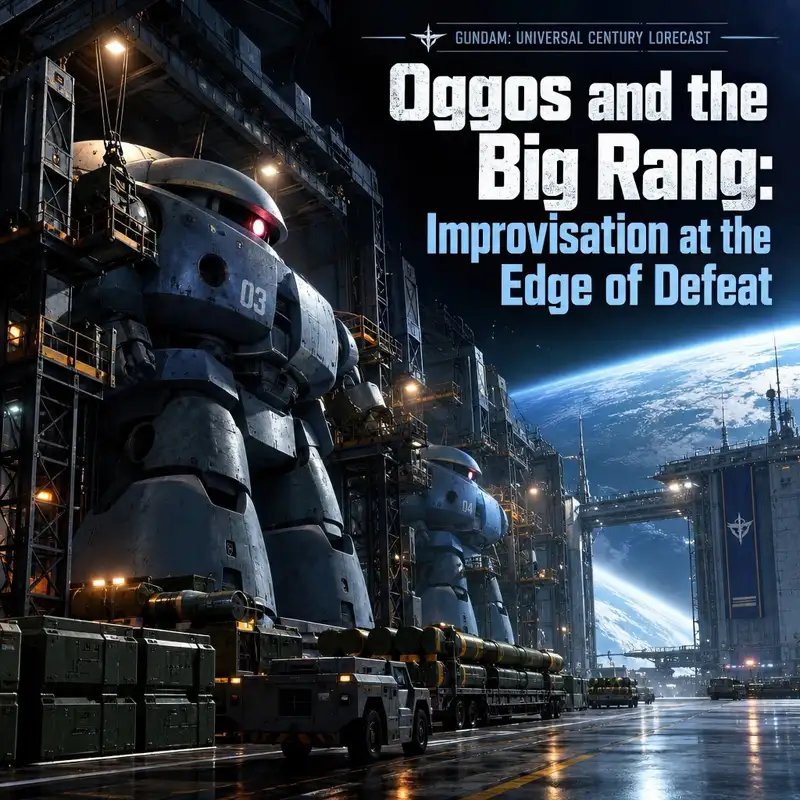
Oggos and the Big Rang: Improvisation at the Edge of Defeat
Inside the E Field of A Baoa Qu, the Big Rang was doing work no one had expected an engineer to do. Oliver May had spent the war evaluating weapons, measuring performance, recording failures, and reporting whether a machine could survive the demands placed upon it. Now he was operating an unfinished mobile support base in combat, with Federation forces pressing toward the fortress and Zeon’s defensive line already under strain. The Big Rang carried weapons, certainly. It had missiles, heavy gunfire, and a high-output mega particle cannon. But its more important purpose was less dramatic. It was meant to keep smaller machines supplied, repaired, sheltered, and useful at the front. It was an answer to a practical question: how do you sustain a defense when the rear area is disappearing?
That question explains almost everything about the Oggo and the Big Rang. Neither system was a miracle weapon. Neither offered Zeon a path back to strategic equality with the Earth Federation. They were emergency adaptations built for a military that had lost the time required for normal development, normal training, and normal logistics. The Oggo gave Zeon a simple combat pod that could be assembled from familiar ideas and equipment. The Big Rang attempted to turn sustainment itself into a mobile defensive weapon. Together, they created a temporary local system. It could fight. It could delay. It could cover a withdrawal. But it could not replace trained personnel, secure supply lines, or restore a state already nearing military and political collapse.
The unit operating these machines was the 603rd Technical Evaluation Unit, based aboard the Jotunheim. The Jotunheim was not designed as a celebrated front-line warship. It had been a civilian cargo vessel, later adapted to carry equipment, technical personnel, and the peculiar assortment of projects assigned to the 603rd. It was laboratory, transport, workshop, warehouse, and floating headquarters. That made it useful during a long war of rapid technological change. Zeon needed weapons tested outside ideal proving grounds. A machine that looked impressive in a factory or a demonstration could fail under acceleration, combat damage, confused communications, poor maintenance, or the simple exhaustion of the people expected to operate it.
Under normal circumstances, that gave the 603rd a defined role. Its personnel examined weapons and systems in conditions close to combat, then reported what worked, what did not, and what had to change before wider deployment. Oliver May belonged to that technical world. He was an evaluator, not a conventional combat pilot. Captain Martin Prochnow commanded the Jotunheim and carried responsibility for the ship, its crew, and its survival. Monique Cadillac represented another form of authority, one linked to Zeon’s central military and political system. Their work depended on distinctions that a functioning military usually tries to preserve. Ship commanders command ships. Engineers test equipment. Staff officers direct operations. Combat formations fight.
Late in the One Year War, those distinctions began to dissolve. A military under pressure often pulls specialists toward the front. Mechanics become recovery crews under fire. Technical officers make tactical decisions. Training units become replacement pools. Cargo vessels become combat-support ships. None of this is inherently irrational. In an emergency, unused expertise and available hulls are resources. But it is also a warning sign. The more a military must convert every workshop, trainee, and experiment into a combat asset, the less margin it has left for error. It is no longer preparing for the next campaign. It is trying to survive the current one.
By the final weeks of Universal Century seventy-nine, Zeon faced precisely that condition. The Earth Federation had recovered from its early disasters, built the capacity to contest Zeon’s mobile-suit advantage, and pushed its offensive toward Zeon’s remaining major defensive positions. Solomon had fallen. The Federation’s advance toward A Baoa Qu did not mean every Zeon unit had lost the ability to fight. Far from it. Local commanders still had weapons, crews, defensive works, and the capacity to inflict real losses. But the strategic geometry had changed. Zeon had fewer safe rear areas, fewer opportunities to reorganize formations, and less time to train replacements before they were needed.
This is what defeat looks like before the final surrender. It does not always appear as a single shattered army or an empty battlefield. More often, it appears as shrinking choices. A damaged machine cannot be sent back to a secure depot because the depot is too distant, too overwhelmed, or no longer secure. A recruit cannot receive months of training because the battle will arrive in days. A prototype cannot be tested carefully because commanders need it immediately. A technical unit cannot remain technical because every functioning crew and every available weapon is being drawn into the defense. The army may still possess courage, skill, and moments of local superiority. What it lacks is depth.
A Baoa Qu became the place where that loss of depth could no longer be concealed. The fortress was a major defensive position, industrial base, staging point, and symbol. Its value was not merely the firepower mounted on its structures. It represented one of the last places from which Zeon could organize large-scale resistance in space. That made it a military objective for the Federation and a political necessity for Zeon. Yet a fortress is not self-sustaining. It needs crews, ammunition, repair capacity, communications, reserves, and commanders who can keep units coherent when the battle stops following the plan. By the time the Federation assault began, Zeon had a fortress. What it no longer possessed in adequate quantity was the operational system needed to guarantee that the fortress could hold.
Colonel Herbert von Kuspen arrived aboard the Jotunheim as an expression of that pressure. He brought combat personnel and the authority of a front-line commander. His presence changed the unit’s character. Prochnow remained responsible for the ship. May retained technical knowledge that no ordinary line officer could replace. Monique occupied her own position within the system of military and political authority. But Kuspen possessed the most immediate claim on events. He was there to fight, and the Jotunheim, its staff, its equipment, and its experimental machines were now being absorbed into a battle that no longer respected their original purpose.
This created a familiar wartime problem. Formal authority and practical authority were no longer neatly aligned. A ship captain may know what the vessel can safely endure. An engineer may understand the limitations of a new machine. A combat commander may understand the immediate tactical threat. In a stable organization, these perspectives are reconciled through orders, planning, and staff work. In a collapsing defensive situation, they collide in real time. Kuspen’s discipline gave the improvised formation a degree of focus. He understood that scattered assets, timid commitment, and uncertain leadership could get everyone killed without slowing the enemy at all. But discipline could not solve the deeper problem. He was being asked to employ personnel and machines that had not been organized for sustained front-line attrition.
Kuspen was neither simply a hero nor simply a fanatic. His insistence on duty had military utility. In a battlefield where communications were degraded, plans were incomplete, and units were being thrown together, somebody had to impose a mission and demand coordination. Yet the mission itself carried a brutal logic. Zeon needed the 603rd because it no longer had enough conventional formations available to keep experimental personnel safely outside the battle. The very competence of the technical unit made it vulnerable to being consumed. It had people who knew machines. It had a ship that could carry them. It had equipment not yet assigned elsewhere. In the final phase of a war, that is often enough to turn a test organization into a combat formation.
The Oggo was one of the clearest products of this emergency logic. It was a simplified mobile pod, built for late-war service and equipped through the reuse of Zaku-derived weapons and components. Its significance was not that it represented a bold leap beyond existing mobile suits. It represented the opposite. The Oggo was valuable because it reduced the distance between available materials and a usable weapon. In an emergency procurement system, elegant design is often less important than availability. Familiar parts can be obtained, assembled, understood, and maintained more quickly than entirely new systems. Familiar weapons reduce at least part of the training burden. A simple combat machine can be fielded where a sophisticated mobile suit would require more time, more specialized labor, and a more stable supply chain.
That did not make the Oggo a standard front-line mobile suit in another shape. It was a compromise. A proper mobile suit combines armor, mobility, control systems, weapons, and endurance in a package intended to survive a range of combat conditions. The Oggo accepted narrower margins. It gave its pilot a weapon capable of threatening enemy mobile units, but it did not offer the protection, flexibility, or tolerance for error that a more complete combat machine might provide. Its pilot had fewer ways to recover from a bad approach, a damaged system, a missed shot, or a moment of confusion. Its endurance depended on weapons, fuel, support, and the ability to return to some form of maintenance and resupply.
Those constraints matter because simplified weapons are often misunderstood. It is tempting to say that Zeon had discovered a cheap answer to the Federation’s growing material advantage. The evidence points in another direction. The Oggo was useful because Zeon was short of time. It allowed the state to put something into the hands of people who otherwise might have had no combat machine at all. That is different from solving an industrial crisis. A weapon can be quick to assemble and still be difficult to employ effectively. It can use common parts and still require trained mechanics. It can be cheaper than a mobile suit and still cost lives that cannot be replaced.
The Oggo’s military logic was therefore brutally straightforward. It was not meant to dominate the battlefield. It was meant to add armed bodies and mobile firepower to a defense under pressure. Against Federation Balls and other mobile weapons, an Oggo could be dangerous if its pilot had initiative, if its weapons functioned, if the formation retained cohesion, and if some support structure existed behind it. In the Minovsky environment of late-war space combat, short-range identification and local decision-making mattered. A small machine did not need to be the best system in the war to destroy an enemy or disrupt an attack. It only needed to be in the right place with a functioning weapon and a pilot capable of acting before the enemy did.
But that final condition was the hardest to create. Simplifying the machine did not simplify combat. Zeon placed young cadets, inexperienced recruits, and hastily mobilized personnel into the Oggos. The episode does not require us to assign exact ages, training schedules, or a national manpower policy in order to understand the situation. The reality is visible in the gap between language and capability. A uniform does not create experience. A speech about duty does not create judgment under fire. Calling a formation elite does not give its members the accumulated instincts of pilots who have survived previous sorties, learned to identify threats, recognized the limits of their machines, and understood when to break contact.
The young Oggo pilots were not incompetent because they were young. They were being asked to do work for which experience matters deeply. Space combat under Minovsky interference punishes hesitation, but it also punishes reckless confidence. Pilots must interpret incomplete information, manage weapons, maintain formation awareness, judge relative movement, and make decisions while their machines are vulnerable. None of that can be fully taught by issuing a weapon and giving a recruit a mission. Training creates habits. Repeated operations create trust between pilots, mechanics, and commanders. Losses destroy that trust before it can mature.
Erwin Cadillac made this crisis personal aboard the Jotunheim. He was Monique Cadillac’s younger brother, and his presence in the Oggo formation prevented anyone from treating the unit merely as a line in a readiness report. Monique was not simply a grieving sister standing outside the chain of command. She was part of the command environment in which these young personnel were committed. Erwin’s assignment revealed the intimate cost of a state’s final mobilization. The same system that spoke in the language of service and sacrifice had reached the point where it needed inexperienced people, including the relatives of its own officers, to fill combat machines designed for emergency use.
Near Granada, in late lunar-space operations before the final battle, the 603rd’s Oggo force moved from evaluation toward direct combat employment. The terminology of testing still existed, but the meaning had changed. A weapons trial normally seeks to learn under controlled conditions. A combat mission seeks to achieve an objective against an enemy who is also trying to kill you. By this point, Zeon no longer had the luxury of separating the two. The Oggo pilots were expected to demonstrate the value of the system while fighting Federation opposition. Their performance would produce data, but the data would come at the cost of damaged machines and dead personnel.
The Federation force encountered there included Balls and other mobile weapons. It is important not to turn that engagement into an invented roster of named opponents or a contest of machine statistics. The historical point is larger. The Federation could bring armed mobile units into the fight and continue applying pressure across the broader theater. The Oggos had to prove themselves in that environment. They did so, to a point. Their use of familiar weapons and their mobility allowed them to engage. Pilots who acted with initiative could create danger for the enemy. The pods were not helpless targets. They possessed real tactical value.
Yet the battle also exposed their limits. The Oggo had little room for the ordinary friction of combat. Equipment could fail. Pilots could become disoriented. A formation could lose cohesion. A machine designed to be quick to field could not be expected to absorb the same punishment or endure the same operating burden as a more mature system. Even when individual pilots fought effectively, the unit as a whole remained vulnerable to the cumulative effects of combat. Damage, ammunition expenditure, separation from support, and the loss of experienced guidance all mattered. The Oggos could demonstrate local usefulness without becoming a durable answer to the Federation’s offensive.
That is the difference between tactical capability and operational endurance. A weapon may destroy an enemy machine. A unit may win a brief exchange. But an operation asks whether that unit can continue to function after the exchange. Can it recover damaged machines? Can it rearm? Can it replace crews? Can it retain enough experienced people to improve after each battle rather than becoming less capable? The 603rd’s Oggo force could not easily do these things. It was consuming its limited pool of personnel at the same time it was trying to prove the weapon’s worth.
Erwin’s death made that cost impossible to ignore. The event should not be reduced to a sentimental tragedy or embellished with imagined final words. Its meaning lies in what it revealed. Zeon had created a system that could put a young, inexperienced person into a combat machine quickly. It could not guarantee that person the support, training, or operational depth that might make survival more likely. Every loss was more than a missing pilot. It was lost potential experience, lost confidence for the surviving recruits, lost technical understanding of the machine in combat, and lost trust inside the unit.
Emergency mobilization can look efficient at first glance. It moves people from the rear to the front. It fills empty cockpits. It adds weapons to an order of battle. But it imposes hidden costs. The more rapidly inexperienced personnel are committed, the less time they have to become effective veterans. The more rapidly they are lost, the less institutional memory the force retains. A military can replace a machine more easily than it can replace a person who understands that machine under fire. Near the end of the One Year War, Zeon was increasingly short of both.
For Monique, Erwin’s death was not merely a private grief. It altered the emotional climate of the Jotunheim and the meaning of the missions that followed. She remained a combatant and an officer. Her actions were not explained away by loss, nor should they be. But the death stripped away whatever distance remained between policy and consequence. The unit had been told, in effect, that the war required this. Now the requirement had a face and a family connection. That is often how institutions reveal themselves in wartime. Abstract necessity becomes personal only after the order has been given and the casualty has been reported.
By the time the fighting reached A Baoa Qu, Zeon’s answer was to make the support system itself into a weapon. The Big Rang, designated MA-05Ad, was an improvised mobile armor built around a Bigro-derived control section and a large support module. Its appearance invited attention because it was huge, heavily armed, and unlike a conventional mobile suit. But its historical significance lies in its role. The Big Rang was designed as a mobile front-line support base for Oggos and related defensive units. It could carry ammunition, provide shelter, support repairs, and offer heavy firepower. It was a depot pushed forward into the battle.
That was a sensible answer to a specific military problem. Small, lightly protected combat machines cannot remain useful if every rearmament, repair, or rescue requires them to retreat all the way to a distant ship or fixed base. In a static defense, rear services can operate behind layered fortifications. In a collapsing fortress battle, the rear may be under attack, bypassed, overloaded, or simply too far away. The Big Rang attempted to close that gap. It brought the workshop, magazine, and defensive gun position closer to the pilots who needed them.
Its armament mattered because a support platform at the front must defend itself. The Big Rang carried missiles, gatling fire, a powerful mega particle cannon, and beam-disruption projectiles. Those systems gave it the means to engage attackers and shape the immediate defensive space around it. But firepower was not its central purpose. A mobile armor that merely shoots is one thing. A mobile armor that allows damaged or low-end combat units to rearm, regroup, and return to battle is something more important. It affects endurance. It allows a small formation to stay in contact longer than its individual machines otherwise could.
The design also carried obvious risks. Concentrating support functions in one large mobile structure creates efficiency, but it creates a target. Ammunition, repairs, shelter, command coordination, and heavy weapons were all gathered in a platform the enemy could recognize as valuable. If it was destroyed, the defensive system around it could unravel quickly. The Big Rang was not a substitute for a distributed logistics network. It was an emergency concentration of resources because Zeon no longer had the time or security to create that network in the conventional way.
That concentration also demanded coordination. A forward support base only works if the units around it understand how to use it. Pilots must know where to return. Mechanics must be ready to receive damaged machines. Commanders must decide whether to commit the platform to danger or pull it back. Escorts must prevent the enemy from isolating it. The Big Rang’s effectiveness at A Baoa Qu depended on precisely this kind of cooperation. It was not a solitary superweapon. It was the center of a local defensive system involving the remaining Oggos, Kuspen’s combat formation, Monique’s Zudah, Oliver’s technical knowledge, and the personnel trying to keep the entire improvised structure functioning under attack.
On December thirty-first, as the Federation assault struck A Baoa Qu, that local system briefly worked. The E Field was one sector of a vast fortress battle, not the whole war and not the entire Federation offensive. That distinction matters. The Big Rang did not hold back every attacker converging on A Baoa Qu. It did not settle the fate of the fortress. But within its sector, the defenders created a real obstacle. The support platform extended the ability of smaller units to operate. Its weapons added defensive weight. Its presence gave pilots a point around which they could regroup. Kuspen’s direction imposed coherence. Monique and the remaining combat personnel fought within a mission that was finally clear: delay the advance and preserve what could still be preserved.
In Minovsky-era combat, local cooperation can matter enormously. The larger headquarters may know that an assault is underway, but it cannot necessarily see every contact or issue detailed instructions in time to shape each engagement. Pilots and unit commanders must rely on prior coordination, visual recognition, prearranged intent, and immediate judgment. The 603rd had been forced together by crisis, but that shared ordeal also gave its survivors an understanding of each other’s strengths and limits. May knew what the equipment could do. Kuspen understood the need to commit force decisively. Monique understood the people being asked to fight. The Big Rang gave those relationships a physical center.
The result was a temporary defensive success. The attackers were delayed. Elements of the Federation advance were repelled or disrupted. The defenders demonstrated that the Oggo and Big Rang could create more combat power together than either could alone. This is why it would be wrong to dismiss the systems as failures merely because Zeon lost the war. They solved real short-term problems. The Oggo created available combat units. The Big Rang improved their ability to remain in action. Kuspen’s formation gave them tactical direction. In the E Field, that combination produced a defense with real teeth.
But the very conditions that made the system useful prevented it from being scaled. The Big Rang could sustain a local fight only while its own stores, machinery, crew, escorts, and maneuver space remained intact. The Oggos could return to it only while routes back remained open and pilots survived long enough to make use of the support. Kuspen’s battalion could impose order only while it had enough combat power left to protect the system. Once sustained Federation pressure began to break those elements apart, the local defense faced the same problem that had haunted Zeon throughout the final campaign. It had no depth behind it.
This is the central limitation of emergency innovation. A technically capable response can address the immediate symptom without curing the underlying illness. The Big Rang addressed forward sustainment. The Oggo addressed immediate availability. Both were sensible answers to immediate questions. Yet neither could be manufactured, crewed, integrated, and protected at the scale needed to reverse the strategic situation. A mobile support base requires components, technical labor, ammunition, and units worth supporting. A simplified combat pod still requires pilots, weapons, maintenance, and command. At the edge of defeat, every one of those resources was becoming harder to replace.
Kuspen’s formation eventually collapsed under the continuing assault. His death was not proof that discipline had been meaningless. His command had helped create a defense where chaos might otherwise have prevailed. But his death also marked the limit of what personal authority could accomplish. A commander can steady a unit. He cannot manufacture a reserve force by force of will. He can order a position held. He cannot guarantee that the ammunition, pilots, and machines necessary to hold it will remain available. In the final defense of A Baoa Qu, Zeon repeatedly asked individuals to carry burdens that belonged to institutions.
The destruction of the Big Rang followed the same logic. Its loss was not simply the defeat of a large and unusual machine. It was the destruction of an entire concentrated support system. When the platform was gone, the local defenders lost more than a gun platform. They lost a forward source of ammunition, repair, shelter, and organization. The machine’s vulnerability had always been built into its concept. It had to be near the fight to sustain the fight. That made it useful. It also made it exposed.
Monique’s rescue of Oliver in the heavily damaged Zudah was therefore not a triumphant reversal. It was survival inside defeat. The remaining personnel were no longer fighting to restore the battle or reclaim the initiative. Their action contributed to covering the withdrawal of other Zeon forces from the fortress. That was a real mission outcome. Withdrawal under pressure is not automatically collapse. A force that buys time for others to escape can preserve trained personnel, ships, records, and fragments of future capacity. In military terms, delay can matter. It can save lives. It can prevent a local disaster from becoming even worse.
But a successful withdrawal is not the same as a strategic victory. A Baoa Qu fell. Zeon lost the war. The 603rd’s final actions did not alter that result. Their tactical achievement was genuine, and their operational contribution was limited but meaningful. They delayed the enemy. They supported surviving defenders. They helped cover a retreat. Yet the strategic conditions remained unchanged. Zeon had exhausted too much trained manpower, lost too much operational depth, and placed too much hope in emergency measures that could not be sustained beyond the immediate crisis.
The Oggo and Big Rang deserve to be remembered not as absurd curiosities of Zeon desperation, nor as hidden wonder weapons that might have changed the war if only they had appeared earlier. They were competent responses to immediate battlefield problems. The Oggo gave Zeon a quickly available armed platform. The Big Rang gave those small units a forward support base and a measure of endurance. In the E Field, the system worked well enough to make the Federation pay for its advance and to give other defenders time to withdraw.
Their final value lies in what they reveal. At the edge of defeat, a technically capable military can still improvise. It can combine common components, unfinished projects, engineers, cadets, cargo ships, and damaged combat units into something that functions under fire. But improvisation cannot substitute indefinitely for the foundations of war: trained replacements, secure logistics, industrial capacity, operational reserves, coherent command, and political survival. The Oggo and the Big Rang bought time because time was the one resource Zeon no longer had.